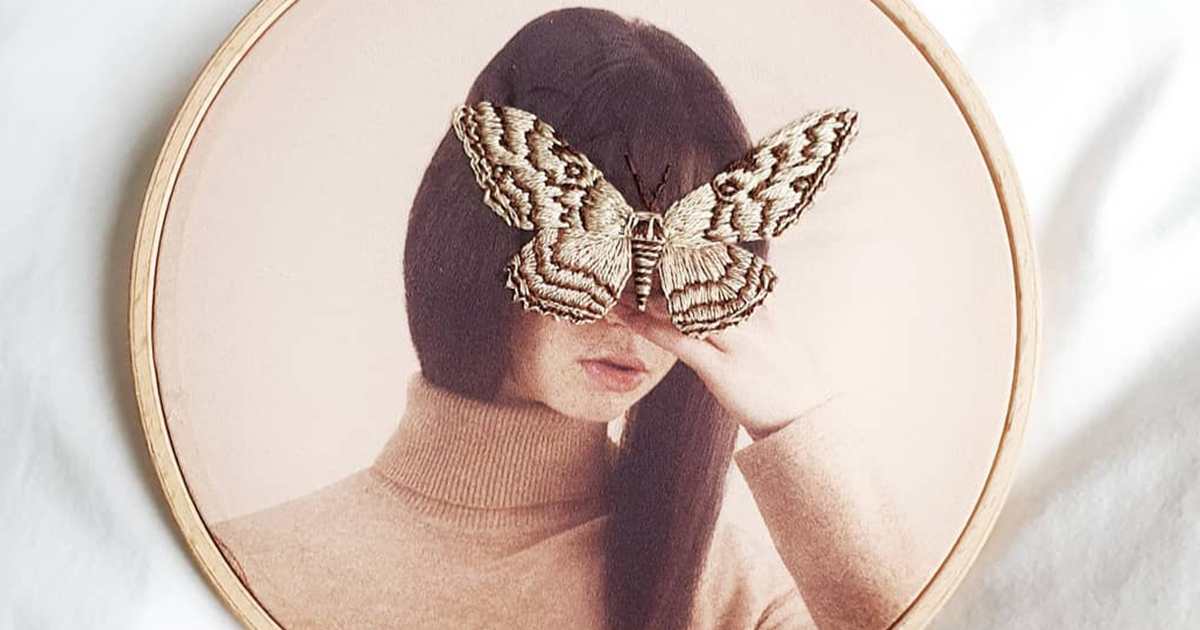
There is something wildly satisfying about taking a perfectly nice printed fabric and saying, “You know what this needs? More personality.” That is exactly where this collection began. These 41 embroideries were made by combining printed fabrics with hand stitching and layered textile techniques, and the result is somewhere between illustration, collage, needlework, and a very polite rebellion against flat surfaces.
I have always loved the moment when thread changes the mood of fabric. A printed flower becomes more alive when a stem stitch gives it direction. A geometric pattern becomes playful when a few seed stitches interrupt its neat little routine. A face, a leaf, a bird, or even an abstract patch of color suddenly gets depth, texture, and a kind of quiet movement that print alone cannot deliver. That is the beauty of mixed-technique embroidery: it lets the fabric speak first, then gives the needle the final word.
In this collection of 41 pieces, I used printed fabrics not as background wallpaper, but as collaborators. Some fabrics suggested shapes. Some offered color stories. Some practically yelled, “Turn me into a weird little dreamscape immediately.” So I listened. The embroidery followed the print, responded to it, contradicted it, highlighted it, and sometimes gently rescued it from being too predictable.
Why Embroidery and Printed Fabrics Work So Well Together
Embroidery has always had a special freedom that other textile methods do not. It can outline, shade, exaggerate, soften, decorate, or completely reinvent a surface. Printed fabric, on the other hand, arrives with instant color, rhythm, and visual structure. Put the two together, and you get a rich mixed-media language that feels both traditional and fresh.
That combination works especially well because print and stitch do different jobs. Printed fabric can establish a mood in seconds. It can create the illusion of foliage, tiles, skies, wallpaper, clothing, architecture, or chaos with excellent taste. Embroidery then steps in and adds emphasis, contour, texture, and emotion. A few lines of backstitch can sharpen a form. Satin stitch can create weight and shine. Seed stitch can suggest shadow, dust, pollen, or atmosphere. French knots can turn a flat design into something you want to touch, which is both the blessing and the curse of textile art because people absolutely will try to touch it.
There is also a historical charm to this approach. Textile traditions have long borrowed from one another, and stitched surfaces have often been inspired by patterned cloth. That makes mixed-technique work feel connected to a larger story of fabric, ornament, and handwork rather than like a trendy experiment that wandered in from social media wearing oversized glasses.
What Makes These 41 Embroideries Feel Cohesive
1. The Print Is Never Just a Background
One of my biggest goals in this collection was to avoid treating printed fabric like passive scenery. I wanted the print to do real visual work. In some pieces, the printed motif became the skeleton of the composition, and I stitched directly over it to create contrast and definition. In others, I used small fragments of print almost like collage elements, letting the embroidery connect them into something new. That tension between “already there” and “added by hand” is what gives the work its spark.
2. Stitch Direction Creates Motion
Even when the fabric is busy, the direction of the stitches can guide the eye. Running stitch can create an airy path across a bold print. Backstitch can frame a shape without overwhelming it. Longer stitches can suggest movement in hair, feathers, petals, or water. When you place thread carefully, you are not just decorating fabric. You are directing the viewer’s attention, almost like using a pencil on top of paint.
3. Texture Does the Emotional Heavy Lifting
Printed fabric gives you instant imagery, but texture is where the feeling lives. Raised knots, layered stitches, couched threads, and appliquéd fragments create a surface that feels more intimate and handmade. In these 41 works, texture became the difference between “pretty fabric” and “finished textile art.” It is the part that slows people down. They stop. They lean in. They squint a little. They say, “Wait, is that stitched?” That is usually the moment I know the piece is working.
How I Build a Piece Using This Mixed Technique
Start with Stable Fabric Choices
For this kind of work, stable woven fabrics are your best friends. Cottons, quilting cottons, linen, and similar flat fabrics are easier to embroider neatly because they are less likely to stretch or pucker. That matters when you are adding detailed stitch work on top of a print. If the fabric shifts too much, your clean little line turns into a dramatic emotional event, and not in a good way.
I also pay attention to weight. Light threads pair better with lighter fabrics, and heavier threads feel more natural on denser cloth. That balance matters. If the thread is too heavy for the fabric, it can distort the surface. If it is too fine, it may disappear into a loud print like a shy guest at a very chaotic party.
Sketch Before Stitching
One of the most useful habits I developed while making these 41 embroideries was sketching over photos of the fabric before I began. This sounds simple because it is simple, but it saves an enormous amount of guesswork. I would look at the print, imagine where a few motifs or outlines could go, and test color ideas before making the first stitch. Printed fabric already contains rhythm, so the real challenge is not inventing everything from scratch. It is editing wisely.
Transfer Only What You Need
Not every piece needs a full traced drawing. Sometimes the print itself is the guide. Other times, especially on lighter fabrics, a light box or bright window helps transfer a simple outline. On darker fabrics, transfer paper or water-soluble marking tools make the design easier to place. The key is to mark only what is necessary. Overdrawing can make the surface feel stiff before the fun even begins.
Use Stabilizer When the Fabric Demands It
This is not the glamorous part of embroidery, but it is the part that saves your project from looking like it lost a fight with gravity. When working on stable woven fabrics, a tear-away stabilizer can give temporary support while stitching. When the fabric is stretchy or soft, a cut-away stabilizer is often the smarter choice because it keeps supporting the embroidery over time. If the fabric surface is tricky, light support materials or water-soluble helpers can make placement and tension much easier.
In plain English: if your fabric wants to wiggle, help it behave.
Stitch on Larger Pieces Before Final Cutting
Another lesson that changed everything for me was stitching on a larger piece of fabric before cutting the final shape, especially for garments or framed compositions. It is much easier to hoop, position, and control a larger section than a tiny finished piece. This sounds obvious now, but in the beginning I occasionally made things harder for myself in the classic artist tradition of learning the easy way only after trying the difficult way first.
Favorite Visual Effects in This 41-Piece Collection
Outlining Printed Motifs
Sometimes the most effective decision is also the simplest: outline part of the print and let the contrast do the magic. A stitched border around a printed leaf, vase, bird, or abstract shape can make it pop instantly. This works especially well when the print already has strong forms but needs definition.
Adding New Motifs on Top of Existing Patterns
Some of my favorite pieces in this set came from adding completely new embroidered forms over an unrelated print. Tiny stars over florals. Faces over stripes. Organic shapes over geometric repeats. This contrast creates surprise, and surprise is one of the most useful ingredients in textile art. It keeps the work from becoming overly polite.
Layering with Appliqué
In several pieces, I used bits of printed fabric as layered appliqué, then stitched around or over the edges to blend them into the composition. This creates dimension and gives the work a painterly, collaged quality. Embroidery is excellent at disguising joins, softening seams, and making separate fabric layers feel intentional rather than patched together in a panic five minutes before sunset.
Using Repetition Without Becoming Boring
Repetition is powerful in a gallery of 41 pieces. Repeating certain stitch families, color accents, or visual gestures creates consistency across the collection. But repetition only works when there is variation inside it. A similar scallop, outline, knot cluster, or stitched contour can appear across multiple pieces without making them feel duplicated. Think of it as a visual accent, not a copy-and-paste habit.
What These 41 Embroideries Reveal About the Creative Process
The biggest thing this collection taught me is that mixed-technique embroidery is not about forcing thread onto fabric. It is about collaboration. The printed cloth arrives with a voice, and the stitching responds to it. Some prints want minimal intervention. Others invite bold outlines, heavy texture, and layered construction. The most successful pieces are the ones where I listened first.
I also learned that good textile art often depends on restraint. Just because you can cover every square inch with thread does not mean you should. Sometimes the printed fabric needs room to breathe. Sometimes a small stitched accent does more than a thousand heroic knots. Negative space is not laziness. It is confidence wearing comfortable shoes.
Color decisions matter just as much as stitch decisions. On printed fabrics, thread can either blend quietly or create contrast that changes the whole composition. Matching tones can create subtle texture, while contrasting thread can turn a decorative print into a graphic statement. Across these 41 works, I found myself using both strategies, often in the same piece. The result feels layered not only in surface, but in mood.
Tips for Anyone Who Wants to Try This Technique
Start with a print that already interests you. If the fabric says absolutely nothing to you, the embroidery will have to work too hard. Choose a stable woven fabric when possible. Test stitch combinations before committing to the final piece. Keep your needle sharp. Use just enough support to prevent distortion. And remember that embroidery on printed fabric does not have to be precious. It can be playful, experimental, rough around the edges, and deeply personal.
If you are using fabric designed by another artist, also be thoughtful about how you use it, especially if you plan to sell finished work. Inspiration is wonderful. Respect is better.
Conclusion
These 41 embroideries are proof that printed fabric is not the end of a design story. It is the beginning of one. By combining print, stitch, layering, and texture, I was able to turn flat cloth into artwork with depth, character, and movement. Some pieces feel delicate. Some feel mischievous. Some feel almost like stitched drawings that just happened to land on fabric. Together, they form a collection that celebrates the handmade mark in all its imperfect, tactile glory.
And honestly, that is what I love most about this mixed technique. It lets fabric keep its original charm while giving embroidery a chance to improvise. It is thoughtful without being stiff, decorative without being shallow, and detailed without losing its sense of fun. In other words, it is exactly the kind of creative chaos I hope never becomes too organized.
A Longer Note from the Studio: My Personal Experience Making These 41 Embroideries
Making 41 embroideries with printed fabrics taught me more patience than I expected and more flexibility than I probably deserved. At the beginning, I thought the fabric print would make everything easier because so much visual information was already there. In reality, it made every decision more interesting. A blank fabric asks, “What do you want to do?” A printed fabric asks, “All right, but what do you want to do with me?” That difference changed the way I approached every piece.
There were days when I picked up a fabric and immediately saw the answer. A curve in the print became a stem. A dot became an eye. A floral motif turned into the center of a much larger stitched scene. Those pieces felt magical, as if the embroidery had been hiding in the print all along and I was just revealing it. Then there were the other days, the humbling days, when I stared at a beautiful fabric for twenty minutes and produced nothing except suspicion, one bad sketch, and the strong feeling that my tea had gone cold out of spite.
What helped me most was learning to stop forcing the design. If a print was already loud, I used quieter stitches. If a fabric was subtle, I let the embroidery do more of the talking. If a pattern had movement, I followed it. If it felt too rigid, I interrupted it with organic lines. Over time, I began to understand that this mixed technique works best when there is a conversation between the surface and the stitching. The fabric does not need to be conquered. It needs to be answered.
I also became more aware of how much texture affects emotion. A piece with simple line work felt crisp and witty. A piece packed with knots and layered threads felt lush and slightly obsessive in the best possible way. A little appliqué made some works feel collage-like and playful, while denser embroidery made others feel intimate, almost secretive. That emotional range surprised me. The materials were humble, but the final effect could be incredibly expressive.
Another real experience from making this collection was accepting imperfection as part of the voice of the work. Not every stitch landed exactly where I imagined. Not every fabric behaved. Some prints pulled attention in unexpected directions. Some combinations that looked brilliant in my head looked completely ridiculous in the hoop. But those moments were not failures. They were edits. They taught me which colors fought too much, which motifs needed more breathing room, and which ideas were better saved for another piece.
By the time I finished the 41st embroidery, I realized the collection was not just about technique. It was about trust. Trusting my eye. Trusting the process. Trusting that a fabric scrap with a strange pattern and a half-formed idea might become something memorable if I sat with it long enough. That feeling is hard to explain to people who do not make things by hand, but makers know it well. It is the tiny thrill of turning materials into meaning.
So yes, these 41 pieces are about embroidery and printed fabrics. But they are also about observation, patience, risk, revision, and joy. They are about seeing potential in a surface that already seems complete and deciding to add your own mark anyway. And maybe that is why I love this technique so much. It reminds me that art does not always begin from emptiness. Sometimes it begins by responding to what is already there, one stitch at a time.