Note: This article is written in original language for web publication and is based on real public information about Riley, a 9-year-old from Melbourne, Australia, who recreated celebrity outfits using common household items with help from her family.
Celebrity fashion is supposed to make us gasp, applaud, screenshot, and occasionally ask, “Is that a gown or did someone lose a very expensive duvet?” That is exactly why the internet fell in love with Riley, a wildly creative 9-year-old girl who turned famous red-carpet looks into homemade comedy gold. Her project, often described as budget cosplay or DIY celebrity fashion recreation, proves that you do not need a couture studio, a stylist, or a team of assistants to make a memorable outfit. Sometimes all you need is cardboard, foil, toilet paper, snacks, a supportive family, and the confidence of a tiny runway legend.
The viral collection known as “30 Ridiculous Celebrity Outfits Recreated By 9-Year-Old” became popular because it hits a perfect internet sweet spot: celebrity glamour, family creativity, harmless parody, and the delightful realization that a child with a laundry basket can sometimes outshine a designer with a million-dollar mood board. Riley’s recreations featured looks inspired by celebrities and public figures including Nicki Minaj, Zendaya, Rihanna, Emma Stone, Sabrina Carpenter, Kim Kardashian, Jojo Siwa, Gigi Hadid, Lil Pump, Lil Tay, Ashanti, Chiara Ferragni, Stella Maxwell, and others. The result was not just funny. It was clever visual commentary on how wonderfully strange fashion can be when viewed through a child’s eyes.
Who Is the 9-Year-Old Behind the Viral Celebrity Outfit Recreations?
Riley is a young Australian creator from Melbourne whose celebrity outfit recreations were shared under the name Riley Diary. What made her project stand out was the family-team energy behind it. According to the original public coverage, her mom and dad helped choose, prepare, and photograph the looks. Her father would usually pick a selection of funny celebrity outfits, then Riley and her mother would choose favorites to recreate. That detail matters because it changes the story from “kid plays dress-up” to “family turns pop culture into a weekend craft sport.” Honestly, that sounds healthier than arguing over what to watch on TV.
The family reportedly completed one cheap cosplay each weekend, and each recreation took about 15 to 45 minutes. That time frame is part of the charm. These are not museum-level replicas with hidden stitching and Swarovski crystals. They are quick, witty interpretations. If a celebrity outfit had a dramatic shoulder, Riley might use a cardboard cutout. If a red-carpet dress had strange volume, a blanket, towel, or household prop might get promoted from “laundry problem” to “fashion statement.” The joy is in the translation.
Why These Ridiculous Celebrity Outfits Became So Shareable
Viral fashion content usually works when it is instantly readable. You see the original look, then you see the parody, and your brain gets the joke before your coffee kicks in. Riley’s recreations worked because they were visually simple, funny, and affectionate. They did not feel mean-spirited. Instead, they highlighted the playful absurdity already present in celebrity fashion.
Red carpets have always been part glamour show, part marketing machine, and part high-stakes costume party. The Met Gala, for example, is often called fashion’s biggest night and is tied to the Metropolitan Museum of Art’s Costume Institute. The Costume Institute itself preserves tens of thousands of fashion objects across centuries, reminding us that clothing can be art, history, identity, theater, and social signal all at once. When celebrities step onto a carpet in a giant cape, glittering headpiece, sculptural gown, or outfit that looks like it came with its own weather system, the public naturally reacts. Riley simply joined the conversation with tape and imagination.
30 Celebrity Looks Recreated With Household Genius
The original collection included 30 outfit recreations, and the names alone show how broad Riley’s inspiration board became. It covered music stars, actors, influencers, models, performers, athletes, and fashion labels. Some looks were based on highly recognizable celebrity moments, while others were more niche, making the project even funnier for fashion-watchers who enjoy decoding references.
1. Nicki Minaj
Nicki Minaj’s fashion history is already a candy-colored playground of wigs, dramatic silhouettes, and bold styling. Riley’s take captured that theatrical energy without needing couture. It showed that when a celebrity look is strong enough, a few clever household substitutions can make the reference land immediately.
2. Zendaya
Zendaya is known for sharp, intentional fashion choices and a long-running partnership with stylist Law Roach. Recreating a Zendaya look is a brave move for anyone, let alone a 9-year-old. Riley’s version worked because it focused on pose, shape, and attitude rather than expensive fabric.
3. Rihanna
Rihanna appeared more than once in the collection, which makes sense. Her fashion résumé includes some of the most meme-friendly red-carpet moments of the modern era. Her famous yellow Guo Pei Met Gala gown, for example, became a global internet moment because it was majestic, massive, and somehow also made people think about omelets. That is not criticism; that is cultural immortality.
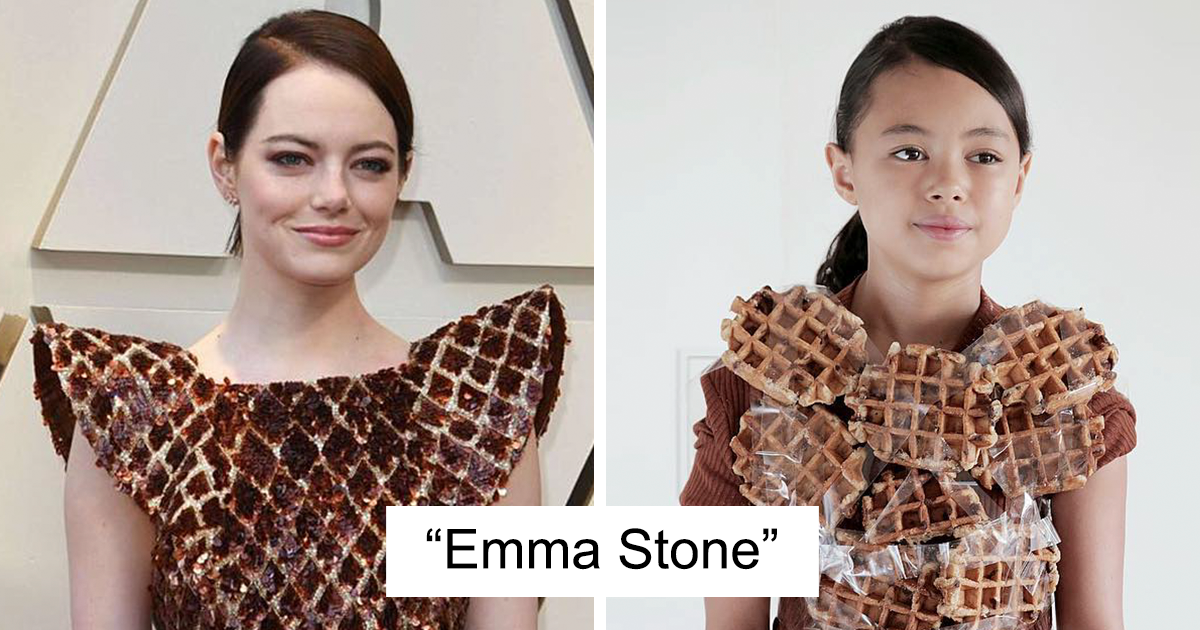
4. Emma Stone
Emma Stone’s celebrity style tends to mix elegance with risk, which gives a parody artist useful material. Riley’s recreation leaned into the recognizable outline of the outfit, proving that shape often matters more than luxury details when translating fashion into comedy.
5. Sabrina Carpenter
Sabrina Carpenter’s style often includes playful sweetness, pop-star polish, and a touch of theatrical performance. Riley’s recreation showed the same wink-wink energy: polished enough to recognize, silly enough to make the internet smile.
6. Kim Kardashian
Kim Kardashian’s fashion moments are almost designed to be discussed. Whether the look is sleek, sculptural, shiny, or confusing in the way only celebrity fashion can be, it invites reaction. Riley’s budget version turned high-fashion seriousness into a lovable craft-table punchline.
7. Jojo Siwa
Jojo Siwa’s aesthetic has always embraced bright colors, bows, sparkle, and unapologetic volume. That makes her a natural target for a kid-friendly recreation. Riley’s version understood that Jojo-inspired fashion is not about blending in. It is about entering the room like a confetti cannon with shoes.
8. Gigi Hadid
Gigi Hadid’s model-off-duty and runway-adjacent looks often rely on styling confidence. Riley’s parody highlighted how even serious fashion can become funny when recreated with playful props and a child’s fearless expression.
9. Lil Pump and Lil Tay
Riley also recreated looks inspired by internet-era personalities such as Lil Pump and Lil Tay. These choices made the project feel current for its time because celebrity fashion no longer belongs only to movie premieres and award shows. Social media personalities create their own visual brands, and those brands are often ripe for parody.
10. Fashion Figures, Models, and Niche Style Moments
The collection also included looks inspired by names such as Vanessa Moe, Chiara Ferragni, Stella Maxwell, Paris Bishop, Teagan Rybka, Sam Rybka, Haley Bennett, Joy Villa, Nia Sioux, Ashanti, Michelle Waterson, Valentino Garavani Valentino, Malin Malle Jansson, and even Moncler. This range gave the project depth. It was not only about the biggest celebrities. It was about any outfit dramatic enough to deserve a household-item remix.
The Secret Sauce: Budget Cosplay Meets Family Humor
Riley’s project belongs to a wider internet tradition often called budget cosplay, cheap cosplay, or low-cost celebrity outfit recreation. The formula is simple: take an expensive, dramatic, or highly stylized look and rebuild it with ordinary objects. The less glamorous the material, the funnier the result. Aluminum foil becomes metallic couture. A towel becomes a train. Cereal boxes become armor. A mop might suddenly have a second career as a wig. Somewhere in the distance, a designer clutching a sketchbook quietly whispers, “Why does this work?”
Other creators, including adult comedians and cosplay artists, have built large followings around this same idea. What made Riley’s recreations special was her age and her sincerity. A child can parody celebrity fashion without sounding cynical. The joke is not “fashion is stupid.” The joke is “fashion is hilarious when you stop pretending it is always serious.” That distinction gives the project warmth.
Why Celebrity Fashion Is So Easy to Parody
Celebrity outfits are not just clothes. They are messages. A red-carpet gown might say, “I am elegant.” A sculptural headpiece might say, “Please photograph me from every angle.” A transparent bodysuit might say, “My stylist and I had a meeting, and subtlety was not invited.” The more dramatic the message, the easier it becomes to reinterpret.
Red-carpet fashion also depends on exaggeration. Designers use shape, volume, color, and texture to create an image that travels across photos, videos, and social feeds. But exaggeration has a funny side. A giant sleeve can look regal on a carpet and like a snack bag in a kitchen recreation. A dramatic train can look powerful in couture and like a bedspread when recreated at home. Riley’s genius was noticing the visual shortcut and running with it.
What Adults Can Learn From a 9-Year-Old’s Fashion Parodies
There is a surprisingly useful lesson hiding under all the cardboard and giggles: creativity does not always require expensive tools. Riley’s celebrity outfit recreations are a reminder that imagination often works better when there are limits. When you cannot buy the perfect material, you have to solve the problem differently. That is where the magic happens.
Child-development experts often emphasize the value of play, pretend scenarios, and hands-on creativity. Dress-up play can support communication, problem-solving, emotional expression, and social cooperation. In Riley’s case, the project also encouraged observation. To recreate a celebrity outfit, she had to look closely: What is the main shape? What makes this look recognizable? Is it the color, the pose, the hat, the hair, the sleeves, the attitude, or the fact that the original outfit appears to be fighting gravity?
That kind of visual analysis is more sophisticated than it looks. It teaches pattern recognition, improvisation, humor, and storytelling. It also gives kids permission to experiment without chasing perfection. The goal is not to become a tiny fashion critic with a clipboard. The goal is to make something, laugh, adjust it, take a picture, and try again next weekend.
How to Recreate Celebrity Outfits at Home Safely and Cheaply
If Riley’s project inspires your own family fashion challenge, start with looks that are visually bold but easy to imitate. Choose an outfit with one obvious feature: a giant bow, dramatic cape, shiny dress, huge sunglasses, unusual hat, bright color, or unforgettable pose. Then collect safe household materials such as paper, cardboard, scarves, towels, blankets, foil, ribbon, washable markers, paper plates, old gift wrap, and clean packaging.
Avoid anything sharp, heavy, breakable, or difficult for a child to move in. The funniest recreations are usually the simplest ones. You do not need to build an exact gown. You need to capture the “Wait, I know that look!” feeling. Pose matters, too. A serious celebrity expression recreated by a child wearing a cereal-box crown is comedy with excellent posture.
Parents can make the activity more meaningful by turning it into a mini design challenge. Ask questions like: “What part of this outfit makes it famous?” “What object in our house has the same shape?” “How can we make it funny without being unkind?” This helps kids think creatively while learning the difference between playful parody and mockery.
Why the Internet Loves Kid-Led Creativity
The internet can be chaotic, loud, and allergic to nuance, but it still has a soft spot for genuine creativity. Kid-led projects often go viral because they feel refreshing. They are not overly polished. They are not optimized by a brand committee. They do not arrive with a 47-slide marketing deck titled “Authenticity Strategy.” They are just fun.
Riley’s celebrity fashion recreations were successful because they made people feel included in the joke. You did not need to understand every designer reference to enjoy them. You only needed to recognize the absurd contrast between luxury fashion and everyday materials. The original outfit might belong to a celebrity, but the recreation belongs to everyone who has ever looked at a red-carpet photo and thought, “I could make that with a shower curtain.”
Experience Section: What It Feels Like to Recreate Ridiculous Celebrity Outfits
Trying to recreate celebrity outfits at home is one of those activities that sounds easy until you are standing in the living room holding aluminum foil, a scarf, two paper plates, and a mysterious sense of ambition. The first experience is usually confusion. You look at the celebrity photo and think, “Okay, it is just a dress.” Then you look closer and realize the dress has three layers, one sleeve, a collar shaped like modern architecture, and a train long enough to require its own parking space.
The second experience is negotiation. Someone suggests using a blanket. Someone else says the blanket is too heavy. A child suggests using snacks, because children understand fashion on a deeper spiritual level. Suddenly a cereal box becomes a handbag, a laundry basket becomes a skirt, and a roll of paper towels becomes a luxury accessory. At this point, the room may look like a craft store sneezed, but the energy is excellent.
The third experience is laughter. This is where the activity becomes more than a costume project. When a kid steps into a homemade version of a dramatic celebrity outfit, everyone sees the same joke at once. The pose becomes serious. The outfit is ridiculous. The confidence is enormous. A child wearing a cardboard shoulder piece can deliver the facial expression of an Oscar nominee entering a room full of flashbulbs. That contrast is priceless.
The fourth experience is problem-solving. Maybe the foil keeps tearing. Maybe the blanket cape keeps sliding. Maybe the giant paper bow looks less “runway” and more “last-minute school project.” That is fine. In fact, that is the point. Recreating celebrity outfits teaches kids that creativity is not about getting everything right on the first attempt. It is about adjusting, laughing, and discovering that mistakes often make the final image funnier.
The fifth experience is appreciation. After attempting even one DIY celebrity outfit recreation, you start looking at real fashion differently. You notice structure, styling, proportion, color, and performance. You also appreciate the absurd bravery of celebrities who wear outfits that invite instant memes. Fashion becomes less distant and more interactive. It turns into a conversation between designers, stars, fans, parents, kids, and anyone with tape.
Most importantly, the experience creates a memory. A family may forget the exact celebrity look they recreated, but they will remember the afternoon when the living room became a red carpet and someone strutted across the rug wearing a blanket cape like royalty. That is the real appeal of Riley’s project. It is not just about 30 ridiculous celebrity outfits. It is about turning ordinary objects into extraordinary fun, one homemade fashion disasterpiece at a time.
Conclusion
“30 Ridiculous Celebrity Outfits Recreated By 9-Year-Old” is more than a funny viral fashion story. It is a reminder that pop culture becomes more enjoyable when people are invited to play with it. Riley’s recreations worked because they were clever, affordable, family-made, and full of personality. They transformed celebrity style from something distant and expensive into something anyone could laugh about, imitate, and understand.
In a world where red-carpet fashion can sometimes feel overly polished, Riley’s homemade outfits brought back the joy of experimentation. Her project celebrated creativity over perfection, humor over luxury, and imagination over price tags. That is why these recreations still make people smile: they prove that great style does not always come from a designer showroom. Sometimes it comes from a 9-year-old, a weekend project, and a household item that never expected to become couture.