Note: This article is written as a design-forward editorial feature inspired by the real history, architecture, and cultural atmosphere of Saint-Paul de Vence. The “French architect” is used as a narrative lens to explore how a thoughtful local designer might live, restore, and create inside one of the French Riviera’s most poetic hilltop villages.
There are villages that introduce themselves politely, and then there is Saint-Paul de Vence, which arrives like a full orchestra tuning up at sunset. Perched above the French Riviera, wrapped in stone ramparts, olive trees, galleries, and that impossible Mediterranean light, Saint-Paul de Vence has the rare confidence of a place that knows it has been admired for centuries and has decided not to let it go to its head. Mostly.
To be at home here with a French architect is to understand that beauty is not decoration first. It is proportion, restraint, shade, stone, silence, and the very serious business of knowing where to put a chair so that morning coffee feels like a small national holiday. A home in Saint-Paul de Vence is not simply a house with a nice view. It is a negotiation between medieval walls, Provençal materials, contemporary comfort, and the kind of sunshine that makes even a chipped terracotta pot look like it has an agent.
The Village That Teaches Architecture Before Anyone Opens a Sketchbook
Saint-Paul de Vence is one of the oldest medieval villages on the French Riviera, and its architecture still carries the logic of defense, climate, community, and craft. Its narrow lanes are not narrow because someone wanted them to look charming on postcards. They were shaped by centuries of practical living: keeping cool in summer, protecting homes from harsh weather, allowing foot traffic and daily trade, and folding houses into the hill rather than forcing the hill to behave.
The village’s 16th-century ramparts remain one of its defining features. Ordered during the reign of Francis I, the fortifications transformed Saint-Paul de Vence into a strategic stronghold and gave the village much of the powerful silhouette visitors admire today. From the outside, the walls make the village look almost cinematic, as if it were designed by someone who knew drone photography would eventually exist. From the inside, they create a sense of enclosure, intimacy, and rhythm.
A French architect living here does not need to invent atmosphere. The village has already done the heavy lifting. The real work is listening. Every doorway, arch, stair, shutter, and worn stone step offers a lesson in scale. Nothing is oversized for ego. Nothing is flashy without purpose. The best homes here understand the quiet discipline of old Provence: thick stone walls, filtered light, cool interiors, hand-finished plaster, timber beams, tiled roofs, and rooms that open slowly rather than shout for attention.
Inside a Saint-Paul de Vence Home: Stone First, Ego Last
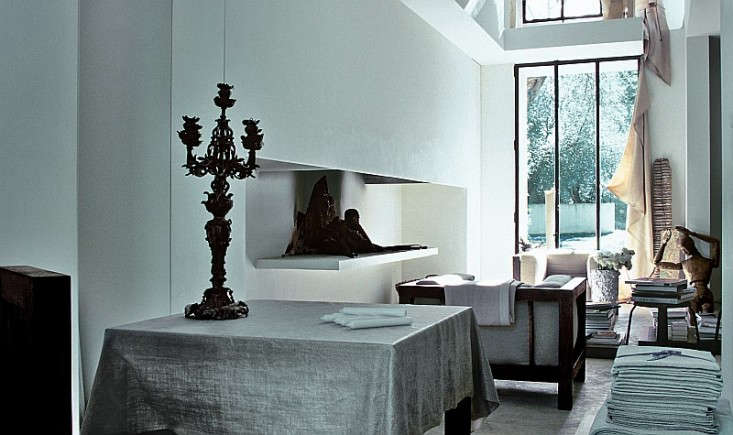
Step into a thoughtfully restored home in Saint-Paul de Vence and the first thing you notice is often the temperature. Even on a warm day, old stone keeps the rooms calm. The walls are thick, the windows carefully placed, and the interior seems to breathe at its own pace. This is not the glossy “villa fantasy” of the Riviera, all marble and mirror and panic-level air conditioning. This is a home that has survived trends, revolutions, bad plumbing, and probably at least one overconfident decorator from Paris.
A French architect might begin with the bones: expose the stone where it matters, repair rather than replace, and let irregularities remain visible. In Saint-Paul de Vence, perfection can feel suspicious. A slightly uneven wall has more authority than a flawless new surface. A centuries-old beam does not need theatrical lighting. It needs respect, wax, and perhaps a discreet structural engineer who knows when to speak softly.
The palette is usually drawn from the landscape: limestone, chalk white, olive green, clay, faded ocher, linen, walnut, iron, and the pale gold of late afternoon. Instead of overwhelming the rooms with color, the architect allows light to do the painting. In the morning, it cools the plaster. At noon, it sharpens the edges of arches and shutters. By evening, it turns the entire house into a quiet argument in favor of staying home.
The French Riviera Without the Glitter Hangover
The French Riviera is famous for glamour, but Saint-Paul de Vence offers a more textured version of luxury. It is close enough to Nice, Cannes, Antibes, and Monaco to enjoy the Riviera’s energy, yet high enough in the hills to feel removed from the beach-club soundtrack. Here, luxury is not always a superyacht. Sometimes it is a shaded terrace, a bowl of olives, a linen napkin, and the realization that nobody has asked you to wear formal shoes.
This is why Saint-Paul de Vence attracts design lovers. The village does not separate art, architecture, food, and daily life into neat categories. A gallery might sit next to a centuries-old doorway. A sculpture may appear in a garden as naturally as rosemary. A hotel dining room can feel like an informal museum. A walk to buy bread may become a lesson in stone masonry, urban planning, and the emotional benefits of blue shutters.
For a French architect, the village is a living case study in how to balance preservation and modernity. The challenge is not to freeze the past in amber. Homes still need kitchens that function, bathrooms that do not feel medieval in the wrong way, wiring that behaves, and storage for modern life’s many unromantic objects. The trick is to add comfort without erasing character.
What Fondation Maeght Teaches About Modern Architecture
No serious design conversation about Saint-Paul de Vence can ignore Fondation Maeght. Created by Aimé and Marguerite Maeght and designed with architect Josep Lluís Sert, the foundation opened in 1964 and remains one of the region’s great encounters between art, architecture, and landscape. Sert’s design is modern but not arrogant. It works with gardens, courtyards, terraces, sculpture, shade, and sky.
For a French architect at home nearby, Fondation Maeght is more than a museum visit. It is a reminder that modern design does not need to bully old places into submission. Sert’s architecture shows how clean lines, white surfaces, sculptural roofs, and open-air circulation can belong in a Mediterranean setting when they are handled with intelligence. The building does not pretend to be medieval. It also does not pretend the landscape is a blank canvas. That balance is the lesson.
Inside a Saint-Paul de Vence home, this lesson might appear in subtle ways: a contemporary steel-framed window set into old stone, a minimalist kitchen tucked behind a traditional arch, a modern sofa paired with an antique farm table, or a plain plaster wall left open for one strong artwork. The architect’s hand is present, but not loud. The goal is to create rooms that feel collected over time, not purchased during one dramatic afternoon with a corporate credit card.
La Colombe d’Or and the Art of Living With Art
Saint-Paul de Vence is inseparable from La Colombe d’Or, the legendary inn and restaurant associated with many major 20th-century artists. Its history has become part of the village’s mythology: artists, writers, actors, and travelers gathering around tables, exchanging ideas, meals, and sometimes artworks. Whether one visits for lunch, history, or the pleasure of sitting where creative people once lingered far too long over wine, La Colombe d’Or captures a central truth about the village: art here is not sealed behind glass. It lives in rooms, gardens, conversations, and memory.
That idea matters deeply in residential design. A French architect’s home in Saint-Paul de Vence would not treat art as a last-minute accessory. Art would shape the way rooms are composed. A painting might determine the height of a lamp. A ceramic piece might inspire the tone of a niche. A sculpture could command a corner of the terrace without needing a spotlight or a speech.
The best interiors in this village understand negative space. They do not cover every wall. They let a single object breathe. They give old stone permission to be art too. This is especially important in a place where famous names such as Marc Chagall and James Baldwin are part of the cultural memory. Chagall lived near Saint-Paul de Vence for many years and absorbed the area’s light into his dreamlike visual world. Baldwin spent the later part of his life in a stone villa here, writing from a place that offered both refuge and confrontation. The village has always given creative people space to wrestle with beauty and seriousness at the same table.
Design Details That Make a Provençal Home Feel Authentic
1. Shutters That Actually Work
In a Saint-Paul de Vence home, shutters are not merely decorative eyelashes for windows. They manage light, privacy, heat, and mood. Painted in soft greens, blues, grays, or weathered neutrals, they give the façade rhythm while helping interiors stay cool during long summer afternoons.
2. Floors With a Memory
Stone slabs, reclaimed terracotta tiles, or aged oak flooring give rooms a sense of permanence. The floor should not look frightened by footsteps. A proper Provençal floor accepts sandals, dogs, market baskets, and the occasional guest who insists on explaining natural wine.
3. A Kitchen Built for Real Life
The kitchen in a French architect’s home would be elegant, but it would also work hard. Think stone counters, open shelving, copper or stainless accents, ceramic dishes, woven baskets, and a table large enough for friends who “only stopped by for ten minutes” and are somehow still there three hours later.
4. Terraces as Outdoor Rooms
In the Mediterranean, the terrace is not a bonus. It is a second living room, dining room, studio, and therapy session. A good terrace in Saint-Paul de Vence offers shade, views, durable furniture, potted herbs, and lighting soft enough to make everyone look as if they have been sleeping eight hours a night.
5. Contemporary Comfort Hidden in Plain Sight
Modern insulation, climate control, lighting, and appliances matter, but they should not dominate the house. The best renovations integrate technology discreetly. The result feels timeless, not theatrical. Nobody comes to Saint-Paul de Vence to admire a thermostat.
How a French Architect Balances Old and New
The central design question in Saint-Paul de Vence is simple: how do you make an old home livable without making it look newly confused? The answer usually begins with humility. A French architect studies what exists before deciding what to change. Wall thickness, window orientation, original materials, rooflines, drainage, and circulation all matter. So does the village context. A house that screams for attention may be technically impressive, but in Saint-Paul de Vence it will sound out of tune.
Old homes often require structural repairs, moisture control, sensitive electrical updates, and careful planning permissions. That may not sound romantic, but it is the foundation of romance. Nothing ruins Mediterranean charm faster than a beautiful room with a mysterious leak. A good architect understands that invisible work is still design work.
Once the essentials are solved, the poetry begins. A former storage room can become a reading nook. A narrow stair can be lit like a quiet sculpture. A low ceiling can feel intimate rather than cramped if the furniture is scaled correctly. A small window can frame a view more powerfully than a giant glass wall. In Saint-Paul de Vence, restraint is not a lack of imagination. It is imagination with manners.
The Emotional Architecture of Living Here
Living in Saint-Paul de Vence changes one’s relationship with time. The village does not reward rushing. The lanes curve. The steps slow you down. The view interrupts your schedule. Even the light seems to have a strong opinion about when you should stop working.
A French architect’s home here would likely reflect that rhythm. There would be places for transition: an entry with hooks and baskets, a bench near the door, a shaded landing, a small desk near a window, a terrace chair angled not toward a television but toward the hills. These gestures may seem small, but they shape daily life. Architecture is not only about what a building looks like. It is about what it asks you to notice.
That may be Saint-Paul de Vence’s greatest design lesson. The village teaches attention. It asks residents and visitors to notice texture, shadow, scent, history, and proportion. It reminds us that a home does not become beautiful because it is expensive. It becomes beautiful because every choice understands where it is.
Experiences Related to “At Home in Saint-Paul de Vence with a French Architect”
Spending time in Saint-Paul de Vence with the mindset of a French architect changes the entire experience of the village. Instead of simply walking from one pretty corner to the next, you begin to read the place like a layered drawing. The ramparts become more than a backdrop. They become evidence of military engineering, political anxiety, and human endurance. The lanes become climate design. The shaded passages become old technology doing its job beautifully without needing an app update.
One of the most memorable experiences is arriving early, before the day-trippers fully wake the village. Morning in Saint-Paul de Vence has a private quality. Stone façades hold the coolness of night. Shopkeepers open shutters. A café sets out chairs with the calm precision of a ritual. This is the hour when an architect would study thresholds: how a doorway meets the street, how steps turn at the corner, how a small window can make a wall feel alive. It is also the hour when coffee tastes better because you have earned it by climbing.
A second essential experience is walking the perimeter near the ramparts and looking outward. The views toward the hills and the Mediterranean explain why artists and writers have been drawn here for generations. The landscape is not just scenic; it is compositional. Olive trees create texture, cypress trees add vertical punctuation, and distant blue tones soften the horizon. A home designed in this context should never compete with the view. It should frame it, shade it, and occasionally invite it inside.
Visiting Fondation Maeght adds another layer. After wandering medieval lanes, the foundation’s modernist architecture feels like a conversation across centuries. Its courtyards, sculptural forms, and relationship to the surrounding pines show how contemporary architecture can belong in Provence without copying the past. For anyone interested in Mediterranean home design, this is a powerful lesson: contrast can be respectful when scale, material, and light are handled with care.
Lunch at or near La Colombe d’Or offers a different kind of education. Here, the art of living is not theoretical. It is on the table, in the garden, in the casual coexistence of food, conversation, and art history. The experience suggests that a home should not feel staged for inspection. It should welcome long meals, wandering guests, imperfect flowers, and stories that improve with repetition.
By late afternoon, the village becomes golden and theatrical, but never fake. This is the best time to imagine the architect returning home: unlocking an old wooden door, stepping into cool shadow, placing market herbs on a kitchen counter, and opening shutters toward the valley. The day’s design work may be finished, but the village continues teaching. Saint-Paul de Vence proves that architecture is not only in museums, monuments, or luxury villas. It is in the daily choreography of stone, light, food, art, and human presence. To be at home here is to live inside a masterclass that never raises its voice.
Conclusion: A Home That Belongs to Its Place
At home in Saint-Paul de Vence with a French architect, one discovers that the most compelling interiors are not the loudest. They are the most attentive. They understand the village’s medieval structure, its artistic legacy, its Mediterranean climate, and its quiet appetite for beauty. They make room for history without becoming dusty. They welcome modern life without turning every room into a showroom.
Saint-Paul de Vence is not simply a destination for art lovers, design travelers, or Riviera romantics. It is a reminder that architecture works best when it belongs to its place. A French architect’s home here would not be a performance of Provençal style. It would be a conversation with stone, sunlight, memory, and landscape. And like all good conversations in France, it would probably continue over lunch.