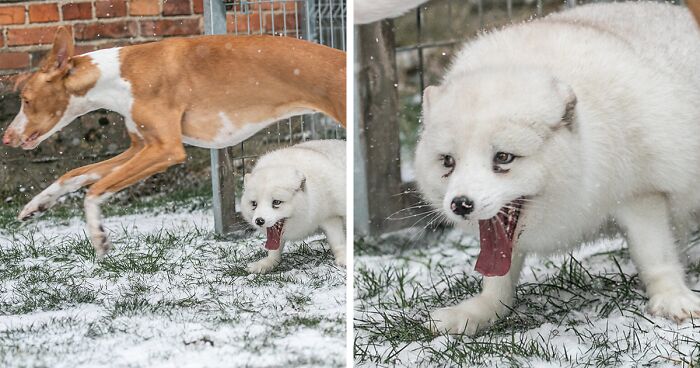
Some animals are born into wide-open places: forests, fields, tundra, burrows, wind, rain, dirt, and snow. Others, through no fault of their own, first meet the world through metal bars. Maciek, a rescued snow fox also known as an arctic or polar fox, belonged to the second group. He was born on a fur farm in Poland, where foxes are raised not as living, curious, clever animals, but as future fashion material. That sentence alone is enough to make your heart put on a tiny black armband.
But Maciek’s story did not end in a cage. In September 2019, animal activists from Otwarte Klatki, known in English as Open Cages Poland, rescued him after discovering that he had a severe untreated paw injury. Veterinarians fought to save the paw, but the damage was too advanced. Eventually, Maciek lost one of his hind paws. What he gained, however, was something far bigger: safety, care, space, companionship, and the chance to behave like a fox instead of an object waiting in inventory.
Then came the moment that made people all over the internet melt into emotional soup: Maciek saw snow for the first time. A snow fox, designed by nature for frost, white landscapes, fluffy-footed movement, and winter camouflage, had never been able to truly enjoy snow. When he finally stepped into it, sniffed it, hesitated over it, and then began to play, the moment was both adorable and quietly devastating. It was a reminder that rescue is not only about survival. Sometimes, rescue is about giving an animal back the simple joys he should have had from the beginning.
Who Was Maciek, the Rescued Snow Fox?
Maciek was an arctic fox, a small cold-weather canid often called a snow fox, white fox, or polar fox. In the wild, arctic foxes are famous for their thick winter coats, compact bodies, furry feet, and remarkable ability to handle freezing climates. They are built like tiny winter athletes wearing built-in parkas and snow boots. If nature had a cold-weather design department, the arctic fox would be the employee of the month every December.
Unfortunately, those same beautiful coats have made arctic foxes targets of the fur industry. On fur farms, foxes are often kept in restrictive wire cages that deny them the chance to dig, run, explore, hide, play, or make meaningful choices. For a fox, that is not a minor inconvenience. Foxes are active, intelligent predators with strong instincts for movement and environmental exploration. A barren cage is not a home; it is a waiting room with no good appointment at the end.
Maciek’s injury showed the brutal cost of neglect. Reports about his rescue describe a serious open fracture on his left hind paw. Without timely veterinary care, an injury that might have been treated earlier became life-changing. After rescue, doctors tried to save the limb, but amputation became necessary. The happy part is that Maciek adapted. Three paws did not erase his curiosity, his attitude, or his ability to enjoy life. If anything, his story became proof that animals are often more resilient than the systems that fail them.
Why Seeing Snow Mattered So Much
To understand why Maciek’s first snow was so emotional, you have to understand what snow means to an arctic fox. In nature, snow is not just pretty scenery. It is part of the fox’s world. Snow shapes how arctic foxes hide, hunt, move, rest, and survive. Their white winter coats help them blend into snowy landscapes. Their furry paws provide insulation and traction. Their bushy tails can wrap around their bodies like a scarf when temperatures drop. Basically, an arctic fox is a small, dramatic winter survival expert with excellent outerwear.
So when Maciek touched snow for the first time, it was not just a cute animal video moment. It was a species-appropriate experience finally becoming available to an animal who had been denied natural stimulation. His first reaction was not instant Olympic-level snow zoomies. He hesitated. He watched. He sniffed. He seemed unsure whether this cold white stuff was a friend, an enemy, or a suspicious new floor texture invented by humans.
That hesitation makes the story more powerful. Animals rescued from poor environments do not always leap joyfully into freedom as if they have read the script. Many need time. New surfaces, open spaces, sounds, smells, and choices can be overwhelming. For Maciek, snow was both familiar at a biological level and unfamiliar as a personal experience. His body was made for it. His life had not prepared him for it.
How Maciek Reacted: Curiosity First, Joy Second
Maciek’s first snow day unfolded like a tiny emotional movie. At first, he appeared cautious. His dog friend Klara helped show him that snow was not a mysterious frozen trap set by the universe. Klara ran, played, and invited him into the fun. Maciek watched like a skeptical uncle at a water park, not fully convinced but clearly tempted.
Then curiosity took over. He stepped forward. He tested the snow. He sniffed it. He moved through it. The more comfortable he became, the more his playful side appeared. Soon he was running, chasing, resting, and then chasing again. It was joyful, but not in a polished greeting-card way. It was better than that: slightly awkward, deeply real, and full of personality.
There is something unforgettable about watching a rescued animal discover a basic pleasure. Maciek’s snow day was not just “cute fox plays outside.” It was “animal who survived neglect gets to experience the world as his species was meant to experience it.” That difference matters. It turns a viral moment into a meaningful story about animal welfare, rescue, and the importance of giving captive animals environments that meet more than their bare minimum needs.
The Problem With Fur Farms
Fur farming is often discussed in terms of clothing, luxury, or tradition, but for the animals involved, it is a life of confinement. Foxes, mink, raccoon dogs, rabbits, and chinchillas are commonly raised for fur. Many are kept in small wire cages that severely limit natural behavior. For foxes, that means no real running, digging, denning, exploring, or hunting. Imagine being born with the instincts of a wilderness problem-solver and being handed a wire floor as your entire universe. Even the most optimistic fox would leave a one-star review.
Animal welfare organizations have documented injuries, stress behaviors, untreated wounds, poor sanitation, and severe confinement in fur-farm settings. While conditions vary by farm and country, the core welfare issue remains: wild or semi-wild animals are being kept in systems designed primarily for production, not well-being. When an animal’s body and mind are built for movement, complexity, and choice, a tiny barren cage can cause physical and psychological harm.
Maciek’s case shows how quickly neglect can become permanent damage. An untreated injury cost him a paw. Other rescued foxes from fur farms have been found with missing limbs, infected wounds, malnutrition, stress-related behaviors, and fear of human contact. These are not fashion details. They are living consequences.
Why Rescue Does Not Mean Release
One common question people ask when they hear about rescued fur-farm foxes is: “Why not release them into the wild?” It is a fair question, but the answer is complicated. Many fur-farm foxes are not prepared to survive in wild ecosystems. They may lack hunting skills, fear responses, territory knowledge, or physical health. Some have disabilities, like Maciek. Others may be too habituated to humans or too stressed to adapt safely.
That is why sanctuary care matters. A good sanctuary is not a cage with nicer branding. It should provide safety, veterinary treatment, appropriate diet, space, enrichment, shelter, and opportunities for natural behavior. For a rescued fox, enrichment might include digging areas, scent trails, puzzle feeders, seasonal changes, safe social companions, hiding places, and outdoor access. Snow, in Maciek’s case, became enrichment delivered directly by the weather department.
Sanctuary life is not the same as wild freedom, but for animals who cannot safely return to the wild, it can be the difference between existing and living. Maciek’s snow day showed what happens when an animal is given room to make choices. He could approach, retreat, rest, run, and play. Those choices are small only to people who have always had them.
What Arctic Foxes Are Built For
Arctic foxes are among the most cold-adapted mammals on Earth. Their rounded bodies, short ears, short muzzles, thick coats, and fur-covered feet help reduce heat loss. Their tails are not just decorative fluff; they help with balance and warmth. In winter, many arctic foxes turn white, blending beautifully into snow and ice. In warmer seasons, their coats may shift toward brown or gray, helping them disappear against rocks and tundra vegetation.
They are also skilled hunters and scavengers. In the wild, arctic foxes may listen for small animals moving beneath snow, then leap and dive nose-first to catch prey. It is one of nature’s most charming hunting techniques: part science, part ballet, part faceplant. They may eat lemmings, voles, birds, eggs, fish, insects, berries, carrion, and whatever the harsh Arctic menu happens to offer.
These adaptations help explain why Maciek’s first snow resonated so strongly. Snow was not a luxury for his species. It was part of the environment his body had been shaped to understand. Watching him finally interact with it felt like watching a missing puzzle piece click into place.
The Role of Klara, His Dog Friend
One of the sweetest details in Maciek’s story is Klara, the dog who helped introduce him to the joy of snow. The two reportedly met when they were young and developed a sibling-like bond. For rescued animals, trusted companions can make new experiences less frightening. Klara’s confidence gave Maciek a model: snow is for running, chasing, tumbling, and acting like your legs have temporarily joined a jazz band.
Of course, foxes and dogs should not be casually mixed by inexperienced caretakers. Their interactions require knowledge, supervision, and attention to individual temperament. But in Maciek and Klara’s case, the relationship appears to have been part of his healing environment. She helped turn uncertainty into play. Sometimes courage arrives with four paws, a wagging tail, and absolutely no respect for personal space.
Why the Internet Loved This Story
Maciek’s story spread because it combined three powerful ingredients: cuteness, injustice, and recovery. People love animal rescue stories, but the most memorable ones do more than produce a quick “aww.” They reveal what was taken from an animal and what can be restored. Maciek did not simply get a second chance at life. He got a first chance at snow.
That phrase matters. A first chance at snow. A first chance at running without wire beneath his feet. A first chance at choosing whether to chase Klara or flop down and recharge. Those experiences sound ordinary until you remember that many animals in industrial systems never receive them.
Stories like Maciek’s can also change how people think about fur. A fur-trimmed hood or decorative pom-pom can feel distant from the animal it came from. But a fox with a name, a missing paw, a best friend, and a snow-day personality makes the connection harder to ignore. Once you see the individual, the product becomes less abstract.
What Maciek Teaches Us About Animal Welfare
Animal welfare is not only the absence of hunger, thirst, or untreated injury. Those basics are essential, but they are not the whole picture. Modern welfare thinking also asks whether animals can express natural behaviors, feel secure, experience comfort, solve problems, explore, play, and enjoy positive experiences. In other words, the goal is not merely to keep animals alive. The goal is to give them lives worth living.
Maciek’s snow day is a perfect example of positive welfare. Nothing about the scene was medically dramatic. No one was performing surgery. No one was pulling him from danger. He was simply exploring, choosing, and playing. That is exactly why the moment is important. Rescue should not stop at emergency care. The best rescue work continues into rehabilitation, enrichment, and long-term emotional recovery.
How Readers Can Help Animals Like Maciek
You do not need to run a sanctuary to make a difference for animals like Maciek. Start by choosing fur-free clothing and accessories. Check labels carefully, especially on trims, pom-poms, gloves, hats, and decorative linings. Support brands that have clear animal welfare policies. Share credible rescue stories, but avoid spreading graphic content without context. Donate to reputable rescue and animal welfare groups when possible. And when you see an animal story online, let it be more than a passing moment of cuteness. Let it sharpen your compassion.
It also helps to support stronger animal protection laws and better enforcement. Fur farms often operate out of sight, which makes public awareness especially important. The more people understand the conditions behind fur, the harder it becomes for cruelty to hide behind fashion language.
Experience Notes: What Maciek’s First Snow Feels Like From the Ground
Imagine standing at the edge of a yard after spending your entire early life in a cage. The air smells different. Not just cleaner, but layered: cold wood, damp earth, dog fur, human gloves, distant trees, and something crisp falling from the sky. Snow changes sound, too. It softens footsteps. It makes the world quieter, as if someone turned down the volume so healing could speak first.
For a rescued fox like Maciek, the first few seconds would not necessarily be easy. People often imagine rescue as instant happiness, but freedom can be strange when an animal has never been allowed to practice it. A cage teaches limitation. Sanctuary teaches possibility. There is a learning curve between the two.
The first step into snow might feel unstable. The surface gives way. It is cold but not dangerous. It clings to fur. It carries scent differently. A fox’s nose, far more sensitive than ours, would receive a whole weather report from a single sniff. Who crossed here? Where did the dog run? What did the humans touch? Is there food? Is this fluffy white nonsense edible? These are important scientific questions, especially the last one.
Then comes the breakthrough. The animal realizes that nothing bad happens after one step, so he takes another. Curiosity widens. The body remembers what the past never allowed. The shoulders loosen. The head drops. The paws test and push. A little burst of speed appears, then a pause, then another burst. Suddenly the fox is not just standing in snow. He is using it. He is reading it. He is playing in it.
That is why Maciek’s reaction is so moving. The snow did not fix everything. It did not grow back his missing paw or erase the pain of neglect. But it offered something precious: a moment where his identity as a fox was stronger than his history as a fur-farm survivor. He was not a victim in that yard. He was Maciek, three-pawed snow explorer, cautious critic of unfamiliar textures, enthusiastic chaser of Klara, and proud owner of one of the internet’s most emotionally persuasive winter adventures.
Anyone who has cared for a rescued animal knows that progress often comes in tiny scenes. The first relaxed nap. The first playful bounce. The first time they accept food without fear. The first time they choose to approach instead of hide. Maciek’s first snow belongs in that category. It was not simply a seasonal event. It was a milestone in trust.
And maybe that is the larger lesson. Animals do not need luxury to heal. They need safety, patience, medical care, suitable environments, and the freedom to rediscover ordinary joys. For Maciek, joy arrived as snowflakes, a dog friend, a safe yard, and the chance to run on his own terms. Not a bad ending for a fox who once knew the world only through wire.
Conclusion
Maciek’s first experience with snow was heartwarming because it revealed both what he had lost and what rescue gave back. Born into a fur-farm system, injured through neglect, and forced to lose a paw, he could easily have been remembered only as another sad statistic. Instead, thanks to rescuers, veterinarians, and sanctuary care, he became a symbol of resilience.
Watching a snow fox discover snow for the first time is charming, yes. It is also a quiet indictment of any industry that denies animals the most basic parts of being themselves. Maciek’s story asks us to look beyond the fluff and see the individual inside it: curious, cautious, playful, brave, and very much alive.
Note: This article is an original, publish-ready synthesis based on real information about Maciek’s rescue, arctic fox behavior, fur-farm welfare concerns, and sanctuary enrichment practices. Source links are intentionally not inserted into the article body.