Note: This article reflects publicly released James Webb Space Telescope imagery and mission highlights available through May 25, 2026.
The Telescope That Turned the Universe Into a High-Resolution Drama
The James Webb Space Telescope has done something rare: it made deep-space astronomy feel personal. Before Webb, most of us knew the universe was huge, old, mysterious, and generally not concerned with our tiny calendar problems. Then Webb started sending back images of galaxies, nebulae, planets, star nurseries, dying stars, and cosmic dust clouds so detailed they looked less like scientific data and more like the universe had hired a professional portrait photographer.
Launched to observe mainly in infrared light, Webb is designed to see through dust, study faint ancient galaxies, examine newborn stars, inspect exoplanet atmospheres, and reveal details hidden from visible-light telescopes. Its primary mirror is about 6.5 meters across, and its instruments include NIRCam, MIRI, NIRSpec, and NIRISS. In normal-person language: Webb is a space telescope with very fancy eyes, a giant golden mirror, and an apparently endless talent for making humans say, “Wait, that’s real?”
Since its first full-color science images arrived in July 2022, the James Webb Space Telescope has produced an expanding gallery of cosmic landmarks. Not every image is just “pretty space wallpaper.” Many of Webb’s best images are also scientific tools that help researchers understand galaxy evolution, star formation, planetary atmospheres, black holes, dust chemistry, and the life cycles of stars. The beauty is the hook. The science is the reason we keep staring.
Webb’s First Images: The Moment the Internet Became an Astronomy Club
Webb’s first major public image release was a cultural event as much as a scientific milestone. The debut set included the deep field SMACS 0723, the Southern Ring Nebula, Stephan’s Quintet, the “Cosmic Cliffs” in the Carina Nebula, and the atmospheric spectrum of the exoplanet WASP-96 b. Together, they introduced the world to Webb’s range: ancient galaxies, dying stars, star birth, galactic interaction, and planets beyond our solar system.
SMACS 0723: A Deep Field Full of Time Machines
The SMACS 0723 image looked like someone spilled jewels across black velvet, but the science behind it was even better. It showed a galaxy cluster acting as a gravitational lens, bending and magnifying the light of more distant galaxies behind it. Some of those galaxies are so far away that their light began traveling billions of years ago. Looking at Webb deep fields is not like looking across a room; it is like looking across history.
The Southern Ring Nebula: A Star’s Grand Finale
The Southern Ring Nebula, also known as NGC 3132, offered a close look at a dying star shedding gas and dust into space. Webb revealed structures that had been difficult to see before, including dust around the central star. The image is both beautiful and slightly rude: it reminds us that even stars have a retirement plan, and apparently it involves throwing glittering material into the cosmos.
Stephan’s Quintet: Galactic Drama, but Make It Scientific
Stephan’s Quintet gave Webb a chance to show off its ability to study interacting galaxies. Four of the five galaxies in the visual grouping are locked in a gravitational dance, pulling gas and stars into long streams and triggering regions of star formation. Webb’s enormous mosaic revealed details about shock waves, black hole activity, and how galaxies influence one another over time. Basically, it is a cosmic group project with gravity as the bossy team leader.
The Cosmic Cliffs: Star Birth in the Carina Nebula
The “Cosmic Cliffs” in the Carina Nebula became one of Webb’s most recognizable images. It looks like a glowing mountain range under a starry sky, but it is actually the edge of a young star-forming region called NGC 3324. Webb’s infrared view pierced dusty regions to reveal newborn stars and jets of material. The image made star formation feel almost touchable, as if the universe were sculpting new suns out of glowing clouds.
The Pillars, the Tarantula, and Other Nebulae That Stole the Show
Some of Webb’s most beloved images are nebulae, and it is easy to understand why. Nebulae are where the universe gets dramatic: stars are born, stars die, gas expands, dust glows, and every cloud seems to have a flair for stage lighting.
Pillars of Creation: A Classic Reimagined
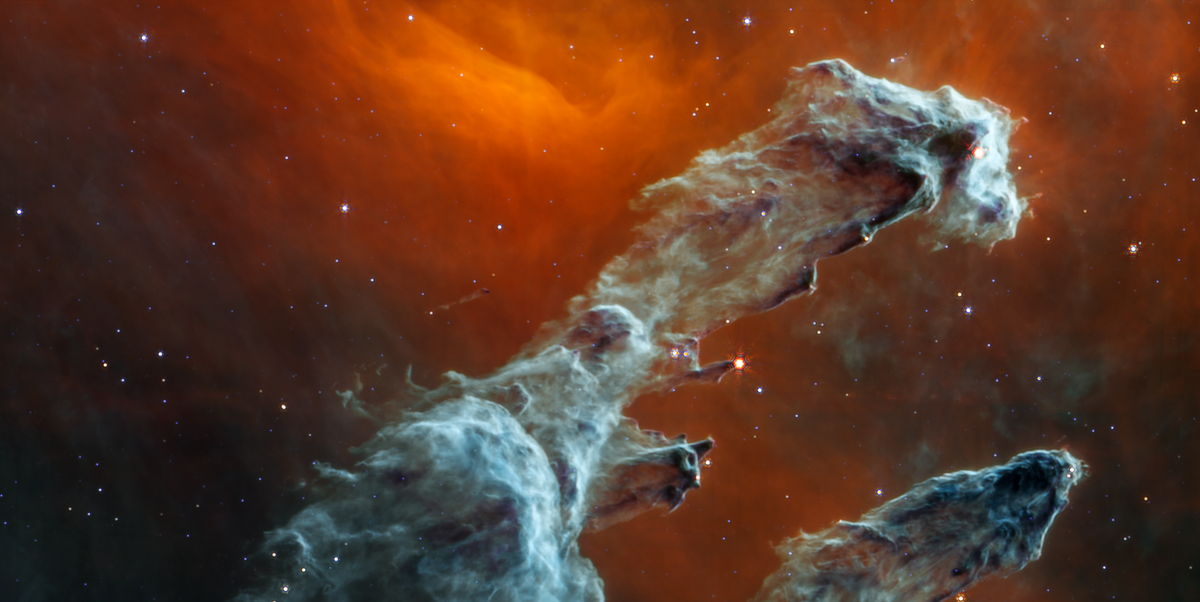
The Pillars of Creation were already famous thanks to Hubble, but Webb gave this Eagle Nebula landmark a new voice. NIRCam revealed young stars and delicate dust structures, while MIRI emphasized cooler dust and dense regions. The composite images showed how different infrared wavelengths can turn one object into several different stories. In one view, the pillars sparkle with newborn stars. In another, they look ghostly and ancient, like the universe’s most intimidating cathedral columns.
Tarantula Nebula: A Stellar Nursery With Bite
The Tarantula Nebula, located in the Large Magellanic Cloud, is one of the most active star-forming regions near the Milky Way. Webb’s image showed cavities carved by young stars, dense clouds of gas and dust, and clusters of hot, massive stars. The image helps astronomers study how stars formed in conditions that resemble the early universe. It also proves that if space names something “Tarantula,” you should expect drama.
Rho Ophiuchi: Webb’s First Anniversary Fireworks
For Webb’s first science anniversary, the telescope released a stunning image of the Rho Ophiuchi cloud complex, one of the closest star-forming regions to Earth. The image captured jets from young stars and glowing dust shaped by radiation. It felt like a birthday card from the cosmos, except instead of balloons, it had stars being born. Fair trade.
Helix Nebula and Exposed Cranium: Dying Stars, Strange Shapes
In 2026, Webb’s view of the Helix Nebula highlighted comet-like knots, fierce stellar winds, and layers of gas shed by a dying star. The Exposed Cranium Nebula, also known as PMR 1, added an even stranger entry to Webb’s gallery. Captured with NIRCam and MIRI, it resembles a brain inside a transparent skull, which sounds like a Halloween decoration until you remember it is a cloud of gas and dust in space. Webb’s strength is not only making the universe beautiful; it also makes the weirdness scientifically useful.
Galaxies: Webb’s Deep-Space Family Album
Webb’s galaxy images are some of its most important scientific contributions. Galaxies are not just pretty spirals or fuzzy blobs. They are giant systems of stars, gas, dust, black holes, and dark matter, evolving over billions of years. Webb studies them in infrared light, which is especially helpful for observing ancient galaxies whose light has been stretched by the expansion of the universe.
The Cartwheel Galaxy: A Collision Frozen in Motion
The Cartwheel Galaxy is one of Webb’s most visually striking galaxy images. Its ring-like shape was created by a high-speed collision with another galaxy. Webb’s instruments revealed star-forming regions in the outer ring and dusty structures inside the galaxy. It is a reminder that galaxies are not static decorations. They crash, merge, stretch, and rebuild themselves on time scales that make our five-year plans look adorable.
The Phantom Galaxy: Spiral Structure in Fine Detail
The Phantom Galaxy, also known as M74, became a Webb favorite because of its elegant spiral arms. Webb’s infrared view revealed filaments of gas and dust that trace the galaxy’s structure. Images like this help scientists understand how stars form inside spiral galaxies and how dust influences what we can observe.
NGC 5134: A 2026 Spiral With Dusty Secrets
In 2026, Webb released a detailed image of NGC 5134, a spiral galaxy in Virgo about 65 million light-years away. Using near- and mid-infrared observations, Webb showed stars peeking through dusty spiral arms while MIRI traced warm dust within clouds of gas. The image matters because nearby galaxies like NGC 5134 can act as laboratories. By studying them in detail, astronomers gain insight into galaxies that are much farther away and harder to resolve.
Penguin and Egg: The Cutest Galactic Collision
For Webb’s second science anniversary, the telescope captured Arp 142, nicknamed the Penguin and the Egg. The distorted spiral galaxy resembles a penguin, while its compact companion looks like an egg. Their gravitational interaction began millions of years ago and will continue reshaping both galaxies. It is charming, scientifically rich, and possibly the only time “penguin guarding an egg” has also meant “galactic merger in progress.”
Planets, Moons, and Rings: Webb Looks Closer to Home
Webb is famous for peering into the early universe, but it has also produced remarkable images of our own solar system. Its infrared eyes reveal atmospheric features, rings, moons, auroras, and thermal structures that visible-light images can miss.
Jupiter: Auroras, Rings, and a Giant Planet Showing Off
Webb’s image of Jupiter revealed glowing auroras, faint rings, small moons, and atmospheric details. Because infrared light highlights different features than visible light, Jupiter looked both familiar and alien. It was still the giant planet we know, but with extra cosmic eyeliner.
Neptune and Uranus: Rings Return to the Spotlight
Webb’s images of Neptune revealed its rings with striking clarity, offering one of the best views since Voyager 2. Uranus also received a spectacular infrared portrait, showing its rings, moons, and seasonal polar features. For planets that often get treated like the solar system’s quiet cousins, Webb gave them a proper red-carpet moment.
Saturn: Bright Rings, Dark Planet, Big Mood
Webb’s infrared view of Saturn is unforgettable because the planet itself appears dark while the icy rings glow brightly. In 2026, NASA released Webb and Hubble views that provided complementary perspectives on Saturn’s atmosphere and rings. Webb’s infrared image showed the rings shining due to reflective water ice, while the planet’s atmospheric layers appeared in unusual tones. Saturn has always been stylish, but Webb made it look like it arrived wearing formalwear.
Titan and Other Moons: Weather Beyond Earth
Webb has also observed Titan, Saturn’s largest moon, helping scientists study clouds and atmospheric behavior. Titan is especially interesting because it has a thick atmosphere and methane-based weather. It is not Earth, but it does have weather, chemistry, and a personality. Webb’s observations help researchers compare planetary environments and understand how atmospheres work in very different conditions.
Exoplanets and Spectra: Not Every Webb Image Looks Like a Poster
Some of Webb’s most important discoveries do not look like colorful nebulae. A spectrum may appear as a graph rather than a dramatic image, but it can reveal what an atmosphere contains. Webb’s early spectrum of WASP-96 b showed water signatures, clouds, and haze in the atmosphere of a hot gas giant. That helped demonstrate Webb’s ability to study planets orbiting other stars.
In 2026, Webb directly imaged 29 Cygni b, a massive gas giant about 15 times the mass of Jupiter. Researchers found evidence for heavy elements such as carbon and oxygen, supporting the idea that it formed more like a planet within a protoplanetary disk rather than like a star. Direct exoplanet imaging is difficult because planets are faint and often close to bright stars. Webb’s ability to separate and analyze such targets is one reason astronomers are excited about the future of exoplanet research.
For casual viewers, exoplanet data may not deliver the same “hang this on my wall” thrill as the Cosmic Cliffs. But scientifically, it is blockbuster material. These observations help answer questions about how planets form, what atmospheres contain, and whether some worlds may have conditions worth studying for habitability.
Why Webb Images Look the Way They Do
One common question is whether Webb images show “real color.” The honest answer is: they show real data, translated into visible colors. Webb observes mostly infrared light, which human eyes cannot see. Scientists and image processors assign visible colors to different wavelengths so we can interpret the structures. This is not trickery; it is translation. It is similar to turning radio waves into sound or medical scan data into an image doctors can read.
NIRCam is excellent for seeing stars, distant galaxies, and near-infrared structures. MIRI captures longer infrared wavelengths, highlighting cooler dust and warm material. When data from both instruments are combined, the result can reveal layers of a cosmic object that no single view could fully explain. That is why Webb images often come in multiple versions: NIRCam, MIRI, composite, annotated, and wide-field. Each one answers a slightly different question.
So, when a nebula appears orange, blue, red, or gold, the colors are not random decoration. They help distinguish wavelengths, temperatures, materials, and structures. The universe is not wearing makeup for us. We are building a visual language to understand what Webb sees.
Experiencing Webb’s Images: A Personal Viewing Guide for Earthlings
There is a particular feeling that comes from opening a new James Webb Space Telescope image. At first, you look for the obvious subject: the glowing nebula, the spiral galaxy, the planet, the ring system, the dramatic dust lane. Then, after a few seconds, the image starts to expand. Tiny background galaxies appear. Faint stars emerge. A smudge becomes a system. A dot becomes a mystery. Suddenly, the image is not one object. It is a crowded room full of cosmic stories.
The best way to experience Webb images is slowly. Zoom in. Then zoom in again. Do not treat them like social media thumbnails, because that is like using a symphony as a ringtone. In the Cosmic Cliffs, look beyond the dramatic “mountains” and notice the small jets from young stars. In the Pillars of Creation, compare the NIRCam and MIRI versions and watch how the same structure changes personality. In Saturn’s infrared image, notice how the rings glow while the planet itself darkens, almost as if the rings are the main character and Saturn is politely supporting the scene.
Another helpful habit is to read the image captions. Yes, captions sound boring. Yes, we all think we can understand an image by staring confidently at it. But Webb captions often explain what colors represent, which instrument captured the data, and why the target matters. Without that context, a galaxy is pretty. With it, the same galaxy becomes evidence of star formation, interaction, dust chemistry, or early-universe structure.
Webb images are also excellent reminders that science and wonder are not enemies. Some people talk about space images as if their beauty is separate from their value. Webb proves the opposite. The beauty invites attention, and attention opens the door to learning. A person may arrive for the glowing nebula and leave knowing about infrared wavelengths, stellar nurseries, gravitational lensing, and planetary atmospheres. That is not bad for an image you first clicked because it looked like cosmic cotton candy.
There is also a strangely calming effect in Webb’s scale. The images show forces far larger than our daily problems: galaxies colliding over millions of years, stars forming inside clouds wider than imagination, light traveling across cosmic time. This does not make human life meaningless. If anything, it makes curiosity feel more precious. We are small, yes, but we built a machine that can unfold a golden mirror in space, park itself far from Earth, and send back portraits of the universe’s childhood. That is a spectacular little species moment.
For families, teachers, students, writers, and anyone who enjoys a good “wow,” Webb’s gallery is one of the best free educational resources available. Pick one image a week. Read the caption. Ask what the colors mean. Find the object’s distance from Earth. Compare Webb’s view with Hubble’s, Spitzer’s, or ground-based images. The more you compare, the more you understand why Webb is not simply “better” than earlier telescopes. It is different, complementary, and tuned to reveal hidden layers.
The joy of Webb is that it gives everyone an entry point. You do not need a PhD to be moved by the Southern Ring Nebula or amused by a galaxy pair nicknamed the Penguin and the Egg. You can begin with awe and build toward understanding. That may be Webb’s greatest public gift: it makes the universe feel enormous without making it feel unreachable.
Conclusion: Webb’s Gallery Is Still Being Written
The James Webb Space Telescope has already delivered an extraordinary visual record of the cosmos: ancient galaxies, newborn stars, dying stars, spiral galaxies, interacting galaxies, glowing planets, delicate rings, exoplanet spectra, and strange nebulae that look like they were named by a science teacher with a Halloween streak. Yet “so far” is the most important phrase in the title. Webb is still observing, still collecting data, and still expanding the gallery.
Every new Webb image is more than a beautiful picture. It is a data-rich glimpse into how the universe forms, changes, destroys, and rebuilds. Some images answer long-standing questions. Others create new ones. That is how good science works: it does not close the universe like a finished book; it keeps turning pages.
For now, Webb’s images give us a rare combination of spectacle and substance. They are stunning enough to stop a scroll, deep enough to reward study, and strange enough to remind us that the universe has never been short on imagination. The James Webb Space Telescope has not simply shown us space. It has shown us how much more there is to notice.