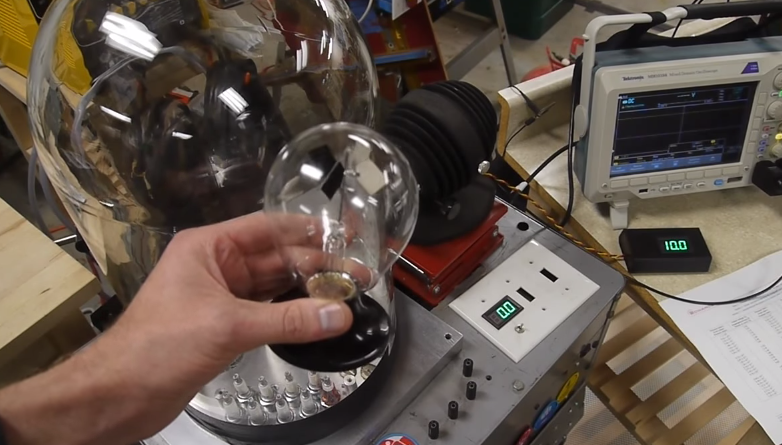
A Crookes radiometer looks like the kind of desk toy a physics teacher would casually place near a sunny window and then refuse to explain for three days. Inside a sealed glass bulb, a delicate little rotor spins as if light itself has turned into a tiny invisible hamster wheel. One side of each vane is black, the other side is shiny or white, and when a strong light shines on it, the vanes whirl around with a strangely confident “I know something you don’t” attitude.
That mystery is exactly why Ben Krasnow, the experimenter behind the Applied Science channel, makes such a good guide to the device. Instead of waving his hands and saying, “It’s pushed by light,” Krasnow does what good experimentalists do: he takes the thing apart conceptually, puts the rotor in a vacuum chamber, changes the pressure, and watches what happens. The result is a beautiful lesson in vacuum physics, heat transfer, gas molecules, and why the obvious answer is sometimes just wrong enough to be interesting.
The Crookes radiometer, also called a light mill, is often described as a device that “spins because of light.” That is technically true, but it is also like saying a car moves because of roads. Helpful? Barely. The real story is that light heats the black sides of the vanes more than the reflective sides, and the remaining gas inside the bulb responds to that temperature difference. The radiometer does not work best in ordinary air, and it does not work in a hard vacuum. It needs the awkward middle ground: a partial vacuum, where gas molecules are sparse enough to behave differently but still present enough to push.
What Is a Crookes Radiometer?
A Crookes radiometer is a sealed glass bulb containing a low-friction rotor with several lightweight vanes. Each vane usually has a blackened side and a bright, reflective side. When light shines on the device, the black sides absorb more energy and become warmer than the reflective sides. That temperature difference sets up microscopic gas behavior that produces torque on the rotor.
Sir William Crookes invented the radiometer in the 1870s while working with sensitive measurements in partially evacuated conditions. He noticed that light could disturb delicate instruments, and that observation led to one of the most famous scientific curiosities of the Victorian era. It was not just a parlor trick. It became a debate about light, matter, pressure, heat, and the behavior of gases at low pressure.
Modern radiometers are commonly sold as educational toys, but that does not mean the science is toy-sized. A Crookes radiometer sits at the intersection of thermodynamics and kinetic theory. It is simple enough to hold in your hand, yet complicated enough to embarrass overly confident explanations. In other words, it is the perfect science object: cute, shiny, and secretly ready to ruin your assumptions.
Why the “Light Pushes the Vanes” Explanation Is Wrong
The most common misunderstanding is that the radiometer spins because photons push directly on the vanes. Light does carry momentum, and radiation pressure is real. In fact, radiation pressure matters in solar sails, astrophysics, and very sensitive laboratory systems. The problem is that a normal Crookes radiometer does not spin in the direction that simple radiation pressure would predict.
If light pressure were the main cause, the reflective side should receive a stronger push because reflected photons reverse direction and transfer more momentum. That would make the shiny sides retreat from the light. In a typical Crookes radiometer, the opposite happens: the black sides tend to trail as the rotor spins. That is your first clue that this is not a photon-punching contest.
Another problem appears when the pressure changes. If the device were powered mainly by light pressure, improving the vacuum should reduce air drag and let the vanes spin more easily. But experiments show that a hard vacuum makes the radiometer stop. No gas, no spin. That is the scientific equivalent of the device saying, “Please bring back my atmosphere, but only a little.”
What Ben Krasnow Demonstrates So Well
Ben Krasnow’s approach is valuable because he treats the radiometer as an experiment rather than a magic ornament. By removing the rotor from the usual sealed gift-shop bulb and placing it inside a controllable vacuum chamber, he can test how the device behaves at different pressures. This is where the explanation becomes clear: the radiometer needs gas molecules to operate.
In a normal sealed radiometer, the bulb contains a partial vacuum. It is not filled with exotic gas, and it is not empty. Krasnow’s demonstration shows that when the pressure is too high, gas drag overwhelms the subtle radiometric force. When the pressure is too low, there are not enough gas molecules left to transfer heat-related momentum. Between those extremes, the vanes spin strongly.
This is the kind of demonstration that turns a museum-shop object into a real physics lesson. Instead of simply saying “thermal transpiration” and watching everyone’s eyes become slightly more vacuum-sealed than the bulb, Krasnow makes the pressure dependence visible. The device becomes a pressure-sensitive heat engine, and the viewer gets to see the invisible gas do its tiny molecular dance.
The Real Engine: Heat, Gas Molecules, and Thermal Creep
The accepted explanation for a Crookes radiometer involves radiometric forces in a rarefied gas. “Rarefied” simply means the gas pressure is low enough that molecules travel relatively long distances before colliding with one another. Inside that partial vacuum, the black side of each vane absorbs more light and warms up. The bright side stays cooler because it reflects more light and absorbs less energy.
Gas molecules hitting the warmer black side leave with more energy than molecules interacting with the cooler side. Near the edges of the vane, this temperature difference creates a flow-related effect often discussed as thermal creep or thermal transpiration. Molecules move and exchange momentum in a way that produces a net force on the vane.
The effect is strongest when the mean free path of the gas molecules is comparable to important dimensions around the vane edges. The mean free path is the average distance a molecule travels before colliding with another molecule. At ordinary air pressure, collisions happen constantly and the delicate effect is smothered by drag. In a hard vacuum, collisions are too rare because too few molecules remain. In the middle, the radiometer gets its sweet spot.
Why the Black Side Trails
When the radiometer spins under light, the black sides usually move away from the light source and trail behind the reflective sides. This motion is consistent with a thermodynamic process rather than simple radiation pressure. The black side gets warmer, the gas near it gains energy, and the asymmetric momentum exchange around the vane edges produces torque.
A helpful way to picture it is to imagine the vane edges as tiny molecular ramps. Molecules from warmer and cooler regions do not bounce around with equal energy. Because the gas is thin, the ordinary rules of bulk airflow do not fully apply. The result is not a breeze you could feel, but it is enough to turn a lightweight rotor balanced on a needle point.
Why Pressure Matters So Much
The Crookes radiometer is fussy about pressure because it relies on gas molecules being present but not crowded. This is why the phrase “partial vacuum” is so important. The device does not want a room full of air, and it does not want the lonely emptiness of deep vacuum. It wants a molecular crowd that has thinned out enough to form interesting temperature-driven behavior.
At higher pressures, gas molecules collide with one another constantly. The rotor experiences a lot of drag, and temperature differences around the vanes are quickly blurred by ordinary heat transfer. The effect is weak because the system behaves too much like normal air.
At very low pressures, the opposite problem appears. The gas is so sparse that there are not enough molecules to carry momentum from the temperature gradient. The vanes may sit still even under bright light. A hard vacuum removes the very material needed for the radiometric force.
Between those two limits, the radiometer comes alive. This is why Krasnow’s vacuum-chamber test is so persuasive. The spinning is not a mysterious property of light alone. It is the result of light heating a surface, gas molecules reacting to that heat, and the pressure being just right for the molecular interaction to create torque.
Is the Crookes Radiometer a Solar Engine?
In a loose sense, yes. A Crookes radiometer converts light energy into mechanical motion. But it is not a practical solar motor in the usual engineering sense. The torque is tiny, the power output is tiny, and the device depends on a sealed low-pressure environment. Nobody is going to power a blender with one unless the smoothie is imaginary and the banana is theoretical.
Still, calling it useless would be unfair. Its real value is educational. It demonstrates energy conversion, heat absorption, molecular motion, pressure effects, and the importance of experimental testing. It also teaches one of the most important lessons in science: the first explanation that sounds elegant may still be wrong.
The radiometer is also connected to broader research on rarefied gas dynamics, microscale thermal transpiration, Knudsen pumps, and tiny devices that use temperature gradients to move gas or produce force. The same family of ideas matters in microelectromechanical systems, vacuum science, and nanoscale engineering. So yes, the little spinning bulb on your desk is distantly related to serious research. It has better credentials than most office decorations.
Common Myths About Crookes Radiometers
Myth 1: It Proves Light Has Pressure
Light does have pressure, but a standard Crookes radiometer is not a clean demonstration of it. The direction and pressure dependence of the spin show that thermal gas effects dominate. A Nichols radiometer, not a Crookes radiometer, is closer to the kind of instrument used to demonstrate radiation pressure directly.
Myth 2: The Bulb Contains a Special Gas
The radiometer does not require a magical gas blend from the secret aisle of the physics store. What matters most is low pressure. The remaining gas allows radiometric forces to develop. The key ingredient is not exotic chemistry; it is the right molecular density.
Myth 3: A Better Vacuum Means Faster Spinning
This myth sounds logical, but it fails experimentally. A better vacuum reduces drag, but it also removes the gas molecules that make the device work. Below a certain pressure, the rotor slows and stops. The radiometer needs balance, which is annoying for anyone who prefers simple answers but excellent for anyone who enjoys physics.
Myth 4: It Works Because Hot Air Rises
Convection is not the main explanation either. Inside a small partial-vacuum bulb, ordinary buoyant airflow is not enough to explain the effect. The important action happens at the molecular level near the heated and cooled surfaces, especially around vane edges.
How to Observe a Crookes Radiometer at Home
If you own a Crookes radiometer, you can learn a surprising amount without disassembling it or building a vacuum chamber in your garage. Place it near sunlight or a bright incandescent lamp and watch the direction of rotation. The black sides should move away from the light source. Then try a weaker light and observe how the speed changes.
You can also compare different heat sources. Sunlight usually works well because it provides both visible and infrared energy. A warm hand placed near the bulb may sometimes affect the rotor, although results vary depending on the radiometer and environmental conditions. Avoid overheating the glass or using intense lamps too close to the bulb. Science is fun; shattered glass is less fun and tends to make parents, roommates, and landlords ask follow-up questions.
Another useful observation is the delay. The vanes often do not instantly leap into motion. They need time for a temperature difference to develop. When the light is removed, the rotor may continue briefly before slowing down as the temperature gradient fades and friction wins.
Why Ben Krasnow’s Style Makes the Topic Click
Ben Krasnow’s Applied Science projects are popular because they combine curiosity with actual measurement. He does not just repeat textbook explanations; he builds systems that test them. In the case of the Crookes radiometer, that means using a vacuum chamber and pressure control to reveal why the device works only under certain conditions.
That hands-on approach is especially helpful here because the radiometer is visually misleading. When people see light shining on a spinning object, they naturally assume light is pushing it. The device looks like a tiny solar sail. Krasnow’s experiment breaks that assumption by showing that the gas pressure is not a side detail. It is central to the mechanism.
This is the difference between learning a fact and understanding a system. A fact says, “The radiometer spins because of thermal creep.” A system says, “Let’s change the pressure and see whether the explanation survives.” Krasnow’s demonstration gives the viewer the second experience, which is why it sticks.
Experiences and Reflections: What a Crookes Radiometer Teaches Beyond the Textbook
The first time many people see a Crookes radiometer, it feels almost supernatural. It sits there silently, no wires, no batteries, no visible motor, and suddenly the vanes begin to spin. For a child, it can look like proof that sunlight has tiny fingers. For an adult, it can look like proof that the universe enjoys practical jokes.
One of the best experiences with a radiometer is using it as a conversation starter. Put one on a windowsill and people will guess how it works. Someone will confidently say, “The light pushes the black side.” Someone else will say, “No, the white side reflects more light, so that side should be pushed harder.” A third person will quietly rotate the bulb, hoping the answer is printed on the bottom. Within two minutes, the room becomes a miniature physics seminar with worse coffee.
The radiometer also teaches patience. It does not behave like a switch. It responds gradually as heat builds up and pressure-dependent forces emerge. That delay is important because it reminds us that physics often depends on conditions, not slogans. The same light source can produce different behavior depending on pressure, surface coating, vane geometry, friction, and temperature differences.
For hobbyists, the most tempting experience is trying to build one. That project quickly reveals why commercial radiometers are sealed and carefully made. The rotor must be extremely light, the pivot must have very low friction, the vanes must absorb and reflect heat differently, and the bulb must hold the right pressure. Too much air and the vanes drag. Too little air and the gas effect vanishes. A homemade attempt can fail for five different reasons at once, which is both frustrating and deeply educational.
This is where Krasnow’s demonstration becomes inspiring. By putting the rotor in a controlled chamber, he separates the variables. Instead of guessing whether the pivot is bad or the light is weak or the vacuum is wrong, he can adjust pressure and observe the result. That is the maker mindset at its best: not merely building something, but designing a situation where nature has fewer places to hide.
The radiometer is also a useful reminder that “simple” objects can contain deep science. A smartphone is obviously complex. A radiometer looks simple. Yet explaining it properly requires energy absorption, molecular collisions, rarefied gas behavior, thermal gradients, edge effects, pressure regimes, and torque. The lesson is humbling: complexity is not always measured by the number of parts. Sometimes the weirdness is hiding in the empty space between them.
From a teaching perspective, the Crookes radiometer is nearly perfect. It attracts attention before the lesson begins. Students can see the motion immediately, argue about the cause, test predictions, and then revise their explanation. That is real science in miniature. Not memorizing a definition, but watching a hypothesis crash into reality with a tiny spinning sound.
For anyone who writes about science, demonstrates experiments, or simply likes objects that make people ask questions, the Crookes radiometer is a gem. Ben Krasnow’s treatment of it shows why good demonstrations matter. They do not just provide answers. They make the wrong answers visible, understandable, and useful. And sometimes, the best way to explain a spinning glass toy is to put it in a vacuum chamber and let the molecules confess.
Conclusion
Ben Krasnow’s exploration of the Crookes radiometer turns a familiar science toy into a serious lesson in experimental thinking. The device is not powered mainly by radiation pressure, and it is not magic hiding in a glass bulb. It works because light creates a temperature difference across black and reflective vane surfaces, and the remaining gas in a partial vacuum converts that heat imbalance into motion through rarefied-gas effects such as thermal creep and radiometric force.
The beauty of the Crookes radiometer is that it looks simple while refusing to be simplistic. It teaches that light can become heat, heat can influence gas molecules, gas molecules can create torque, and pressure can decide whether anything moves at all. Krasnow’s demonstration makes that chain visible, proving once again that the best science experiments do not merely answer questions. They make better questions spin into view.