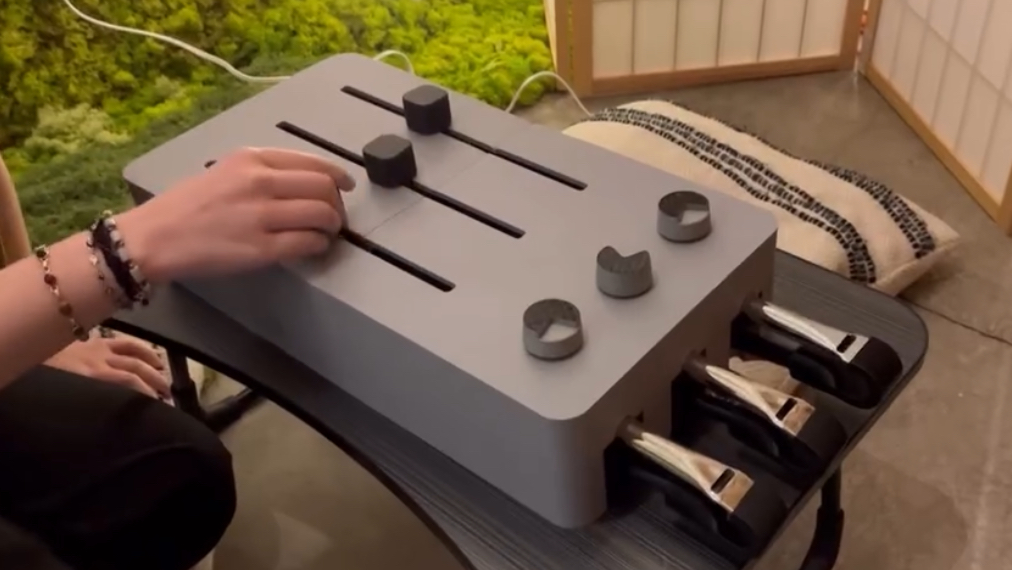
At first glance, the Pneumatone looks like the kind of synthesizer that would make a vintage gear collector whisper, “Don’t touch the sliders unless you know what you’re doing.” It has the visual language of an analog synth: knobs, sliders, a boxy 3D-printed shell, and the wonderful promise of weird sound. But then comes the twist. This “synth” does not rely on oscillators, filters, sample libraries, or a glowing little screen with menu diving. Its voice comes from air, slide whistles, and computer fans.
So, when is a synth a woodwind? When it behaves like a synthesizer on the outside but makes sound like an acoustic wind instrument on the inside. That is the delightful contradiction behind the Pneumatone, a handmade slide flute drone instrument associated with Chris from Sound Workshop. It is part musical instrument, part maker experiment, part comedy prop that accidentally went to music theory school and came back with a surprisingly elegant thesis.
The Pneumatone matters because it pokes at a question musicians and builders love to argue about: what actually defines an instrument? Is it the interface, the sound source, the playing technique, or the cultural context? With the Pneumatone, the answer is yes, yes, yes, and also, “Please pass the 3D printer filament.”
What Is the Pneumatone?
The Pneumatone is best described as an acoustic instrument dressed like a synthesizer. It uses three slide whistles or slide flutes as its sound-producing bodies. Instead of a player blowing into each whistle, small computer fans push air through the pipes. The player manipulates sliders to change pitch and uses controls that look like synth knobs to manage the airflow and volume.
In other words, it has a synthesizer-style interface but a woodwind-style acoustic engine. The sound is not generated electronically. The fans provide air, the whistles vibrate, and the moving slides change the length of the air column, producing smooth pitch sweeps and droning tones. It is charmingly simple, but that simplicity hides a clever design idea: electronic music performance gestures can be mapped onto acoustic sound production.
A Synth Interface With an Acoustic Heart
Most synthesizers begin with an electrical signal. A classic analog synth might use voltage-controlled oscillators. A modern digital synth might use samples, wavetable synthesis, physical modeling, or software instruments. The Pneumatone takes a different route. Its “oscillators” are physical whistles. Its “amplifier” is airflow. Its “pitch bend” is a slide. Its “drone mode” is what happens when the fans keep breathing for you.
This is why the instrument feels both futuristic and ancient. It borrows the control surface of a synthesizer, but it belongs to the same broad family of wind instruments that includes flutes, recorders, whistles, organ pipes, and reed instruments. It is not a normal synth, and that is exactly why it is interesting.
Is a Slide Whistle a Woodwind?
Yes, broadly speaking, a slide whistle fits within the woodwind world because it produces sound through air moving across an edge or through a whistle mechanism. Woodwinds are not defined only by being made of wood. Modern flutes are often metal, saxophones are made of brass, and recorders can be plastic, but they are still treated as woodwinds because of how they create sound.
A slide whistle changes pitch by moving a plunger or slide inside the tube. As the internal air column changes length, the pitch rises or falls. That smooth motion creates the familiar glissando effect many people associate with cartoons, comedy, and someone slipping on a banana peel in an orchestra pit.
The Pneumatone takes that comic little voice and gives it a new job. Instead of using a slide whistle for a quick joke, it uses multiple whistles for layered drones, slow pitch movement, and atmospheric textures. Suddenly, the class clown is wearing a black turtleneck and talking about resonance.
How the Pneumatone Works
The Pneumatone is built around three main ideas: airflow, pitch control, and continuous sound. Each of these comes from traditional wind instrument principles, but the presentation feels like a synth panel.
1. Airflow Comes From Fans
Instead of human breath, the Pneumatone uses computer fans to move air through its slide whistles. This is a clever choice because fans are inexpensive, easy to source, and familiar to makers. They provide a steady stream of air, which allows the instrument to sustain notes without requiring the player to breathe into it.
That changes the performance style. A clarinet or flute phrase is shaped by the musician’s lungs, embouchure, and breath control. The Pneumatone turns airflow into a mechanical parameter. The player can focus on pitch, volume, and texture while the fans do the breathing. It is like hiring three tiny robotic flutists who never complain about rehearsal length.
2. Pitch Comes From Sliding Tubes
The sliders on the case connect to the slides in the whistles. Moving a slider changes the pitch continuously instead of jumping between fixed notes. This gives the Pneumatone a fluid, voice-like character. It can glide, wobble, drift, and bend in ways that feel closer to a theremin, trombone, or modular synth pitch sweep than a traditional keyboard.
This is one reason the instrument works well as a drone machine. Drone music often depends on subtle changes over time. A fixed note can become hypnotic, but a note that slowly bends and beats against another note can become alive. With three slide whistles, the Pneumatone can create shifting intervals, mild dissonance, and slow-moving harmonic clouds.
3. Volume Comes From Air Control
The knobs that look like volume controls are tied to fan speed or airflow control. More air can create a stronger tone; less air can soften or destabilize the sound. Because whistles respond physically to air pressure, the tone may warble at certain settings or pitches. In a perfectly polished commercial instrument, that might be treated as a flaw. In the Pneumatone, it becomes character.
That little instability is part of the appeal. Acoustic instruments are full of tiny imperfections. Reeds squeak. Flutes crack. Bagpipes argue with the weather. The Pneumatone’s warble reminds the listener that this is not a sterile software patch. Air is actually moving through objects, and those objects have opinions.
Why It Feels Like a Synth
Calling the Pneumatone a synthesizer is technically debatable, and synth purists may already be adjusting their glasses. Strictly speaking, a synthesizer generates or processes sound through electronic circuits or digital systems. The Pneumatone does not synthesize sound electronically. It is acoustic.
But the reason people reach for the word “synth” is easy to understand. The interface looks like a synth. The playing experience resembles a control panel. The instrument can produce sustained tones, layered voices, pitch sweeps, and evolving textures. Those are all familiar behaviors in analog and modular synthesis.
It is more accurate to call the Pneumatone a synth-like acoustic drone instrument. That phrase is less catchy, but it keeps everyone’s blood pressure down. The magic is not that it proves slide whistles are secretly Moogs. The magic is that it makes us notice how much of “synth culture” comes from interaction design: knobs, sliders, modulation, continuous control, and the joy of shaping sound in real time.
Why It Also Feels Like a Woodwind
The Pneumatone belongs emotionally, acoustically, and mechanically to the world of wind instruments. It uses air to excite a resonating tube. Its pitch depends on the dimensions of that tube. Its tone responds to airflow. These are classic wind-instrument behaviors.
Woodwinds include flutes and reed pipes, but they are not limited to instruments made from wood. The family is based on sound production. A flute produces tone when air interacts with an edge. A reed instrument produces tone when a reed vibrates. A whistle uses a duct or fipple-like mechanism to direct air. The Pneumatone’s slide whistles therefore give it a real acoustic wind identity, even though the performer does not blow into it directly.
This makes the title question more than a joke. When is a synth a woodwind? When its user interface borrows from synthesis, but its voice comes from air columns and acoustic resonance.
The Drone Instrument Connection
One of the most interesting details about the Pneumatone is its relationship to drone music. Because the fans can stay on continuously, the instrument can sustain sound like a drone instrument. Drone instruments are found in many musical traditions. Bagpipes use continuous airflow from a bag. The hurdy-gurdy uses a wheel to bow strings. Indian instruments such as the tanpura and shruti box are associated with sustained tonal backgrounds that support melody, meditation, and harmonic focus.
The Pneumatone does not copy those instruments, but it shares a musical purpose with them. It creates a bed of sound. It invites slow listening. It rewards small changes. A tiny pitch adjustment can change the emotional color of the whole texture. That is a very different experience from playing a catchy melody on a keyboard. It is closer to tuning a room until the walls start humming back.
What Makers Can Learn From the Pneumatone
The Pneumatone is a great example of modern maker culture because it combines accessible parts with a strong concept. A 3D-printed case, slide whistles, computer fans, mechanical linkages, and airflow control are not exotic components. The innovation is in the arrangement.
This is an important lesson for DIY instrument builders. You do not always need rare materials or expensive electronics to create something fresh. Sometimes the best idea is hiding in a toy aisle, a parts bin, or the dusty corner of a music classroom. The trick is to change the context.
Repurposing Changes Perception
A slide whistle by itself is often treated as a novelty. Put three of them inside a synth-inspired case, give them independent controls, and suddenly they become a sound design tool. That transformation is not just visual. The new interface changes how the player thinks. Instead of “make a funny rising sound,” the musician starts asking, “What happens if I tune these three pipes into a slow beating chord?”
That is the heart of experimental instrument design. A familiar object becomes unfamiliar again. The Pneumatone makes the slide whistle respectable without removing its goofy charm. It is still a little ridiculous, but it is ridiculous in a productive way.
Limitations Can Become Features
The Pneumatone’s airflow path may create pitch warble at certain points. In a conventional design review, that might be marked as a problem. But in experimental music, unstable tone can be beautiful. Slight pitch movement adds life. Air noise adds texture. Mechanical response adds personality.
Many beloved instruments have quirks. Analog synths drift. Tape machines flutter. Old organs wheeze. Saxophones can growl. The Pneumatone’s quirks place it in that tradition of imperfect machines that sound human because they refuse to behave like spreadsheets.
Pneumatone vs. Electronic Wind Instruments
The Pneumatone also sits in conversation with electronic wind instruments, often called EWIs or wind controllers. Instruments from companies such as Akai, Roland, and Yamaha use breath sensors, fingering systems, MIDI, onboard sounds, or digital modeling to give wind players access to electronic tones. A Roland Aerophone, for example, can use breath and bite sensors to control digital sounds. A Yamaha digital saxophone can use breath pressure to shape tone and volume. Akai EWI models can act as expressive wind controllers for acoustic-style sounds and synth sounds.
The Pneumatone reverses that idea. Instead of using breath to control electronics, it uses electronics-adjacent hardware to control acoustic whistles. The fans are powered, but the sound itself is not a sample. It is not a modeled flute. It is a real vibrating air column. That makes the Pneumatone a cousin to electronic wind instruments, not a sibling. They meet at the family reunion, nod politely, and then argue about whether MIDI counts as a personality.
Why Musicians Should Care
Musicians should care about the Pneumatone because it expands the imagination. It reminds us that instruments are not fixed categories. A woodwind can look like a synth. A synth interface can control acoustic sound. A joke instrument can become a serious texture machine. A drone can be playful instead of solemn.
For composers, the Pneumatone suggests new approaches to scoring. Imagine it under a film scene that needs unease but not horror, warmth but not sweetness, motion but not rhythm. For ambient artists, it offers a tactile alternative to software pads. For music educators, it is a perfect conversation starter about acoustics, instrument classification, and design thinking. For makers, it is proof that a strange idea can be worth building just to hear what happens.
Experience Section: Living With the Idea of a Pneumatic Synth-Woodwind
Spending time with the concept of the Pneumatone changes how you listen to small sounds. A fan stops being just a cooling device. A whistle stops being just a toy. A slider stops being just a control. Everything becomes part of a possible instrument. That mindset is one of the best gifts experimental music gives us: it turns ordinary objects into invitations.
The first experience that comes to mind is the feeling of playing with pitch as a physical object. On a keyboard, notes are organized into neat little rectangles. Press C, get C. Press D, get D. Very polite. With a slide whistle, pitch is not a staircase; it is a ramp. You do not jump from note to note. You travel. That movement can be funny, but it can also be deeply expressive. A slow upward glide can feel like sunrise. A downward bend can feel like a sigh. A tiny wobble can feel like nervous energy.
Now imagine three of those pitch ramps running at once. That is where the Pneumatone becomes more than a clever gadget. With three voices, the player can create relationships between tones. Two pitches close together may create beating, that pulsing interference pattern that makes sound feel alive. A wider interval can feel open or tense depending on where it lands. Add a third tone, and the whole instrument becomes a breathing chord machine.
Another experience worth noticing is the difference between breath and mechanical air. When a person plays a flute or saxophone, every note carries the body inside it. Breath pressure, lip position, fatigue, confidence, and even mood can affect the tone. The Pneumatone removes the lungs and replaces them with fans, but it does not remove expression. Expression moves into the hands. The player shapes sound by adjusting airflow, pitch, and blocking or opening the path. It is less like singing through a tube and more like piloting a tiny weather system.
That can be surprisingly satisfying. Many electronic musicians already know the joy of slowly turning a knob and hearing a sound bloom. The Pneumatone gives that same pleasure, but with acoustic consequences. You are not changing a parameter in software; you are changing how air behaves. There is something grounding about that. It makes sound feel less abstract and more physical.
The Pneumatone also invites patience. It is not built for shredding solos at lightning speed. It wants slow gestures, sustained tones, and careful listening. That makes it useful for ambient music, meditation spaces, installation art, experimental performance, and anyone who thinks a single note can be interesting if you give it enough room to stretch. In a world full of instant presets, the Pneumatone says, “What if we just listened to three whistles breathe for a while?” Honestly, not the worst idea.
There is humor in it, too, and that matters. Experimental music sometimes takes itself so seriously that the room temperature drops ten degrees. The Pneumatone avoids that trap. It is playful from the start. It knows slide whistles are funny. It knows a synth powered by fan-blown whistles sounds like something invented during a very productive lunch break. But the humor opens the door rather than closing it. Once you laugh, you listen. Once you listen, you realize the instrument has more depth than expected.
For builders, the experience is equally inspiring. The Pneumatone shows that a prototype does not need to be perfect to be meaningful. A little warble, a rough airflow path, a chunky printed enclosure, and an unusual control scheme can still produce a memorable instrument. In fact, those rough edges may be the reason people remember it. Perfection is impressive, but personality is sticky.
Ultimately, the Pneumatone experience is about curiosity. It asks what happens when we stop treating instrument categories like locked boxes. It suggests that “synth,” “woodwind,” “drone,” “toy,” and “sound sculpture” can overlap. It encourages musicians to think with their hands and makers to think with their ears. Most of all, it proves that the line between silly and brilliant is sometimes just a slide whistle with a fan behind it.
Conclusion
The Pneumatone is not a conventional synthesizer, and that is its superpower. It is a woodwind-flavored, synth-shaped, fan-breathing drone instrument that turns slide whistles into an atmospheric sound machine. By combining acoustic air columns with a synthesizer-style interface, it challenges the way we classify instruments and reminds us that musical innovation does not always arrive in a glossy box with a premium price tag.
When is a synth a woodwind? When it looks like a control panel, breathes through fans, sings through slide whistles, and makes us rethink what an instrument can be. The Pneumatone may be quirky, but it is also a serious lesson in playful design. Sometimes the future of music sounds like the past, looks like a synth, and has just enough whistle-powered weirdness to make everyone lean closer.
Note: This article is written for web publication and synthesizes real information about Pneumatone-style DIY instruments, woodwind acoustics, slide whistles, drone instruments, and electronic wind controllers without inserting source links into the article body.