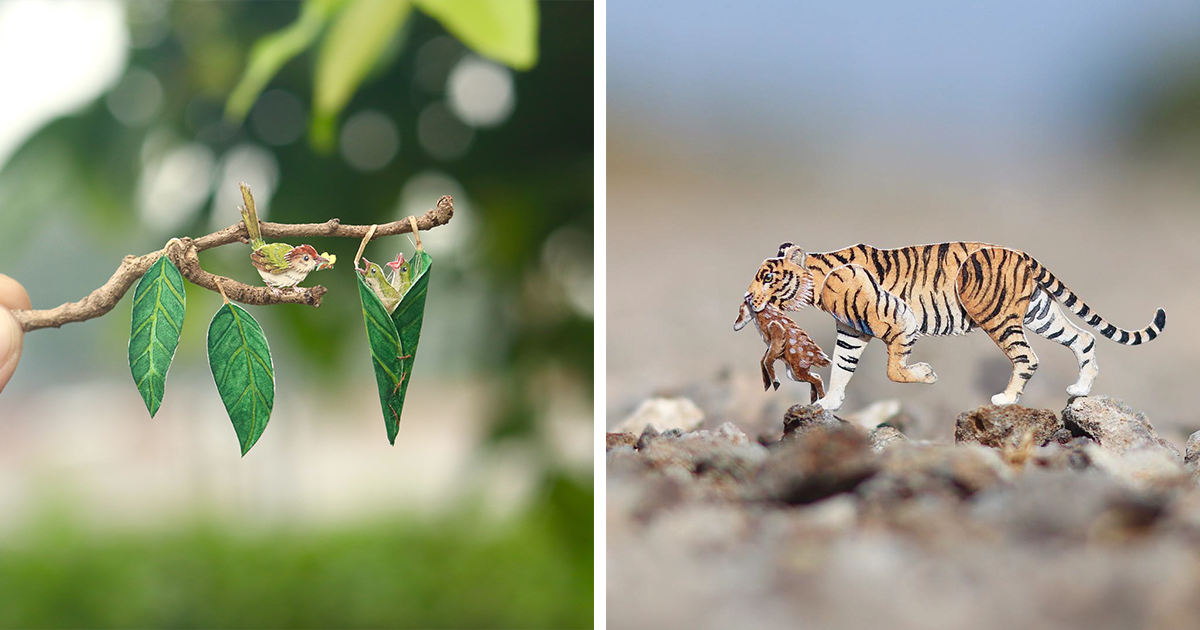
There is a special kind of quiet that happens when a tiny paper fox begins to look back at you from the cutting mat. It is not loud art. It does not arrive with a drumroll, a fog machine, or someone shouting, “Behold, the squirrel!” It begins with paper, a sketch, a blade, a stubborn amount of patience, and the deeply suspicious belief that a creature smaller than your palm deserves whiskers.
We make paper cut miniature animals, and one takes 4 to 6 hours to complete. That sentence sounds simple until you realize what those hours actually contain: drawing, refining, cutting, correcting, layering, shaping, gluing, waiting, trimming, panicking slightly, breathing again, and finally placing the last tiny ear where it belongs. A miniature animal may be small, but the work behind it is anything but.
Paper cut miniature animals sit at the charming crossroads of papercutting, paper sculpture, illustration, folk art, and modern handmade design. They are delicate, detailed, and occasionally dramatic. A single rabbit can demand more focus than a full inbox on Monday morning. A bird wing might require twenty separate feather shapes. A hedgehog, naturally, behaves like it has hired legal representation.
What Are Paper Cut Miniature Animals?
Paper cut miniature animals are small handcrafted animal artworks made by cutting, layering, folding, and assembling paper into detailed forms. Some are flat silhouettes. Others are layered relief pieces with shadow and depth. Some stand upright like tiny sculptures, while others live inside frames, shadow boxes, greeting cards, dioramas, or collectible displays.
The style can be realistic, whimsical, folk-inspired, cartoon-like, botanical, or somewhere between “nature journal” and “storybook creature that knows your secrets.” Common subjects include birds, cats, foxes, rabbits, butterflies, deer, owls, bears, whales, and tiny farm animals. The appeal is easy to understand: animals already carry personality, and paper gives them a light, poetic quality.
In handmade paper animal art, every detail matters. The curve of a tail can suggest movement. The angle of an ear can make a dog look curious instead of confused. A thin paper eyelid can turn a sleepy owl into a dignified philosopher. Because the scale is small, even a millimeter changes the mood.
Why One Miniature Animal Takes 4 To 6 Hours
People often ask, “Why does something so small take so long?” The honest answer is: because small does not mean simple. In miniature paper art, small usually means less room for error. A full-sized drawing lets you hide a wobbly line. A tiny paper animal does not. It notices everything. It judges silently.
The 4-to-6-hour process usually includes several stages. First comes the idea. We choose the animal, pose, expression, color palette, and final size. A sitting fox has a different structure from a leaping fox. A hummingbird needs motion. A turtle requires shell geometry. A cat requires emotional superiority.
Next comes sketching. This stage is where the animal becomes a design rather than just a cute thought. We simplify the body into shapes that can actually be cut from paper. Fur becomes layered strips. Feathers become narrow teardrops. Paws become tiny curved pieces. The goal is not to copy nature exactly, but to translate it into paper language.
Then comes cutting, the slowest and most meditative part. We use fine blades, small scissors, cutting mats, tweezers, and carefully chosen paper. The paper must be strong enough to hold detail but flexible enough to shape. Too thin, and it tears like it has received bad news. Too thick, and it refuses curves like a stubborn door hinge.
After cutting, each piece is shaped and layered. A miniature bird may need separate layers for body, wing, tail, belly, eye, beak, and highlights. A fox may need layered cheeks, chest fur, legs, paws, and the glorious tail that makes the whole creature look like it owns a woodland boutique.
Finally, everything is assembled. Glue must be applied with discipline. Too little glue and the piece falls apart. Too much glue and the animal looks like it survived a craft-store rainstorm. The final minutes are often spent adjusting tiny parts with tweezers, checking shadows, and making sure the miniature animal still feels alive.
The Art History Behind Paper Cutting
Paper cutting is not a new trend invented by someone with a ring light and a suspiciously clean desk. It has deep roots in global folk traditions, decorative arts, storytelling, and visual culture. Chinese paper cutting, for example, has long been connected with festivals, celebrations, weddings, childbirth, prayers, and symbolic designs. Many traditional works use red paper because the color carries meanings of luck, joy, and celebration in Chinese culture.
European papercutting traditions also influenced the way modern artists think about silhouettes and cut shapes. In the 19th century, cut-paper silhouettes became popular because the materials were accessible: paper, scissors, ink, and skill. A profile portrait could be created without expensive oil paints or a grand studio. That democratic spirit still lives in papercraft today. You do not need marble. You do need patience. Possibly snacks.
Artists such as Henri Matisse helped shift paper cutouts into modern art conversations. His late paper cut-outs, often described as “painting with scissors,” showed how color, shape, and composition could become bold, expressive, and elegant without traditional brushwork. Modern paper artists continue to expand the medium through layered installations, shadow work, paper sculpture, laser cutting, collage, and mixed-media experiments.
Miniature paper animals belong to this larger story. They may be tiny, but they inherit centuries of visual problem-solving: how to simplify a form, how to make flat paper feel alive, how to use negative space, how to turn a cut edge into a line of personality.
Materials That Make the Magic Work
Paper Choice
The first secret of paper cut miniature animals is that not all paper behaves the same. Paper comes in different weights, fibers, textures, colors, and finishes. Cotton papers feel different from wood-pulp papers. Smooth cardstock cuts differently from handmade textured paper. Metallic paper shines beautifully but may show every fingerprint like a tiny detective.
For miniature animals, we often choose papers that hold clean edges. Cardstock is useful for body structure. Thinner paper works well for fur, feathers, and small overlays. Handmade paper can add natural texture to animals such as sheep, owls, moths, or woodland creatures. Translucent paper can create delicate wings for butterflies, dragonflies, or fantasy-inspired animals.
Cutting Tools
Precision matters. A sharp craft blade, small detail scissors, a self-healing cutting mat, tweezers, and fine glue applicators are basic tools of the trade. Safety matters too. Blades should be handled carefully, stored properly, and used on a stable surface. Nothing ruins a peaceful craft session faster than chasing a runaway blade cap across the desk like a tiny plastic villain.
Adhesive and Assembly
Glue is the invisible architecture of miniature paper animals. We prefer adhesives that dry clear and do not warp the paper. A small amount is enough. The goal is to connect the layers without flattening the design. Foam dots or tiny spacers can add dimension, especially for framed pieces where shadows become part of the artwork.
How We Design a Miniature Paper Animal
Every animal begins with observation. Before cutting anything, we study the subject’s shape and personality. A fox is not just orange. It is angular, alert, fluffy, and theatrical. A rabbit is soft, rounded, nervous, and somehow always prepared to leave the scene. A whale is huge in real life, but in miniature paper form it becomes a calm, floating comma.
We ask several design questions: What is the animal doing? Sitting, jumping, sleeping, flying, stretching, or staring into the middle distance like it just remembered an embarrassing moment from 2014? What features make it recognizable? What parts can be simplified? Which details must stay?
Then we create a working sketch. The sketch is not always beautiful. Sometimes it looks like a potato with ears. That is fine. The sketch is a map, not the final destination. We refine the silhouette first because the outer shape must read clearly. If the silhouette is weak, no amount of tiny eyelashes will save it.
After the silhouette, we plan the layers. For a miniature owl, the base layer may be the body, followed by wings, chest feathers, face disks, eyes, beak, claws, and small highlights. For a deer, we may separate the body, legs, ears, antlers, nose, belly, and spots. Each piece must be possible to cut and strong enough to survive assembly.
The Beauty of Slow Craft
In a world where everything is fast, paper cut miniature animals are proudly slow. They do not care about your notifications. They do not respond well to rushing. The process asks the maker to sit down, pay attention, and accept that a single paw may take three attempts.
This slow pace is part of the value. Handmade paper art carries the time of the person who made it. You can see it in the tiny decisions: the slightly curved whisker, the layered feather, the carefully trimmed ear, the soft shadow under a wing. Unlike mass-produced decor, each piece has its own small irregularities. Those irregularities are not flaws. They are fingerprints of the process.
That is why one miniature animal can feel more personal than a large printed poster. It is not only an image of an animal. It is evidence of attention. Someone sat with this creature for hours, convincing paper to become fur, feathers, scales, or paws.
Popular Miniature Animals We Love Making
Paper Cut Foxes
Foxes are favorites because their shapes are instantly recognizable. Pointed ears, sharp noses, fluffy tails, and warm colors make them ideal for paper layering. A fox can look clever, sleepy, mischievous, or slightly offended, depending on the eye shape. The tail usually takes the most time because it needs volume without becoming bulky.
Paper Birds
Birds are perfect for miniature paper sculpture because feathers translate beautifully into layers. A tiny songbird may include separate wing feathers, tail feathers, belly shading, and a delicate beak. The challenge is balance. Too many feather pieces can make the bird look heavy. Too few can make it look like a flying bean.
Paper Rabbits
Rabbits rely on softness. Rounded shapes, gentle curves, and subtle layering help create that plush look. The ears are the stars of the show. A slight bend in one ear can make the rabbit feel curious and alive.
Paper Cats
Cats are surprisingly difficult because everyone knows what a cat looks like, and cats have opinions. The eyes, tail, and posture must be just right. A paper cat can look elegant, grumpy, playful, or like it is silently calculating the value of your houseplants.
Paper Sea Animals
Whales, turtles, fish, seahorses, and octopuses work beautifully in paper because their shapes are fluid. Layered blue and green papers can create water-like depth. Small white highlights can suggest movement, shine, and bubbles without overcrowding the design.
Why Miniature Paper Animals Make Meaningful Gifts
A handmade paper animal is more than a cute object. It can hold memory. A tiny paper dog can honor a beloved pet. A paper owl can celebrate a graduation. A whale can symbolize calm. A fox can say, “You are clever, charming, and possibly stealing snacks.”
Because the pieces are small, they fit easily into frames, cards, desk displays, nursery decor, gallery walls, and personal collections. They can be customized by species, color, pose, and mood. A miniature paper animal can be sweet without being generic, personal without being overly serious, and decorative without shouting at the furniture.
They also appeal to people who love sustainable-looking, low-waste, handmade aesthetics. While not every paper product is automatically eco-friendly, paper art often encourages mindful material use. Small offcuts can become leaves, whiskers, flowers, spots, or future experiments. In our workspace, even scraps develop ambition.
Care Tips for Paper Cut Miniature Animals
Paper is beautiful, but it is also sensitive. To keep miniature paper animals looking fresh, protect them from moisture, direct sunlight, dust, and rough handling. Framing them behind glass or acrylic can help preserve delicate edges. Shadow boxes are especially useful for layered paper art because they allow depth while protecting the piece.
Avoid placing paper art in bathrooms, kitchens, or sunny windows. Humidity can warp paper, and strong light can fade colors over time. If the piece is freestanding, display it somewhere stable where curious pets, enthusiastic toddlers, and chaotic elbows cannot launch it into a new career as confetti.
What Makes Handmade Paper Animal Art Special?
The charm of handmade paper animal art comes from contrast. Paper is ordinary, but the result feels extraordinary. The material is humble, but the finished creature can feel full of character. The scale is tiny, but the emotional impact can be surprisingly big.
There is also something magical about seeing a flat sheet become dimensional. A cut line becomes fur. A folded curve becomes a wing. A layered oval becomes a cheek. A dot becomes an eye, and suddenly the whole animal wakes up.
That transformation is the heart of papercraft. It reminds us that creativity does not always need expensive materials. Sometimes it needs the right shape, the right shadow, and the willingness to spend six hours making a paper raccoon look like it has plans.
Our Experience Making Paper Cut Miniature Animals
After making many paper cut miniature animals, we have learned that each creature has its own personality long before it is finished. Some designs behave politely. A small whale, for example, usually cooperates. Its body is smooth, its curves are generous, and it does not ask for individual eyelashes. A hedgehog, on the other hand, arrives with demands. Spines, tiny feet, round body, little nose, textured bellythe hedgehog is basically a paper engineering committee.
One of the biggest lessons is that preparation saves time, even though it feels slower at first. When we rush the sketch, the cutting stage becomes stressful. A poorly planned layer may be too thin, too fragile, or impossible to glue neatly. But when the sketch is clean and the layers are logical, the whole process feels smoother. The blade follows the design instead of arguing with it.
Color choice also changes everything. A fox made with three shades of orange looks warmer and more dimensional than one made with a single flat color. A blue bird becomes livelier when its wing includes navy, sky blue, gray, and a tiny white highlight. Even neutral animals benefit from variation. A paper rabbit may use cream, warm gray, pale pink, and soft brown to avoid looking flat.
We have also learned to respect drying time. It is tempting to keep touching the piece, adjusting the ear, pressing the tail, checking whether the wing is secure. This is usually when mistakes happen. Wet glue makes paper vulnerable. A tiny part can slide out of position, and suddenly the calm deer looks like it has been startled by jazz music. Patience during assembly is just as important as precision during cutting.
The most satisfying moment is adding the eye. Before the eye, the miniature animal is a collection of lovely shapes. After the eye, it becomes a character. A tiny black dot, a curved eyelid, or a white highlight can completely change the expression. That is the moment when we usually lean back and say, “There you are.” It sounds dramatic, but paper artists are allowed a little drama. We spend hours cutting toes.
Of course, not every piece works perfectly. Some animals fail. A squirrel may look too much like a potato. A horse may look like a nervous chair. A bird may develop a wing situation that no veterinarian can explain. But even failed pieces teach something. They show where the structure was weak, where the contrast was too low, or where the scale became too ambitious. In handmade work, mistakes are not wasted time. They are unpaid tutors.
Over time, we have become more comfortable with the natural limits of paper. Paper can bend, layer, shadow, and suggest texture, but it cannot do everything. Instead of fighting the material, we try to design with it. We let paper be paper. That means embracing clean shapes, visible layers, crisp edges, and slight imperfections. A handmade miniature animal should not look like plastic. It should look like paper transformed with care.
We also enjoy the quiet rhythm of the work. Cutting paper requires focus, but it is not cold or mechanical. It feels personal. There is a rhythm to turning the mat, guiding the blade, lifting a finished shape, and seeing the negative space left behind. The desk slowly fills with tiny parts: ears, tails, feathers, paws, spots, leaves, and mysterious scraps that look important but are probably not.
When a finished piece is placed in a frame or display box, those 4 to 6 hours become visible in a very gentle way. Viewers may not know every step, but they can feel the attention. They notice the layers, the shadows, the miniature details, and the humor tucked into the expression. That is why we keep making them. Paper cut miniature animals are small reminders that slow work still matters, details still delight people, and even a tiny paper fox can bring a surprising amount of joy.
Conclusion
Making paper cut miniature animals is a slow, detailed, and deeply rewarding craft. Each animal may take 4 to 6 hours, but those hours are filled with design choices, careful cutting, layered construction, and tiny moments of discovery. From historic papercutting traditions to modern paper sculpture, this art form proves that paper is far more powerful than it looks.
A miniature paper animal is not just a decoration. It is a little story made from edges, shadows, color, and patience. Whether it is a fox with a theatrical tail, a bird with layered feathers, or a rabbit with one curious ear, each piece carries the charm of handmade work. And honestly, in a world full of things made quickly, there is something wonderful about an object that proudly says, “Yes, I took six hours. I am worth it.”