For a while, Wordle owned the morning. Before coffee had fully negotiated peace with the human nervous system, millions of people were already staring at five blank boxes, testing suspicious littleAUDIO.” Then another breakfast-themed puzzle quietly slid onto the plate.
Its name is Waffle, and despite sounding like something that should arrive with butter and syrup, it is a clever daily word game built around letter swapping, vocabulary, and logic. Instead of guessing one hidden word, players rearrange a complete set of letters to create six connected words. The puzzle looks familiar enough to welcome Wordle fans, but the experience feels refreshingly different. Waffle does not merely ask, “What word am I thinking of?” It asks, “Can you untangle this entire mess without wasting your moves?”
That distinction explains why “Waffle is the new Wordle” has become such an appealing idea. Waffle preserves the daily ritual, colorful clues, compact design, and shareable satisfaction that made Wordle famous. However, it replaces uncertain guessing with a more deliberate form of puzzle solving. Wordle gives you a locked door and a few possible keys. Waffle dumps the lock, keys, hinges, and doorknob onto the floor and politely gives you 15 swaps to rebuild everything. 2>What Is the Waffle Word Game?
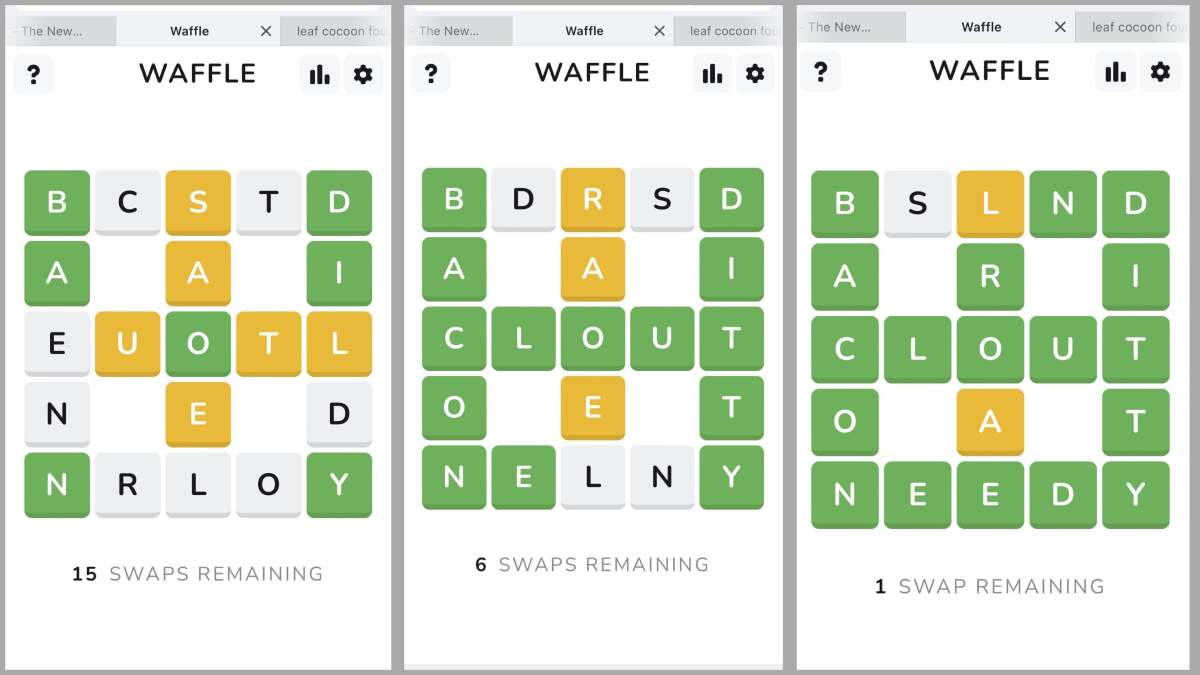
Waffle is a daily browser-based word puzzle created by software developer James Robinson. The board contains 21 letter tiles arranged in a waffle-shaped grid. Three five-letter words run horizontally, while three more run vertically. Every letter required to complete the puzzle is already on the board, but many tiles begin in the wrong locations.
The objective is to swap letters until all six words are correct. Players receive no more than 15 swaps, and each standard daily puzzle can theoretically be solved in 10. Finishing with unused swaps earns stars, giving careful players a reason to pursue efficiency rather than merely stumble across the solution. The official game also offers an archive, additional puzzle modes, word definitions, account-based stat syncing, and mobile versions. 3>How Waffle’s color clues work
Like Wordle, Waffle communicates through colored tiles. A green letter is already in its correct location. A yellow letter belongs in the same word but must move to a different position. Depending on where a tile sits, its clue may apply to the horizontal word, the vertical word, or both.
These intersections are where the game develops its personality. One letter can affect two words at once, so a move that appears brilliant from left to right may create alphabet soup from top to bottom. Waffle constantly encourages players to think beyond the word directly in front of them.
Why the 15-swap limit matters
Without a limit, players could drag letters around until everything eventually turned green. That would be less of a puzzle and more of an afternoon spent reorganizing a refrigerator. The move restriction forces every swap to have a purpose.
Robinson has explained that the mechanic emerged while he was looking for a word game that depended less on luck than Wordle. He experimented with giving players all the necessary letters, connecting several words in one grid, and limiting the number of swaps so the activity would remain strategic. The core format came together quickly and remains close to that original design. 2>Waffle vs. Wordle: What Is the Difference?
Wordle and Waffle share obvious visual DNA. Both are daily word puzzles featuring five-letter words, green and yellow feedback, simple interfaces, and results that can be discussed without revealing the solution. Waffle’s creator has openly acknowledged Wordle’s influence, particularly in its color system and minimalist presentation. >Nevertheless, their underlying challenges are quite different.
Wordle is about discovery
In Wordle, the answer begins completely hidden. Each guess is an experiment designed to reveal information. A strong opening word may test common vowels and consonants, but even a sensible strategy can be ambushed by repeated letters, unusual vocabulary, or a family of nearly identical possibilities.
The pleasure comes from reducing uncertainty. Players begin with thousands of theoretical options and gradually narrow the field. That combination of reasoning and chance helped Wordle become a global phenomenon. Its once-a-day structure, spoiler-free sharing grid, simple rules, and communal schedule made each puzzle feel both personal and social. 3>Waffle is about reconstruction
Waffle reveals all the raw material immediately. You do not need to invent guesses or wonder whether the missing answer contains a letter you have never tested. The correct letters are already sitting on the screen, occasionally looking smug about it.
Your task is to determine their proper arrangement. That turns Waffle into a constrained logic problem involving pattern recognition, vocabulary, tile movement, and planning. It feels partly like a crossword, partly like a sliding puzzle, and partly like trying to seat six argumentative relatives at one holiday table.
One answer versus six connected words
Wordle concentrates attention on a single five-letter answer. Waffle requires six. More importantly, the six words overlap, meaning progress in one direction changes the evidence available in another.
Solving a horizontal word can lock several letters into place and expose the structure of two or three vertical words. Conversely, committing too early to a plausible word may cause trouble throughout the grid. Waffle therefore rewards global thinking: the best move is not always the move that completes the most obvious word.
Why Waffle Feels Like the Natural Successor to Wordle
Calling Waffle “the new Wordle” does not mean Wordle has disappeared. Wordle remains enormously influential and continues to sit at the center of the daily puzzle boom. Its success encouraged publishers, independent developers, streaming companies, professional networks, and news platforms to experiment with short daily games. Waffle stands out because it borrows the best parts of that formula without simply adding more Wordle boards or changing the subject to geography, movies, or arithmetic. 3>It respects the player’s time
A Waffle puzzle usually fits into a coffee break, commute, or quiet moment before work. There is no lengthy tutorial, cinematic introduction, virtual currency shop, or animated wizard asking you to purchase 700 Sparkle Diamonds. You open the game and solve the board.
That restraint is a major advantage. Daily puzzles succeed when they become habits rather than obligations. Waffle offers enough challenge to feel meaningful but is compact enough to avoid taking control of the entire morning.
It provides clearer control over the outcome
Wordle occasionally produces a situation in which several words remain possible and only a limited number of guesses are available. Players may lose despite making reasonable decisions because they selected the wrong option from a group such as “CATCH,” “HATCH,” “MATCH,” “PATCH,” and “WATCH.” The dictionary has formed a gang, and your streak is its latest victim.
Waffle reduces that particular frustration. Since all required letters appear on the board and each puzzle has a single intended solution, success depends more heavily on how well players interpret and rearrange the available information. Researchers have even examined Waffle’s underlying permutations and demonstrated that its difficulty can be discussed in formal combinatorial terms. 3>Its scoring system creates a second challenge
Completing the board is satisfying, but finishing efficiently is even better. Because stars are awarded for remaining swaps, experienced players begin evaluating moves differently. A swap that turns one letter green may be less valuable than a swap that positions two misplaced letters correctly or prepares a chain of future corrections.
This transforms the game after the basic rules have been mastered. Beginners ask, “Can I solve today’s Waffle?” Regular players ask, “Can I solve it perfectly?” That additional layer gives the puzzle lasting appeal without making its interface more complicated.
How to Play Waffle More Effectively
Waffle is easy to understand, but consistently earning five stars requires discipline. The following strategies can improve results without turning the game into a spreadsheet-based military campaign.
1. Protect green tiles
A green tile is confirmed information. Avoid moving it unless you have discovered an exceptional reason to do so. Most of the time, disturbing a correct letter wastes a swap and creates new uncertainty.
2. Study intersections first
Letters located where horizontal and vertical words cross carry more information than letters serving only one word. Correctly identifying an intersection can clarify two answers simultaneously. Before making your first move, examine these high-value positions carefully.
3. Do not complete the first plausible word too quickly
A sequence may support several valid words. Confirm that your proposed answer works with the crossing letters and the remaining tile inventory. Waffle is very good at offering a word that looks perfect until you realize it has stolen the only “R” needed elsewhere.
4. Track duplicate letters
Repeated letters create some of the game’s most confusing situations. A yellow “E” may belong to the word but not to the location you initially expect. Count duplicates across the board and consider every possible destination before moving them.
5. Look for productive swaps
The ideal move improves two tiles at once. Suppose an “A” is sitting where an “O” belongs, and that “O” is currently occupying the correct destination for the “A.” Swapping them fixes both positions in one move. Search for these direct exchanges before using a tile as temporary storage.
6. Build a move sequence mentally
When several letters must rotate among three or more spaces, plan the entire sequence before dragging the first tile. Otherwise, you may place one letter correctly while trapping another behind it. Think of the board as a system rather than six independent vocabulary questions.
7. Use the final moves as a diagnostic tool
If only a few tiles remain incorrect, stop and reconsider the full grid. The problem may not be that you cannot see the final word. You may have placed a repeated letter into the wrong copy of that word. A brief pause often saves more swaps than frantic experimentation.
Why Daily Word Games Are So Hard to Put Down
Daily puzzles combine several powerful forms of motivation. They offer a clear objective, immediate feedback, a manageable challenge, and a recurring opportunity to improve. They also create shared experiences: everyone receives the same puzzle, but each person reaches the answer through a different path.
Wordle popularized the spoiler-free results grid, allowing players to compare their journeys without exposing the solution. Waffle builds on the same culture through stars, move counts, streaks, archives, and friendly competition. Its creator said Waffle reached roughly half a million players in a day in 2024 after growing largely through word of mouth, editorial coverage, and the viral habits of puzzle communities. >The daily limit also matters. Scarcity gives the puzzle a sense of occasion. When unlimited games are available, it is easy to play until the experience becomes mechanical. A daily puzzle arrives, provides a small mental victory or comic disaster, and leaves before wearing out its welcome.
Is Waffle Better Than Wordle?
That depends on what kind of challenge you enjoy.
Wordle may be better for players who enjoy vocabulary recall, probabilistic thinking, creative guesses, and the suspense of uncovering an unknown answer. Its simplicity remains difficult to improve upon: type a word, receive clues, and try again.
Waffle may be better for players who prefer logic, visible information, spatial relationships, and strategic planning. Because every required letter is provided, a loss feels less like unlucky guessing and more like a puzzle that deserves another look.
Many players will not need to choose. Wordle can remain the morning appetizer while Waffle becomes the main course. One tests how efficiently you can discover a hidden word. The other tests how elegantly you can organize six words that have been scrambled into linguistic hash browns.
My Experience Adding Waffle to a Daily Puzzle Routine
The first time I played Waffle, I made the classic beginner’s mistake: I treated every row as an isolated Wordle answer. I saw a nearly complete horizontal word, moved a letter into place, and enjoyed approximately two seconds of confidence. Then I noticed that the swap had turned a promising vertical word into something that looked like the name of an obscure Scandinavian appliance.
That early failure revealed what makes Waffle interesting. It is not simply six Wordle puzzles taped together. Every move has consequences across the board. I had to stop chasing instant green tiles and begin considering which letters served two words, where duplicates might belong, and whether a swap would improve the board as a whole.
After several puzzles, my approach changed. I began spending more time looking and less time dragging. Before the first swap, I would identify fixed letters, examine intersections, and sketch possible words mentally. This made the opening feel slower, but the full solve became much more efficient. It was the puzzle equivalent of reading assembly instructions before attaching the table legs backward.
The star system soon became surprisingly persuasive. At first, solving the board with no swaps remaining felt perfectly respectable. A completed waffle is still a completed waffle. But once I earned four stars, three stars began to look suspiciously like a personal insult. Then I completed a five-star puzzle, and the game quietly installed a new standard in my brain.
Chasing a perfect result changed how I evaluated moves. I stopped asking whether a swap was correct and started asking whether it was optimal. Could two letters be fixed together? Was I creating an unnecessary three-tile rotation? Could a yellow letter be moved directly into its final position rather than used as temporary storage? The vocabulary challenge remained, but efficiency became the real contest.
Waffle also produced a different emotional rhythm from Wordle. In Wordle, tension often increases with each unsuccessful guess. By row five, every keyboard tap feels like it should be approved by an attorney. Waffle feels more like untangling a knot. The board may initially look chaotic, but each correct move makes the overall structure easier to understand.
There were still moments of frustration. Repeated letters caused several avoidable mistakes, especially when the same vowel could logically occupy multiple positions. On difficult boards, I occasionally completed five words only to discover that the remaining letters could not form the sixth. That usually meant one of my “finished” words was a convincing imposter.
The archive proved useful because it allowed practice without the emotional drama of protecting a daily streak. Replaying older puzzles helped reveal recurring techniques: prioritize intersections, preserve confirmed tiles, avoid impulsive completions, and search for swaps that repair both letters. Improvement was visible not only in solved boards but in the number of moves remaining.
The social side was enjoyable too. Comparing Waffle scores feels slightly different from comparing Wordle guesses. A Wordle score suggests how quickly someone found the answer, but a Waffle star count also hints at how efficiently that person managed the board. When someone consistently earns five stars, admiration is appropriate, although investigating whether they have secretly merged with a crossword-solving supercomputer is also reasonable.
Most importantly, Waffle earned a place in the routine because it did not feel redundant. It delivered the same compact satisfaction as other daily word games while exercising a different style of thinking. Wordle wakes up vocabulary and deduction. Waffle activates planning, spatial logic, and the part of the brain that insists there must be a cleaner way to organize everything.
After enough mornings, the phrase “Waffle is the new Wordle” began to make sensenot because Waffle erased the older game, but because it captured the same magical balance of simplicity, challenge, and daily anticipation. It became another small appointment worth keeping, requiring only a few minutes and occasionally an apology to the letters I moved without thinking.
Conclusion: Waffle Deserves a Place in the Daily Puzzle Hall of Fame
Waffle succeeds because it understands what players loved about Wordle while refusing to be a lazy copy. It offers a familiar color language, a shared daily challenge, and a clean interface, then builds a distinctive game around swaps, intersections, connected words, and efficient planning.
The result is approachable enough for a first-time player but deep enough to reward repeated practice. Anyone can drag letters until a few tiles turn green. Consistently solving the entire board with five stars requires a sharper combination of vocabulary, restraint, and tactical thinking.
Wordle may always be the game that launched the modern daily puzzle craze, but Waffle is one of the strongest examples of where that craze went next. It is clever without becoming exhausting, competitive without becoming hostile, and satisfying without demanding half your day. It also proves that a waffle can be mentally nutritious, provided you do not pour syrup onto your phone.
Note: Game modes, mobile features, scoring tools, and account options may evolve over time. This article reflects publicly available information reviewed in July 2026.