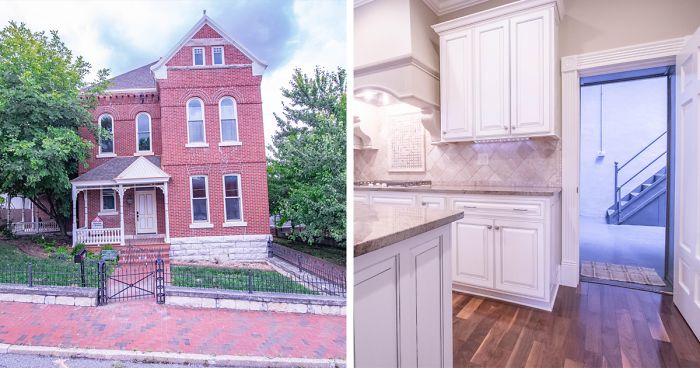
Some real estate listings promise a chef’s kitchen, a spa bathroom, or a backyard large enough for a golden retriever with boundary issues. The historic property at 203 East Morrison Street in Fayette, Missouri, offered something considerably harder to fit into a standard feature sheet: an attached jail with nine cells, a booking room, steel doors, and locking hardware that appeared to remain operational.
The listing exploded across social media in August 2020 because its photo gallery behaved like a well-plotted thriller. For nearly 30 images, viewers saw a handsome brick residence filled with polished wood, stained glass, traditional molding, fireplaces, and an updated kitchen. Then came the reveal. A door near the kitchen led into a dramatically different world of concrete, bars, institutional plumbing, and old correctional equipment. The asking price was $350,000, which made the package feel less like an ordinary home purchase and more like buying a period drama, an escape room, and a county archive in one transaction.
Although the headline describes it as the “latest” viral listing, the timeline matters. The property became an internet sensation in 2020, closed in December of that year, and is currently shown as off market by major real estate platforms. Its story remains fascinating because it captures everything the internet loves about unusual homes: a surprise hidden behind an innocent-looking door, a flood of renovation fantasies, and just enough unease to keep everyone scrolling.
A Beautiful Missouri Home With a Very Unusual Bonus Wing
The residential portion of the property was marketed as a 2,465-square-foot, two-bedroom home with one full bathroom and one half bathroom spread across three levels. Listing records described a major renovation completed in 2005, reportedly costing about $1.5 million. The work appeared to include new wiring, plumbing, zoned heating and cooling, and high-end interior finishes that respected the building’s older character.
That character was not subtle. Photographs showed hardwood floors, tall ceilings, substantial trim, stained-glass details, fireplaces, an antique-style clawfoot tub, and a kitchen equipped with modern counters and appliances. In other words, the house did not look abandoned, makeshift, or ready for a demolition crew. It looked comfortable, polished, and impressively civilizedright up until the kitchen tour took a sharp turn into county-lockup territory.
The Jail Was Not Just Decorative
Attached to the residence was an additional jail area of roughly 2,500 square feet. The original listing advertised nine cells, a booking room, another half bathroom, and cell-door lock mechanisms that appeared capable of operating. Reports sometimes described the jail as being in the basement, but the listing itself presented it as a connected jail structure, while separately noting a full basement beneath the residential portion. That distinction makes the property even stranger: this was not one spooky room added by an eccentric homeowner. It was a substantial institutional wing built to perform a public function.
“Functional,” however, should not be confused with “legally authorized.” Intact bars and working lock throws do not transform a private residence into a licensed detention center. The phrase referred to the preserved physical equipment, not permission for a future owner to start issuing matching jumpsuits to houseguests who overstay brunch.
The Sheriff’s House and Jail Had a Real Public Role
The viral listing identified the building as the former Howard County Sheriff’s House and Jail and gave its construction date as 1875. Some historic-preservation records place the present jail-and-residence building later, around 1889 to 1894, so the exact date attached to the structure is not completely consistent across records. What is clear is that the property served as a combined residence and correctional facility for generations.
For much of that era, the sheriff lived in the adjoining house and took direct responsibility for supervising, feeding, and caring for prisoners. Historical reporting says the jail held approximately 10 people, did not accept women, and remained in use until 2004, when a modern facility replaced it. The old complex also reportedly included gallows, although the sheriff’s historical account says there is no record of a hanging taking place there.
The History Deserves More Than Ghost Jokes
It is easy to reduce an old jail to a spooky backdrop. Social media practically demands jokes about ghosts, awkward Airbnb reviews, and whether the Wi-Fi password is “parole.” Yet a former jail is also a place where real people lost their freedom, sometimes under legal systems shaped by racial discrimination and unequal treatment.
Reporting on the Fayette property specifically emphasized that the building operated through the Jim Crow era and that Black residents were among the people confined there. That does not eliminate the home’s architectural interest or its potential for creative reuse. It does mean any future museum, lodging concept, tour, or entertainment venue should interpret the site honestly rather than turning human suffering into decorative atmosphere. A thoughtful owner would preserve the bars while also explaining what those bars meant.
Why the Listing Went Viral So Quickly
The house arrived at the perfect cultural moment. During 2020, millions of people were spending more time at home and using real estate websites as a form of digital tourism. They were not always shopping for a mortgage. They were shopping for distraction. Unusual-property accounts and social media communities turned strange listings into serialized entertainment, where every swipe promised another carpeted bathroom, indoor lagoon, secret tunnel, or design decision that required a committee investigation.
The Missouri jail house had three ingredients that almost guarantee online attention. First, it looked normal from the street. Second, the listing delayed the surprise until deep into the photo gallery. Third, the jail was authentic rather than themed. A fake dungeon is a decorating choice. Nine genuine cells attached to a refined Victorian-style residence are a narrative.
Coverage spread through real estate groups, major news outlets, lifestyle websites, and social platforms. People proposed using the cells for a haunted attraction, a film set, a role-playing venue, a museum, an escape room, or an unusually strict guest suite. The sellers had reportedly used the residence and jail together as a rental and at times as an Airbnb, while interested buyers discussed destination-lodging or business concepts. The property therefore generated something more valuable than ordinary clicks: it invited people to finish the story themselves.
What Could Someone Actually Do With Nine Jail Cells?
The listing’s promise that the “possibilities are amazing” was technically true, although the possibilities ranged from inspired to deeply questionable. The strongest concepts would preserve the building’s identity while giving visitors a reason to engage with it responsibly.
A Small History Museum
The most historically grounded option would be a museum or interpretive center focused on local law enforcement, incarceration, county government, and civil rights. Individual cells could hold exhibits, oral histories, archival photographs, and timelines. The booking room could explain how prisoners entered the facility, while the sheriff’s residence could show how public duty and private family life occupied the same address.
A Boutique Inn With Serious Storytelling
A heritage inn could use the renovated residence for comfortable lodging while opening the jail wing for scheduled tours, exhibits, or themed events. The key would be avoiding gimmicks that make light of incarceration. Guests may enjoy a mysterious setting, but most will also appreciate context, safety, clean bathrooms, and the ability to open every door from the inside.
A Film, Photography, or Theater Location
Authentic institutional spaces are difficult and expensive to reproduce. The property’s cells, corridors, metalwork, and booking area could attract independent filmmakers, commercial photographers, theater companies, or immersive-event producers. Unlike a temporary set, the building already carries texture that cannot be manufactured with a bucket of gray paint and three trips to a hardware store.
An Escape-Room or Mystery Experience
The internet immediately recognized the entertainment potential. An escape-room concept would be obvious, but it would require professional fire-safety systems, emergency release mechanisms, accessible routes, trained staff, and careful insurance planning. “The lock still works” is a fun listing detail. It is not an acceptable emergency-management strategy.
The Practical Challenges Behind the Viral Fantasy
Unusual historic properties often look inexpensive compared with the amount of building they offer. That can be misleading. A buyer is not only purchasing square footage; the buyer is taking responsibility for specialized masonry, aging steel, unusual mechanical systems, public curiosity, and spaces that may not fit ordinary residential codes or insurance policies.
Any commercial conversion would likely require zoning approval, occupancy permits, fire-code upgrades, accessible entrances, safe exits, and additional bathrooms. A historic designation or location inside a historic district may also affect exterior changes. Insurance providers could ask detailed questions about the locking systems, visitor access, events, and short-term rentals. Even ordinary maintenance becomes unusual when a repair call begins with, “The problem is in cell seven.”
Privacy would be another challenge. Once a home becomes famous online, curious visitors may treat the address like a roadside attraction. Owners of viral homes often inherit unofficial tour traffic, photo requests, and strangers who believe a widely shared listing is the same thing as an invitation. The buyer would need signs, cameras, landscaping, and very clear boundariespossibly the one category in which the property was already overqualified.
Experiencing the Missouri Jail House: What a Visit Might Feel Like
Imagine arriving in Fayette and seeing the property without knowing its secret. The brick exterior feels formal but approachable, the kind of historic building that suggests courthouse-square charm rather than true-crime television. You walk through rooms with warm wood floors, decorative glass, traditional trim, and enough architectural detail to slow your pace. The renovated kitchen feels especially reassuring. It is bright, useful, and familiarthe natural center of an old home adapted for modern life.
Then someone opens the door.
The emotional temperature changes before the physical temperature does. Domestic materials give way to painted metal, masonry, hard surfaces, and the visual repetition of bars. Sound behaves differently. Footsteps sharpen. Voices bounce. A steel door does not close with the polite click of a bedroom latch; it announces itself. Even when every cell is empty, the space feels occupied by its purpose.
That contrast is the property’s most powerful experience. The jail is not hidden miles away from the residence or separated by a secure courtyard. It is connected to the everyday machinery of a home. Meals would once have moved from a family kitchen toward prisoners. The sheriff could cross from private life into official authority in moments. A child, spouse, deputy, visitor, or incarcerated person may have heard the same doors from completely different sides.
For a modern visitor, the first response might be humor because humor creates distance. Someone will joke about placing a teenager’s gaming setup in a cell. Another person will suggest a wine cellar with exceptionally firm membership rules. A third will inspect the lock and immediately step backward. Those reactions are understandable, but they usually fade as the reality of the space settles in.
Living there would produce a similarly complicated experience. The residential rooms could feel elegant and comfortable, yet the attached jail would never become visually neutral. Owners would constantly decide whether to preserve, display, conceal, interpret, or repurpose it. Dinner guests would ask for tours. Contractors would bring coworkers just to look. Overnight visitors would pretend not to be nervous and then request the bedroom farthest from the cellblock.
Operating the property as lodging would magnify those tensions. Guests would arrive expecting novelty, but the best experience would offer more than novelty. A responsible host could provide a concise history of the building, explain the difference between preserved equipment and a working detention license, and establish strict rules against locking people inside cells. Tours could focus on architecture, county history, and the evolution of correctional practices. The goal would be to create curiosity without manufacturing disrespect.
The most memorable moment might come after leaving the jail wing and returning to the kitchen. The warm wood, household lighting, and ordinary appliances would suddenly feel different. The transition would make the building’s original arrangement understandable in a way that photographs cannot. This was not simply a house near a jail. It was a home structurally joined to a system of confinement.
That is why the listing continues to fascinate long after its viral moment. Plenty of homes have dramatic wallpaper or questionable carpet. Very few force visitors to think about comfort and custody, hospitality and authority, preservation and entertainmentall before reaching the dessert course.
Conclusion: More Than a Weird Real Estate Listing
The Missouri home with a functional jail became viral content because the reveal was irresistible. A polished historic residence suddenly opened into nine intact cells, a booking room, institutional fixtures, and a century of complicated history. Yet the property’s lasting appeal goes beyond shock value. It demonstrates how architecture can preserve social systems, how a photo gallery can become a story, and how the internet can transform an offbeat listing into a national conversation.
For the right owner, the Fayette property could support preservation, education, lodging, filmmaking, or carefully designed entertainment. For the wrong owner, it could become an expensive collection of code problems and uncomfortable jokes. Either way, it proves one enduring rule of online real estate: never assume the kitchen door leads to a pantry.
Note: This article synthesizes archival listing records, local historical material, and reporting from more than a dozen sources, including at least 10 U.S.-based real estate and news publications. The property went viral in August 2020 and later sold; major listing platforms currently show it as off market. The term “functional jail” refers to preserved cells and apparently operable locking hardware, not legal authority to detain anyone.