A small jet engine model may sound like the kind of thing a student casually mentions five minutes before a lab supervisor reaches for the emergency clipboard. But when done as a serious engineering project, it becomes something much better than a noisy desk toy. It becomes a living classroom: part aerospace lesson, part 3D printing experiment, part electronics challenge, part teamwork boot camp, and part “please label every tiny component before someone loses it forever.”
The story behind a student-built miniature jet engine model is not simply about making something that looks cool, although, let’s be honest, it looks extremely cool. It is about students learning how modern propulsion systems work by transforming textbook diagrams into a physical, measurable, testable machine. A real jet engine is one of the most demanding inventions humans have ever packed into a metal tube. It manages airflow, compression, combustion, heat, rotation, vibration, materials, sensors, and control systems at the same time. A model version strips away some of the danger and complexity while keeping the central engineering lesson: every part affects every other part.
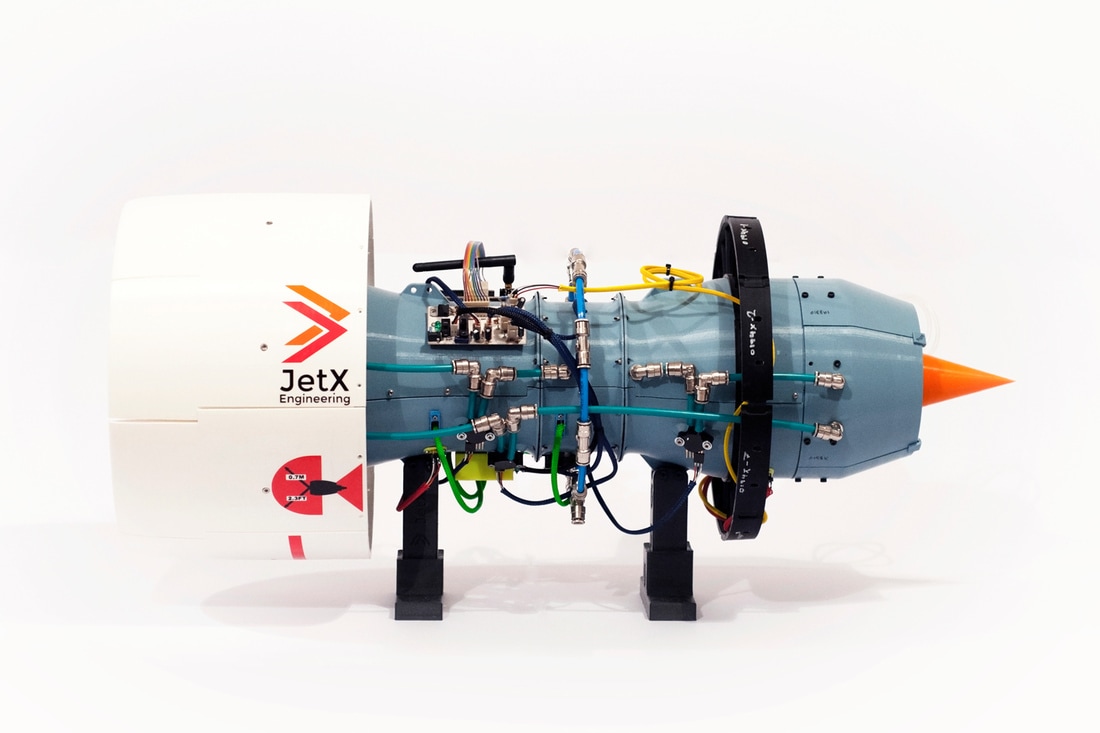
One well-known example is the X-Plorer 1 project from JetX Engineering, a student group associated with the University of Glasgow. The team designed and assembled a detailed 3D-printed model of a high-bypass turbofan-style engine, complete with moving parts and an integrated monitoring system. While the model did not use actual combustion, it used external compressed air to demonstrate airflow, rotation, sensing, and engine behavior. That distinction matters. It was not a fuel-burning turbine, and it was not trying to be one. It was a sophisticated educational model that allowed students to study design, data, and mechanical systems without turning the workshop into a scene from an action movie.
Why a Small Jet Engine Model Captures Big Engineering Ideas
The magic of a small jet engine model is that it makes invisible physics visible. In a full-size aircraft engine, air enters the inlet, passes through compressor stages, mixes with fuel in the combustion section, expands through turbine stages, and exits through the nozzle to produce thrust. That process is fast, hot, loud, and expensive. In a classroom-friendly model, students can slow down the story. They can see the fan blades, examine the casing, observe how airflow changes through the engine, and connect measurements to the theory they previously met in thermodynamics class, where equations sometimes arrive dressed as emotional damage.
NASA educational materials on propulsion often explain thrust through Newton’s third law: air is accelerated in one direction, and the engine experiences a reaction force in the opposite direction. The Federal Aviation Administration describes turbine engines as systems built around intake, compression, combustion, turbine extraction, and exhaust. For students, those ideas become much easier to understand when they can point to a compressor section, follow the path of air, and watch a sensor respond in real time.
A good model engine is not merely a display object. It is a bridge between theory and practice. Students must ask practical questions: Will this blade geometry move enough air? Can the printed part survive repeated testing? How will the shaft stay aligned? Where should sensors be mounted? What data is useful and what is just numerical confetti? Those questions are exactly what engineers face in industry, only with larger budgets, tighter regulations, and fewer excuses involving missing hex keys.
The X-Plorer 1: A Student Project With Professional Habits
The X-Plorer 1 project stands out because it treated a student-built jet engine model like a real aerospace development program. Public descriptions of the project show that the team began with requirements, moved into computer-aided design, performed analysis, manufactured parts through 3D printing, integrated electronics, and used sensor data to refine the system. That is not “we printed a cool fan.” That is the engineering design cycle wearing a flight jacket.
The model reportedly included hundreds of components, including more than 260 3D-printed parts, and used common plastics such as PLA and ABS for many structures. The team also developed a custom monitoring system that could collect and display key performance data. Depending on the project stage and public report, the system included sensors for temperature, pressure, rotational speed, and other performance indicators. Wireless communication and in-house software helped turn the model from a static object into a data-producing test platform.
One of the smartest decisions was also one of the most realistic: the model avoided actual combustion. Plastic parts and real jet-engine temperatures are not friends. They are not even polite acquaintances. Instead of burning fuel, the model used compressed air to drive internal motion and demonstrate engine behavior. That allowed the student team to focus on airflow, mechanical design, instrumentation, and iteration while staying within the limits of available materials and student-project resources.
3D Printing: From Prototype Playground to Aerospace Tool
Additive manufacturing has become a serious technology in aerospace, not just a hobbyist miracle that turns filament into tiny boats and emergency phone stands. Companies such as GE Aerospace have used additive manufacturing for production engine components, including fuel nozzle tips for LEAP engines. NASA has also tested 3D-printed rocket engine components and has long explored how additive manufacturing can reduce part counts, speed up prototyping, and enable complex geometries.
For students, 3D printing offers a powerful advantage: fast iteration. A compressor blade, casing, bracket, or duct can be modeled, printed, checked, revised, and printed again. That does not mean 3D printing magically solves engineering problems. In fact, it introduces new ones. Printed parts have layer lines, tolerance limits, surface finish issues, anisotropic strength, warping risk, and material constraints. The printer may produce a part that looks correct but behaves like it has made other plans.
That is precisely why 3D printing is such a valuable teaching tool. Students learn that manufacturing is not the final step after design; manufacturing is part of the design. A part that cannot be printed reliably is not a finished design. A part that fits only after persuasive sanding and emotional negotiation needs revision. A model jet engine teaches this lesson beautifully because it contains many interdependent shapes: ducts, blades, supports, shafts, housings, mounts, and sensor placements.
What Students Learn From a Miniature Jet Engine
1. Systems Thinking
A small jet engine model forces students to think in systems. The compressor team cannot work in isolation from the turbine team. The electronics team needs mounting points, wiring paths, and thermal awareness. The exhaust geometry affects flow behavior. The shaft alignment affects rotational performance. The outer casing affects assembly and serviceability. In other words, no component gets to be a lonely genius.
This is one of the most valuable lessons in engineering education. Real machines are networks of compromises. A beautiful part that breaks the assembly process is not beautiful for long. A sensor placed in the “perfect” measurement location is not useful if nobody can reach it, wire it, calibrate it, or prevent it from being eaten by vibration.
2. Data-Driven Design
The best student projects do not stop at “it spins.” Spinning is nice. Ceiling fans spin. The stronger question is: what does the data say? By adding pressure sensors, speed measurement, temperature readings, and software dashboards, students can compare predictions with actual test results. That comparison is where learning gets interesting.
A model may reveal unexpected flow losses, mechanical drag, sensor noise, vibration issues, or assembly misalignment. These discoveries can be annoying, but they are also the entire point. Engineering is not proving that the first idea was perfect. Engineering is finding out why the first idea was not perfect and improving it without dramatically blaming the laws of physics.
3. Thermodynamics Without the Snooze Button
Thermodynamics can be difficult because it often describes things students cannot directly see: pressure ratios, temperature changes, energy transfer, efficiency, and flow behavior. A miniature jet engine model gives those abstract concepts a physical home. Even without combustion, students can observe how airflow is guided, how rotating components interact with that flow, and how measurement points reveal pressure or speed changes.
In full gas turbine education, students study the Brayton cycle, compressor work, turbine work, nozzle behavior, and efficiency limits. A classroom model cannot reproduce every hot-section condition, but it can make the architecture understandable. It helps students see why compressors require careful blade geometry, why turbines must extract energy efficiently, and why nozzles are not just fancy exhaust holes.
4. Project Management
A student team building a small jet engine model quickly discovers that engineering is also about meetings, deadlines, documentation, budgets, sponsors, and responsibility. The glamorous part is the engine. The unglamorous part is version control, procurement, test planning, risk assessment, and asking where the missing bearing went. Spoiler: it is under the workbench, exactly where everyone already looked.
JetX Engineering’s project received attention not only because the model was impressive, but because the team operated with structure. They divided work into specialist groups, coordinated design decisions, developed electronics alongside mechanical systems, and presented the result clearly. Those skills are difficult to test on a traditional exam, yet they are essential in real aerospace programs.
Why the Model Did Not Need Combustion to Be Impressive
Some people hear “jet engine model” and immediately ask whether it burns fuel. That is understandable, but it misses the educational value. A fuel-burning microturbine is a serious machine with high rotational speeds, extreme temperatures, dangerous exhaust, fuel handling concerns, and strict safety requirements. It is not a casual garage experiment. For student learning, a non-combustion model can be far more appropriate.
By using compressed air, the students could demonstrate airflow and moving systems while avoiding the risks and costs of a true hot-section engine. This choice also allowed the use of plastic printed parts, which are excellent for prototyping but unsuitable for high-temperature turbine operation. In other words, the model was honest about its purpose. It was not pretending to replace a certified turbine. It was built to educate, measure, and inspire.
That honesty is important. Engineering is not about making the most explosive version of an idea. It is about matching design decisions to objectives, constraints, safety, cost, and available resources. If the objective is to teach propulsion architecture, sensor integration, and iterative design, a carefully instrumented compressed-air model can be a smarter tool than a dangerous mini engine trying to roast itself into fame.
The Role of Sensors and Software
Modern aerospace engineering is inseparable from data. Engines are not simply mechanical devices; they are monitored, controlled, diagnosed, and optimized through electronics and software. Even small educational models benefit from the same mindset. A sensor system turns a model into a testbed.
For a student jet engine model, sensors can help monitor rotational speed, airflow-related pressure changes, temperature conditions, and system response during testing. Software can log results, display live readings, compare test runs, and support design decisions. This introduces students to a practical truth: collecting data is easy compared with collecting useful data.
Bad data can be worse than no data because it arrives wearing a lab coat and pretending to be trustworthy. Students must learn calibration, sensor placement, signal noise, sampling rates, and interpretation. They also learn to ask whether a surprising result is a discovery, a loose wire, a software bug, or someone bumping the table at the exact wrong moment.
Small Jet Engine Models and the Future of Aerospace Education
Aerospace education is evolving. Students still need equations, but they also need hands-on experience with design tools, simulation, additive manufacturing, embedded systems, testing, and teamwork. Organizations such as NASA offer aeronautics STEM resources that encourage design thinking, testing, and iteration. Universities such as Purdue and MIT continue to emphasize propulsion research and laboratory learning because engines are not understood deeply by reading about them once and nodding bravely.
A small jet engine model fits perfectly into this future. It can serve as a capstone project, a club challenge, a demonstration tool, or a recruiting magnet for younger students. Few things attract attention at an engineering showcase like a transparent or 3D-printed engine with moving components and live data on a screen. It says, “Engineering is not just homework. Engineering moves.”
These projects also help students discover career paths. One student may fall in love with turbomachinery. Another may discover embedded systems. Another may realize that project management is where they shine. Someone else may learn that they have a gift for technical communication, which is the underrated superpower that prevents brilliant projects from being misunderstood as expensive desk sculptures.
Challenges Students Face When Building a Jet Engine Model
Material Limits
Plastic is wonderful until heat enters the conversation. PLA and ABS are useful for visual and mechanical prototypes, but they cannot perform like aerospace alloys in hot engine sections. Students must understand material properties, operating conditions, and safety margins. A model designed for compressed air has different requirements from a combustion engine, and confusing the two is a fast way to create a very dramatic failure report.
Manufacturing Tolerances
Rotating machinery does not forgive sloppy geometry. Small alignment errors can cause rubbing, vibration, drag, or inconsistent performance. 3D printers can produce complex shapes, but every printer has limits. Students learn to account for shrinkage, surface finish, support removal, assembly clearance, and part repeatability. The lesson is simple: CAD is optimistic; reality has calipers.
Team Coordination
Large student projects can become chaotic if nobody owns the interface between teams. The compressor section must connect properly to the casing. Electronics must fit within the physical design. The test plan must match what the hardware can safely do. Documentation must be readable by someone who did not attend every meeting. Good coordination turns a pile of clever parts into a functioning system.
Testing Discipline
Testing is not just turning the model on and hoping it behaves while everyone records vertical phone video. Responsible testing requires a plan: what variable is being studied, what data will be collected, what conditions are allowed, what safety boundaries exist, and what result counts as success. That discipline is what separates engineering from “let’s see what happens,” the official motto of many broken prototypes.
Real-World Examples That Make the Project Meaningful
Student jet engine models become more powerful when placed in the broader context of aerospace innovation. Additive manufacturing is already used in aviation and space applications. Engine companies use simulation and test data to refine performance. Universities research gas turbine efficiency, high-speed rotating machinery, combustion stability, and advanced propulsion architectures. NASA and FAA educational materials help define the fundamentals of propulsion and aircraft systems.
The student model is not a toy version of this world; it is an entry point into it. When students print a duct, mount a sensor, study airflow, or revise a blade, they are practicing the habits of professional engineers. The scale is smaller, the budget is friendlier, and the coffee is probably worse, but the mindset is real.
Experience Section: Lessons From Working Around Student Jet Engine Projects
Anyone who has spent time around ambitious student engineering projects knows the pattern. At first, the idea sounds simple. “Let’s build a small jet engine model,” someone says, with the confidence of a person who has not yet met procurement delays. Everyone smiles. A whiteboard appears. Within an hour, the project has teams, subteams, diagrams, deadlines, and at least one person Googling whether a certain part can arrive before the semester ends.
The first major lesson is that enthusiasm is fuel, but structure is the engine. Student teams often begin with enormous energy. That energy is valuable, but without documentation, roles, version control, and test plans, it burns off quickly. The best teams create a rhythm. They track design changes. They define interfaces between subsystems. They record why decisions were made. They make it possible for a new member to join without needing an archaeological expedition through old chat messages.
The second lesson is that prototypes are honest. A computer model may look smooth, balanced, and heroic, but a physical prototype will immediately reveal where assumptions went on vacation. A printed casing may not close cleanly. A shaft may bind. A sensor wire may interfere with a rotating part. A beautiful component may take 20 hours to print and fail because one thin wall was designed with more hope than strength. None of these moments are failures if the team learns from them. In fact, they are the tuition fee of real engineering.
The third lesson is that students often underestimate the value of testing small. Before assembling the entire model, smart teams test individual parts and subsystems. Does the fan rotate freely? Does the sensor report stable values? Does the software log data correctly? Does the casing tolerate repeated assembly? Small tests prevent giant mysteries. They also protect morale, because debugging one subsystem is much less painful than staring at a fully assembled machine that refuses to cooperate and seems personally offended.
The fourth lesson is that communication can make or break the project. A student who can explain compressor behavior to the electronics team is valuable. A student who can translate sensor data into design recommendations is valuable. A student who can present the project to sponsors, faculty, younger students, or judges is extremely valuable. Technical skill builds the machine; communication builds the support system around the machine.
The fifth lesson is safety. Even when a model does not use combustion, rotating parts, compressed air, tools, printers, and electrical systems require respect. Responsible teams create safe test procedures, define operating limits, supervise demonstrations, and avoid turning curiosity into unnecessary risk. The goal is to inspire future aerospace engineers, not to create a campus legend involving a fan blade and a very disappointed lab manager.
Finally, the best experience from projects like this is watching students grow into engineers. At the beginning, many are focused on the object: the engine, the blades, the printed parts, the display screen. By the end, they understand the process. They learn that engineering is asking better questions, making trade-offs, building evidence, accepting constraints, and improving the design one test at a time. A small jet engine model may fit on a table, but the lessons can follow students into aerospace careers, robotics labs, energy research, manufacturing roles, and leadership positions.
Conclusion: Small Engine, Big Mindset
A small jet engine model from students who think big is more than a clever project. It is a compact demonstration of what modern engineering education should be: hands-on, data-driven, collaborative, safe, creative, and connected to real industry practices. Projects like the X-Plorer 1 show that students can move beyond classroom theory and build sophisticated models that teach propulsion, manufacturing, electronics, software, project management, and communication at the same time.
The model does not need to burn fuel to matter. Its real power is educational. It turns airflow into understanding, sensors into insight, and 3D-printed parts into a working example of the engineering design process. It reminds us that the future of aerospace is not built only in giant factories or government labs. Sometimes it begins with a student team, a bold idea, a printer humming late into the night, and the shared belief that even a small engine can carry big ambitions.
Note: This article discusses small jet engine models as educational and engineering design projects. It is not a step-by-step guide for building or operating a fuel-burning turbine. Any powered propulsion experiment should be handled only in properly supervised, compliant, and safety-controlled environments.