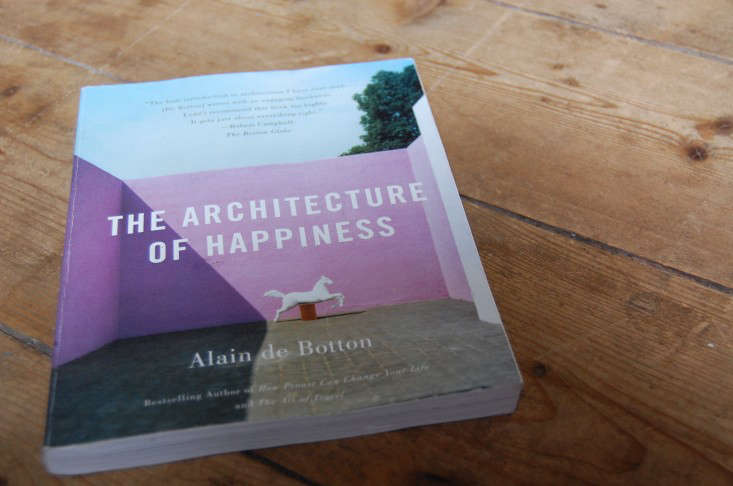
A building does not have to leak, wobble, or contain a mysteriously placed bathroom to make us unhappy. Sometimes it merely needs the wrong light, an unfriendly entrance, or a room arranged with all the warmth of an airport security line. In The Architecture of Happiness, Alain de Botton asks us to take these reactions seriously.
Published in 2006 and richly illustrated with photographs, paintings, and architectural examples, the book explores how homes, streets, furniture, and public buildings influence our emotions and identities. Its central argument is simple but surprisingly powerful: where we live affects who we are able to be.
This is not a decorating manual, and de Botton will not tell you which throw pillow completes your spiritual journey. Instead, he combines philosophy, psychology, architectural history, and social observation to investigate why certain places make us feel composed, hopeful, or at home. For anyone interested in architecture and happiness, environmental psychology, interior design, or the emotional meaning of place, it remains required reading.
What Is The Architecture of Happiness About?
De Botton begins with an experience most people recognize but rarely analyze. We enter one room and immediately relax. Another makes us restless, although nothing appears obviously wrong. A sunny kitchen can suggest that life is manageable; a gloomy hotel corridor can make an ordinary business trip feel like the opening scene of a detective movie.
The book argues that architecture is never merely shelter. Buildings communicate through materials, proportions, colors, shapes, scale, and historical associations. A stone façade may appear dignified. A glass pavilion may suggest openness and optimism. A low ceiling can feel protective in one setting and oppressive in another.
These interpretations are not completely universal. Culture, memory, class, climate, and personal experience all influence architectural taste. Nevertheless, de Botton believes buildings possess recognizable personalities. We respond to them much as we respond to people: some seem generous, others arrogant, awkward, disciplined, playful, or painfully desperate to impress.
Buildings as Guardians of Identity
One of the book’s most memorable ideas is that a home can act as a guardian of identity. People are not perfectly consistent creatures. We become impatient, distracted, discouraged, and occasionally defeated by a drawer that refuses to close. Our surroundings can remind us of the qualities we want to preserve.
A calm, orderly room may reinforce our desire for clarity. A handcrafted table can express respect for patience and skill. Family photographs, worn books, inherited objects, and familiar colors can reconnect us with memories that daily routines push into the background.
In this sense, the ideal home does more than represent its occupants. It supports a preferred version of them. Good residential architecture does not guarantee virtue, but it can quietly encourage reflection, hospitality, concentration, or rest.
Why Architectural Style Is Never Just About Style
One section of The Architecture of Happiness examines a question that has troubled designers for centuries: in what style should we build? Classical columns, Gothic arches, Arts and Crafts simplicity, industrial Modernism, and concrete Brutalism have each carried different promises.
Architectural movements often emerge as reactions to whatever society believes has gone wrong. The Arts and Crafts movement valued workmanship and natural materials partly because industrial mass production appeared to be separating makers from meaningful labor. Modernist architects rejected decorative historical imitation and embraced engineering, clean geometry, concrete, steel, and glass.
Le Corbusier famously described the house as a machine for living in, although his ambitions extended beyond mechanical efficiency to poetry, harmony, and beauty. Yet the history of Modernism also demonstrates that technical rationality does not automatically produce emotional comfort. A building may function impressively on paper while leaving its occupants longing for ornament, familiarity, privacy, or a front door that does not resemble a loading dock.
We Often Admire What We Lack
De Botton proposes that taste can be compensatory. We are drawn to buildings that embody qualities missing from our lives. Someone surrounded by disorder may crave strict symmetry and uncluttered surfaces. A person constrained by rigid routines may prefer organic shapes, vivid colors, and playful decoration.
This helps explain why architectural styles rise and fall. A society overwhelmed by complexity may praise simplicity. One bored by uniformity may rediscover ornament. Taste is therefore not simply a contest between informed and uninformed people. It can be a record of psychological need.
The idea also offers a useful defense against design snobbery. Instead of asking whether someone’s taste is correct, we might ask what emotional promise that taste contains. The plastic garden gnome may not win an architectural award, but it could be doing serious psychological work.
The Five Virtues of Beautiful Buildings
De Botton’s most practical discussion identifies five broad architectural virtues: order, balance, elegance, coherence, and self-knowledge. They are not a guaranteed recipe for beauty. Architecture has resisted guaranteed recipes with almost comic determination. They are better understood as tools for examining why a building feels satisfying.
1. Order Without Monotony
Order gives the eye a structure it can understand. Repeated windows, aligned cornices, and consistent proportions can make a street feel calm and cooperative. The Royal Crescent in Bath is a powerful example: individual homes participate in one sweeping composition, producing civic harmony through disciplined repetition.
Too much order, however, becomes lifeless. The most successful architecture balances repetition with detail and variation. Venice’s Doge’s Palace, for example, combines a clear façade pattern with enough intricate visual activity to sustain attention. Beauty frequently lives between chaos and boredomtwo roommates no one wants but everyone eventually encounters.
2. Balance Between Opposites
Balanced architecture reconciles contrasting qualities rather than eliminating them. It can feel strong and delicate, modern and historical, open and private, formal and welcoming. At the Yale Center for British Art, Louis Kahn’s use of concrete, steel, wood, and carefully controlled light demonstrates how industrial and natural materials can coexist without appearing to argue across the room.
This balance resembles emotional maturity. A compelling building, like a compelling person, may contain contradictions while maintaining an intelligible character.
3. Elegance That Conceals Effort
Elegance occurs when difficult work appears graceful. De Botton illustrates this idea through structures such as Robert Maillart’s Salginatobel Bridge, whose slender concrete arch crosses a Swiss ravine with extraordinary visual lightness.
The bridge is impressive because it performs a demanding engineering task without looking bulky or anxious. Architectural elegance does not mean avoiding complexity. It means resolving complexity so well that the result appears inevitable.
4. Coherence and a Sense of Belonging
Coherence describes a meaningful relationship among a building’s parts and between the building and its setting. Materials, windows, doors, landscaping, and neighboring structures need not match, but they should appear to participate in the same conversation.
De Botton contrasts authentic relationships with architectural imitation stripped of context. A Japanese theme park reproducing a historical Dutch town may be technically detailed yet emotionally strange. The buildings borrow recognizable forms, but their location, purpose, and history do not align with the story those forms originally told.
5. Self-Knowledge
Self-knowledge may be the most important and difficult architectural virtue. A successful building must understand what its occupants actually need rather than what a designer, client, or advertising campaign wishes they needed.
A dramatic open-plan home may photograph beautifully while making privacy nearly impossible. Floor-to-ceiling windows can symbolize freedom until residents begin living behind permanently closed curtains. A pristine white kitchen may represent discipline, unless its owner has three children, two dogs, and an adversarial relationship with tomato sauce.
Design improves when people distinguish between an admired image and a livable environment. The right space accommodates human habits rather than requiring its occupants to behave like unusually tidy museum exhibits.
Where Philosophy Meets Environmental Psychology
De Botton writes as a philosopher and essayist, not as an experimental psychologist. Even so, contemporary research supports the broader claim that the built environment can influence well-being.
Studies of homes, offices, neighborhoods, and health-care facilities have associated daylight, acoustic comfort, ventilation, privacy, access to nature, and a sense of environmental control with better psychological or physical outcomes. Natural views may help reduce mental fatigue, while excessive noise, crowding, poor air quality, and inadequate light can contribute to stress and dissatisfaction.
Design can also shape behavior indirectly. Walkable neighborhoods encourage movement and chance encounters. Welcoming shared spaces can support social connection. Flexible rooms allow people to choose between company and solitude. These findings do not prove that attractive architecture manufactures happiness, but they show that environmental quality is not a frivolous concern.
Beauty Is Supportive, Not Magical
The book is more nuanced than its title may suggest. De Botton does not claim that a beautiful house will repair an unhappy marriage, cure depression, or persuade the plumbing to respect weekends. Architecture’s power is real but limited.
A good building creates favorable conditions. It can offer dignity, comfort, inspiration, and reminders of valued qualities. It cannot eliminate grief, conflict, financial anxiety, illness, or loneliness. Happiness depends on relationships, health, purpose, security, and opportunity as well as place.
This distinction matters because design conversations can become detached from affordability and access. A peaceful view is valuable, but so are stable housing, safe construction, accessible entrances, reasonable energy costs, and freedom from mold. Architecture achieves little by celebrating beauty for a privileged few while ignoring the conditions in which most people live.
What the Book Gets Rightand What It Leaves Unfinished
The greatest achievement of The Architecture of Happiness is that it teaches readers to notice. After reading it, a doorway is no longer just a doorway. It becomes a gesture of welcome or exclusion. A row of windows becomes rhythm. A public square becomes an experiment in how strangers might share space.
The illustrations make architectural philosophy approachable, while de Botton’s humor prevents the discussion from turning into a solemn procession of columns. He gives non-specialists a vocabulary for talking about why places matter without demanding fluency in technical drafting or the ability to identify every chair designed since 1919.
Critics have fairly noted that the argument can be selective. The book devotes more attention to aesthetic and psychological interpretation than to economics, politics, labor, disability, climate, or zoning. It sometimes treats buildings as personalities while giving less attention to who paid for them, who maintains them, and who is allowed inside.
Its psychological claims are also more interpretive than scientific. A façade cannot be assigned a stable personality as neatly as a patient completing a questionnaire. Cultural associations vary, and the same concrete wall can seem honest to one observer, brutal to another, and wonderfully free of repainting expenses to a third.
These limitations do not weaken the book’s value as an introduction. They define where the next conversation should begin. Readers can take de Botton’s sensitivity to beauty and combine it with evidence-based design, sustainability, accessibility, housing justice, and community participation.
How to Apply the Book’s Ideas at Home
You do not need to commission a glass pavilion or relocate to a Georgian crescent. The book’s ideas can improve ordinary spaces through careful observation.
- Identify the feeling you need. Decide whether a room should encourage rest, focus, conversation, or energy before choosing its appearance.
- Improve environmental basics. Address lighting, airflow, temperature, noise, storage, and circulation before buying decorative objects.
- Balance order with personality. Remove distracting clutter while preserving books, photographs, art, and objects that carry meaning.
- Create visual coherence. Repeat selected colors, shapes, or materials so the room feels connected rather than assembled during five unrelated sales.
- Make space for different needs. Provide both shared areas and private corners whenever possible.
- Observe actual behavior. If everyone drops keys beside the door, place storage there instead of waging a daily campaign against human nature.
Conclusion: Why The Architecture of Happiness Is Required Reading
The Architecture of Happiness succeeds because it changes the reader’s relationship with everyday surroundings. De Botton shows that architecture is not an elite hobby reserved for professionals discussing façades over very small cups of coffee. It is the background of ordinary life and one of the forces shaping how people rest, work, remember, socialize, and imagine themselves.
The book’s lasting lesson is not that perfect rooms create perfect lives. It is that places can support or obstruct the people we hope to become. Beauty offers a promise rather than a guarantee: the promise of greater calm, coherence, dignity, and possibility.
Read the book for its architectural history and philosophical wit, but keep it for the sharpened attention it leaves behind. The next time a library makes you feel thoughtful, a hospital makes you uneasy, or a sunlit kitchen makes tomorrow appear slightly more manageable, you may understand why.
A Seven-Day Experience Inspired by The Architecture of Happiness
A useful way to experience the book is to spend one week treating familiar surroundings as active participants in daily life. The exercise requires no renovation budget. It begins with attention, which is convenient because attention rarely arrives with a delivery fee.
Day One: Notice Emotional Temperature
Walk through your home slowly and assign each room an emotional temperature. The living room may feel warm and social, while a neglected hallway feels strangely hostile. Resist the urge to judge your taste. Instead, identify what produces the response: light, color, ceiling height, clutter, texture, smell, or memories associated with the space.
Many people discover that their favorite area is not the most expensive or carefully styled. It may be a chair near a window because morning light reaches it at the right angle. This supports de Botton’s argument that emotional value often comes from subtle relationships rather than spectacle.
Day Two: Listen to What Objects “Say”
Choose three household objects and describe their personalities. A heavy oak desk might seem dependable but stern. A curved lamp may appear cheerful. A glossy cabinet could look efficient while making fingerprints feel like acts of rebellion.
This experience reveals that design decisions communicate attitudes. Replacing an object is not always necessary; moving it, changing its surroundings, or understanding why it feels wrong may be enough.
Day Three: Test Order and Complexity
Clear one small surface, then return only a few meaningful objects. Complete emptiness may feel refreshing or oddly impersonal. Too many items may create visual noise. The goal is not minimalist obedience but balance: sufficient order to produce calm and enough complexity to express life.
Day Four: Follow Real Behavior
Observe where shoes, bags, mail, chargers, and coffee cups naturally accumulate. These patterns reveal the difference between a home designed for an imaginary resident and one that understands its actual occupants.
Adding a basket where clutter already gathers often works better than repeatedly carrying everything to a beautifully organized cabinet located in another zip code. Self-knowledge, in this context, means designing around honest habits.
Day Five: Compare Two Public Spaces
Visit two contrasting places, such as a library and a shopping center. Notice entrances, seating, sound, navigation, daylight, and opportunities for privacy. Ask what behavior each environment encourages. One may invite lingering and concentration; the other may prioritize movement and consumption.
The comparison demonstrates that architecture contains social instructions. Benches suggest staying. Narrow corridors suggest passing through. A prominent staircase may encourage movement, while hidden stairs quietly surrender the building to elevators.
Days Six and Seven: Make One Small Change
Finally, change one element based on the week’s observations. Move a desk toward daylight, improve a reading lamp, create a quieter corner, display a meaningful photograph, or remove an object that represents a life you do not actually want.
The result may be modest, but that is part of the lesson. Architecture does not need to transform life in one cinematic reveal. Its influence accumulates through repeated encounters. A better-positioned chair offers comfort every morning; a welcoming entry reduces friction every evening.
After a week, the most important experience is often a new awareness of agency. Not every environment can be changed, and renters, workers, patients, and students frequently have limited control. Yet noticing what supports well-being provides a vocabulary for requesting improvements, making careful choices, and advocating for healthier shared spaces. That may be the book’s most practical promise: once we learn to read our surroundings, we become better prepared to rewrite them.
Note: Architectural beauty can support well-being, but it cannot replace safe construction, affordability, accessibility, healthy relationships, or appropriate medical and mental health care.