Family Christmas photos are supposed to be cozy little time capsules: matching sweaters, suspiciously shiny smiles, one toddler refusing to look at the camera, and at least one adult whispering, “Just one more, I promise.” But sometimes a holiday photo does more than preserve a memory. Sometimes it exposes the family values hiding behind the garland.
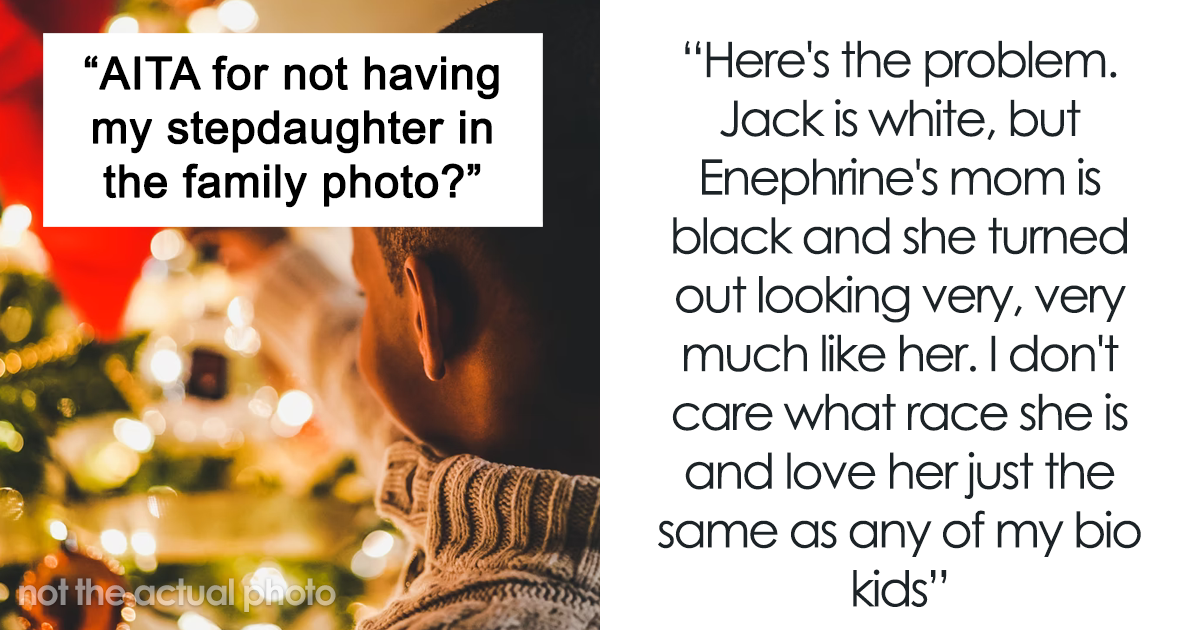
That is exactly why one viral family conflict hit such a nerve online. A mother reportedly wanted to take a Christmas card photo with her husband and their children but leave out her husband’s Black daughter from a previous relationship. Her explanation was not that the girl refused to participate, was unavailable, or had asked for privacy. The reason, according to the story, was that the woman’s own parents were racist and might make a fuss if they saw a Black child in the picture.
And then came the internet, walking in with a folding chair and a group chat full of opinions.
People quickly called the decision racist, not because every family photo must include every person every time, but because the exclusion was based on race and designed to keep racist relatives comfortable. That distinction matters. A blended family can take many kinds of pictures: siblings only, parents only, silly cousins, “grandma forced us to wear plaid,” and the classic one where everybody looks like they just survived a department-store lighting attack. But when one child is removed because her Blackness might offend someone else, the issue is no longer photography. It is belonging.
Why This Christmas Family Photo Drama Sparked Such A Strong Reaction
At first glance, the situation may sound like a private family disagreement. But the details turned it into a much bigger conversation about racism in families, stepchildren feeling excluded, and what it means to protect a child.
The mom reportedly framed her choice as an attempt to shield her stepdaughter from racist grandparents. In theory, protecting a child from racist comments is a good instinct. In practice, the chosen method sent a very different message: “You can be in our family, but only where certain people cannot see you.” That is not protection. That is editing.
Children, especially stepchildren, notice where they are placed. They notice who gets invited, who gets named, who gets framed on the wall, and who gets treated like a temporary guest in a house where everyone else has a permanent stocking. A Christmas card may seem small to adults, but to a child it can become proof of whether they are truly included.
The Real Problem Was Not The Photo. It Was The Reason.
There are plenty of harmless reasons someone might not appear in a family photo. Maybe they were at school. Maybe they had the flu. Maybe they were making a face so chaotic that even the family dog looked concerned. But this case was different because the stepdaughter’s race was the reason she was singled out.
That is why commenters reacted so sharply. The mom was not simply managing family logistics. She was prioritizing the comfort of racist adults over the dignity of a child. Worse, she seemed surprised that people saw the decision as racist, as though racism only counts when someone uses a slur, waves a flag, or monologues like a villain in a poorly written movie.
Racism often shows up in quieter decisions. It can appear as “Let’s not mention that.” It can sound like “You know how they are.” It can look like cropping one child out of the public version of a family. The damage is not softened because the person doing it claims good intentions. Good intentions are nice, but they do not magically turn a bad decision into a Hallmark special.
Blended Families Need Belonging, Not Fine Print
Blended families already come with emotional complexity. Children may be adjusting to divorce, remarriage, new siblings, different households, loyalty conflicts, and new adults trying to find their role. Experts on stepfamily dynamics often emphasize patience, consistency, and realistic expectations because bonds cannot be forced like a zipper on an overpacked suitcase.
In a blended family, small rituals matter. A seat at the dinner table matters. Being included in holiday traditions matters. Seeing your picture next to everyone else’s matters. These are the quiet signals that say, “You are not an accessory to this family. You are part of it.”
That is why excluding a stepchild from a Christmas family picture can hurt even when no one raises their voice. The picture becomes symbolic. It tells the child whether the family sees them as a real member or as an awkward detail to manage around other people’s prejudice.
“I Was Protecting Her” Is Not Always Protection
The mother’s defense reportedly centered on protecting the child from her racist parents’ reaction. That sounds noble for about three seconds, until you ask one basic question: who was actually being protected?
If the child was not going to see the grandparents’ reaction, then leaving her out did not shield her from their words. It shielded the mother from conflict. It protected the racist relatives from discomfort. It protected the holiday card from becoming a moral test. But the stepdaughter paid the price.
Real protection would look different. It might mean not sending a card to racist relatives. It might mean setting a firm boundary: “This is our family. If you cannot respect every child in it, you do not get access to us.” It might mean having a difficult conversation before the photo, not after the damage is done. It might mean choosing the child over the approval of people who refuse to see her humanity.
Why Racial Exclusion Inside A Family Cuts So Deep
Racism from strangers is painful. Racism from family can be even more confusing because family is supposed to be the safe place. When a child experiences rejection inside the home or from extended relatives, the harm can become tangled with questions of identity, loyalty, and self-worth.
For a Black child in a mostly white family environment, inclusion cannot be vague. It has to be visible, active, and repeated. That means adults must do more than say, “We love you.” They must show it when it becomes inconvenient. Especially when it becomes inconvenient.
A child should never have to wonder whether their skin color makes them a problem for family branding. A Christmas card is not a corporate brochure. You do not remove a child because the “audience” may react badly. The audience can cope. Adults have had decades to practice emotional regulation. Children should not be sacrificed on the altar of “keeping the peace.”
The Difference Between Avoiding Drama And Enabling Racism
Many families have at least one relative who treats Thanksgiving dinner like an open-mic night for terrible opinions. Because of that, some people become experts at avoidance. They change the subject, laugh nervously, hide relationships, edit stories, and tell themselves they are just keeping the peace.
But peace built on someone else’s erasure is not peace. It is a hostage situation with better table settings.
When a parent or stepparent changes family behavior to avoid upsetting racist relatives, the racist relatives are still controlling the family. They may not be in the room, but their prejudice is directing the photo, the mailing list, the conversation, and the emotional weather. That is why people online were not buying the “I meant well” explanation.
Boundaries are not rude. Boundaries are how a family says, “This is what we allow near our children.” If grandparents cannot handle seeing a Black child in a family photo, the answer is not to remove the child. The answer is to remove the grandparents from the list of people whose comfort determines family choices.
What The Husband’s Reaction Reveals
According to the viral account, the husband was angry about the exclusion. That reaction makes sense. A parent seeing their child treated as optional because of race is not going to respond with, “Interesting creative direction for the Christmas card.” He saw what many commenters saw: the decision placed his daughter outside the family circle.
In blended families, the biological parent has a special responsibility to protect the child’s place in the household. But the stepparent also has a responsibility. Marriage to someone with a child is not a subscription with selective features. You do not get the spouse, the shared home, the cute holiday traditions, and then opt out of fully acknowledging the child who complicates the picture.
If the mother wanted a healthy blended family, this was a moment to stand beside her husband and stepdaughter. Instead, she appeared to stand between them and the racist expectations of her own parents.
Intentions Matter, But Impact Matters More
One of the most common defenses in family conflict is, “That was not my intention.” Fair enough. Intentions matter. They help explain what someone thought they were doing. But impact tells us what actually happened.
If you step on someone’s foot, you may not have intended to hurt them. But the correct response is not to deliver a TED Talk about your pure heart while your shoe is still on their toes. You move your foot. You apologize. You pay attention next time.
The mother may not have thought of herself as racist. Many people do not. But a person can participate in racism without seeing themselves as a cartoon villain. Supporting a racist outcome to avoid racist relatives is still a problem. The stepdaughter was excluded because she was Black. That is the impact.
What A Better Response Would Have Looked Like
A healthier response would have started with one firm principle: every child in the household belongs in the family photo unless they choose not to be there. From there, the parents could decide how to handle the racist relatives.
1. Take the full family photo proudly
The first and simplest step would be to include the stepdaughter without hesitation. Family photos are not only for the people receiving them. They are also for the people inside them.
2. Set a boundary with racist relatives
The mother could tell her parents, “This is my family. Any racist comment about my stepdaughter will end the conversation.” Then she would need to follow through. Boundaries without consequences are just decorative sentences.
3. Talk to the stepdaughter with care
If the child already knew what happened, the adults owed her an apology without excuses. Not “I am sorry you felt excluded,” but “I was wrong to exclude you. You belong in this family, and I should have protected that.”
4. Do repair work as a family
Repair might include family counseling, honest conversations about race, and a commitment to challenging racist behavior instead of working around it. One apology is a start, not a magic eraser.
Why Online Commenters Were So Unforgiving
Some readers may wonder why the internet reacted so intensely. After all, online communities are not exactly known for gently sipping tea before offering balanced feedback. But in this case, the outrage came from a clear ethical point: a child was treated as less presentable because of race.
People also recognized the familiar pattern. Someone claims they are not racist but makes decisions that accommodate racism. Someone says they love a child but asks that child to disappear when bigoted relatives might notice. Someone frames exclusion as kindness. The internet may be messy, but it can identify hypocrisy faster than a toddler identifies an unattended cupcake.
The Bigger Lesson For Parents And Stepparents
This story is not only about one Christmas picture. It is about the daily choices that tell children who counts. Parents and stepparents should ask themselves: Who gets included when it is inconvenient? Whose feelings are protected first? Who is expected to shrink so adults can avoid uncomfortable conversations?
In families with children of different racial backgrounds, adults must be especially intentional. Colorblind language may sound polite, but pretending race does not matter can leave children unsupported when race clearly affects how others treat them. A Black stepdaughter does not need adults to ignore her race. She needs adults to honor all of who she is and defend her when others do not.
That defense does not have to be dramatic. It can be as simple as hanging her photo in the hallway, correcting relatives who make comments, learning about her hair care needs, reading books that reflect her identity, celebrating her culture, and refusing to make her the family secret.
Experiences And Reflections Related To This Topic
Many people who grow up in blended families remember the small moments more vividly than adults expect. They remember whether their stepmother introduced them as “my husband’s daughter” or “our daughter.” They remember whether their school photos were displayed next to the other kids’ pictures or kept in a drawer. They remember whether holiday cards included them, cropped them, or treated them like a scheduling conflict with shoes.
For children of color in white or mostly white families, those memories can carry an extra layer. Imagine being the only Black child at a family gathering where everyone insists they “do not see color,” while also making comments about your hair, your features, your parent, or your “different” look. Now imagine the adult who is supposed to protect you quietly deciding that the easiest solution is for you to be less visible.
That kind of experience can teach a child the wrong lesson: that love is conditional, that family acceptance depends on presentation, and that racism is something they must politely absorb so adults can avoid awkwardness. It can also create resentment between siblings. The included children may not understand the racial dynamics, but they will notice who is treated differently. Silence becomes a family language.
A better family experience looks more courageous. It might involve a stepparent saying, “I made a mistake, and I am going to fix it.” It might involve retaking the photo with everyone included, then sending it without apology. It might involve telling grandparents, “You do not get to have a relationship with us while disrespecting one of our children.” That conversation may be uncomfortable, but discomfort is not danger. For the child being excluded, the danger is learning that her place in the family can be negotiated.
Some stepparents worry that they will overstep if they talk about race or defend a child who is not biologically theirs. But love in a blended family is not proven by biology. It is proven by behavior. A stepparent does not need to replace a biological parent to be a safe adult. They need to be consistent, humble, protective, and willing to learn.
There are also lessons here for extended family members. If your adult child marries someone with a child from a previous relationship, that child is not a footnote. They are part of the package. If race makes that difficult for you, the work belongs to you, not to the child. A child should not have to become invisible while grown adults “process” basic decency at the speed of a dial-up modem.
The most meaningful holiday pictures are not perfect because everyone matches. They are meaningful because everyone belongs. A family photo with different skin tones, different last names, different histories, and a few complicated relationships is not a problem to hide. It is the truth of the family. And if someone cannot handle that truth on a Christmas card, perhaps they are the one who should be left off the mailing list.
Conclusion: Inclusion Is Not Optional When A Child Is Family
The controversy around the mom who excluded her Black stepdaughter from a Christmas family pic is a reminder that racism is not always loud. Sometimes it is quiet, polite, and wrapped in holiday stationery. Sometimes it appears as a decision that seems practical to one adult but devastating to the child being pushed out of frame.
A blended family does not have to be perfect. No family is. Someone will forget the rolls, someone will blink in every picture, and someone will start a debate over whether matching pajamas are festive or a cry for help. But children should never have to question whether they belong because of their race.
If a family wants to be healthy, the adults must choose courage over convenience. They must protect children from racism, not protect racism from consequences. And when the camera comes out, the message should be simple: this is our family, all of us, no cropping required.
Note: This article is an original rewritten analysis based on publicly discussed family-conflict reporting and established guidance from reputable U.S. family, child-development, psychology, and anti-racism resources. No source links are included by request.