The Large Rabbit Throw Forest is what happens when a cozy blanket decides it would rather be a work of art. Designed by Finnish artist Klaus Haapaniemi, this generously sized wool-and-silk throw combines an enchanted rabbit motif, jewel-like colors, hand-finished details, and enough visual drama to rescue even the most aggressively beige room.
It is warm without looking bulky, whimsical without becoming childish, and decorative enough to hang on a wall when nobody is curled beneath it. In other words, this is not the blanket you hide in a closet before guests arrive. It is the blanket that makes guests ask, “Where did you find that?”
What Is the Large Rabbit Throw Forest?
The Large Rabbit Throw Forest is a luxury woven textile featuring Klaus Haapaniemi’s distinctive rabbit pattern. The composition resembles a scene from a forgotten Nordic fairy tale: a large rabbit appears within an intricate forest of leaves, flowers, decorative shapes, and richly colored details.
An earlier large-format listing describes the throw as approximately 245 by 220 centimeters, or about 96.5 by 86.6 inches. It is made from 70% fine New Zealand wool and 30% silk, using hand-dyed yarns and hand-finished fringe. Its palette includes black, forest green, white, purple, turquoise, and pink.
At that size, “throw” is almost an understatement. This textile can cover a substantial portion of a bed, spread across a roomy sectional, or function as a dramatic wall hanging. Calling it a little couch blanket would be like calling a peacock a moderately colorful chicken.
Available Sizes and Editions
Shoppers may encounter several Rabbit Throw versions. The brand’s current collection has included a 200-by-180-centimeter Forest throw and a larger 215-by-245-centimeter Forest Black version. Because dimensions, color names, and availability can vary by edition, buyers should check the individual product description rather than relying on the title alone.
The Artist Behind the Rabbit
Klaus Haapaniemi is a Finnish artist and designer known for combining folklore, nature, fantasy, decorative art, and contemporary color. Born in Helsinki in 1970, he has developed an instantly recognizable visual language populated by rabbits, owls, foxes, insects, swans, flowers, and imaginary creatures.
His work often feels Scandinavian, but not in the familiar sense of white walls, pale wood, and one lonely ceramic vase. Haapaniemi explores the more theatrical side of Nordic culture: deep forests, long nights, seasonal mythology, ornamental storytelling, and animals that look as though they have important royal appointments.
Haapaniemi and Mia Wallenius established their design brand in 2010. Its collections have included printed fabrics, cushions, rugs, throws, fashion accessories, and decorative objects, with a creative approach shaped by Finnish folklore and traditional decorative arts.
Why the Rabbit Motif Works
Rabbits are familiar enough to feel friendly, but mysterious enough to carry symbolic weight. In folklore and visual culture, they can suggest speed, fertility, cleverness, spring, the moon, transformation, or a secret world hidden beyond the garden gate.
On the Large Rabbit Throw Forest, the animal is not treated as a cartoon mascot. It becomes part of an elaborate ornamental landscape. The rabbit gives the design a clear focal point, while the surrounding foliage rewards closer inspection. From across the room, the throw reads as a bold pattern. Up close, it becomes a miniature universe.
Materials: Why Wool and Silk Make Sense
The combination of wool and silk is central to the character of this luxury forest throw blanket. Each fiber contributes something different, creating a textile that feels substantial yet refined.
Fine Wool for Warmth and Structure
Wool provides insulation, resilience, body, and a pleasantly tactile surface. It can hold warmth while remaining breathable, making it practical for cool evenings, drafty reading corners, or the unofficial household sport of refusing to adjust the thermostat.
Unlike many synthetic fleece blankets, a woven wool throw tends to have a structured drape. It looks intentional when folded across a bed or arranged over furniture. Wool also helps the elaborate pattern remain visually crisp rather than collapsing into a shapeless fuzzy cloud.
Silk for Luster and Fluidity
Silk introduces softness, subtle shine, and a smoother hand. It helps the colors appear more luminous, especially the turquoise, violet, green, pink, and ivory details set against the dark background.
The 30% silk content does not turn the throw into a slippery evening gown for your sofa. Instead, it adds refinement to the wool, improving the sense of movement and giving the surface a quiet glow as lighting changes throughout the day.
Hand-Dyed Yarn and Hand-Knotted Fringe
The official collection describes its throws as being crafted with hand-dyed wool and silk yarns, with fringes intricately knotted by hand. These details reinforce the object’s artisanal character and distinguish it from mass-produced printed blankets.
Hand finishing may also introduce minor variations. Those differences should not automatically be treated as flaws. In a decorative textile, slight irregularity can be part of the charm, proof that the edge was not completed by a machine having another emotionally uneventful Tuesday.
Color and Pattern Analysis
The Large Rabbit Throw Forest relies on contrast. A black or nearly black foundation gives the forest scene visual depth, while saturated colors appear to float above it. Forest green provides the natural anchor. Turquoise adds cool brightness. Purple and pink create fantasy, and white details improve definition.
This palette makes the throw surprisingly adaptable. Although the pattern is complex, the dark base can connect naturally with black furniture, charcoal upholstery, walnut wood, bronze fixtures, dark green walls, or navy bedding. The brighter tones provide convenient colors to repeat in pillows, artwork, flowers, lamps, and smaller accessories.
Is It Too Bold for an Everyday Room?
Not necessarily. A large patterned textile can actually make decorating easier because it supplies a ready-made color scheme. The trick is to let the throw lead rather than surrounding it with several equally demanding patterns.
Pairing it with solid upholstery, simple curtains, restrained bedding, and natural wood allows the rabbit design to become the room’s main visual event. The result feels layered and collected instead of chaotic.
How to Style the Large Rabbit Throw Forest
1. Drape It Across a Neutral Sofa
A cream, tan, gray, olive, or charcoal sofa creates a calm foundation for the intricate pattern. Fold the throw lengthwise and arrange it over one end of the sofa, allowing the fringe to remain visible.
For a more relaxed look, drape it loosely over the back and seat. The goal is casual elegance, not the appearance that a rabbit-themed avalanche has just occurred.
2. Place It Across the Foot of a Bed
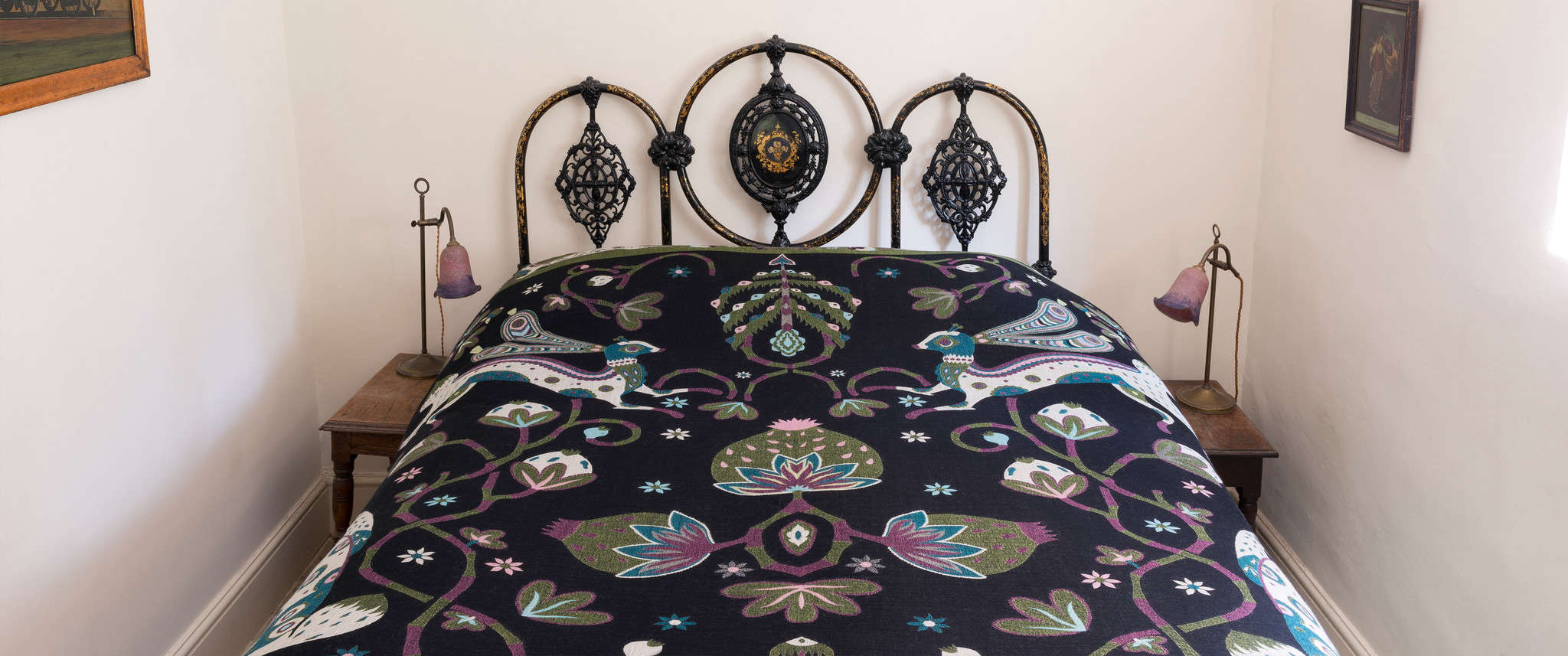
The generous size makes the Large Rabbit Throw Forest especially suitable for a queen or king bed. Spread it across the lower third of the mattress, or fold it to display the most recognizable portion of the rabbit motif.
White, ivory, charcoal, forest green, aubergine, and dusty pink bedding can all work. Keep the main duvet relatively simple so the throw remains the focal point. Layering a decorative blanket at the foot of a bed can add warmth, texture, and visual depth without requiring a complete bedroom makeover.
3. Use It as a Wall Hanging
Because this piece is large and graphically detailed, it can function as textile art. A wall display is particularly effective above a bed, sofa, console, or dining bench.
Use a mounting system that distributes weight evenly and does not puncture, stretch, or clamp delicate areas. Keep the textile away from heating vents, moisture, cooking residue, and strong direct sunlight. The Smithsonian notes that protective storage and reduced exposure to light, abrasion, and soil can help preserve valuable textiles.
4. Build a Reading Corner Around It
Drape the throw over a chaise, deep armchair, or window seat, then add one or two solid pillows and a warm reading lamp. A small wood table and a stack of books complete the setting.
The enchanted forest pattern works especially well in a reading nook because it already feels narrative. It is difficult to read a fantasy novel beneath this blanket without suspecting the rabbit knows how the story ends.
5. Add It to a Dark, Moody Interior
In a room with black, navy, chocolate brown, or deep green walls, the throw becomes part of a richer, more immersive scheme. Velvet upholstery, aged brass, smoked glass, and dark timber complement its decorative intensity.
This approach creates an elegant atmosphere rather than a conventionally “cute” rabbit-themed room. The animal motif remains visible, but the overall effect is sophisticated, artistic, and slightly mysterious.
Who Will Appreciate This Luxury Rabbit Throw?
The Large Rabbit Throw Forest is best suited to someone who values distinctive design more than anonymous practicality. It may appeal particularly to:
- Collectors of Finnish and Scandinavian design
- Fans of Klaus Haapaniemi’s illustrations
- Homeowners seeking a dramatic statement textile
- Rabbit lovers who prefer sophisticated animal décor
- People drawn to folklore, fantasy, botanical patterns, and maximalist interiors
- Gift buyers searching for a memorable wedding, anniversary, or housewarming present
It is less suitable for households that want a blanket for muddy paws, outdoor picnics, snack-heavy movie nights, or frequent machine washing. This is a functional textile, but it deserves more thoughtful treatment than an inexpensive polyester throw.
Care and Maintenance
A wool-and-silk blend requires cautious care. A related Rabbit Forest wool-and-silk piece sold by a U.S. Finnish design retailer is labeled dry clean only. Owners should always follow the care label attached to their specific throw, as instructions can differ by size or edition.
Routine Freshening
Frequent washing is usually unnecessary. Lightly shake the throw outdoors in dry weather, air it in a shaded location, and use a clean upholstery attachment at very low suction when dust removal is needed. Avoid aggressive brushing, which may disturb the fibers or fringe.
Handling Spills
Blot a fresh spill immediately with a clean, white, absorbent cloth. Do not scrub. Friction may push liquid deeper into the weave or alter the surface texture. Avoid generic stain removers unless they are confirmed safe for both wool and silk.
Never apply chlorine bleach. Smithsonian textile-care guidance warns that chlorine bleach can seriously damage or dissolve protein fibers such as silk and wool.
Drying and Heat
Do not tumble-dry the throw or place it directly on a radiator. Heat, moisture, and agitation can cause shrinkage, distortion, felting, color movement, or damage to hand-finished details.
Storage
Before storage, make sure the textile is clean and fully dry. Fold it loosely rather than compressing it into a small plastic bag. Store it in a breathable textile bag or an appropriate archival box in a cool, dry, dark location.
For long-term storage, periodically change the fold lines so the same areas are not under continuous stress. Protect wool from clothes moths by keeping the storage area clean and checking the throw occasionally for webbing, larvae, or unexplained fiber loss.
Advantages and Possible Drawbacks
Key Advantages
- Distinctive design: The rabbit and forest pattern is memorable and immediately recognizable.
- Premium natural fibers: Wool provides warmth and structure, while silk adds softness and luster.
- Generous dimensions: Large editions can cover a bed, sofa, chaise, or substantial wall area.
- Decorative versatility: It works as bedding, a couch throw, a reading-nook layer, or wall art.
- Rich color palette: The mix of black, green, turquoise, purple, pink, and ivory supports several decorating schemes.
- Artisanal finishing: Hand-dyed yarn and hand-knotted fringe add character.
Possible Drawbacks
- Special care: Wool and silk are less carefree than cotton or polyester.
- Premium cost: Materials, scale, designer authorship, and hand finishing place it in the luxury category.
- Pattern intensity: It can overwhelm a room already filled with strong prints.
- Limited availability: Certain sizes and colorways may sell out or be offered only by selected retailers.
- Pet and child concerns: Claws, spills, sticky fingers, and enthusiastic blanket forts may shorten its elegant career.
How to Shop for an Authentic Large Rabbit Throw Forest
Because product names may be shortened, translated, or reused across listings, compare the details rather than relying on the title alone.
Look for clear identification of Klaus Haapaniemi as the designer, an accurate fiber composition, stated dimensions, detailed care instructions, and high-resolution photographs of the weave and fringe. Reputable sellers should also provide a return policy and transparent information about condition if the textile is vintage or preowned.
Ask whether the listing is for the full-size throw or the smaller square shawl. A Rabbit Forest shawl may measure around 150 by 150 centimeters, while large throw editions are considerably bigger. A suspiciously low price may indicate a smaller version, a used item, a reproduction, or a product that merely borrows the “forest rabbit” description.
The Ownership Experience: Living With the Large Rabbit Throw Forest
Bringing a Large Rabbit Throw Forest into a room is different from adding an ordinary blanket. A plain throw usually fills a practical gap: the sofa looks bare, the weather is cold, or someone keeps stealing the comforter. This piece changes the visual hierarchy of the entire space.
Imagine opening the package for the first time. The textile feels lighter than its large dimensions suggest, but the weave still has substance. The wool contributes a warm, dry softness, while the silk gives the surface a smoother movement. As the throw unfolds, the rabbit emerges gradually from the pattern instead of appearing as a simple printed character.
The first styling attempt might involve folding it neatly over a sofa arm. That arrangement looks polished, but it hides too much of the design. The second attempt spreads it across the back cushions. Suddenly the forest becomes visible, yet the sofa begins to look as though it has been dressed for a ceremonial occasion.
The most successful sofa arrangement is often somewhere in between: fold the throw loosely, display the rabbit’s face or body, and let a section of the fringe fall naturally at one side. Add one solid green or violet pillow, then stop. This is important. Decorative confidence sometimes means knowing when the room has enough rabbits.
On a bed, the experience is calmer. The large format has room to breathe, and the pattern can be appreciated from farther away. Against white linen, it appears crisp and theatrical. With charcoal bedding, the design feels deeper and moodier. Under warm bedside lighting, the silk catches a subtle glow and the colored details become more pronounced.
Using the throw is pleasant, but owners may become slightly protective. Coffee is suddenly held with two hands. Red wine is relocated to a different chair. A cat approaching with kneading paws receives the kind of diplomatic attention normally reserved for an international incident.
That caution does not mean the textile should never be touched. Its appeal comes partly from the combination of visual beauty and physical comfort. Draped over the legs during a cold evening, it feels warmer and more breathable than many lightweight synthetic blankets. The size also allows two people to share it without immediately beginning territorial negotiations.
The pattern has a different effect throughout the day. In bright morning light, the green and turquoise details feel fresh and botanical. In the evening, the dark background dominates, and the scene becomes more mysterious. This shifting appearance helps explain why decorative textiles can have more presence than flat prints: their fibers, folds, shadows, and sheen continually alter the image.
There is also an emotional dimension to living with a statement piece. Mass-produced décor often disappears into the background after a week. The Large Rabbit Throw Forest continues to invite attention because there is always another small leaf, line, color transition, or creature-like form to notice.
Over time, the best arrangement may change with the seasons. In winter, it belongs on the sofa where it can be used regularly. In spring, it might move to the foot of the bed. During warmer months, it can become a wall hanging, allowing the design to remain visible without adding another layer to the furniture.
The practical experience, then, is a balance between use and preservation. Treat it too casually and the delicate fibers may suffer. Treat it like an untouchable museum artifact and you lose the pleasure of the wool, silk, scale, and warmth. The ideal approach is thoughtful enjoyment: clean hands, careful storage, prompt attention to spills, and no spaghetti dinners beneath the rabbit’s watchful gaze.
Final Thoughts
The Large Rabbit Throw Forest is more than a luxury blanket. It is a large-scale decorative textile that merges Finnish folklore, animal imagery, rich color, traditional craft details, and everyday comfort.
Its wool-and-silk construction makes it warm, lightweight, and visually refined. Its generous size gives it several roles, from bed cover and sofa throw to reading-nook companion and wall art. Most importantly, Klaus Haapaniemi’s rabbit pattern gives the piece a personality that generic home accessories rarely achieve.
It requires careful cleaning and a little decorating restraint, but for collectors and design enthusiasts, that effort is part of owning something special. The Large Rabbit Throw Forest does not quietly coordinate with a room. It tells the room a storyand naturally, the rabbit gets the best part.