Writing a cover letter can feel like trying to explain your entire professional personality while wearing business-casual shoes that are slightly too tight. You want to sound confident, but not arrogant. Interested, but not desperate. Professional, but still like a human who occasionally laughs at terrible office memes.
That is where ChatGPT can help. Used properly, it can turn a blank page into a useful starting point, help you identify your most relevant experience, improve awkward sentences, and tailor your message to a specific job description. Used badly, it can create a cover letter that sounds like it was written by a motivational poster trapped inside a corporate elevator.
This easy guide explains how to use ChatGPT to write a cover letter that is personalized, truthful, polished, and much more likely to sound like you. You will learn what information to provide, which prompts work best, what mistakes to avoid, and how to edit the final draft before sending it to a hiring manager.
What Is a Cover Letter, Really?
A cover letter is not a longer version of your resume. Your resume shows what you have done. Your cover letter explains why those experiences matter for this specific role and company.
The best cover letters answer three questions quickly:
- Why are you interested in this job?
- Why are you a strong match for the role?
- Why should the employer want to learn more about you?
Think of it as the movie trailer for your application. You do not need to reveal every plot detail. You just need to make the hiring manager curious enough to keep watching.
ChatGPT can help you organize your story, but it should not replace your judgment. A great cover letter still needs your real accomplishments, personal motivation, career context, and natural voice.
Can ChatGPT Write a Cover Letter?
Yes, ChatGPT can help write a cover letter, but the strongest results usually come when you treat it as a writing assistant instead of an autopilot button. It can brainstorm ideas, summarize a job description, suggest relevant achievements, improve structure, and polish grammar.
However, ChatGPT does not know your life unless you tell it. It does not know that you managed a difficult client, trained new employees, launched a small project, solved a messy spreadsheet problem, or worked three jobs while finishing school. Those details are what make your application memorable.
Never submit a cover letter without reviewing every sentence. Make sure it is accurate, specific, and believable. If the draft says you “led a cross-functional transformation initiative” when you mostly fixed a broken inventory tracker, that is a problem. A useful inventory tracker is still impressive. No need to dress it in a tuxedo and give it a fancy consulting title.
Why Use ChatGPT for Cover Letter Writing?
ChatGPT can save time during a job search, especially when you are applying to several roles. Instead of staring at a blinking cursor until it starts judging you, you can use AI to create a structured first draft.
It Helps You Start Faster
The hardest part of cover letter writing is often the beginning. ChatGPT can create an outline, a first paragraph, or several opening options based on your background and the job description.
It Can Identify Important Keywords
Most job descriptions repeat certain skills, responsibilities, tools, and values. ChatGPT can help you spot those patterns so you can tailor your cover letter around what the employer actually wants.
It Improves Clarity
Many candidates know they have valuable experience but struggle to explain it. ChatGPT can help turn vague statements such as “I am a hardworking person” into stronger evidence-based language such as “In my previous role, I improved customer response time by organizing support requests and creating a clearer follow-up process.”
It Offers Editing Support
ChatGPT can review a draft for repetition, weak wording, grammar issues, awkward transitions, or an overly formal tone. It can also help shorten a letter that has somehow become longer than a small novel.
What You Need Before Asking ChatGPT to Write
Before opening ChatGPT, gather the raw materials. The better your input, the better your cover letter draft will be.
1. The Full Job Description
Copy the job title, responsibilities, qualifications, preferred skills, and company information. Pay attention to repeated phrases. If the company mentions “customer retention,” “data analysis,” and “cross-functional collaboration” several times, those ideas probably deserve space in your letter.
2. Your Resume or Career Summary
You do not always need to paste your entire resume. You can provide the most relevant roles, achievements, skills, education, certifications, and accomplishments. Remove sensitive personal information before sharing anything with an AI tool.
3. Your Best Examples
Choose two or three experiences that prove you can do the work. Strong examples usually include an action, a challenge, and a result.
For example:
- Managed a customer service queue during a busy product launch.
- Created a reporting dashboard that reduced manual weekly work.
- Trained five new team members on a new software process.
- Improved event attendance through email and social media outreach.
- Handled a difficult client issue and helped retain the account.
4. Your Personal Reason for Applying
This is the ingredient that generic AI letters often miss. Why this company? Why this position? Why now?
Your answer does not need to sound like a movie speech. A simple, honest explanation is enough. Maybe you admire the company’s approach to customer experience. Maybe the role fits the direction you want your career to take. Maybe you have used the company’s product and understand the problem it solves.
How to Use ChatGPT to Write a Cover Letter Step by Step
Step 1: Ask ChatGPT to Analyze the Job Description
Do not begin by asking, “Write my cover letter.” Start by understanding what the employer wants.
Use a prompt like this:
Analyze this job description for a [Job Title] role. Identify the five most important skills, responsibilities, and qualifications. Then explain what a strong candidate should emphasize in a cover letter.
Paste the job description after the prompt. ChatGPT can identify themes such as leadership, customer service, writing, sales, technical ability, project management, communication, or industry knowledge.
This step helps you avoid writing a letter that focuses on your favorite accomplishments instead of the accomplishments most relevant to the employer.
Step 2: Match Your Experience to the Role
Once you know the key job requirements, ask ChatGPT to compare them with your experience.
Here is the job description and a summary of my experience. Identify the three experiences I should highlight in a cover letter. Do not invent achievements or qualifications that are not included in my information.
This is especially useful if you have a long work history or are changing industries. ChatGPT can help you find transferable skills, such as communication, problem-solving, customer support, project coordination, budgeting, training, research, organization, or leadership.
For example, someone moving from hospitality into office administration may have strong experience in customer service, scheduling, conflict resolution, multitasking, and handling fast-paced situations. That is not “unrelated experience.” That is useful experience wearing a different uniform.
Step 3: Create a Cover Letter Outline
Before asking for a complete draft, ask ChatGPT for an outline. This makes the writing process easier to control.
Create a cover letter outline for a [Job Title] position at [Company Name]. Include an opening paragraph, two body paragraphs, and a closing. Use the job description and my experience below. Keep the tone professional, warm, and direct.
A good outline should include:
- An opening that names the role and explains your interest.
- A first body paragraph focused on your strongest relevant achievement.
- A second body paragraph showing another skill, value, or connection to the company.
- A short closing that reinforces your interest and invites further discussion.
Step 4: Ask for a First Draft
Now you can request a complete first draft. Give ChatGPT clear instructions about tone, length, and important details.
Write a tailored cover letter for the [Job Title] position at [Company Name]. Use only the experience and achievements I provide. Keep it between 300 and 400 words. Use a confident but natural tone. Avoid clichés such as “I am thrilled,” “dynamic professional,” and “results-driven individual.” Include one specific reason I am interested in this company.
The line “use only the experience I provide” matters. It reminds ChatGPT not to invent projects, awards, numbers, software skills, or leadership responsibilities.
Also tell ChatGPT what to avoid. AI writing can become overly polished, overly enthusiastic, or slightly allergic to normal human language. Giving style instructions helps keep the draft realistic.
Step 5: Make the Letter Sound More Like You
The first draft is not the finished draft. Read it aloud. If you would never say “I am uniquely positioned to leverage synergistic stakeholder relationships,” delete it immediately and give it a respectful burial.
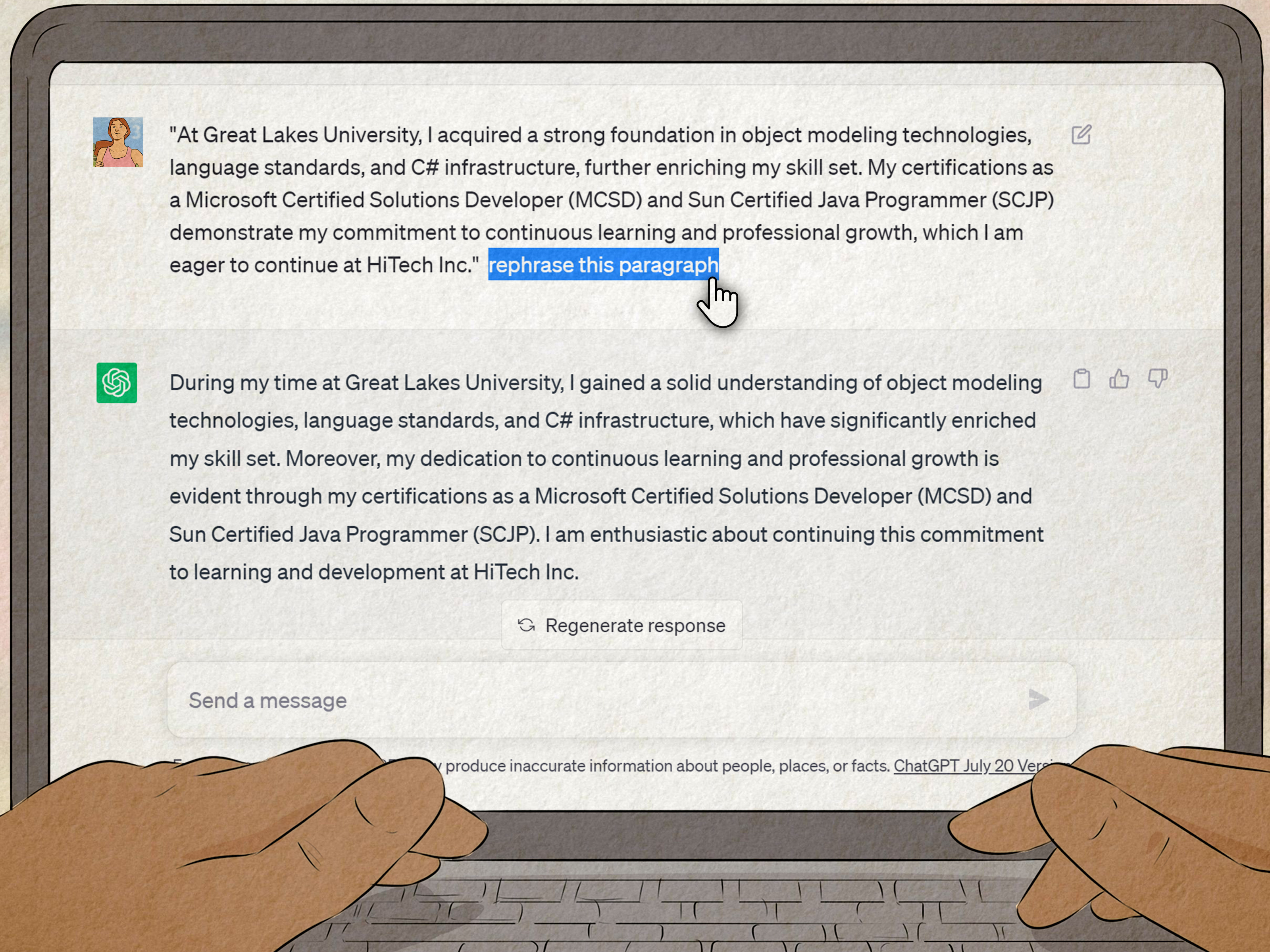
Ask ChatGPT to revise the style:
Rewrite this cover letter in a more natural American English voice. Keep it professional but less corporate. Use shorter sentences, concrete language, and a confident tone. Do not change or add any facts.
You can also provide a sample of your own writing, such as a professional email or LinkedIn post, and ask ChatGPT to match the general tone without copying phrases.
Step 6: Check for Repetition and Weak Language
Many cover letters repeat the same words: passionate, excited, skilled, qualified, motivated, opportunity. None of these words are illegal, but too many can make your letter sound like it was assembled from a corporate word magnet set.
Use this prompt:
Review this cover letter for repeated words, vague claims, generic phrases, and overly formal language. Suggest stronger alternatives while preserving my original meaning and facts.
ChatGPT can help you replace vague claims with clearer evidence. Instead of saying, “I have excellent communication skills,” you might write, “I worked with customers, vendors, and internal teams to resolve issues quickly and keep projects moving.”
A Simple ChatGPT Cover Letter Prompt Template
Here is a reusable prompt you can customize for almost any application:
I am applying for the [Job Title] position at [Company Name]. Please write a personalized cover letter using the job description and my background below.
Requirements:
- Keep the letter between 300 and 400 words.
- Use professional, natural American English.
- Highlight the three most relevant experiences from my background.
- Explain why I am interested in this company and role.
- Do not invent achievements, job duties, skills, numbers, awards, or education.
- Avoid clichés, filler, and overly formal corporate language.
- Make the letter sound confident, specific, and human.
Job description: [Paste job description]
My background: [Paste relevant experience, skills, and accomplishments]
Why I am interested in this role: [Add your personal reason]
Example: Turning Basic Information Into a Stronger Cover Letter
Imagine you are applying for a marketing coordinator job at a small software company. Your experience includes managing social media, writing email campaigns, helping with events, and tracking engagement data.
A weak cover letter might say:
I am applying for the marketing coordinator role. I have marketing experience and strong communication skills. I believe I would be a great fit for your company.
Nothing is technically wrong with it. It is also about as memorable as a plain rice cake.
A stronger version could say:
I am interested in the Marketing Coordinator role because it combines campaign execution, content development, and performance trackingthree areas I have enjoyed building in my recent work. In my previous position, I supported email and social media campaigns, helped coordinate customer events, and used engagement data to improve future content. I am especially drawn to your company’s focus on making complex software easier for growing businesses to use.
The stronger version connects experience, skills, and motivation. It does not need dramatic language. It simply makes the reader understand what the candidate can do and why the role makes sense.
How to Use ChatGPT for Different Cover Letter Situations
For Entry-Level Jobs
If you are a student, recent graduate, or early-career applicant, focus on internships, coursework, volunteer work, student leadership, freelance projects, part-time jobs, and transferable skills.
Prompt:
I am applying for an entry-level [Job Title] role. Help me write a cover letter that highlights my coursework, internship experience, volunteer work, and transferable skills. Make it sound confident without pretending I have years of experience.
For Career Changers
A career change cover letter should explain the bridge between your previous work and your target field. You do not need to apologize for changing directions. You need to show that your skills travel well.
Prompt:
I am changing careers from [Previous Industry] to [New Industry]. Help me write a cover letter that emphasizes transferable skills, relevant training, and my motivation for the transition. Do not make the career change sound like a weakness.
For Employment Gaps
You do not always need to explain an employment gap in a cover letter. When the gap is relevant or likely to raise questions, keep the explanation brief, honest, and forward-looking.
Prompt:
Help me write one concise, professional sentence explaining an employment gap caused by [brief reason]. Keep the tone positive and focus on my readiness to return to work. Do not overshare personal information.
For Internal Job Applications
When applying for a role within your current company, focus on your knowledge of the business, your accomplishments, and the value you can bring in the new position.
Prompt:
Write a cover letter for an internal application to a [Job Title] position. Highlight my current contributions, my understanding of the company, and the skills that make me ready for this next step.
Common ChatGPT Cover Letter Mistakes to Avoid
Letting AI Invent Your Accomplishments
This is the biggest risk. Review every claim. Do not submit numbers you cannot verify, skills you do not have, or responsibilities you did not perform. A cover letter should make you look stronger, not create a fictional professional cousin who somehow has your name.
Using the Same Letter for Every Job
ChatGPT makes it easy to produce drafts quickly, but speed is not the same as customization. Tailor each letter to the role, company, mission, and main requirements.
Sounding Too Generic
Watch for phrases such as “I am a highly motivated professional,” “I would be honored,” “I am thrilled to apply,” and “I bring a unique combination of skills.” These phrases are not always wrong, but they become weak when they are not supported by specific examples.
Repeating Your Resume Word for Word
Your resume lists duties and accomplishments. Your cover letter should explain the story behind the most relevant ones. Use it to connect the dots for the employer.
Ignoring Company Research
A cover letter should not feel like it could be sent to 50 companies without changing a word. Mention a product, mission, customer group, growth area, culture, industry challenge, or business goal that genuinely interests you.
Final Cover Letter Checklist Before You Apply
- Does the letter name the correct company and job title?
- Does it explain why you want this specific role?
- Does it include two or three relevant examples from your experience?
- Are all achievements, numbers, skills, and claims accurate?
- Does it sound like a real person wrote it?
- Have you removed generic phrases and unnecessary repetition?
- Is the letter concise enough to fit comfortably on one page?
- Did you proofread names, dates, punctuation, and company details?
Experiences: What Actually Changes When You Use ChatGPT Well
Using ChatGPT for cover letters can feel surprisingly useful once you stop expecting it to perform magic. The best experience usually happens when you use the tool like a helpful editor sitting beside you, not like a mysterious robot that somehow knows your career better than you do.
For many job seekers, the biggest benefit is momentum. A blank document can be intimidating, especially when you have already spent hours updating your resume, searching job boards, filling out application forms, and wondering why every company needs you to create a separate password. ChatGPT can make the process less exhausting by giving you a starting structure.
For example, a candidate may know they want to apply for a customer success role but struggle to connect previous retail management experience to the new job. ChatGPT can help identify relevant strengths: solving customer problems, coaching employees, handling complaints, tracking inventory, communicating with different personalities, and keeping calm when a Saturday afternoon becomes unexpectedly chaotic.
That does not mean the AI should write the entire story alone. The candidate still needs to add the details that matter. Maybe they trained six new employees. Maybe they helped reduce customer complaints by changing a confusing return process. Maybe they were trusted to handle difficult situations because they could calm people down without sounding like a prerecorded customer service message.
Another common experience is discovering that your first draft sounds more generic than expected. ChatGPT may produce a polished paragraph that looks impressive at first glance, but after reading it aloud, you may realize that it does not sound like you at all. That is normal. Use the draft as a diagnostic tool. Ask yourself, “Would I say this in an interview?” If the answer is no, revise it.
Job seekers also often find ChatGPT especially useful for editing. Perhaps you have already written a cover letter, but it feels repetitive or too long. Instead of asking ChatGPT to replace everything, ask it to highlight the weakest sentences, identify repeated phrases, or suggest three stronger openings. This keeps you in control of the final message.
There is also a confidence benefit. Many people underestimate their own experience because it feels ordinary to them. You may think, “I just answered emails,” while a better description might be, “I coordinated customer communication, resolved account questions, and maintained accurate records during a high-volume period.” The work is the same. The difference is learning how to describe it clearly.
Still, the experience only works when you protect accuracy. ChatGPT may suggest wording that sounds stronger than the facts support. Resist the temptation to keep it just because it sounds impressive. Hiring managers may ask follow-up questions in interviews, and you should always be able to explain every accomplishment in your letter without suddenly developing an intense interest in the ceiling.
The most effective job seekers use ChatGPT in a loop: analyze the job description, select relevant proof, draft, revise, personalize, proofread, and submit. That process is faster than starting from scratch, but it still requires thought. The AI handles some of the heavy lifting. You provide the truth, the judgment, the personality, and the final approval.
Conclusion
ChatGPT can make cover letter writing easier, faster, and less stressful when you use it as a strategic writing partner. Start with the job description, provide your real experience, ask for a tailored outline, create a first draft, and then revise until the letter sounds natural and specific.
The goal is not to make your cover letter sound like AI. The goal is to communicate your value clearly enough that a hiring manager sees the person behind the resume. Let ChatGPT help with the structure, wording, and editing. Then bring the human part: your experience, your motivation, your judgment, and your voice.