When your air conditioner suddenly stops cooling, goes silent, or starts behaving like it has forgottenin electronic controls, safety switches, and compressor-protection features that can temporarily shut the system down after a power interruption, voltage fluctuation, overheating event, or control error.
Resetting an air conditioner is essentially a controlled power cycle. It clears certain temporary faults and allows the control board to restart. It does not, however, refill refrigerant, repair a burned wire, unclog a drain, or persuade a failing compressor to reconsider its career choices.
This guide explains how to reset a central air conditioner and a window AC unit safely, what to check before restoring power, and when repeated resetting could make a small problem more expensive.
What Does Resetting an Air Conditioner Actually Do?
An AC reset interrupts electricity long enough for the unit’s electronic controls to shut down completely. When power returns, the control board starts a new operating sequence and checks whether normal conditions have been restored.
A reset may help after:
- A brief power outage or voltage fluctuation
- A tripped circuit breaker
- A thermostat communication error
- A temporary control-board glitch
- An accidental change in thermostat settings
- A window unit’s power-cord safety device being triggered
- A compressor protection delay following interrupted power
A reset is less likely to help when the system has a dirty evaporator coil, failed capacitor, clogged condensate drain, refrigerant leak, damaged fan motor, defective thermostat, or serious electrical problem. In those cases, resetting merely turns the problem off and back on. The problem, unimpressed by the ceremony, remains.
Before You Reset the AC: Perform These Quick Checks
Many apparent AC failures are caused by settings, airflow restrictions, or power issues that can be identified without resetting the entire system.
Confirm the thermostat settings
Set the thermostat to Cool, not Heat, Off, or Fan Only. Set the desired temperature at least 3 to 5 degrees Fahrenheit below the current room temperature. Make sure the fan is set to Auto unless you intentionally want continuous air circulation.
If the thermostat screen is blank, replace its batteries if the model uses them. A wired thermostat with a blank display may have lost power because of a tripped indoor-unit breaker, open access-panel switch, blown low-voltage fuse, or condensate safety switch.
Inspect the air filter
A heavily clogged filter reduces airflow and can contribute to overheating, frozen coils, poor cooling, and safety shutdowns. Replace a disposable filter or clean a washable one according to the manufacturer’s instructions.
Check the filter monthly during periods of heavy cooling. Many homes can replace filters every one to three months, but homes with pets, construction dust, smoke, or allergy concerns may need more frequent service.
Check vents and outdoor airflow
Make sure supply registers and return-air grilles are open and unobstructed. Outside, remove loose leaves, grass clippings, and debris from around the condenser without opening its cabinet. Give the outdoor unit adequate breathing room; an AC condenser should not have to inhale through a shrubbery beard.
Look for ice or water
If ice is visible on refrigerant lines or the indoor coil, turn cooling off. Do not repeatedly restart the compressor. Restricted airflow, a dirty coil, a blower problem, or low refrigerant may be causing the freeze-up.
Water around the indoor air handler may indicate a blocked condensate drain or full drain pan. Some systems have a float switch that shuts off cooling to prevent water damage. Resetting the breaker will not fix the blockage, and bypassing the switch could turn your ceiling into an indoor waterfall feature.
How to Reset a Central Air Conditioner
Central AC systems usually have at least two powered sections: an indoor furnace or air handler and an outdoor condenser. Each may have a separate circuit breaker. A thermostat can also have its own batteries or receive low-voltage power from the indoor equipment.
Step 1: Turn the thermostat off
Set the thermostat’s system mode to Off. This prevents it from immediately calling for cooling when electrical power is restored.
Step 2: Find the HVAC circuit breakers
Open the electrical panel and look for breakers labeled AC, Air Conditioner, Condenser, Heat Pump, Furnace, or Air Handler. The outdoor unit often uses a double-pole breaker, while the indoor equipment may use a separate single- or double-pole circuit.
A tripped breaker may sit between the On and Off positions rather than appearing completely off. To reset it correctly, move the breaker firmly to Off first. Do not repeatedly force a loose, hot, damaged, or sparking breaker.
Step 3: Switch off both relevant breakers
Turn off the breaker for the outdoor AC equipment and the breaker for the indoor furnace or air handler. If you cannot confidently identify the correct circuits, consult the system manual or call a qualified professional rather than experimenting with the electrical panel.
Step 4: Wait for the system to discharge and reset
Wait at least five minutes before restoring power. Some manufacturer procedures recommend a longer shutdownoccasionally up to 30 minutesdepending on the equipment and the reason for the shutdown. Follow your owner’s manual when it specifies a particular waiting period.
The pause gives electronic controls time to power down and helps protect the compressor from restarting while internal pressures are still unequal.
Step 5: Restore power
Turn the indoor-unit breaker back on, followed by the outdoor-unit breaker. If either breaker immediately trips, leave it off and call an HVAC technician or electrician. A breaker is a safety device, not an unusually stubborn light switch.
Step 6: Restart the thermostat
Wait another few minutes for the thermostat and control board to boot. Set the thermostat to Cool, select Auto for the fan, and lower the temperature below the room temperature.
Do not assume the reset failed if the condenser does not start instantly. Many systems include a three- to five-minute anti-short-cycle delay that protects the compressor.
Step 7: Observe one cooling cycle
Listen for the indoor blower and outdoor condenser. After several minutes, check whether cool air is coming from the supply vents. The air should feel noticeably cooler than the room, although the exact temperature difference depends on indoor humidity, system condition, and operating conditions.
Let the system run for 10 to 15 minutes. Watch for unusual noises, weak airflow, repeated starts and stops, ice formation, or another breaker trip.
Does a Central AC Unit Have a Reset Button?
Some air conditioners have a dedicated reset button, but many do not. Depending on the model, a button may be located near the outdoor unit’s control area or on another accessible part of the equipment. It may be red or yellow, although color and location are not standardized.
Do not remove a service panel to search for a reset button. If the button is not plainly accessible and identified in the owner’s manual, use the approved breaker-reset procedure or contact the manufacturer.
Pressing random buttons inside powered HVAC equipment is not troubleshooting. It is electrical hide-and-seek, and the electricity usually wins.
How to Reboot a Smart Thermostat
A thermostat reboot is different from a factory reset. A reboot restarts the device while generally preserving schedules, equipment settings, and Wi-Fi information. A factory reset may erase configuration data and require the thermostat to be set up again.
Begin with the thermostat’s on-screen restart option, if available. If it is frozen or unresponsive, follow the manufacturer’s instructions for cycling power to the indoor furnace or air handler. Some thermostats restart after their HVAC breaker is off for 20 to 30 seconds, while others require a longer interruption.
Avoid choosing “factory reset” merely because the AC is not cooling. Incorrect equipment configuration after a factory reset can create additional problems, especially with heat pumps, multi-stage systems, communicating controls, and auxiliary heat.
How to Reset a Window Air Conditioner
Window AC units combine the controls, fan, evaporator, condenser, and compressor in one cabinet. Many modern room air conditioners also have a current-interrupter safety device built into the power-cord plug.
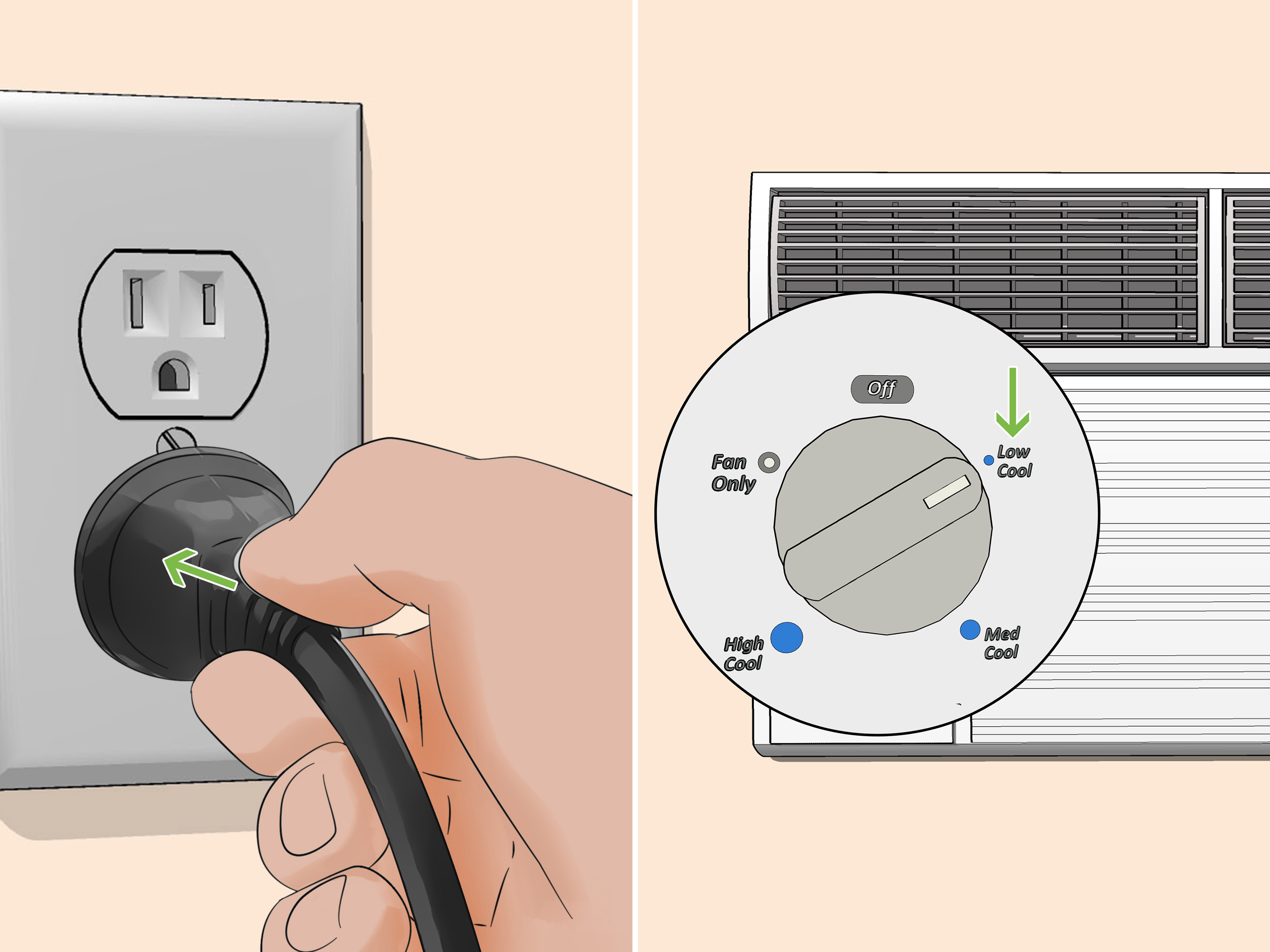
Step 1: Turn the window AC off
Press the unit’s power button and set its control to Off. If the control panel is frozen, proceed to unplugging it without repeatedly pressing buttons.
Step 2: Unplug it from the wall
Grip the plug rather than pulling on the cord. Leave the unit unplugged for at least one full minute. A longer three- to five-minute pause is sensible before restarting the compressor, especially after a power failure.
Plug a window air conditioner directly into a properly grounded wall outlet unless its manual specifically permits another arrangement. Do not use a typical extension cord, power strip, multi-outlet adapter, or ordinary surge protector. These products may overheat under the AC’s electrical load.
Step 3: Inspect the plug and cord
Do not continue if the cord is cracked, cut, unusually warm, discolored, or melted. Check the plug blades for dark marks or deformation. Also inspect the outlet for looseness, heat damage, or a burned odor.
Step 4: Reset the safety plug
If the plug contains TEST and RESET buttons, follow the sequence printed on the plug or listed in the owner’s manual. A common procedure is:
- Press the Reset button.
- Insert the plug fully into the grounded outlet.
- Press Test; the Reset button should pop out and cut power.
- Press Reset again to restore power.
If the Reset button will not remain engaged, the test does not interrupt power, or the device repeatedly trips, stop using the air conditioner. Do not tape the button down or bypass the plug. The safety device may be detecting cord damage or electrical leakage.
Step 5: Check the outlet and house breaker
If the AC still has no power, confirm that the outlet works. Check the home’s electrical panel for a tripped breaker and check whether the receptacle is protected by a GFCI outlet that needs resetting.
Reset a tripped breaker only once. If it trips again when the air conditioner starts, leave the unit unplugged and arrange professional inspection.
Step 6: Plug in and restart the AC
After waiting at least three minutes, plug the unit in, turn it on, choose Cool mode, and select a temperature below the room temperature. Set the fan to a medium or high speed initially so you can confirm airflow.
Some electronic window units automatically restore their previous settings after a power interruption. Others return to a default mode and must be reprogrammed.
Power Reset Versus Filter Reset
A Filter Reset light does not usually indicate an electrical fault. It is a maintenance timer that appears after a certain number of operating hourscommonly around 250 hours on some models.
Remove and clean the filter according to the manual, allow it to dry completely, reinstall it, and then press the Filter Reset button. Pressing the button without cleaning the filter only silences the reminder. That is rather like turning off a smoke alarm because dinner is still smoking.
Why the Air Conditioner May Still Not Work After a Reset
The breaker trips again
A second trip may indicate a short circuit, grounded compressor, failing motor, defective capacitor, damaged wiring, overloaded circuit, or faulty breaker. Leave the system off. Repeated resets can increase the risk of equipment damage, electric shock, or fire.
The indoor fan runs, but the outdoor unit does not
Possible causes include a failed capacitor, contactor problem, compressor protection condition, disconnect issue, broken control wire, or outdoor-unit failure. These components require professional testing.
The AC runs but does not cool
Check the thermostat, filter, vents, and outdoor airflow. If those items are normal, the system may have a dirty coil, refrigerant leak, compressor problem, duct issue, or incorrect equipment operation.
The system starts and stops repeatedly
Short cycling can result from thermostat problems, overheating, restricted airflow, electrical faults, oversized equipment, or refrigerant issues. Turn the unit off if it cycles every few minutes. Frequent restarting is hard on the compressor.
The coil or refrigerant line freezes
Switch cooling off and allow the ice to melt naturally. Do not chip ice from the coil or pour hot water over electrical equipment. Check the filter and airflow, then schedule service if freezing returns.
The window unit displays an error code
Record the exact code before disconnecting power. Some codes identify temperature-sensor, drainage, communication, or control-board problems. Consult the model-specific manual instead of assuming every code can be cleared permanently with a reset.
When to Call an HVAC Technician
Turn the air conditioner off and request professional help when:
- A breaker trips more than once
- The power-cord Reset button will not stay engaged
- You smell burning insulation or melting plastic
- The electrical panel, plug, cord, or outlet feels hot
- The system buzzes, crackles, smokes, or sparks
- The outdoor fan is stationary while the compressor hums
- Ice returns after the filter and airflow have been corrected
- Water is leaking around the air handler or electrical components
- The system loses cooling repeatedly
- You suspect a refrigerant leak
- The reset works temporarily but the same failure returns
Refrigerant circuits, capacitors, contactors, motors, compressors, and internal wiring are not safe do-it-yourself repair areas. Capacitors may retain a dangerous charge even when the equipment is disconnected.
How to Reduce the Need for Future AC Resets
Resets should be occasional troubleshooting tools, not part of the morning routine. Regular maintenance can prevent many shutdowns and cooling problems.
- Inspect the air filter monthly during heavy-use seasons.
- Keep return grilles and supply registers open and clear.
- Remove debris from around the outdoor condenser.
- Clean a window unit’s reusable filter as directed.
- Use a dedicated, properly grounded outlet for room air conditioners.
- Avoid rapid thermostat changes that repeatedly start and stop the compressor.
- Keep condensate drains inspected and professionally cleared when needed.
- Schedule periodic HVAC maintenance before peak summer demand.
Real-World AC Reset Experiences and Practical Lessons
The most useful reset experiences are often the ones in which the reset is only part of the solution. Consider a typical central AC scenario after a summer thunderstorm. The house briefly loses power, electricity returns, and the thermostat lights upbut the outdoor condenser remains silent. The homeowner immediately lowers the thermostat several times, as though enthusiasm might help. Nothing happens.
A more effective approach is to turn the thermostat off, reset the indoor and outdoor HVAC breakers, wait for the controls to discharge, and then restart the system. Even after power returns, the condenser may remain quiet for several minutes because of compressor-protection programming. That delay can feel suspicious when the house is warm, but patiently waiting often prevents unnecessary additional resets.
Another common experience begins with a central AC that runs but delivers weak airflow. Resetting the breaker appears to help because the system starts again, yet the airflow soon weakens and the indoor coil freezes. The real culprit is frequently a clogged filter or blocked return grille. Once airflow is restored and the ice has melted, the system may operate normally. The lesson is simple: check the lungs of the system before attempting to reboot its brain.
Condensate problems create a similarly confusing situation. A homeowner may find that the thermostat works and the breaker is on, but cooling will not start. After a reset, the system may run briefly and then stop again. A full drain pan or clogged condensate line may be activating a float switch. That shutdown is intentionalit is trying to prevent water damage. Repeatedly resetting the system without clearing the drainage problem can turn a maintenance issue into damaged flooring, drywall, or ceilings.
Window units produce their own memorable reset stories. Following a power outage, a unit may appear completely dead even though other appliances work. The small TEST and RESET buttons on the plug are easy to overlook. Pressing the Reset button can restore power, but it should remain engaged and pass the manufacturer’s test procedure. A button that repeatedly pops out is not being dramatic; it may be warning of a damaged cord, faulty outlet, or internal electrical problem.
One especially important lesson involves impatience. After unplugging a window AC, some users reconnect it immediately and hear the compressor struggle or the overload protection trip. Waiting at least three minutes before restarting gives refrigerant pressures time to balance and allows protective controls to reset. Those few minutes can feel long in a hot bedroom, but they are considerably shorter than compressor replacement.
Filter-reset indicators also cause unnecessary confusion. A unit may cool normally while displaying a Filter Reset light. Owners sometimes unplug the machine repeatedly, expecting the light to disappear. In many models, the light is simply a timed cleaning reminder. The correct experience is far less exciting: remove the filter, clean it, let it dry, reinstall it, and press the designated filter button.
The best practical habit is to treat one successful reset as useful information and repeated resets as a warning. If the AC resumes normal operation after a storm and continues cooling reliably, the event may have been a temporary power or control issue. If it fails again later that day, trips a breaker, freezes, leaks, or makes unusual noises, the pattern points to an underlying fault. Write down what happened, including thermostat settings, error codes, noises, and which breaker tripped. Those details can help a technician diagnose the problem faster.
In other words, a reset should provide a fresh startnot an endless series of second chances.
Conclusion
To reset a central air conditioner, turn the thermostat off, switch the indoor and outdoor HVAC breakers fully off, wait at least five minutes or the period specified by the manufacturer, restore power, and restart cooling. For a window air conditioner, turn it off, unplug it, inspect the cord, reset the power-cord safety device when equipped, wait at least three minutes, and restart the unit from a properly grounded outlet.
Always investigate basic causes such as incorrect thermostat settings, dirty filters, blocked airflow, ice, or condensate problems. Reset a tripped breaker only once. When the breaker trips again, the plug reset will not stay engaged, or the equipment produces heat, smoke, buzzing, leaking water, or repeated failures, leave the AC off and call a qualified professional.
Final note: Model-specific instructions take priority over general guidance. Consult the owner’s manual before using a reset button, changing thermostat configuration, or restoring power after an error code.