Nothing makes a peaceful backcountry sunrise feel less poetic than watching your phone battery drop to 3% while your map app, camera, headlamp, GPS watch, and satellite messenger all stare at you like hungry raccoons. Modern outdoor adventures are still about fresh air, sore calves, and suspiciously crunchy trail snacksbut gadgets have become part of the safety system. A charged phone can hold offline maps. A GPS watch can track your route. A satellite communicator can send a rescue message. A headlamp can help you avoid introducing your shin to a rock at midnight.
The good news? Keeping electronics charged in the backcountry is not complicated. It is mostly about planning your power needs, choosing the right portable charger, using solar only when it makes sense, protecting batteries from temperature swings, and turning off the energy vampires hiding in your device settings. This guide breaks down the smartest ways to keep your gadgets charged in the backcountry without carrying a backpack that feels like it contains a car battery, three bricks, and your regrets.
Why Backcountry Power Planning Matters
Backcountry charging is different from everyday charging. At home, battery anxiety means your phone is at 22% and the couch outlet is six feet away. On trail, 22% may mean you still need to navigate ten miles, check weather, use your camera, message family, and preserve emergency communication. That changes the math.
Before packing power banks or solar panels, list every device you will rely on: smartphone, GPS unit, GPS watch, headlamp, camera, satellite messenger, rechargeable lantern, earbuds, or small camp light. Then divide them into two groups: essential and nice-to-have. Essential devices support navigation, safety, communication, and lighting. Nice-to-have devices make camp more comfortable, but they should not steal power from your map, messenger, or headlamp.
Start With a Simple Power Budget
A power budget sounds like something a spreadsheet would say while wearing hiking boots, but it is extremely useful. Estimate how many times each device needs to be recharged during the trip. For a weekend, a 10,000 mAh power bank may be enough for many hikers using one phone and a headlamp. For a longer backpacking trip, heavy photography, GPS tracking, cold weather, or satellite messaging, a 20,000 mAh battery bank may be more practical.
Think in watt-hours when comparing larger systems. Milliamp-hours, or mAh, are common on power banks, but watt-hours give a more complete picture because they include voltage. Many airline-friendly power banks stay under 100 watt-hours, which is also the common U.S. aviation limit for spare lithium-ion batteries carried without special approval. If you fly to the trailhead, keep power banks in your carry-on, not checked luggage.
A Practical Rule of Thumb
For light use, plan around one phone recharge every two days. For navigation-heavy use, photography, cold conditions, or frequent satellite messaging, plan closer to one phone recharge per day. Add extra capacity if you are guiding others, traveling solo, or entering remote terrain where your electronics are part of your emergency plan.
Choose the Right Power Bank for Backpacking
The best backcountry power bank is not always the biggest one. It is the one that offers the best balance of capacity, weight, durability, charging speed, and reliability. A tiny 5,000 mAh charger may save weight but only provide one meaningful phone boost. A 20,000 mAh model may recharge several devices but adds bulk. For most backpackers, 10,000 mAh is the sweet spot for shorter trips, while 20,000 mAh makes sense for multi-day adventures, camera-heavy travel, or cold weather.
Look for USB-C Power Delivery if your phone, camera, or GPS device supports it. Fast charging is useful when you have a short break at camp or need to top up before bad weather rolls in. Multiple ports are also helpful because you can charge your phone and headlamp at the same time. That said, every extra cable is another tiny snake waiting to vanish into your pack, so keep the setup simple.
Power Bank Features Worth Carrying
Choose a battery bank with a clear charge indicator, rugged casing, efficient USB-C output, and enough capacity for your trip length. Water resistance is helpful, but do not treat a power bank like a river otter. Store it in a dry bag or waterproof pouch, especially during rain, river crossings, snow travel, or canoe trips.
Solar Chargers: Brilliant Tool or Trail Decoration?
Solar charging can be excellent in the backcountry, but only when expectations are realistic. A solar panel works best on sunny, exposed routes where you can angle it toward the sun and leave it there for hours. Desert hikes, alpine routes, base camps, bikepacking trips, and paddling routes can be great candidates. Dense forests, short winter days, deep canyons, cloudy regions, and constant movement make solar less reliable.
Small solar power banks with tiny built-in panels often look heroic in product photos, but many recharge slowly from sunlight alone. For actual backcountry solar charging, a dedicated folding panel is usually better. Pair the panel with a power bank instead of charging your phone directly from inconsistent sunlight. The panel fills the bank, and the bank safely charges your devices later. Think of the power bank as a snack bag for electricity.
When Solar Makes Sense
Solar is most useful for trips longer than three or four days, base-camp adventures, expeditions, van-supported camping, and routes with strong sun exposure. For a two-night backpacking trip, carrying a larger power bank is often lighter, simpler, and more reliable than packing a panel. For a week-long route in bright terrain, solar can reduce the number of batteries you need to carry.
Use Your Phone Like a Backcountry Tool, Not a Tiny Television
Your smartphone is probably the most power-hungry device in your pack because it does everything. It navigates, photographs, tracks, communicates, entertains, and occasionally tempts you to check messages where there is absolutely no service. To save battery, download offline maps before leaving home, switch to airplane mode, lower screen brightness, and close unnecessary apps.
Turn on Low Power Mode on iPhone or Battery Saver on Android before the battery gets low, not after panic has already moved into camp. Disable background app refresh, automatic uploads, constant Bluetooth connections, and unnecessary location access. If you are using a GPS app, check your position when needed instead of leaving the screen glowing all day like a campfire for moths.
Phone Settings That Save Serious Power
Use airplane mode, dark mode, low brightness, short screen timeout, offline maps, and manual photo backup. Turn off Wi-Fi scanning and Bluetooth unless you need them. Keep your phone warm in cold weather by storing it in an inside pocket or sleeping bag. A cold phone may appear to drain quickly, but some capacity returns when the battery warms up.
Keep Navigation Redundant
A charged phone is useful, but it should not be your only navigation plan. Carry a paper map and compass, and know how to use them. A dedicated GPS unit or GPS watch can add redundancy because many outdoor devices are designed for long battery life, rugged use, and low-power tracking modes. Some GPS devices offer expedition or battery-saving modes that reduce tracking frequency and shut down nonessential features.
The key is to match your settings to your needs. You may not need second-by-second tracking for a mellow trail. Longer intervals can save power. If you are navigating complex off-trail terrain, you may choose more frequent GPS updates. Battery life is always a trade-off between precision, safety, and endurance.
Do Not Forget Headlamps and Small Essentials
Phones get all the attention, but a dead headlamp is the fastest way to turn a normal campsite into a slapstick comedy. If your headlamp is rechargeable, confirm the cable type and charge it before leaving. If it uses removable batteries, carry fresh lithium batteries or rechargeable spares. Lithium batteries tend to perform better than alkaline batteries in cold conditions and are often lighter.
Small devices such as satellite communicators, GPS watches, cameras, and rechargeable lanterns should be topped off before the trip. Put them all on a pre-trip charging checklist. The most expensive power bank in the world will not help if you forgot the one proprietary cable that charges your camera. That cable will be sitting at home, smugly coiled on your desk.
Cable Management: The Unsexy Secret to Staying Charged
Backcountry charging systems fail for silly reasons. The power bank is full, the phone is ready, the sun is shiningand the cable is broken, missing, or packed in the food bag under seven pounds of oatmeal. Bring short, durable cables that match your devices. USB-C is increasingly common, but many outdoor gadgets still use Micro-USB, Lightning, or proprietary charging clips.
Carry one backup cable for your most important device. Use a small pouch for all electronics: cables, adapters, power bank, wall plug, spare batteries, and cleaning cloth. Label weird cables if you travel with a group. At camp, charge devices in one place so you do not wake up to find your satellite messenger hiding under a sock.
Protect Batteries From Heat, Cold, and Moisture
Lithium-ion batteries prefer moderate temperatures. Heat can shorten battery lifespan, and cold can temporarily reduce performance. In winter or at high elevation, keep your phone and power bank close to your body during the day and inside your sleeping bag at night. Do not leave electronics on frozen ground or inside an outer pack pocket during a bitter night.
In hot desert environments, do not cook your electronics in direct sun. Solar panels need sunlight; power banks and phones do not need to bake. Shade the devices while the panel collects light, and allow ventilation. Moisture is another enemy. Use waterproof pouches, zip bags, or dry bags, and avoid charging wet devices until the ports are dry.
Charge Efficiently at Camp
The best time to charge is often at camp, when devices can sit still and cables are less likely to get yanked. Charge your phone while it is powered off or in airplane mode to reduce waste. If your power bank supports multiple outputs, charge several essentials during dinner or before sleep. Unplug devices once they are sufficiently charged so the power bank does not keep waking up to top them off.
Try not to drain your power bank to zero unless necessary. A little reserve can matter if the weather changes, your route takes longer than expected, or someone else in your group needs emergency power. Backcountry power is like chocolate: you will never regret having a little left.
Match Your Charging Strategy to the Trip Type
Weekend Backpacking Trip
Bring a fully charged phone, headlamp, and 10,000 mAh power bank. Download offline maps, use airplane mode, and keep the phone mostly off unless navigating or taking photos. Solar is usually unnecessary unless you enjoy carrying rectangles for emotional support.
Five- to Seven-Day Trek
Consider a 20,000 mAh power bank or two smaller banks for redundancy. Use aggressive battery-saving settings. If the route is sunny and exposed, add a lightweight folding solar panel. Charge the bank during lunch breaks or at camp, then charge devices from the bank.
Base Camping or Overlanding
A portable power station may be more practical than pocket-sized power banks. Larger stations are measured in watt-hours and can support phones, cameras, lights, tablets, and even small appliances. Pairing a power station with a solar panel creates a stronger off-grid setup, though it is better suited to cars, canoes, rafts, and base camps than human-powered backpacking.
Backcountry Charging Mistakes to Avoid
Do not rely on service-dependent apps without offline maps. Do not bring one cable for five mission-critical devices. Do not leave your phone tracking all day if you only need occasional navigation. Do not assume solar will save you in cloudy forests. Do not pack lithium power banks in checked luggage when flying. And please, do not use your emergency battery to stream videos in your tent unless your survival plan includes becoming entertainment for mosquitoes.
The biggest mistake is treating power as an afterthought. Test your setup before the trip. Charge your phone from your power bank at home. Confirm cables work. Check how much battery your GPS app uses on a local hike. Learn your devices before they become important.
A Field-Tested Charging Routine
The simplest routine works best. Before the trip, fully charge every device and power bank. On trail, keep the phone in airplane mode and check navigation only when needed. At breaks, top off devices if solar is available. At camp, charge essentials first: satellite messenger, headlamp, phone, GPS watch, then camera or comfort devices. Overnight, keep batteries warm and dry. In the morning, pack cables in the same pouch every time.
This routine prevents the classic backcountry mystery: “Where did my battery go?” Usually, it went to screen brightness, background apps, cold weather, unnecessary tracking, and the five minutes you spent filming a chipmunk who was not nearly as interested in cinema as you were.
of Real-World Experience: What Actually Works on Trail
After enough backcountry trips, you learn that charging gear is less about owning the fanciest power bank and more about developing boring habits. Boring is good. Boring means your headlamp works when you need to pee at 2 a.m. Boring means your phone still has enough battery to show the trail junction you missed while admiring a suspiciously photogenic tree.
One of the best habits is charging before you are desperate. I like to top off essential devices when they drop near 50%, not when they are gasping at 4%. A phone at 4% makes people nervous, and nervous people make bad decisions, such as turning brightness to maximum to “check quickly” and then opening the camera because the sunset is doing something dramatic. Nature has no respect for your battery percentage.
I also prefer carrying two smaller power banks instead of one huge one on longer trips. The total capacity may be similar, but redundancy matters. If one bank fails, gets wet, or disappears into the black hole beneath a sleeping pad, the other still works. It also lets two people charge at once without forming a tiny electronics committee at dinner.
Cold-weather trips teach another lesson fast: batteries belong close to your body. A phone stored in an outer pocket on a freezing morning may act like it has aged fifty years overnight. Keep it in an inner jacket pocket during the day and inside the sleeping bag at night. The same goes for power banks and camera batteries. Warm batteries are happier batteries. Sadly, they still do not appreciate your jokes.
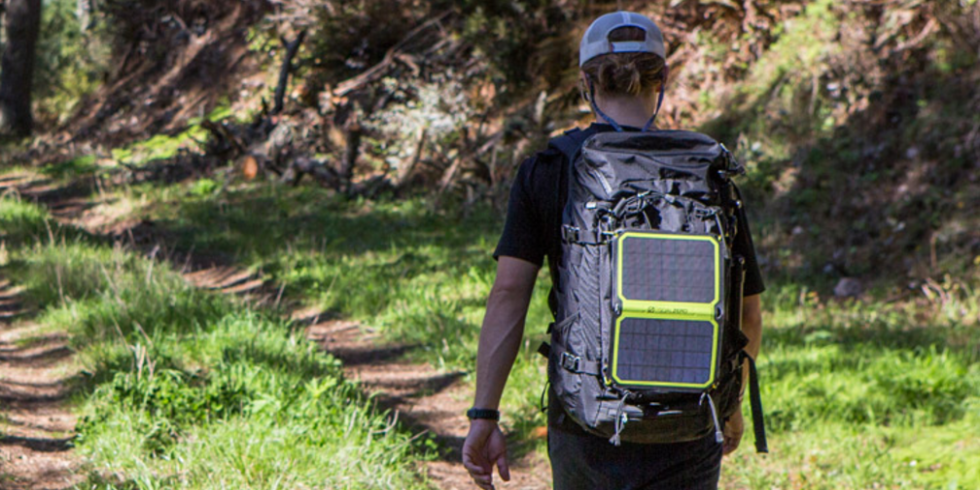
Solar has been wonderful on open, sunny trips and nearly useless in dense tree cover. The best results come from treating solar like a patient camp chore. Set the panel in direct sun, angle it properly, move it as the sun shifts, and charge a power bank rather than a phone. Clipping a panel to a backpack while hiking looks cool, but it often gives inconsistent results because shade, angle, and movement interrupt charging. It is not magic; it is sunlight with paperwork.
The cable pouch is another small thing that prevents big problems. I keep short cables, a tiny wall adapter for town stops, and one backup cable in a bright zip pouch. Bright matters. A black cable pouch inside a dark tent at night is basically a magic trick performed by an unhelpful wizard. I also avoid bringing devices with oddball chargers unless they are truly worth it.
The final experience-based tip is to separate entertainment power from safety power. Music, photos, and videos are fun, but navigation, communication, and lighting come first. If you want camp entertainment, budget extra battery for it. Otherwise, let the stars do their job. They are free, they do not require USB-C, and they have excellent resolution.
Conclusion: Power Up Without Weighing Down
Keeping your gadgets charged in the backcountry is a mix of preparation, restraint, and common sense. Choose a power bank that matches your trip, use solar when conditions justify it, protect batteries from temperature and moisture, and make your phone behave like a tool instead of a bored teenager. With offline maps, smart settings, reliable cables, and a realistic power budget, your electronics can support the adventure without taking over the adventure.
The goal is not to turn the wilderness into a charging station. The goal is to keep the important tools alive long enough to navigate safely, communicate when necessary, capture a few memories, and find your way back home with your batteryand dignitystill above zero.