Poison ivy is the botanical version of a practical joke: it changes clothes with the seasons, grows in several forms, and often hides beside perfectly innocent plants. One careless reach into a garden bed can turn an ordinary weekend into an itchy lesson in plant identification.
The good news is that poison ivy is not impossible to recognize. Its leaves, stems, growth pattern, berries, and climbing habits provide a useful set of clues. The trick is to examine several features together rather than trusting a single rhyme or one blurry photograph.
This nine-step guide explains how to identify poison ivy safely, distinguish it from common look-alikes, and reduce your risk of contact with urushiol, the plant oil responsible for most poison ivy rashes.
Why Accurate Poison Ivy Identification Matters
Poison ivy contains urushiol in its leaves, stems, vines, roots, flowers, and fruit. The oil can transfer directly from the plant or indirectly from contaminated clothing, tools, shoes, gloves, and pet fur. Even a leafless vine or dead plant can still expose you, which is why winter cleanup and brush burning deserve extra caution.
Many people develop allergic contact dermatitis after exposure. Symptoms may include intense itching, redness, swelling, bumps, and fluid-filled blisters. The rash itself is not contagious, and blister fluid does not spread it. However, urushiol left on an object can cause a fresh reaction later. In other words, your garden rake may remember poison ivy long after you have forgotten it.
Step 1: Look for Three Leaflets, Not Three Separate Leaves
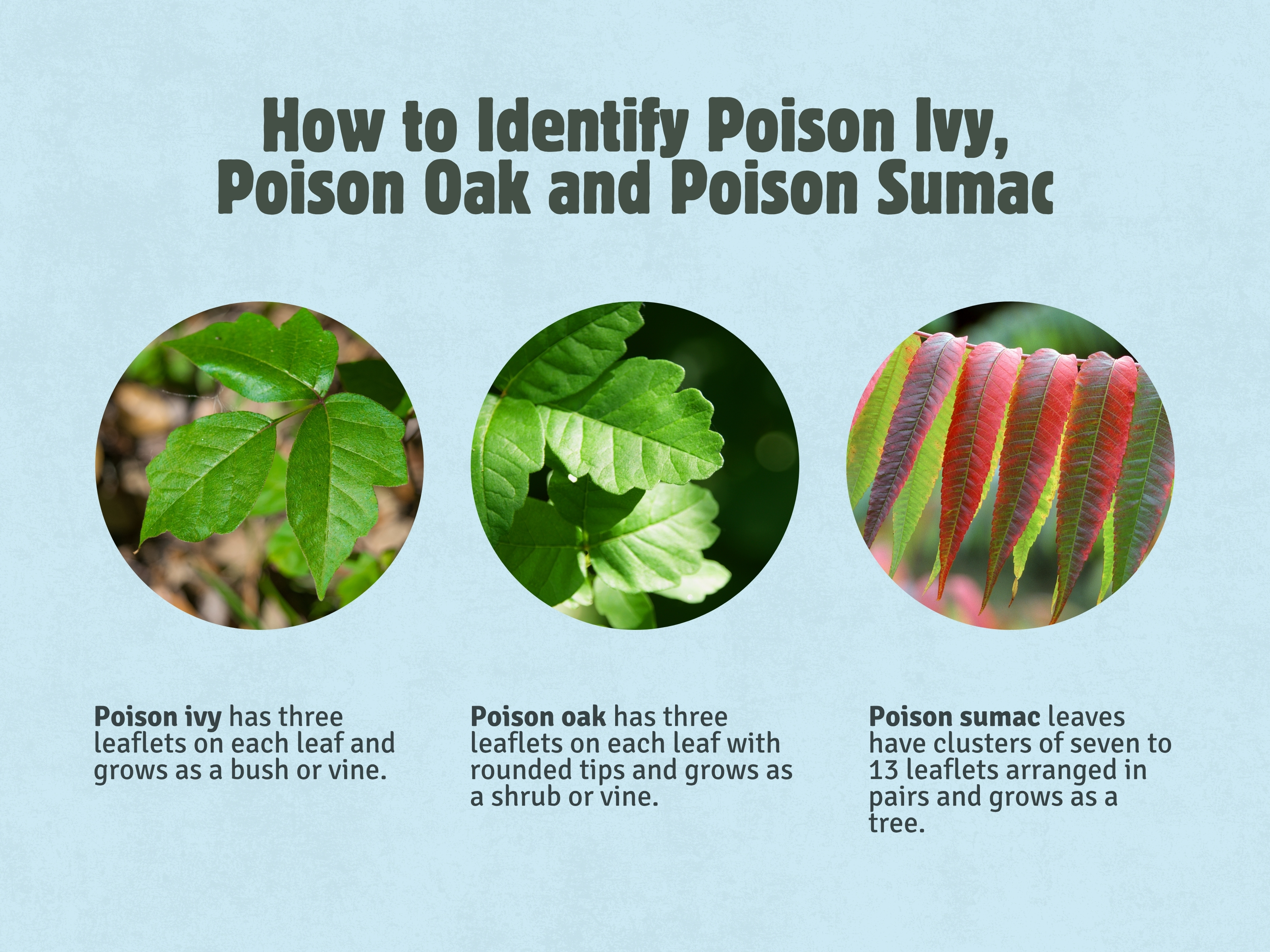
The best-known poison ivy clue is “leaves of three, let it be.” Botanically, each poison ivy leaf is compound and usually consists of three leaflets. The three leaflets meet at one point on a shared leaf stalk.
Do not simply count every green shape in sight. Follow the stalk back toward the vine or stem. A poison ivy plant usually shows repeated groups of three leaflets, with each group functioning as one leaf. Young growth can be small and easy to overlook, while mature climbing vines may produce surprisingly large leaflets.
What the Three-Leaflet Pattern Looks Like
Two side leaflets sit across from each other, and one terminal leaflet extends forward. This creates a loose mitten or trident shape. The spacing may be compact or open, but the three-part arrangement is the first clue worth checking from a safe distance.
Remember that “usually three” is more accurate than “always three.” Unusual growth can occasionally produce extra or malformed leaflets, so continue through the remaining steps before making a final identification.
Step 2: Check the Longer Stalk on the Center Leaflet
The center leaflet usually has a noticeably longer little stalk than the two side leaflets. The side pair may appear almost attached to the main leaf stalk, while the terminal leaflet stands farther away.
Gardeners sometimes remember this feature with the phrase, “The middle child gets the long chair.” It is not formal botany, but it is difficult to forget.
This clue is especially helpful when comparing poison ivy with other three-leaflet plants. A longer-stalked center leaflet combined with alternating leaves and a climbing, hairy vine strongly supports the identification.
Step 3: Study Leaf Shape, Surface, and Edges
Poison ivy leaflets are commonly oval, egg-shaped, or somewhat pointed at the tip. Their edges can be smooth, irregularly toothed, shallowly lobed, or a mixture of those forms on the same plant. That variation is one reason poison ivy fools people who expect every leaflet to match a textbook drawing.
The leaf surface may look dull, glossy, or slightly shiny depending on its age, moisture level, and exposure to sunlight. New leaves often appear reddish or bronze before turning green.
Do not use shine alone as a deciding factor. Plenty of harmless plants have glossy leaves, and poison ivy does not carry a tiny warning label.
Look for Asymmetrical Side Leaflets
The two side leaflets are often asymmetrical, with a fuller outer edge and a narrower inner edge. The center leaflet tends to look more balanced. Consider this supporting evidence rather than a stand-alone test.
Step 4: Observe How the Leaves Alternate Along the Stem
Poison ivy leaves usually grow alternately along the main stem. One leaf group appears on one side, the next group appears farther up on the other side, and so on. They do not normally form matching pairs directly across from each other.
This alternating arrangement helps separate poison ivy from young boxelder trees, one of its most convincing look-alikes. Boxelder can also have three leaflets, but its leaves and branches grow in opposite pairs.
When the plant is large enough to examine without touching, leaf arrangement may be more dependable than leaflet shape.
Step 5: Inspect the Vine for Hairy Aerial Roots
Eastern poison ivy frequently climbs tree trunks, fences, walls, poles, and shrubs. Its vine attaches with masses of short aerial rootlets, giving older stems a fuzzy or hairy appearance. The classic warning is, “Hairy vine, no friend of mine.” This is one folk saying that earns its keep.
Never grab a suspicious vine to inspect it. Urushiol is present in the stem and rootlets, and a thick, leafless vine can still cause a reaction.
From several feet away, look for a brown or gray vine that seems glued to bark by dense, hairlike fibers. Mature poison ivy vines may become thick and woody, occasionally resembling small tree trunks.
Hairy Roots Versus Adhesive Pads
Virginia creeper typically climbs with branched tendrils ending in small adhesive pads. Poison ivy uses fuzzy aerial rootlets distributed along the vine. These climbing details become especially valuable in winter, when no leaves are available for inspection.
Step 6: Recognize Its Different Growth Forms
Poison ivy does not always look like ivy. Depending on the species, region, age, and available support, it may grow as a low groundcover, trailing vine, climbing vine, or upright shrub.
Western poison ivy is more commonly shrubby, while eastern poison ivy often trails along the ground or climbs available supports. A plant growing upright without a nearby tree is therefore not automatically innocent.
Look for poison ivy along forest edges, fence lines, paths, stream banks, roadsides, disturbed soil, vacant lots, and the border between lawns and wooded areas. Birds eat the fruit and distribute the seeds, so new plants often appear beneath trees, along hedges, and wherever birds pause for a snack.
Its ability to blend into other vegetation is part of the challenge. A poison ivy vine may weave through a lilac, climb behind an ornamental vine, or creep under groundcover. When pruning dense shrubs, identify every unfamiliar vine before reaching into the foliage.
Step 7: Use Seasonal Color, Flowers, and Berries as Clues
Poison ivy changes throughout the year. Emerging leaves may be red, coppery, or yellow-green in spring. Summer foliage is usually green. In fall, the leaves can turn yellow, orange, scarlet, or deep red before dropping.
Beautiful? Absolutely. Safe to add to a centerpiece? Absolutely not.
Mature plants may produce small, inconspicuous greenish-white or yellowish flowers. Clusters of round, pale berries develop afterward. The fruit is often whitish, cream-colored, or grayish and may remain visible after the leaves fall.
These berries are a valuable supporting clue because Virginia creeper produces dark blue or purple fruit instead. Fragrant sumac produces clusters of reddish fruit.
Birds can eat poison ivy berries without developing the human skin reaction. Wildlife interest does not make a plant safe for handling.
Step 8: Rule Out Common Poison Ivy Look-Alikes
Many harmless plants share one or two poison ivy features. Proper identification is a process of elimination, not a speed-counting contest.
Virginia Creeper
Virginia creeper usually has five leaflets radiating from one point. Very young growth may occasionally display three, so also inspect its climbing structure and fruit. Virginia creeper uses tendrils with adhesive pads and produces dark blue or purple berries. Poison ivy generally has three leaflets, hairy aerial rootlets, and pale fruit.
Boxelder Seedlings
Young boxelder may have three leaflets with toothed edges. The decisive clue is arrangement: boxelder leaves grow opposite each other, while poison ivy leaves alternate. Boxelder also develops into a branching tree rather than a clinging, hairy vine.
Raspberry and Blackberry
Raspberry and blackberry plants can carry three leaflets, but their stems usually have prickles or thorns. The undersides of their leaves may also look pale or fuzzy. Poison ivy vines do not have thorns.
Fragrant Sumac
Fragrant sumac often has three leaflets, but it forms a shrub and produces red, hairy fruit rather than loose clusters of pale berries. Its leaflets are also usually more consistently lobed.
Wild Strawberry
Wild strawberry has three toothed leaflets but grows low to the ground, produces white flowers and red strawberries, and lacks woody climbing vines with aerial roots. If it has actual strawberries, congratulations: your suspect has provided both identification and dessert.
Step 9: Confirm Safely Without Touching the Plant
Use your eyes, a camera zoom, or a plant-identification application as a secondary aid. Do not rub a leaf, snap a stem, smell the sap, or conduct any “just one quick touch” experiment.
Wear long sleeves, long pants, closed shoes, and impermeable gloves when working near a suspected plant. Avoid touching your face, phone, door handles, or vehicle interior while wearing potentially contaminated gloves.
If removal is necessary, follow local Cooperative Extension guidance and the directions on any herbicide label. Bag plant debris where local rules permit, and never burn poison ivy. Smoke can carry urushiol particles and cause severe irritation, including dangerous respiratory problems.
After possible contact, wash exposed skin promptly with soap and plenty of cool or lukewarm water. Clean beneath your fingernails, launder clothing, wash footwear, and decontaminate tools.
Bathe pets that may have brushed against the plant while wearing protective gloves. Dogs and cats may not develop a rash, but their fur can carry urushiol to human skin.
What to Do If a Poison Ivy Rash Appears
A mild poison ivy rash often improves with cool wet compresses, colloidal oatmeal baths, calamine lotion, or over-the-counter hydrocortisone used according to its label. Avoid scratching because damaged skin can become infected.
Seek immediate medical attention for difficulty breathing or swallowing, serious facial swelling, or respiratory symptoms following exposure to burning plants.
Contact a healthcare professional when the rash is severe or widespread, affects the eyes, mouth, face, or genitals, shows signs of infection, causes a fever, prevents sleep, or does not improve as expected.
Common Poison Ivy Identification Mistakes
- Assuming every three-leaflet plant is poison ivy: Check the center stalk, alternating arrangement, vine texture, fruit, and growth habit.
- Assuming every poison ivy leaf is shiny: Surface gloss varies considerably.
- Ignoring leafless vines: Stems and aerial roots can still contain urushiol.
- Thinking dead plants are harmless: Dried or cut material may remain irritating.
- Believing blister fluid spreads the rash: New areas usually reflect delayed reactions or continuing contact with urushiol on objects.
- Burning suspicious brush: This can turn a skin hazard into an inhalation hazard.
Experience-Based Lessons: What Real-World Encounters Teach
The most useful poison ivy lessons often come from ordinary outdoor situations rather than perfect botanical displays. The following composite examples reflect common experiences reported by gardeners, hikers, homeowners, and outdoor workers. They are not a substitute for professional plant identification, but they demonstrate how the nine-step method works when the plant is muddy, half-hidden, or inconveniently located exactly where you planned to put your hand.
The Shrub-Pruning Surprise
A homeowner begins trimming an overgrown hedge and notices three green leaflets mixed among the branches. At first, the foliage appears to be part of the shrub. A closer, hands-off inspection reveals that the suspicious leaves belong to a separate vine.
The leaf groups alternate along the stem, the middle leaflet has a longer stalk, and a fuzzy brown vine disappears toward the ground. The lesson is simple: before reaching deep into a shrub, trace unfamiliar foliage to its own stem. Poison ivy frequently borrows another plant’s silhouette.
The “It Has Five Leaves” Hiking Debate
Two hikers stop beside a climbing vine. One person sees a cluster of five leaflets and declares poison ivy; the other remembers that Virginia creeper usually has five.
Instead of relying on leaflet count alone, they look at the attachment structure. The vine uses small tendrils with adhesive pads, not a mat of hairy aerial roots. Dark berries provide another clue.
The experience shows why identification improves when several features agree. A single memorable rhyme is helpful, but a checklist is safer.
The Winter Firewood Mistake
A family collects dead branches and notices a thick, hairy vine wrapped around one log. With no leaves present, it is tempting to dismiss the vine as harmless. Fortunately, someone recognizes the aerial rootlets and removes the log from the burn pile without touching the vine directly.
This scenario highlights one of the most important year-round rules: poison ivy does not stop being a concern when its leaves fall. Never burn a hairy, unidentified vine.
The Dog-Walk Mystery Rash
A dog explores brush beside a trail and then receives an enthusiastic hug at home. The dog remains comfortable, but the owner later develops itchy patches on the forearms. The likely route is an indirect transfer of urushiol from fur to skin.
The practical takeaway is to keep pets on cleared paths where possible and wash them carefully after suspected exposure while wearing gloves. Collars, leashes, harnesses, towels, and vehicle upholstery may also need cleaning.
The Boxelder False Alarm
A gardener spots three leaflets on a seedling and prepares for battle. Before applying anything, the gardener checks the stem and discovers paired leaves directly opposite each other. That arrangement points toward boxelder rather than poison ivy.
The plant is allowed to grow long enough for a confident identification. The lesson here is restraint: misidentification can lead to unnecessary herbicide use, removal of useful native plants, and a lot of dramatic whispering at innocent seedlings.
The Delayed Glove Problem
After clearing vines, a person washes their hands but tosses the work gloves onto a garage shelf. Days later, the gloves are used again, and a new rash develops. Urushiol can remain on equipment until it is thoroughly removed.
Good cleanup should include gloves, handles, pruning tools, boots, clothing, vehicle surfaces, and anything else touched during the job. Identification prevents the first exposure; careful decontamination prevents an encore.
The Lesson Shared by Every Encounter
Real-world poison ivy rarely presents itself as a tidy group of three flawless leaves against a plain white background. It may be insect-damaged, sun-scorched, tangled with another vine, or missing its leaves entirely.
The safest approach is to slow down and combine several clues. Three leaflets begin the investigation. The longer center stalk, alternating arrangement, variable edges, pale berries, growth form, and hairy vine complete it. When the clues remain uncertain, distance is the smartest identification tool available.
Conclusion
Learning how to identify poison ivy is less about memorizing one perfect leaf and more about combining clues. Start with three leaflets, confirm the longer stalk on the center leaflet, examine the variable edges, check for alternating leaves, and look for hairy aerial roots on climbing vines.
Then consider the plant’s growth form, seasonal color, pale berries, habitat, and common look-alikes. Virginia creeper, boxelder, raspberry, fragrant sumac, and wild strawberry may resemble poison ivy in one way, but they do not match its entire identification profile.
When uncertainty remains, keep your distance. A cautious photograph is much more useful than an itchy field test. With practice, poison ivy becomes easier to spot in spring, summer, fall, and even winterand your future self will be grateful every time your gardening weekend ends with lemonade instead of calamine lotion.