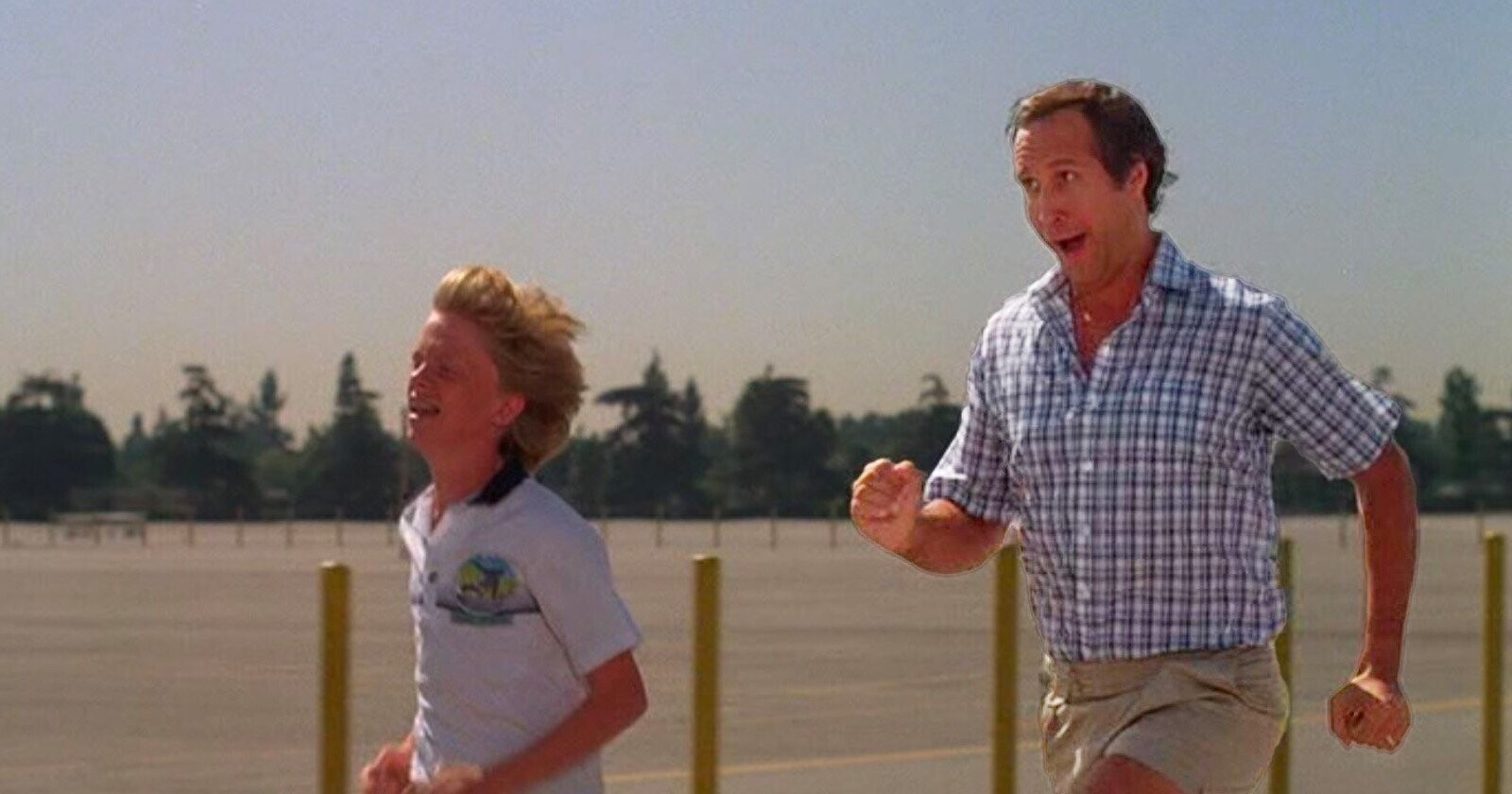
Few movie dads have turned frustration into an Olympic sport quite like Clark Griswold. In National Lampoon’s Vacation, Chevy Chase plays Clark as the ultimate American optimist: part loving father, part suburban dictator, part man who should absolutely not be trusted with a BB gun after driving 2,460 miles. The 1983 road-trip comedy has become a classic because it understands something deeply true about family vacations: the more carefully you plan them, the more likely the universe is to throw a dead car, a dead aunt, a closed theme park, and Cousin Eddie into your itinerary.
But the version of Vacation audiences love today almost ended in a much darker place. The original ending did not give the Griswolds the chaotic Walley World payoff that fans remember. Instead, Clark dragged his exhausted family to the home of Roy Walley, the park’s Walt Disney-like owner, and essentially invaded the place. Funny? Maybe on paper. Charming? Not so much. Test audiences reportedly laughed through most of the movie, then went quiet when the finale denied them the park they had been waiting to see.
That silence changed everything. Director Harold Ramis recognized that the movie had a likability problem, especially with Chevy Chase’s Clark Griswold. Clark could be selfish, delusional, rude, impulsive, and wildly irresponsible, but the audience still needed to root for him. Ramis asked screenwriter John Hughes to write a new ending. The result was the Walley World climax we know now: Clark snaps, buys a BB gun, takes a security guard played by John Candy on an unwilling park tour, and somehow turns a criminal act into a goofy, cathartic finale.
In other words, Harold Ramis did not simply change the ending of National Lampoon’s Vacation. He changed how audiences felt about Chevy Chase’s character. He rescued Clark Griswold from becoming too mean, too creepy, and too hard to forgive. That rewrite helped transform a sharp, strange, sometimes cruel comedy into a beloved American road-trip movie that still makes viewers laugh, wince, and reconsider driving anywhere with relatives.
The Original Ending Was Much Darker Than the One Fans Know
The finished movie builds toward a simple promise: the Griswolds are going to Walley World. Every disaster matters because Clark keeps insisting that the destination will justify the suffering. The ugly Wagon Queen Family Truckster, the motel misery, the desert breakdown, Aunt Edna on the roof, the awkward flirtation with Christie Brinkley’s mysterious Ferrari driver, and the family’s mounting irritation all point toward one question: will they finally get their day at the park?
In the original cut, the answer was basically: no, not really. After arriving in California and learning that Walley World is closed, Clark did not force his way into the park. Instead, he tracked down Roy Walley at home. The Griswolds crashed into the world of corporate comfort and demanded entertainment as compensation for their ruined journey. The sequence reportedly involved Clark holding Walley and his associates hostage with a pellet gun while making them sing and dance for him.
As an idea, the ending matched the savage spirit of National Lampoon humor. It was anti-sentimental, aggressive, and absurd. It took the American family vacation fantasy and smashed it through a mansion gate. The problem was that it did not feel like a satisfying ending to the movie audiences had been watching. After spending more than an hour on the road with Clark, Ellen, Rusty, and Audrey, viewers wanted the payoff of Walley World. They wanted the roller coaster. They wanted the ridiculous moose mascot. They wanted to see the promised land, even if the promised land had a “closed for repairs” sign on it.
By shifting the action from Roy Walley’s house back to the theme park, Ramis made a crucial storytelling correction. He gave the audience the location it had earned. Clark still behaved outrageously, but now his meltdown happened inside the fantasy space the whole movie had been chasing. The difference sounds small, but in comedy, geography matters. A desperate dad hijacking a theme park feels like farce. A desperate dad invading a private home feels more like the evening news with a laugh track.
Why Clark Griswold Needed to Stay Likable
Chevy Chase’s performance in National Lampoon’s Vacation walks a very thin line. Clark Griswold is not a saint. He lies, steals, loses his temper, ignores his family’s feelings, and becomes obsessed with proving that his vacation dream is meaningful. He wants togetherness, but he often treats his wife and children like passengers on the Clark Griswold Emotional Support Express. Next stop: denial.
That is also why the character works. Clark is funny because he is recognizably human. He is the parent who overschedules the trip, the driver who refuses to admit he is lost, the vacation planner who treats a closed attraction like a personal betrayal by the Constitution. He is not evil; he is overwhelmed, embarrassed, and desperate to turn chaos into a memory his family will someday appreciate. Preferably before they file a group complaint.
The original ending pushed Clark too far into menace. Taking a security guard through a closed amusement park at BB-gun-point is obviously wrong, but it remains cartoonish because the sequence is staged as slapstick. John Candy’s gentle, nervous presence softens the danger. The roller coasters, costumes, and park setting keep the tone playful. Roy Walley eventually appears, hears Clark out, and chooses not to press charges. The movie lands on absurd forgiveness rather than bitter punishment.
At Roy Walley’s home, however, Clark’s actions become more personal and invasive. He is no longer a frustrated customer confronting an institution; he is a man breaking into someone’s private space. Even in a broad comedy, that changes the emotional temperature. The audience can forgive Clark for losing his mind at the gates of Walley World because the park represents everything he has been chasing. It is harder to forgive him for terrifying executives at a private lunch. That version makes Chevy Chase less lovable and Clark Griswold less like a misguided dad and more like a warning label in khaki pants.
Harold Ramis Understood the Comedy Math
Harold Ramis was a master at making chaotic characters feel strangely understandable. Before directing Vacation, he had co-written National Lampoon’s Animal House and directed Caddyshack. He knew how to make unruly comedy feel loose without letting it collapse. His best work often balanced rebellion with structure. The jokes could be wild, but the emotional logic still had to hold.
That instinct mattered enormously here. A road-trip comedy is episodic by nature. The plot keeps moving from one disaster to another, and the audience accepts the loose structure because travel itself is loose. You stop, suffer, snack, argue, and continue. But an episodic movie still needs a destination that feels worth the ride. Ramis realized that Vacation could survive dead dogs, dead relatives, car trouble, wrong turns, and Clark’s wandering eye. What it could not survive was withholding the climax the whole story had promised.
The revised ending also gave the movie one of its most important supporting performances. John Candy, playing the Walley World security guard, brings warmth to a scene that could have been harsh. Candy had a gift for making panic adorable. His character is frightened, confused, and physically dragged into Clark’s breakdown, yet he never turns the scene grim. His presence helps the audience laugh at Clark’s madness without feeling too uneasy about it.
That is the comedy math Ramis solved: Clark could be unreasonable as long as the movie remained generous around him. The theme park setting, Candy’s sweetness, the family’s shared exhaustion, and Roy Walley’s eventual mercy all create a cushion. Clark goes too far, but the movie tells us he is a fool, not a villain. Without that cushion, the ending would have landed with a thud.
John Hughes’ Story Had a Sharper Edge
National Lampoon’s Vacation began as John Hughes’ short story “Vacation ’58,” which was inspired by childhood road-trip memories and filtered through the anarchic style of National Lampoon. The story was originally told from the son’s point of view, which gave the material a different flavor. A child watching a father unravel can make the father seem mythic, embarrassing, scary, and hilarious all at once.
When the story became a film, the focus shifted toward Clark. That change made sense with Chevy Chase in the lead role. Chase was already known for his dry arrogance, physical comedy, and smug comic timing. But shifting the center of gravity from Rusty to Clark created a new challenge: the movie now depended on the audience’s relationship with the dad. Clark could no longer be only a ridiculous figure observed from a distance. He had to carry the movie.
That is why the ending mattered so much. A darker ending might have worked better if the movie had remained more clearly Rusty’s story. From a child’s perspective, Dad shooting the American vacation dream in the leg is outrageous satire. From Dad’s perspective, the same behavior risks becoming alienating. Ramis and Chase had helped reshape the story around the father, so Ramis also had to protect the father’s comic appeal.
Hughes’ rewritten finale did not remove the dark humor. Clark still threatens someone. The police still arrive. The family still ends the trip in a state of legal and emotional absurdity. But the revised scene turns the darkness into a roller coaster, literally and structurally. It allows the audience to experience the fantasy of rule-breaking without fully abandoning affection for the rule-breaker.
The Walley World Ending Gives the Audience the Payoff
The brilliance of the final Walley World ending is that it satisfies two needs at the same time. First, it confirms that Clark’s dream is ridiculous. After everything the family has endured, the park is closed. Reality wins. The universe looks Clark in the face and says, “Nice itinerary, buddy. Try again in two weeks.”
Second, it lets Clark rebel against that reality in a way that feels like comic wish fulfillment. Everyone who has arrived somewhere after a long, painful journey only to find a locked gate understands the feeling. Most people sigh, take a photo of the sign, and go find a sad sandwich. Clark buys a BB gun and creates a private theme-park experience. This is not recommended behavior, but as comedy, it is wonderfully unhinged.
The ending also completes the movie’s emotional arc. Clark’s dream of the perfect family vacation has been exposed as selfish and impossible, yet the family ends up sharing an experience they will never forget. Not a wholesome experience, exactly. More like a “please never tell Grandma the full story” experience. Still, they are together. They ride the rides. They survive the trip. They become the Griswolds as pop culture remembers them: dysfunctional, resilient, and weirdly bonded by disaster.
Had the movie ended at Roy Walley’s house, the audience would have been denied that final release. The family would have crossed America for a destination the film refused to fully deliver. The revised ending turns disappointment into action, action into farce, and farce into forgiveness. That is why it feels bigger, funnier, and more rewatchable.
How the Changed Ending Helped Chevy Chase
Chevy Chase’s comic persona has always had a sharp edge. He is excellent at playing men who think they are smoother, smarter, and more charming than they actually are. Clark Griswold uses that quality perfectly. He is confident when he should be humble, cheerful when everyone else is miserable, and romantic in ways that make viewers want to hide behind a sofa cushion.
The revised ending helps Chase because it reframes Clark’s selfishness as desperation rather than cruelty. By the time he reaches Walley World, Clark has lost money, dignity, patience, sleep, and possibly several layers of sanity. The closed park becomes the final insult. Chase plays the breakdown as a man whose entire identity as a provider of fun has collapsed. He is not simply angry that the park is closed; he is terrified that the whole journey meant nothing.
That emotional panic makes Clark more sympathetic. Viewers may not approve of his choices, but they understand the wound underneath them. His family did not want his perfect vacation as intensely as he did, but he wanted to give them something grand. The fact that he failed spectacularly is the joke. The fact that he cared is what keeps him human.
Ramis’ change made Chevy Chase more likable because it gave his character a more audience-friendly form of madness. Clark hijacking fun at Walley World is absurdly wrong, yet it is connected to a relatable disappointment. Clark invading Roy Walley’s mansion would have made him look entitled in a colder way. The final version lets Chase remain smug, manic, and foolish while still being the dad audiences quote, imitate, and forgive.
Why the Reshoot Became Part of the Film’s Legend
The replacement ending was not just a minor edit. It required new material, a new location, and a new supporting character. The Walley World scenes were shot after the original production, which explains why sharp-eyed viewers notice continuity changes, especially with young Anthony Michael Hall. The reshoot also added physical demands, including repeated roller-coaster rides, which reportedly were not exactly a spa day for Chevy Chase’s stomach.
Yet the inconvenience paid off. National Lampoon’s Vacation opened in 1983 and became a major comedy hit. Its success helped launch a franchise and gave American pop culture one of its most durable families. The Griswolds returned in later films, most famously National Lampoon’s Christmas Vacation, where Clark’s impossible dream shifted from the perfect road trip to the perfect holiday. Apparently, the man learned nothing, and we are all better off for it.
The lost original ending remains fascinating because it reveals how close the movie came to becoming something harsher. Fans naturally want to see it. Deleted scenes have a special power, especially when they involve a classic film. They feel like secret rooms in a house we thought we knew. But the fact that the original ending remains largely unseen may also protect the movie’s magic. We can imagine it, discuss it, and appreciate the creative decision without having it replace the version that works.
Experiences Related to the Ending: Why This Rewrite Still Feels Personal
The reason this production story still connects with audiences is that almost everyone understands Clark Griswold on some uncomfortable level. Maybe you have not driven a station wagon across the country with a dead aunt on the roof. Hopefully, that box remains unchecked. But most people have experienced a plan collapsing after they invested too much hope in it. A hotel reservation disappears. A flight gets canceled. A theme park closes. A restaurant with “world-famous” pancakes turns out to be world-famous only among raccoons. Suddenly, the cheerful planner becomes the family villain.
That is where National Lampoon’s Vacation becomes more than a collection of gags. It captures the emotional weirdness of travel. Vacations are supposed to be relaxing, but they often become performances. Parents want children to be grateful. Couples want everything to feel romantic. Families want photos that suggest harmony, even if everyone was silently furious three minutes before the shutter clicked. Clark is ridiculous because he tries to force meaning onto every mile. He does not want a vacation; he wants proof that he is a good father.
Ramis’ changed ending works because it turns that familiar pressure into a comic explosion. The audience laughs at Clark because he does what civilized people secretly imagine for half a second before common sense returns. When the destination fails him, he refuses to accept it. He demands the memory he was promised. That is childish, dangerous, and very funny. It is also emotionally recognizable. Anyone who has spent money, time, and energy on a family experience knows the terrible temptation to say, “No, we are having fun, and we are having it now.”
The better lesson, of course, is not to buy a BB gun or terrorize a security guard. The better lesson is that the story we think we are creating is rarely the one our family remembers. Kids may forget the perfect schedule, but they remember the weird detours. Couples may forget the planned dinner, but they remember laughing in the broken-down car. The trip becomes meaningful not because it went smoothly, but because everyone survived the chaos together.
That is why Clark remains oddly lovable. He is wrong in nearly every practical sense, yet his emotional mistake is common: he confuses love with control. He thinks being a great dad means delivering the perfect vacation. By the end, the movie gently suggests that family memories are messier than that. Sometimes the best story begins when the plan fails. Sometimes the closed gate becomes the punchline. And sometimes a director like Harold Ramis saves a movie by understanding that audiences will forgive a fool much faster than they will forgive a bully.
Conclusion
Harold Ramis changed the original ending of National Lampoon’s Vacation because the movie needed more than a shocking finale. It needed a satisfying one. The first ending pushed Clark Griswold too far into unpleasant territory, turning his frustration into a home-invasion-style confrontation that made Chevy Chase’s character harder to like. The revised Walley World ending kept Clark outrageous but made his meltdown feel connected to the audience’s own expectations.
That creative decision helped preserve the movie’s heart. Clark still behaves badly, but he does so inside a comic fantasy the audience understands. John Candy’s security guard softens the chaos, Roy Walley’s forgiveness keeps the ending buoyant, and the long-awaited trip through Walley World gives viewers the payoff they had been promised. It is a perfect example of how a rewrite can save not just a scene, but an entire character.
More than four decades later, National Lampoon’s Vacation remains funny because it is built on a truth every traveler knows: the road to family happiness is usually under construction. Ramis saw that the ending had to make Clark Griswold foolish, not unforgivable. That one adjustment helped turn a troubled finale into a comedy classicand made Chevy Chase’s most chaotic movie dad just likable enough to invite back for another disastrous trip.