Some inventions begin with a dramatic flash of inspiration. Others begin when someone stares at a row of prescription bottles and thinks, “There has to be a less confusing way to do this.” The Smart Desktop Medicine Organizer, a semifinalist in the 2015 Hackaday Prize, belonged firmly to the second category.
Created by a maker named Joe, the project was imagined as a coffee-machine-sized device that could store medications, organize individual pills, dispense the correct dose, record medication activity, and communicate with caregivers or pharmacies. In other words, it was a pillbox after several semesters of engineering school and one unusually productive weekend.
Although the prototype emerged more than a decade ago, its central idea remains highly relevant. Medication management is not simply a matter of remembering that pills exist. People may need several prescriptions with different schedules, dosage limits, food instructions, refill dates, and interaction warnings. A smart medication dispenser attempts to turn that complicated routine into a safer, clearer process.
Why Medication Management Needs More Than a Beeping Pillbox
Traditional weekly organizers are useful, inexpensive, and refreshingly free of software updates. However, they still depend on someone correctly sorting every dose and remembering when each compartment should be opened. That system becomes harder to manage when a person takes several medications, has changing prescriptions, experiences memory difficulties, or needs an as-needed medicine with strict limits.
Medication nonadherence can include forgetting a dose, taking it at the wrong time, using the wrong medicine, accidentally repeating a dose, or stopping treatment without professional advice. These mistakes are not always caused by carelessness. Small labels, similar-looking tablets, complex schedules, reduced dexterity, poor eyesight, cost concerns, side effects, and simple human fatigue can all interfere with a medication routine.
A connected automatic pill dispenser can address part of the problem by combining storage, reminders, controlled access, logs, and remote notifications. It cannot replace a doctor or pharmacist, and it certainly should not begin improvising prescriptions like an overly confident kitchen appliance. Its job is narrower: help the user follow an already verified medication plan.
Inside the Hackaday Smart Medication Dispenser
A Raspberry Pi at the Center
The Smart Desktop Medicine Organizer was controlled primarily by a Raspberry Pi. The computer ran a local web server and displayed its interface through a small touchscreen operating in kiosk mode. Commands from the interface controlled servos, checked the mechanical position, retrieved schedules, and recorded dispensing events.
Medication inventory and timing information were stored in a local SQLite database. A Wi-Fi adapter allowed a smartphone to connect to the machine’s internal server, creating a path for remote management without making internet access essential for basic dispensing. This local-first approach was an important design choice: a person should not lose access to a scheduled dose merely because the router has decided to take an unscheduled vacation.
Rotating, 3D-Printed Mechanics
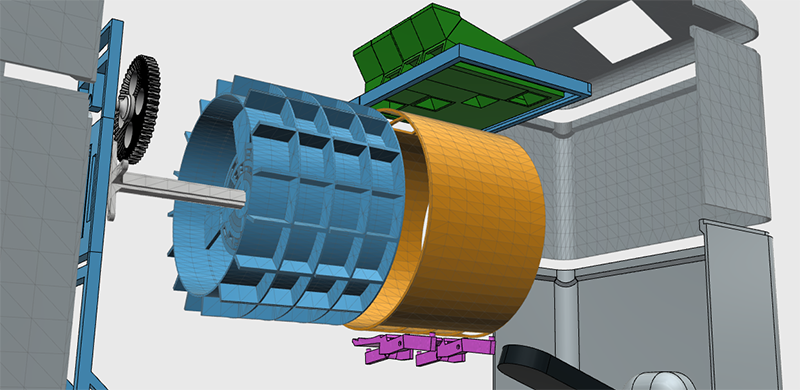
The prototype used 3D-printed mechanical parts, servos, an encoder, and a custom power-management board. Its rotating barrel contained a grid of individual storage locations. The project logs described a 16-by-4 arrangement, giving the mechanism dozens of separate pill slots.
A pill could be loaded into a selected opening at the top. When the correct slot rotated into position, a small door at the bottom opened and gravity delivered the pill. The concept allowed each tablet to be stored and accessed independently rather than mixing an entire dose in one compartment.
For demonstrations, the builder used colorful M&M candies instead of actual medication. The candy made movement easier to see on video and gave the prototype a cheerful vending-machine personality. The M&Ms were stunt doubles, however; the real engineering problem was much less cooperative.
Scheduling, Logging, and User Choices
The software checked the schedule database regularly to determine whether a medication was due. When it was time for a dose, the machine could show a message and play an audible or spoken reminder. The user could then choose to dispense the medication, snooze the alert, or cancel it.
Every event could be logged with the time, medication, user, and outcome. That record was useful for answering the familiar question, “Did I already take that pill?” It also created a foundation for caregiver monitoring and more informed conversations with healthcare professionals.
Features That Made the Project Ambitious
Independent Access to Individual Pills
Many electronic pillboxes unlock a prefilled compartment at a scheduled time. Joe’s design aimed to go further by storing pills individually and retrieving a specific item on demand. That architecture could theoretically support schedule changes, several users, inventory tracking, and medicines taken only when needed.
Independent access also introduced serious engineering responsibilities. The mechanism needed to select exactly one pill, prevent neighboring pills from escaping, detect jams, and confirm that the requested item had actually reached the cup. “Probably dispensed something” is not an acceptable status message in medication technology.
Flexible Rules for As-Needed Medication
A normal alarm works well for a tablet taken every morning at 8:00. It works less well for a medication prescribed only when symptoms occur, especially when the prescription includes a maximum frequency or daily limit.
The proposed interface could prevent another dose from being released until the appropriate interval had passed. This represented an early attempt to encode more realistic medication rules rather than forcing every prescription into a simple daily timer.
Such controls would need to be configured and verified by an authorized professional in a production device. Software can enforce a rule faithfully while still enforcing the wrong rule, which is why safe configuration matters as much as reliable code.
Connections to Pharmacy and Drug Information Systems
The project envisioned barcode scanning and pharmacy integrations that could retrieve prescription details, identify medications, monitor inventory, and request refills. It also explored using drug-information databases to warn about possible interactions.
That vision anticipated many features now associated with connected medication-management products. It also exposed a problem that remains familiar to health-technology developers: useful data may be scattered across incompatible systems, restricted interfaces, changing APIs, and databases with different identifiers.
A consumer device should never independently decide that two medicines are safe together. Interaction screening should function as a warning and communication aid, with final decisions left to pharmacists, prescribers, and verified clinical systems.
Remote Caregiver Visibility
The planned smartphone interface could allow a family member or caregiver to review medication activity. Community feedback also encouraged missed-dose notifications, recent-dose history, and an assistance button for reporting a problem.
These ideas have become common in modern smart medication dispensers. Remote visibility can reduce uncertainty for caregivers, but alerts must be carefully designed. A single missed event should not automatically trigger five phone calls, three emergency messages, and a neighborhood search party. Good escalation begins with a gentle reminder and becomes more urgent only when appropriate.
The Hard Engineering Problems Hidden Inside the Box
Pills Refuse to Be Standardized
Tablets and capsules come in different diameters, thicknesses, coatings, shapes, textures, and levels of fragility. A mechanism that handles a smooth round tablet may struggle with a soft gel capsule or an oblong pill. Humidity and static electricity can make matters worse.
The rotating barrel also raised concerns about pills rubbing against surfaces or being damaged as other compartments moved. The builder considered alternative horizontal storage designs that would reduce unnecessary movement. That willingness to rethink the mechanism is exactly what prototype development should look like: build, test, discover that physics has opinions, and revise.
Cleaning and Cross-Contamination
Residue from one medication must not contaminate another. Even a small amount can be important when allergies or highly potent drugs are involved. The first prototype was not easy to clean, so later design ideas included removable trays and reusing specific slots for the same medication.
A production-ready dispenser would need smooth, accessible surfaces, documented cleaning procedures, compatible materials, replaceable medication-contact parts, and a design that minimizes direct contact between loose pills and shared mechanisms. Individually packaged doses may offer additional protection, although they require a different dispensing architecture.
Detecting a Successful Dispense
Moving a servo is not the same as delivering a pill. A reliable system must confirm that the medication left storage, passed through the chute, and reached the user. Optical sensors, weight measurements, motor-current monitoring, cameras, or multiple sensing methods could provide that confirmation.
The device should also stop safely when it detects a jam. Continuing to grind the mechanism until something gives up is a reasonable strategy for a cheap toy robot, but less charming in a machine containing prescription medicine.
Power, Connectivity, and Recovery
The prototype could dispense locally without Wi-Fi, using connectivity mainly for monitoring and management. A practical version should also include battery backup, visible power status, offline logs, secure synchronization, and a manual recovery procedure.
Users need clear instructions for handling an outage. The interface should explain whether a dose was released, whether it was acknowledged, and how manually taken medication can be recorded without accidentally creating a second dose.
Privacy and Cybersecurity
Medication records can reveal sensitive information about a person’s health. A connected dispenser therefore needs encrypted communications, authenticated accounts, access controls, secure software updates, audit logs, and sensible data-retention policies.
Remote management also requires strict boundaries. Caregivers may need status information, but changing schedules or unlocking restricted medication should require stronger authorization. Convenience is valuable; an internet-connected “dispense now” button with casual security is not.
How the Smart Medication Dispenser Could Be Improved Today
A modern redesign could preserve the original maker spirit while applying lessons from human-factors research, medication safety, and connected-device development.
- Use modular medication cartridges: Removable, labeled cartridges would simplify refilling, cleaning, and medication changes.
- Add redundant dispense verification: Optical and weight sensors could confirm that the correct number of pills reached the cup.
- Keep core functions local: Scheduling and dispensing should continue during internet outages, with secure synchronization afterward.
- Design for accessibility: Large text, high contrast, spoken instructions, physical buttons, and adjustable volume would help users with different abilities.
- Provide graduated reminders: The system could begin with a local prompt, repeat it, notify a caregiver, and escalate only according to an approved plan.
- Separate clinical rules from user preferences: Users might adjust reminder sounds, but dosage limits and prescription schedules should require authorized approval.
- Include a transparent event history: The screen should clearly show what was scheduled, dispensed, canceled, missed, or manually recorded.
Most importantly, development should involve patients, caregivers, pharmacists, nurses, and clinicians from the beginning. A device may perform beautifully on an engineer’s workbench yet become frustrating in a dim kitchen at 6:00 a.m. Human-centered testing reveals problems that CAD software cannot.
Why This Hackaday Prize Semifinalist Still Matters
The Smart Desktop Medicine Organizer was not merely a timer connected to a motor. It proposed a broader medication-management platform combining mechanical automation, inventory control, scheduling, local records, mobile access, pharmacy data, and caregiver communication.
Some parts of the vision were more mature than others. The mechanical tolerances were difficult, pharmacy integrations were inconsistent, and cleaning required a redesign. Those limitations do not make the project less interesting. They show why medication dispensing is a rich engineering challenge rather than a weekend variation on a candy machine.
The project also demonstrated the value of open development. Community members questioned cleaning, pill identification, power failures, logs, wearable alerts, caregiver access, and emergency features. The builder responded publicly and incorporated several suggestions. That conversation turned a personal prototype into a small, collaborative design laboratory.
Research into modern smart medication systems suggests that reminders, real-time records, controlled access, and caregiver support can be useful. However, effectiveness depends heavily on usability, affordability, training, reliability, and how well the product fits an individual’s routine. The smartest dispenser is not necessarily the one with the most features. It is the one that quietly helps the right person take the right medication without creating a new part-time job.
Practical Experiences With Smart Medication Dispensers
The following experience-based scenarios combine common lessons reported by users, caregivers, researchers, and prototype builders. They are illustrative rather than the medical history of one specific person.
The First Morning: Less Guessing, More Trust
The greatest benefit may appear during an ordinary morning. A user enters the kitchen, hears a calm reminder, and sees a large message identifying the scheduled dose. After pressing the dispense button, the machine releases the medication and records the event.
The process feels almost boring, which is a compliment. There is no need to open several bottles, study tiny labels, or wonder whether yesterday’s compartment was accidentally reused. The machine removes several small decisions from a routine that may already feel crowded.
Trust does not arrive immediately, though. New users often inspect the cup, compare the pill with its description, and watch the mechanism suspiciously. A clear display helps by showing the medication name, scheduled time, quantity, and successful-dispense status. After repeated accurate operation, the device begins to feel less like an experimental robot and more like a dependable household tool.
The Caregiver Experience: Information Without Constant Checking
For a family caregiver, uncertainty can be more stressful than the physical task of filling an organizer. A missed phone call may lead to questions: Was the medication taken? Was the reminder heard? Is the person asleep, outside, or having a problem?
A connected dispenser can replace some of that uncertainty with a simple status record. The caregiver may see that the morning dose was dispensed and acknowledged, eliminating an unnecessary call. When a dose remains uncollected, the system can send a notification after a reasonable delay.
The quality of those alerts matters enormously. Too many notifications create alarm fatigue, and alarm fatigue eventually turns a smartphone into an expensive device for ignoring beeps. The best experience comes from customizable escalation rules, accurate event detection, and language that explains what happened without pretending the system knows more than it does.
The Builder Experience: The Software Is Easy Until the Pill Moves
From a maker’s perspective, creating schedules and database entries can feel straightforward compared with handling physical medication. On-screen buttons behave predictably. Pills do not. They tilt, stick, bounce, chip, bridge across openings, and occasionally demonstrate entirely new interpretations of gravity.
Testing with candy is useful for visibility, but it cannot represent every tablet or capsule. Builders quickly learn to test different shapes and sizes, introduce deliberate jams, disconnect power at inconvenient moments, fill storage incorrectly, and press interface controls in the wrong order. A safe design must survive imperfect use rather than assuming every refill will be performed by a rested engineer under studio lighting.
One of the most valuable experiences is watching a new user operate the prototype without coaching. A control that seemed obvious may be overlooked. A spoken reminder may be too fast. A touchscreen target may be too small. The refill process may require more strength or precision than expected. Every hesitation is design data.
The Long-Term Lesson: Support the Routine, Not the Gadget
After the novelty fades, users care less about processors, cloud dashboards, and servo specifications. They care whether the dispenser fits on the counter, wakes them at night, survives an outage, remains easy to refill, and gives an understandable answer to “Did I take it?”
That is the lasting lesson of the Hackaday Prize semifinalist. Successful health technology does not show off constantly. It reduces friction, prevents avoidable confusion, and stays out of the way until it is needed. The engineering may be sophisticated, but the daily experience should feel wonderfully simple.
Conclusion
The Hackaday Prize Smart Medication Dispenser captured a powerful idea: medication management could be treated as a coordinated system rather than a collection of bottles and alarms. Its Raspberry Pi controller, touchscreen interface, local database, rotating pill mechanism, flexible schedules, remote monitoring plans, and pharmacy-integration ambitions made it unusually forward-looking for a 2015 maker project.
The prototype also revealed the difficult realities behind automatic pill dispensing. Reliable selection, contamination prevention, accessible controls, dispense confirmation, data security, offline operation, and professional oversight are not optional finishing touches. They are the foundation of a safe product.
Even with those challenges, the project deserves its place among memorable Hackaday Prize semifinalists. It demonstrated how open-source hardware and thoughtful software could address an everyday healthcare problem while inviting the community to improve the design. Sometimes the best hack is not a device that performs a spectacular trick. It is one that helps someone complete an important routine correctly, day after day, without needing a flowchart and three reminder notes.