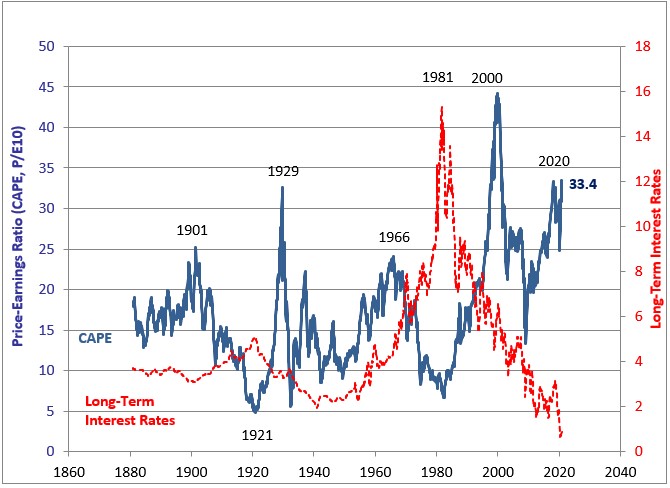
Every market cycle eventually produces a sentence that makes investors sit up straighter, clutch their coffee, and wonder whether they should hide under the nearest dividend-paying sofa: “Stocks are expensive.”
In the current cycle, that sentence is not entirely wrong. U.S. stocks have been supported by resilient corporate earnings, huge investment in artificial intelligence infrastructure, powerful profit margins, and an economy that has repeatedly refused to collapse on schedule. At the same time, major equity benchmarks have traded at elevated valuation levels compared with long-term averages.
So, could we see record stock market valuations this cycle? Yes. It is absolutely possible. But the more useful question is not whether valuations can reach records. Markets are remarkably talented at doing things that once seemed unreasonable. The better question is whether earnings, interest rates, productivity gains, and investor expectations can support those valuations without turning the market into a very expensive game of musical chairs.
The Short Answer: Record Valuations Are Possible, but They Need a Strong Foundation
Stock market valuations can reach record levels when investors believe future profits will grow faster, last longer, or become more dependable than previously expected. That sounds obvious, but the market often treats “obvious” as an invitation to build a 40-story expectation tower and then argue over whether it needs a rooftop pool.
For valuations to keep climbing, the market will likely need several things to happen at once:
- Corporate earnings must continue rising at a healthy pace.
- Inflation must remain manageable enough to avoid a major rise in interest rates.
- AI investment must translate into measurable productivity and profit growth.
- Economic growth must stay positive without overheating.
- Investors must remain willing to pay premium prices for large-cap growth companies.
That is not impossible. In fact, much of the current bullish argument is built around exactly those conditions. Still, the market is demanding a lot. Elevated valuations leave less room for bad earnings reports, stubborn inflation, weak consumer spending, geopolitical shocks, or a sudden realization that not every company with “AI” in its earnings presentation is about to become the next industrial revolution.
What Does “Record Stock Market Valuations” Actually Mean?
Before declaring that the stock market has entered the financial version of outer space, it helps to define what valuation means. Investors use several measures to judge whether stocks are cheap, fair, expensive, or priced as though every CEO has discovered a portal to a profitable alternate universe.
Forward Price-to-Earnings Ratio
The forward price-to-earnings ratio, often called the forward P/E ratio, compares today’s stock prices with analysts’ estimates of future earnings. It is one of the most watched measures because markets are supposed to care about future profits, not just last year’s accomplishments.
During 2026, the S&P 500’s forward P/E ratio has remained above its long-term average, even as earnings estimates have improved. That matters because rising earnings can reduce valuation pressure. If stock prices rise 10% but profits rise 15%, the market may become less expensive on an earnings basis even while headlines scream about record highs.
Shiller CAPE Ratio
The cyclically adjusted price-to-earnings ratio, often called the Shiller CAPE ratio, uses inflation-adjusted earnings over a longer period. It is designed to smooth out short-term profit swings and provide a broader view of valuation.
High CAPE readings do not tell investors exactly when a downturn will happen. They are not market-timing magic wands. They are more like a dashboard warning light: ignore it for too long, and you may eventually hear a noise that sounds expensive.
Price-to-Sales and Profit Margins
Price-to-sales ratios are useful when investors want to understand how much the market is paying for each dollar of company revenue. This is especially relevant for large technology companies, software firms, semiconductor businesses, and AI infrastructure providers.
However, sales alone are not enough. A company can have massive revenue and still lose money with the efficiency of a teenager holding a credit card at a sneaker release. Profit margins matter. The current market has benefited from strong operating margins, particularly among major technology and communication-services companies.
Equity Risk Premium
The equity risk premium compares the expected return from stocks with the return investors can earn from safer assets such as Treasury bonds. When bond yields rise, stocks must work harder to justify high valuations. Investors may decide that a reliable bond yield looks more attractive than paying premium prices for future growth.
This is one of the biggest challenges facing high stock market valuations. If Treasury yields remain elevated, there is less room for valuation multiples to expand. Stocks can still rise, but the gains may need to come more from earnings growth than from investors simply paying higher prices for the same dollar of profit.
Why Stock Market Valuations Could Reach New Highs
1. Earnings Growth Could Do the Heavy Lifting
The strongest argument for continued stock market gains is earnings. Analysts have raised expectations for S&P 500 earnings growth as companies report stronger revenue, healthier margins, and improving demand across several sectors.
This matters because high valuations are easier to defend when earnings are genuinely growing. A market trading at a premium multiple is far less concerning when corporate profits are expanding quickly than when prices are rising while profits are standing still and pretending to look busy.
Large technology companies have played a major role in this story. Cloud computing, digital advertising, semiconductors, cybersecurity, data centers, and enterprise software remain important contributors to market earnings. But the more encouraging development is that earnings growth has broadened beyond just a handful of mega-cap companies.
2. Artificial Intelligence Could Improve Productivity
Artificial intelligence is the main growth narrative of this cycle, and unlike some past investing frenzies, it is connected to real corporate spending. Major companies are investing heavily in data centers, chips, networking equipment, cloud services, energy infrastructure, and software tools.
The optimistic case is that AI could eventually improve productivity across industries. Manufacturers may automate planning and quality control. Hospitals may streamline administrative work. Financial firms may speed up research and customer service. Retailers may manage inventory more efficiently. Even the office printer may someday stop behaving like it has unresolved emotional issues.
If AI helps companies increase revenue while controlling labor and operating costs, profit margins could remain stronger for longer than investors currently expect. That would support higher stock market valuations because future earnings would become more valuable.
3. Strong Corporate Margins Can Support Premium Prices
Corporate profit margins have been unusually resilient. Many large companies have adapted to higher input costs, improved supply-chain efficiency, raised prices, automated operations, and focused aggressively on productivity.
Higher margins make the market more valuable because each dollar of sales produces more earnings. In a world where many companies can generate large cash flows with relatively low incremental costs, investors may be willing to pay higher multiples than they did in older, more capital-intensive economic eras.
That does not mean valuations can rise forever. It does mean historical averages should be interpreted carefully. Today’s S&P 500 includes a much larger share of asset-light, high-margin technology businesses than it did decades ago. Comparing every valuation measure with 1980 can be helpful, but it can also be like comparing a smartphone with a fax machine and declaring the fax machine “more reasonably priced.”
4. The Economy Has Been More Durable Than Expected
Economic growth has remained more resilient than many investors expected. Consumer spending, business investment, government spending, and infrastructure-related activity have all helped support demand.
A soft-landing scenario remains possible if inflation cools gradually, employment remains stable, and the Federal Reserve avoids keeping monetary policy restrictive for too long. In that environment, corporate earnings could continue climbing while interest rates slowly become less of a valuation headwind.
A soft landing is the market’s favorite outcome because it offers growth without a recession, lower inflation without a collapse in demand, and interest rates that are high enough to look responsible but not so high that they ruin everyone’s spreadsheet.
Why Record Valuations Could Become Dangerous
1. Interest Rates Still Matter More Than Investors Want to Admit
When interest rates are low, future profits become more valuable because investors are willing to wait longer for them. When rates rise, future earnings are discounted more heavily. This is especially painful for expensive growth stocks whose valuations depend on profits expected several years from now.
If inflation remains sticky, long-term Treasury yields could stay elevated or move higher. That would place pressure on the most richly valued parts of the market. A company can still be excellent, but even excellent companies can become disappointing investments when purchased at a valuation that assumes excellence will continue until the sun burns out.
2. Market Concentration Creates Fragility
The biggest U.S. technology and communication-services companies make up a large share of the market’s total value. Their earnings are impressive, but concentration creates risk. When a small group of companies drives a large share of index returns, the overall market can look healthier than the average stock actually feels.
That means a disappointment from one major semiconductor company, cloud provider, software platform, or digital advertising giant can ripple through index performance. Investors should distinguish between a broad-based bull market and a market where a few giant companies are doing the emotional heavy lifting for everyone else.
3. AI Spending Must Eventually Produce Results
AI investment is massive, and investors are currently rewarding companies that spend aggressively on chips, data centers, cloud capacity, and advanced software. But capital spending is not the same as profit.
At some point, investors will ask harder questions. Are companies earning attractive returns on AI investments? Are customers willing to pay enough for AI services? Can businesses defend their margins as competition grows? Does the technology reduce costs, create new revenue, or simply generate very impressive conference slides?
If AI productivity gains arrive slowly, valuations could fall even if the long-term technology story remains intact. Markets are impatient. They often want the future delivered overnight, preferably before the next quarterly earnings call.
4. Earnings Expectations Are Already High
Rising earnings estimates are good news, but they also raise the bar. When investors expect strong sales growth, expanding margins, and upbeat guidance, companies must deliver. A business that grows earnings by 12% may be doing very well in the real world, but its stock can still decline if investors were expecting 18%.
This is the central risk of record stock market valuations: not necessarily that companies become bad businesses, but that they become merely good when the market has priced them as flawless.
Three Scenarios for Stock Market Valuations This Cycle
Bull Case: Earnings Growth Justifies Higher Multiples
In the bullish scenario, AI investment drives productivity gains, earnings expand across more sectors, inflation gradually cools, and long-term interest rates remain manageable. Investors become more comfortable with premium valuations because profits keep rising fast enough to justify them.
Under this outcome, the S&P 500 could reach new highs in both price and valuation measures. The market would not necessarily be cheap, but it could remain expensive for rational reasons.
Base Case: Prices Rise, but Valuation Multiples Stay Contained
The more balanced scenario is that stocks continue rising mostly because earnings grow, while valuation multiples remain near elevated levels rather than expanding dramatically. This would be healthier than a pure speculation-driven rally.
In this environment, investors could still earn positive returns, but leadership may broaden beyond mega-cap technology. Financials, industrials, health care, energy, small-cap companies, and international stocks could become more important contributors.
Bear Case: High Expectations Meet Higher Rates
In the bearish scenario, inflation remains stubborn, bond yields rise, consumers weaken, and AI-related spending fails to produce fast enough returns. Earnings estimates decline while valuation multiples compress.
This does not require a recession. A market correction can happen simply because investors decide that paying 22 times earnings is less exciting when safer assets offer attractive yields. The market does not need a catastrophe to fall. Sometimes it only needs a calculator.
What Investors Should Watch Next
Investors looking for clues about whether record stock market valuations are sustainable should focus on a few key indicators:
- Earnings revisions: Are analysts raising or cutting profit forecasts?
- Revenue growth: Are companies growing sales, not just reducing expenses?
- Profit margins: Can businesses protect margins as wage, energy, and financing costs shift?
- Treasury yields: Are long-term yields falling, stable, or rising?
- AI spending returns: Are capital expenditures producing measurable business results?
- Market breadth: Are more stocks participating in gains, or is the rally narrowing?
- Consumer strength: Are households still spending, borrowing, and staying employed?
These indicators matter more than dramatic headlines. Markets often move in ways that look irrational in the short term, but earnings, cash flow, interest rates, and economic demand eventually reclaim the steering wheel.
A Sensible Response to Elevated Stock Market Valuations
High valuations are not an automatic signal to sell every stock, convert your portfolio into canned beans, and begin studying the emotional habits of gold coins. They are a signal to become more disciplined.
Long-term investors may consider maintaining diversified exposure instead of making all-or-nothing market bets. Diversification across sectors, company sizes, geographies, and asset classes can reduce the damage if a concentrated group of expensive stocks disappoints.
Investors can also focus on business quality. Companies with durable cash flow, reasonable debt levels, pricing power, strong balance sheets, and credible growth plans may be better equipped to handle economic uncertainty than speculative companies built entirely on enthusiasm and unusually photogenic slide decks.
Most importantly, avoid confusing a high-quality company with a guaranteed high-return investment. Great businesses can be poor investments when bought at extreme prices. Mediocre businesses can sometimes deliver strong returns when expectations are low. Valuation is not everything, but it is almost never nothing.
Investor Experiences: What This Cycle Feels Like in Practice
One common experience in a high-valuation market is feeling late to the party. Investors see indexes near record levels, hear constant discussion about AI, cloud computing, semiconductor demand, and automation, and assume that everyone else has already become wealthier while they were busy paying bills and trying to remember their password for the brokerage account.
That feeling can create urgency, and urgency can lead to poor decisions. Investors may buy the stocks that have already risen the most because those names are everywhere: in financial news, social media feeds, earnings call headlines, and conversations with the one friend who suddenly refers to himself as a “macro strategist” after owning an index fund for six months.
Another common experience is frustration with diversification. When a few giant technology companies lead the market, diversified portfolios can feel boring. Value stocks may lag. Small-cap stocks may seem invisible. International markets may not receive much attention. Bonds may feel uncool, which is not a scientific valuation metric but has been surprisingly powerful throughout financial history.
Yet boring diversification often becomes valuable when leadership changes. Investors who own only the hottest names may experience the full emotional roller coaster when earnings disappoint or interest rates jump. Investors with balanced exposure may not win every sprint, but they are less likely to discover that their portfolio was secretly built like a Jenga tower.
This cycle also creates a strange conflict between optimism and skepticism. The optimistic investor sees legitimate technological change. AI tools are improving, corporate capital spending is real, and many large companies are generating enormous profits. The skeptical investor sees high valuation multiples, concentrated indexes, rising capital expenditure, and a market that sometimes appears to have confused “exciting” with “risk-free.”
Both views can be reasonable. The challenge is avoiding extremes. Being bullish does not require pretending valuations do not matter. Being cautious does not require assuming every innovation is a bubble. The most useful investor mindset is often flexible rather than ideological.
Experienced investors also recognize that markets can stay expensive longer than expected. Selling everything simply because a valuation metric looks elevated can be costly if earnings keep growing and sentiment remains strong. On the other hand, ignoring valuation completely can be painful when enthusiasm finally fades and the market remembers that gravity has been patiently waiting nearby.
The practical lesson is to build a process. Decide how much risk you can tolerate before market volatility arrives. Rebalance when positions become too large. Keep enough cash or high-quality fixed income to avoid selling stocks during a panic. Review company fundamentals instead of chasing every headline. And remember that a market reaching a record high is not proof that it must immediately crash. It is simply proof that prices are higher than they were before.
Record stock market valuations may happen this cycle, especially if earnings remain strong and AI-driven productivity gains become more visible. But the higher valuations rise, the more investors should demand evidence. Optimism is healthy. Blind optimism is just optimism wearing sunglasses indoors.
Conclusion
Could we see record stock market valuations this cycle? Yes. Strong corporate earnings, AI investment, resilient profit margins, and a durable economy could push U.S. equity valuations to new highs. The market may be able to support premium prices if companies continue converting ambitious growth stories into measurable cash flow.
Still, elevated valuations create a narrow path. Interest rates, inflation, market concentration, capital spending, and earnings expectations will determine whether this cycle becomes a durable expansion or a painful reminder that the market occasionally gets carried away at its own birthday party.
The smartest approach is neither panic nor blind enthusiasm. Investors should watch earnings, rates, margins, and market breadth while staying diversified and disciplined. Record valuations can be rational, but they are never an excuse to stop asking difficult questions.