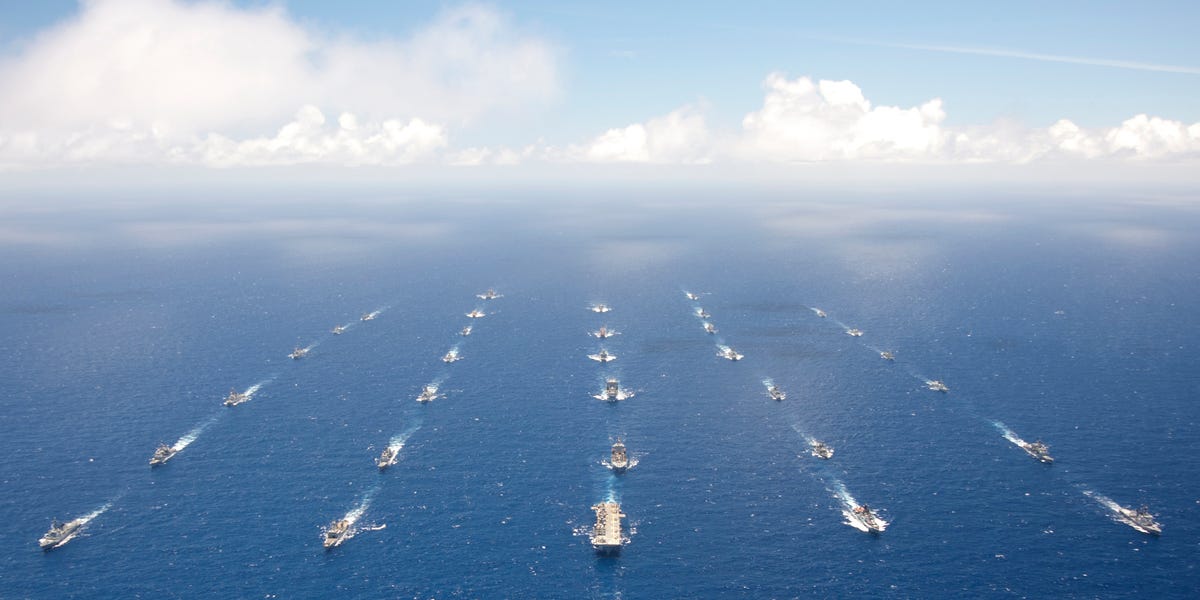
Every two years, the waters around Hawaii turn into the world’s largest maritime classroom, gymnasium, and geopolitical group chat. The event is called the Rim of the Pacific Exercise, better known as RIMPAC, and it brings together naval forces from across the Indo-Pacific and beyond. Ships arrive, aircraft roar, submarines slip quietly beneath the surface, and sailors from dozens of countries practice how to work together when the ocean stops being calm and starts being complicated.
But one major Pacific power is not on the guest list: China. Again.
That absence is not a clerical error, a lost email, or a “please check your spam folder” situation. It reflects a bigger strategic shift. RIMPAC used to be a place where the United States experimented with military engagement with China. Beijing participated in 2014 and 2016, and for a brief moment, there was hope that inviting the People’s Liberation Army Navy into a U.S.-led multinational exercise might encourage transparency, improve communication, and lower the risk of dangerous encounters at sea.
That optimism aged about as well as milk left on a destroyer deck in July. By 2018, the United States disinvited China from RIMPAC, citing Beijing’s militarization of disputed features in the South China Sea. Since then, China has remained outside the exercise, while RIMPAC has continued to expand as a gathering of U.S. allies and partners committed to a free and open Indo-Pacific.
So what does China’s absence from America’s big Pacific war games really mean? It is not just about one exercise. It is about trust, sea power, alliances, deterrence, and the increasingly crowded chessboard of the Pacific Ocean.
What Is RIMPAC, and Why Does It Matter?
RIMPAC is the world’s largest international maritime exercise. It began in 1971 and is hosted by the United States, centered in and around the Hawaiian Islands. The exercise usually includes warships, submarines, aircraft, land forces, coast guard units, and thousands of military personnel from partner nations.
At its core, RIMPAC is about interoperability. That is a big military word that basically means, “Can everybody work together without creating a floating traffic jam?” Different countries use different ships, command systems, languages, procedures, and military cultures. RIMPAC gives them a chance to practice together before a real crisis demands it.
The training can include maritime security, disaster response, search and rescue, amphibious operations, anti-submarine warfare, air defense coordination, logistics, and command-and-control exercises. In plain English, it is where navies learn how to coordinate under pressure.
RIMPAC also sends a message. When dozens of countries gather near Hawaii under a U.S.-led framework, it demonstrates that Washington is not operating alone in the Pacific. It has friends, partners, and allies who are willing to show up with ships, sailors, aircraft, and political commitment. In modern geopolitics, showing up is half the message. Showing up with a destroyer is the other half.
China Was Once Invited In
China’s absence today is striking because it was not always outside the tent. The United States invited China to RIMPAC as part of a broader effort to build military-to-military communication. China first participated in 2014, sending several vessels, including a hospital ship. It returned in 2016.
At the time, the logic was simple: if U.S. and Chinese forces were going to operate near each other in the Pacific, they should understand each other better. Joint participation could reduce misunderstandings, open channels of communication, and show Beijing that responsible maritime behavior came with international acceptance.
That was the hopeful version. The less charming version was that China also gained a close look at how the United States and its partners operate. Military exercises are not cocktail parties. They reveal habits, procedures, communication rhythms, command relationships, and sometimes weaknesses. Even when sensitive information is protected, the mere act of watching advanced navies cooperate can be educational.
China’s RIMPAC participation quickly became controversial. In 2014, while invited Chinese ships joined the exercise, China also sent an uninvited surveillance vessel near the exercise area. That move was technically legal under international law if conducted in appropriate waters, but diplomatically, it was the naval equivalent of bringing binoculars to a neighborhood barbecue.
By 2018, the experiment had largely run out of patience in Washington.
Why the United States Disinvited China in 2018
The turning point came with the South China Sea. The United States accused China of militarizing disputed features, especially in the Spratly Islands, where Beijing had built artificial islands and added military facilities. U.S. officials pointed to deployments such as anti-ship missiles, surface-to-air missile systems, electronic jamming equipment, and bomber activity as signs that China was changing facts on the water and in the air.
For Washington, this behavior clashed with the spirit of RIMPAC. The exercise is designed to strengthen cooperation, protect sea lanes, and support a rules-based maritime order. If a country is seen as undermining that order, inviting it to the world’s largest naval exercise becomes awkward. Very awkward. Like inviting a fox to a poultry safety seminar.
So the Pentagon withdrew China’s invitation to the 2018 exercise. The message was clear: participation in RIMPAC was not an entitlement. It was connected to behavior.
China rejected the U.S. accusations and argued that its activities in the South China Sea were lawful and defensive. Beijing has long maintained broad claims in the region and often describes U.S. military activity near China as provocative. That disagreement remains one of the central disputes in the Indo-Pacific.
Since then, China has not returned to RIMPAC. Meanwhile, the exercise has kept growing, with more countries using it as a platform to deepen ties with the United States and with one another.
RIMPAC Without China: More Than an Empty Chair
China’s absence does not make RIMPAC smaller in strategic meaning. In some ways, it makes the message sharper.
When China was present, RIMPAC had a confidence-building flavor. It suggested that the United States was willing to engage Beijing inside a cooperative framework. Without China, the exercise increasingly looks like a coalition rehearsal for a region where trust in Beijing has declined.
That does not mean RIMPAC is a “war with China” rehearsal in a simple or cartoonish sense. Real military exercises serve many purposes. They prepare forces for humanitarian crises, natural disasters, maritime accidents, piracy, illegal fishing, regional conflict, and high-end naval warfare. Still, nobody needs a decoder ring to understand the strategic backdrop. The Indo-Pacific is the main theater of U.S.-China competition, and RIMPAC is the biggest U.S.-led maritime exercise in that theater.
The guest list matters. Countries such as Japan, Australia, South Korea, the Philippines, Canada, India, Singapore, France, the United Kingdom, and others have participated in recent RIMPAC exercises. Many of these countries have direct concerns about maritime security, freedom of navigation, supply chains, and China’s growing naval reach.
In other words, China may not be at the exercise, but China is definitely in the room as a strategic subject. It is the guest not invited, the topic not always named, and the shadow on the briefing slide.
The South China Sea Is Still the Core Issue
The South China Sea is one of the world’s most important waterways. It connects major economies, carries huge volumes of trade, and sits near countries with overlapping territorial and maritime claims. China, the Philippines, Vietnam, Malaysia, Brunei, and Taiwan all have claims in the region, but Beijing’s claims are the most expansive and controversial.
Over the past decade, China has built artificial islands and installed infrastructure that can support military operations. The United States and many partners argue that these actions threaten freedom of navigation and increase pressure on smaller countries. China argues that it is defending its sovereignty and that outside powers are stirring trouble.
For U.S. planners, the issue is not only who owns which reef, rock, or artificial runway. It is whether a powerful country can use military and paramilitary pressure to reshape the rules of the sea. If that becomes normal in the South China Sea, the concern is that similar pressure could appear elsewhere.
That is why RIMPAC matters. It builds habits of cooperation among countries that want maritime disputes handled through law, negotiation, and open access rather than intimidation. The exercise is not a court ruling, a treaty, or a magic wand. But it is a visible demonstration that many countries prefer an ocean governed by rules rather than muscle.
China’s Navy Has Grown Dramatically
China’s exclusion from RIMPAC also reflects the changing balance of naval power. The People’s Liberation Army Navy has expanded rapidly and is now a central tool of Beijing’s global ambitions. China has invested in aircraft carriers, destroyers, submarines, amphibious ships, coast guard forces, maritime militia activity, and long-range missile systems.
This growth has changed how other countries view Chinese participation in sensitive exercises. In the early 2010s, inviting China to RIMPAC could be framed as engagement with a rising navy. Today, many U.S. strategists see China as a peer competitor whose forces are training to challenge U.S. advantages in the Western Pacific.
That creates a dilemma. Military communication with China is important because accidents and miscalculations at sea can escalate quickly. But giving Chinese forces access to advanced multinational training environments may also help them learn how U.S.-led coalitions operate. Diplomacy says “talk.” Security says “be careful what you reveal.” The result is a policy balancing act performed on a wet floor.
What America Gains by Keeping China Out
Keeping China out of RIMPAC gives the United States and its partners more freedom to train at higher levels of complexity. When a competitor is present, some scenarios may be limited, sensitive systems may be hidden, and planners may avoid certain discussions. Without China, the exercise can focus more openly on the capabilities and coordination that matter in a contested Indo-Pacific.
It also reassures allies. Countries that feel pressure from Beijing want to know whether the United States is serious about regional security. RIMPAC provides a visible answer. It shows that Washington can still convene a large coalition and that many countries are willing to train together under U.S. leadership.
There is also a political signal. Exclusion tells China that military behavior has consequences. Beijing may not change course because of one missing invitation, but the decision contributes to a broader pattern of diplomatic pushback, defense cooperation, and alliance strengthening.
What America Risks by Keeping China Out
There are costs, too. When China is excluded from major military engagement, opportunities for communication shrink. U.S. and Chinese ships and aircraft still operate near each other. If commanders do not understand each other’s habits, signals, and red lines, the risk of miscalculation increases.
Military-to-military contact is not a reward for good behavior only. Sometimes it is a safety valve. Even rivals need channels to prevent accidents from becoming crises. The Cold War proved that communication between competitors can be just as important as communication among friends.
That is the hardest part of the RIMPAC debate. China’s behavior has made inclusion politically and strategically difficult. But total isolation is not a perfect answer either. The challenge is finding ways to maintain crisis communication without giving away valuable operational insight or normalizing coercive behavior.
The 2024 and 2026 RIMPAC Signals
RIMPAC 2024 brought together 29 nations, around 40 surface ships, submarines, more than 150 aircraft, land forces, and over 25,000 personnel. China was not listed among the participating countries. The official theme, “Partners: Integrated and Prepared,” said a lot in just three words. The exercise was about integration, readiness, and partnership in a region where the security environment is anything but sleepy.
For 2026, U.S. Pacific Fleet announced the 30th RIMPAC exercise, scheduled from June 24 to July 31, 2026, with 31 nations, around 40 surface ships, five submarines, 140 aircraft, and more than 25,000 personnel. The size alone tells a story. RIMPAC is not fading. It is becoming more important.
China’s continued absence suggests that Washington’s approach has hardened. The United States is not closing every door to military dialogue with Beijing, but RIMPAC is no longer the place for that experiment. The exercise has become a trusted-partner environment, not a confidence-building showcase with America’s top strategic competitor.
What This Means for Smaller Pacific Nations
For smaller countries, RIMPAC offers more than military training. It provides access, visibility, and reassurance. A country does not need a massive navy to benefit from learning how to coordinate with larger partners. Disaster relief, maritime patrol, search and rescue, and logistics are practical skills that matter in the Pacific, where storms, distance, and limited infrastructure can turn emergencies into regional events.
For nations concerned about China’s pressure, RIMPAC also offers quiet strength in numbers. A small state standing alone may feel exposed. A small state training with dozens of partners looks less lonely. That matters in diplomacy as much as in defense.
The Pacific is not just a map of big-power rivalry. It is home to island nations, fishing communities, shipping routes, undersea cables, ports, and people whose daily lives depend on stable seas. RIMPAC’s military side gets the headlines, but its broader purpose is about keeping the ocean usable, open, and predictable.
Is RIMPAC Aimed at China?
Officially, RIMPAC is not advertised as an anti-China exercise. It is framed around cooperation, readiness, maritime security, and a free and open Indo-Pacific. That language matters because many participating countries do not want to be forced into a simplistic “choose Washington or Beijing” box.
Unofficially, China is the strategic elephant on the pier. The exercise prepares countries for the kinds of challenges that China’s rise has made more urgent: contested sea lanes, gray-zone pressure, naval expansion, coercive behavior near disputed waters, and the possibility of a crisis involving Taiwan or the South China Sea.
The best way to understand RIMPAC is this: it is not only about China, but it would not look the same without China’s behavior. Beijing’s choices have helped turn RIMPAC from a broad maritime cooperation event into a powerful symbol of coalition readiness.
Experience-Based Reflections: What China’s Absence Feels Like in the Pacific Security Conversation
Anyone who has followed Indo-Pacific security debates over the years can feel how the mood has changed. A decade ago, discussions about China and U.S.-led military exercises often included cautious optimism. Analysts talked about engagement, transparency, and the possibility that shared exercises could reduce suspicion. The idea was not naive; it made sense on paper. If two powerful navies might encounter each other at sea, why not let them practice basic communication in a controlled environment?
But the Pacific has a way of punishing wishful thinking. Over time, China’s island-building, maritime pressure, and increasingly assertive naval posture made the old engagement model harder to defend. The question changed from “How do we bring China into the system?” to “What happens if China uses the system while weakening the rules behind it?” That is a much colder question, and it has shaped the way policymakers talk about RIMPAC.
From a practical perspective, China’s absence also changes the atmosphere of the exercise. When a strategic competitor is present, every interaction carries extra weight. A routine maneuver becomes a data point. A communications drill becomes a learning opportunity. A port visit becomes a diplomatic signal. Without China, participating nations can focus more on building trust among themselves. That does not make the exercise casualnobody is showing up to RIMPAC for a beach vacation with uniformsbut it does create a more comfortable environment for deeper cooperation.
There is also a human side. Sailors and officers from different countries often learn as much from informal interaction as from scheduled drills. They compare procedures, share professional habits, and build relationships that may matter years later during a crisis. When China is absent, those relationship networks grow around a different center of gravity: U.S. allies and partners. Over time, that matters. Coalitions are not built only by treaties. They are built by repeated contact, shared routines, and the simple confidence that the person on the other radio channel knows what they are doing.
Still, exclusion is not a magic solution. It may protect sensitive training, but it does not eliminate the need for U.S.-China communication. The Pacific is too crowded, too important, and too heavily armed for silence to be a strategy. The best outcome would be a region where China’s military behavior no longer makes exclusion necessary. But that would require more than a new invitation. It would require trust, restraint, and credible respect for maritime rules.
For now, China’s empty seat at RIMPAC tells a story of an experiment that failed. The United States tried engagement through inclusion. China gained access but did not ease the concerns that led to the invitation in the first place. Now RIMPAC has moved on, larger and more partner-focused than ever. The message is not shouted, but it is easy to hear across the Pacific: cooperation is open to those who support the rules, not those who bend them until they squeak.
Conclusion
China’s absence from America’s big Pacific war games is not a small scheduling detail. It is a symbol of how far U.S.-China military relations have shifted. RIMPAC once represented a possible bridge between the U.S. Navy and the People’s Liberation Army Navy. Today, it represents something closer to a coalition of countries preparing for an Indo-Pacific shaped by uncertainty, competition, and the need for shared rules at sea.
The United States and its partners are using RIMPAC to strengthen interoperability, reassure allies, and show that the Pacific is not a one-country lake. China, meanwhile, remains outside the exercise because its actions in the South China Sea and broader regional behavior have undermined trust.
That does not mean dialogue with China is unnecessary. In fact, it is essential. But RIMPAC is no longer the venue where Washington is willing to test that dialogue. This time, China is not comingand that absence may say as much as any ship in the harbor.
Note: This article is written in original American English for web publishing and is based on publicly available information from official defense sources and reputable U.S.-based reporting.