You turn on the bathroom light at 2 a.m., and there it is: a creature with more legs than seems legally necessary sprinting across the floor. Your first thought probably is not, “What a fascinating arthropod.” It is more likely, “Is that thing poisonous, and why is it moving toward my towel?”
The short answer is centipedes are venomous, not poisonous. They produce venom and use specialized pincer-like appendages near the head to inject it into prey. Fortunately, the centipedes most Americans encounter around homes are generally not considered medically dangerous. House centipedes rarely injure people, and when bites occur, symptoms are usually limited to temporary pain, redness, or swelling. Larger species can deliver considerably more painful bites, however, and serious allergic reactions are possible.
So, before you sell the house because something with 30 legs appeared behind the toilet, here is what you should actually know about centipede venom, bites, symptoms, treatment, and prevention.
Are Centipedes Poisonous or Venomous?
The terms poisonous and venomous are often treated as synonyms, but biologically they describe different methods of delivering toxic substances.
A poisonous animal typically causes harm when its toxin is eaten, touched, or otherwise absorbed. A venomous animal actively introduces venom through a bite, sting, spine, or similar structure.
Centipedes fall squarely into the second category. They are venomous predators. Their venom helps immobilize insects, spiders, and other small arthropods so the centipede can eat them without negotiating first.
Technically, what people commonly call a centipede’s “fangs” are modified front legs called forcipules. These structures sit just behind the head and connect to venom glands. The centipede grabs prey and injects venom through them.
Are Centipedes Dangerous to Humans?
For most people in the United States, a typical encounter with a centipede is much more startling than dangerous.
University extension guidance describes centipedes as beneficial predators, while medical references note that the common house centipede’s bite is usually not dangerous. Smaller centipedes often cannot easily penetrate human skin, and centipedes generally prefer escaping to confronting something several thousand times their size.
The situation changes somewhat with large centipedes, including some members of the genus Scolopendra. When provoked or handled, larger species can inflict a painful venomous injury accompanied by localized swelling, redness, discoloration, or numbness.
Can a Centipede Bite Kill You?
For the ordinary household encounters experienced in the United States, fatal centipede envenomation is not what homeowners should expect. MedlinePlus states that centipede bites can be very painful but are generally not fatal, while Oklahoma State University notes that species encountered there do not possess venom considered lethal to children or adults.
That does not mean every bite should be ignored. Allergic reactions can become serious, and unusually severe symptoms deserve medical evaluation.
What Does a Centipede Bite Feel Like?
The intensity depends on several factors, including the species, size of the centipede, amount of venom delivered, location of the injury, and individual sensitivity.
Common symptoms can include:
- Pain or burning around the bite
- Redness
- Localized swelling
- Tenderness
- Occasional numbness
- Rare swelling of nearby lymph nodes
Some large centipedes may cause significantly more painful reactions. Medical references report that symptoms from many bites resolve within roughly 48 hours, although swelling or tenderness can occasionally last longer.
In other words, a centipede bite may ruin your afternoon, but for most healthy people it is not the opening scene of a medical disaster movie.
Signs of a Serious Allergic Reaction
A person who is allergic to centipede venom can experience symptoms beyond the immediate bite area. Warning signs described by MedlinePlus include difficulty breathing, throat swelling, and a rapid heart rate. These symptoms require urgent medical attention.
Seek emergency care promptly if someone develops breathing difficulty, severe facial or throat swelling, faintness, rapidly worsening symptoms, or other signs of a serious allergic reaction.
What Should You Do After a Centipede Bite?
Most uncomplicated centipede injuries can be managed with basic first aid, although professional medical advice should be sought for severe symptoms or uncertainty about the species involved.
1. Wash the Area
Clean the affected skin thoroughly with soap and water. This removes contamination and helps reduce the chance of secondary infection. MedlinePlus specifically recommends washing exposed skin with plenty of soap and water.
2. Apply a Wrapped Cold Pack
A cold pack can reduce discomfort and swelling. Do not place ice directly against bare skin. MedlinePlus recommends wrapping ice in a clean cloth and applying it intermittently.
3. Monitor the Reaction
Watch the area over the next several hours. Mild redness and localized swelling can occur, but rapidly expanding swelling, worsening pain, fever, drainage, or other concerning changes warrant medical advice.
Any bite or skin injury can also become secondarily infected if bacteria enter broken skin, particularly when the area is repeatedly scratched or picked.
4. Get Help for Severe Symptoms
If there are signs of a serious allergic reaction, call emergency medical services. In the United States, Poison Control can also provide individualized guidance for suspected centipede envenomation.
Are House Centipedes Poisonous?
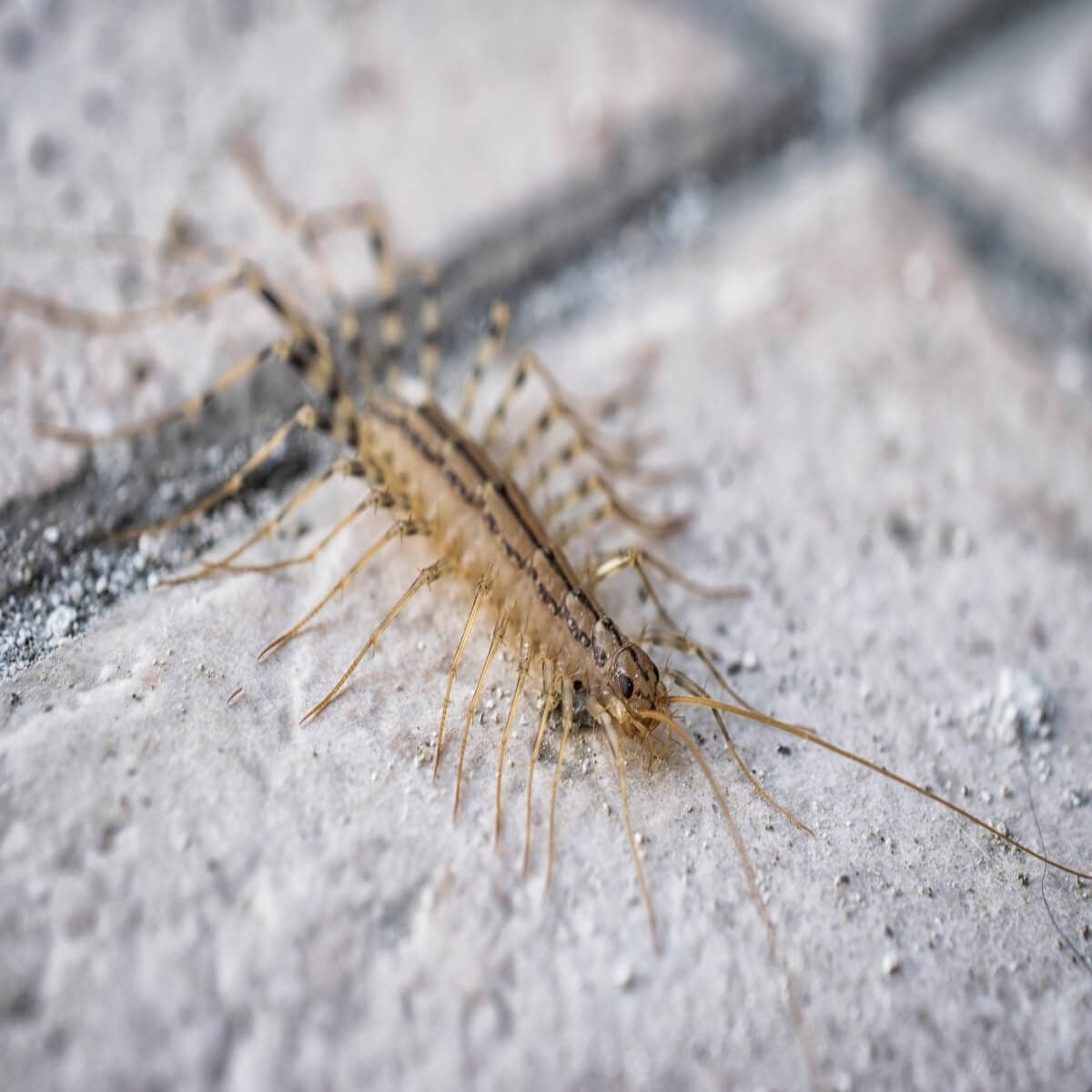
If the creature racing across your wall looks like a mustache that suddenly learned to run, you may be looking at a house centipede (Scutigera coleoptrata).
House centipedes typically have a grayish-yellow body, dark longitudinal stripes, 15 pairs of extremely long legs, and long antennae. Their legs make them appear much larger than their body really is.
House centipedes possess venom because they are predators, but they are considered of little concern to people. Bites are uncommon, and Oklahoma State University’s house-centipede guidance describes the animal as essentially harmless to humans despite its technical ability to bite.
Why Are Centipedes in Your House?
A centipede usually is not moving into your home because it appreciates your interior decorating. It is looking for three things: moisture, shelter, and food.
Centipedes favor damp, dark locations. Indoors they are commonly associated with basements, bathrooms, closets, crawl spaces, utility areas, and cracks or crevices where moisture and prey are available. They are mainly nocturnal and come out to hunt other arthropods.
If you repeatedly see house centipedes, the bigger question may therefore be, “What are they eating?”
The answer could include cockroaches, flies, spiders, silverfish, insect larvae, and other small household pests. UC Integrated Pest Management specifically notes that house centipedes prey on flies, cockroaches, and other household arthropods.
Are Centipedes Actually Good to Have Around?
From an ecological perspective, yes.
Centipedes are predators rather than structural pests. They do not chew through wooden beams, raid the cereal cabinet, or eat your favorite sweater. Many species help control other arthropods in gardens and around homes.
House centipedes are particularly useful hunters. They move rapidly and feed on numerous small pests. Of course, appreciating their contribution to pest control is easier when the contribution is happening somewhere other than directly above your bed.
How to Get Rid of Centipedes Naturally
If centipedes are appearing frequently, attacking the underlying environment is usually smarter than repeatedly spraying every many-legged visitor you see.
Reduce Excess Moisture
Fix leaking plumbing, ventilate damp bathrooms, improve basement airflow, address drainage problems, and consider a dehumidifier where appropriate.
The EPA recommends reducing the food, water, and shelter available to household pests. Moisture management is particularly important because centipedes and many of their prey favor humid environments.
Seal Entry Points
Inspect gaps around:
- Doors and windows
- Foundation cracks
- Pipes and utility penetrations
- Basement openings
- Crawl-space entrances
- Exterior siding
Caulking cracks, installing door sweeps, weatherstripping openings, and repairing screens make it harder for centipedes and their prey to enter. EPA pest-prevention guidance similarly recommends blocking pest entryways and sealing openings.
Remove Outdoor Hiding Places
Leaves, logs, stones, boards, heavy mulch, and damp organic debris provide excellent shelter. Keep excessive mulch and accumulated debris away from the foundation when possible.
University extension recommendations emphasize reducing damp hiding places around buildings as an effective long-term strategy for many wandering arthropods.
Control Their Food Supply
A recurring population of house centipedes may indicate a healthy buffet of other arthropods. Controlling cockroaches, flies, silverfish, spiders, or similar prey can make the environment less attractive to centipedes.
UC IPM notes that reducing other household peststhe centipede’s food supplycan reduce house-centipede numbers.
Centipede vs. Millipede: Which One Is Dangerous?
Centipedes and millipedes are frequently confused, but they are quite different.
| Feature | Centipede | Millipede |
|---|---|---|
| Body shape | Generally flattened | Usually cylindrical or rounded |
| Legs per body segment | One pair | Usually two pairs |
| Movement | Fast | Slow |
| Diet | Predatory | Mainly decaying plant material |
| Defense | Venomous bite/envenomation | Some release irritating defensive chemicals |
Centipedes can inject venom. Millipedes do not bite people in the same way, although some species release defensive secretions capable of irritating skin or eyes.
Common Myths About Centipedes
Myth: A Centipede Walking Across Your Skin Can Poison You
No. Simply walking on your skin does not normally inject venom. Venom must be introduced through the centipede’s forcipules. Oklahoma State University specifically addresses the myth that centipedes walking across skin cause tissue death or rotting and states that this is not true.
Myth: Every Centipede Has Exactly 100 Legs
The name is impressively misleading. Centipede species vary significantly in leg count. House centipedes, for example, have 15 pairs as adults.
Myth: Seeing One Centipede Means Your House Is Infested
Not necessarily. Outdoor centipedes sometimes wander indoors. A single visitor may simply have entered accidentally. Frequent sightings, however, can point toward persistent moisture or plentiful prey.
Frequently Asked Questions About Centipedes
Do Centipedes Bite People While They Sleep?
Centipedes do not normally seek humans as prey. They hunt much smaller arthropods and generally avoid people. Accidental bites are more likely when a centipede is trapped against skin, handled, stepped on, or otherwise threatened.
Are Baby Centipedes Poisonous?
Young centipedes are predators and belong to the same venom-using group as adults. Their ability to injure a person depends greatly on species and size. Small individuals are generally less capable of penetrating human skin effectively.
Can Centipedes Damage a House?
House centipedes are not wood-destroying pests. They hunt other arthropods rather than feeding on structural materials. UC IPM reports that house centipedes do not damage household items or plants.
Should You Kill House Centipedes?
You do not need to kill every house centipede. If only an occasional one appears, capturing it and releasing it outdoors is an option. If sightings become frequent, investigate moisture and other insect populations instead of focusing solely on the centipedes.
Practical Experiences With Centipedes: What Real Encounters Can Teach You
Centipedes are one of those household creatures whose appearance often creates a bigger problem psychologically than biologically. The following examples are representative household scenarios based on typical centipede behavior rather than claims of personal firsthand experiences.
The Midnight Bathroom Sprinter
A classic encounter goes something like this: someone enters a bathroom at night, flips on the light, and watches a house centipede accelerate across the tile at a speed that seems completely unreasonable for something with so many legs.
The natural reaction is often to reach for a shoe, aerosol can, broom, telephone, real-estate agent, or all four.
Yet repeated sightings in bathrooms can provide useful information. Bathrooms offer humidity, plumbing penetrations, hiding spaces, and sometimes populations of silverfish or other tiny arthropods. The centipede may be less of an invading villain and more of a clue that favorable conditions exist.
Checking under sinks may reveal a slow leak. Improving ventilation can reduce humidity. Sealing gaps around pipes can close an entry route. Suddenly, the “centipede problem” becomes a moisture-management project.
The Basement With Too Many Hunters
Another common situation is the basement where house centipedes appear every few days. Removing each centipede solves the immediate visual problem but does not explain why new ones keep appearing.
Basements frequently combine nearly everything these predators appreciate: darkness, cracks, high humidity, and prey.
In a situation like this, placing monitoring traps for crawling insects can reveal the larger ecosystem. Silverfish, small cockroaches, spiders, or other arthropods may be present. The house centipedes are effectively following the groceries.
Reducing basement humidity, eliminating clutter, fixing water intrusion, sealing foundation gaps, and controlling prey can make the space much less inviting. This approach takes more effort than flattening the occasional centipede with a magazine, but it targets the reason the animals are there.
The Giant Centipede Someone Decided to Pick Up
Then there is the opposite type of encounter: someone sees a large centipede outside and decides to handle it.
This is unnecessary enthusiasm.
Large centipedes have substantially more impressive defensive equipment than the skinny house centipede racing around a bathtub. University and medical sources warn that larger species can deliver painful venomous injuries.
The practical lesson is beautifully simple: admire large centipedes without using your fingers as wildlife-handling equipment. If one must be moved, use a container or appropriate tools while maintaining distance.
The Outdoor Centipede That Was Doing Its Job
Homeowners also encounter centipedes while moving rocks, flowerpots, logs, mulch, or landscaping material.
Finding one outdoors does not mean pest control is necessary. Damp hiding places are normal centipede habitat, and these arthropods help consume insects and other small organisms. Outdoors, they are part of the local predator community.
Unless the animal poses an immediate problem, leaving it alone is usually reasonable. The centipede is essentially providing pest-control services without sending an invoice.
The Most Useful Lesson: Don’t Treat the Symptom Only
Perhaps the biggest practical lesson from recurring centipede encounters is that the animal you can see may not be the real household issue.
A centipede needs appropriate humidity, shelter, and prey. Remove those conditions and you make your home less attractive not just to centipedes but to numerous other pests as well. That is why integrated pest-management recommendations focus heavily on moisture control, sanitation, exclusion, habitat modification, and reduction of food sources before automatically reaching for pesticides.
And if you see one lonely house centipede once every several months? You may simply have a strange-looking little predator passing through. It is unlikely to be plotting anything more sinister than dinner.
Conclusion: So, Are Centipedes Poisonous?
Nocentipedes are better described as venomous rather than poisonous. They use venom delivered through modified front legs to capture prey. While virtually any centipede deserves respectful handling, the common house centipede poses little risk to most people, and bites are uncommon. Large centipedes can produce painful bites with swelling, redness, or numbness, while serious allergic reactions require immediate medical attention.
Centipedes are also surprisingly useful predators. They eat insects, spiders, and other arthropods, and their presence can reveal excess moisture or another pest population inside your home.
If they appear repeatedly, focus on fixing leaks, reducing humidity, sealing gaps, removing damp outdoor hiding places, and controlling their food supply. In many cases, the best centipede control is simply making your home less appealing to everything a centipede wants to hunt.
They may look like evolution accidentally held down the “add legs” button, but most centipedes encountered around American homes are far less threatening than their appearance suggests.
Note: This article is intended for general educational information and is based on U.S. medical, poison-control, government, and university-extension guidance available through August 2026. A severe bite, rapidly worsening symptoms, or signs of an allergic reaction should be evaluated by an appropriate medical professional.