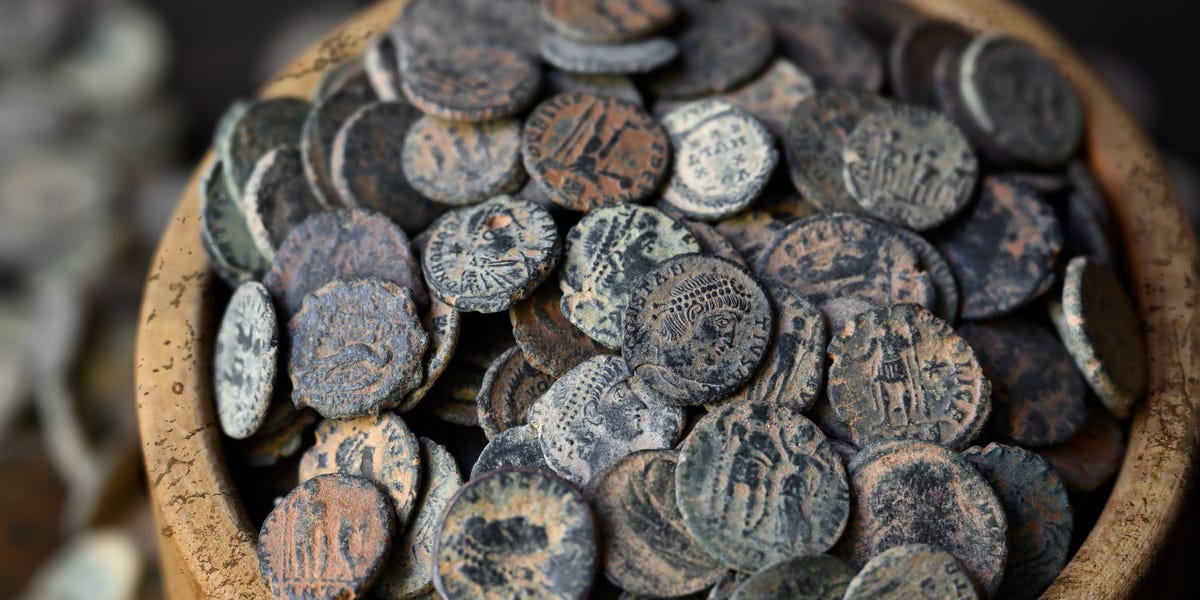
A home-extension project in northeastern France opened a window into an ancient financial system: three ceramic vessels, carefully set beneath the floor of a Roman-period residence, held an estimated 40,000-plus coins. The discovery is spectacular, but the real story is not simply “buried treasure.” It is about household savings, urban life, imperial instability, and the priceless value of finding artifacts exactly where ancient people left them.
A Routine Construction Project Met an Ancient Bank Vault
Most living-room renovations uncover dust, old wiring, and one mysterious sock that has apparently achieved archaeological status. In Senon, a village in northeastern France, work connected to the extension of a modern house led to something considerably more dramatic.
Preventive archaeologists investigated a roughly 1,500-square-meter parcel and uncovered a densely layered ancient neighborhood. The site contained streets, homes, workshops, cellars, courtyards, and evidence of occupation stretching back to the Gallic period.
Beneath floor levels inside Roman-period residences, researchers identified three monetary deposits. Large ceramic vessels had been placed upright in carefully prepared pits. Two still held enormous quantities of coins. A third vessel appears to have been removed in antiquity, leaving its impression in the soil and only three coins behind.
The headline numbermore than 40,000 ancient Roman coinsis an estimate based largely on weight. One deposit weighed about 83 pounds, or 38 kilograms, and may contain between 23,000 and 24,000 coins. The second weighed about 110 pounds, or 50 kilograms, including approximately 400 coins recovered around its broken neck. Researchers estimate that vessel may hold another 18,000 to 19,000 pieces.
Exact counting and identification require slow laboratory work, so the final total may change. Even so, the two surviving deposits represent an astonishing amount of ancient currency stored beneath an ordinary domestic floor.
Was the Treasure Really Under Someone’s Living Room?
The floor was not the polished floor of the present-day homeowner’s finished living room. It belonged to an ancient domestic building uncovered during the modern construction project. That distinction makes the story slightly less like a television makeover show, but much more valuable to archaeologists.
The vessels were found in ordinary residential rooms, apparently close to the ancient walking surface. Their necks may have remained at or near floor level, allowing an owner to reach the contents without excavating the entire container.
Researchers also found coins adhering to the outside of two vessels. That suggests the containers were already in position when additional coins were handled around their openings, before the pits were completely filled with sediment.
These details challenge the familiar image of a frightened resident burying wealth five minutes before an invading army arrived. The jars were vertical, supported by carefully placed stones, and installed in prepared spaces. Their accessible openings point toward deliberate financial management involving deposits, withdrawals, sorting, or long-term storage.
More Piggy Bank Than Panic Button
Calling the vessels “piggy banks” is useful as long as nobody imagines a cheerful ceramic pig with a slot in its back. These were large, heavy storage containers integrated into a building.
They may have served a household, merchant, workshop, administrator, or organization connected to nearby military activity. The owners apparently wanted the money protected but still available.
A panic hoard tells historians about fear during a specific crisis. An accessible savings deposit can reveal how people managed money in everyday life. In Senon, the arrangement resembles an offline banking system with no passwords, no service fees, and extremely good battery life.
What the Coins Reveal About a Turbulent Roman World
The deposits appear to date from approximately A.D. 280 to 310. This period marked the transition from the chaotic third century into the reorganized empire of Diocletian and his successors.
Some coins carry portraits of Victorinus, Tetricus I, and Tetricus II, rulers associated with the breakaway Gallic Empire. This regional empire controlled Gaul and several neighboring provinces from A.D. 260 to 274, when central Roman authority was under severe pressure.
Roman emperors rose and fell rapidly during the third century. Frontier warfare intensified, rival commanders competed for power, and monetary inflation became a serious economic problem. Aurelian eventually reunited the Gallic territories with the central Roman Empire, but the coins issued by earlier rulers did not instantly disappear.
Older currency could continue circulating in markets, payrolls, workshops, tax collections, and household savings long after the ruler pictured on it had vanished from power.
Coins Are Tiny Historical Documents
A Roman coin may carry an emperor’s portrait, official titles, political slogans, religious symbols, military victories, or images of prosperity. Together, thousands of coins can reveal patterns that a single specimen cannot.
Researchers can examine which issues circulated together, how long older coins remained useful, whether certain rulers were unusually common, and when the latest additions entered a deposit. The physical wear on the coins can also suggest how long they had passed through daily commerce before being stored.
Forty Thousand Coins Do Not Automatically Equal Forty Thousand Fortunes
A huge coin count sounds like unimaginable wealth, but quantity and purchasing power are not the same thing. Late third-century currency was affected by debasement, inflation, imperial reforms, and regional differences.
Until specialists identify the denominations, mints, metal composition, wear, and chronological groups, converting the hoard into a modern dollar value would be highly misleading.
The better question is not, “How many sports cars could this buy?” It is, “What purpose did this mass of currency serve?” The coins could represent accumulated small payments, wages, taxes, commercial revenue, institutional funds, or a financial reserve assembled over many years.
Senon Was Once a Busy and Prosperous Settlement
Today, Senon is a small community in France’s Meuse department. In antiquity, however, it was an important settlement associated with the Mediomatrici, a Celtic people whose principal center was Divodurum, present-day Metz.
The excavation indicates that a concentrated settlement existed before the Roman conquest. Archaeologists found postholes, pits, ditches, and traces of timber-framed structures dating back to the later Iron Age.
By the late first century A.D., the neighborhood had changed considerably. Stone construction expanded, roads were rebuilt, and local limestone was quarried intensively. At least three residential units stood along paved streets.
Some rooms had lime-concrete floors, while at least one house used a hypocaust. This Roman heating system circulated hot air beneath a raised floor, proving that heated flooring was fashionable long before modern home-design influencers discovered it.
The neighborhood also contained cellars, ovens, hearths, work areas, and broad rear courtyards. Nearby public architecture included a square, temples, baths, and a theater. The quality of construction and material culture suggests that the residents were relatively prosperous, possibly merchants or skilled artisans.
The coin jars were therefore not hidden beneath an isolated rural hut. They belonged to an urban environment filled with trade, production, public buildings, transportation, and complicated financial needs.
A Possible Connection to the Roman Military
A fortification dating to approximately the same period stood about 150 meters from the excavated neighborhood. Researchers have not concluded that the money belonged to soldiers or a military office, but the proximity creates an important line of investigation.
Military installations generated payrolls, supply contracts, food purchases, transportation, taxation, and local business. A merchant or administrator living nearby could have handled large volumes of currency connected indirectly to the fort.
Why Did Nobody Return for the Coins?
An extensive fire damaged the neighborhood at the beginning of the fourth century. The settlement was later rebuilt, with old walls, cellars, stone, and tiles reused in new arrangements. Yet the buried monetary deposits were apparently forgotten.
A later major fire around the middle of the fourth century preceded the area’s final abandonment. This sequence offers a plausible explanation for the survival of the coin hoard.
The owners may have died, fled, lost access to the property, or failed to locate the jars after destruction changed the buildings above them. Records, memories, room layouts, and property boundaries can disappear quickly when an entire neighborhood burns and is reconstructed.
A perfectly sensible hiding place can become invisible after damaged floors are leveled, walls are moved, and new structures are built over the remains.
Archaeologists remain cautious, however. The vessels could have belonged to different owners or served separate purposes. They may not have been filled at exactly the same time. Their relationship to the fires, nearby fortification, and rebuilding phases will depend on additional laboratory and stratigraphic analysis.
Why Archaeological Context Matters More Than Treasure
More than 30 coin deposits are already known in the Meuse department. That does not make 40,000 coins boringarchaeologists are professionals, not robotsbut it explains why the Senon discovery is exceptional for reasons beyond size.
The jars were excavated in place by specialists who could record their depth, orientation, structural supports, surrounding sediment, relationship to walls and floors, and connection to the neighborhood’s destruction layers.
Every detail helps reconstruct ancient behavior. Remove the coins without documentation, and the discovery collapses into a pile of collectible objects.
Context Can Answer Questions That Coins Alone Cannot
The location of a deposit can help distinguish household savings from ritual offerings, military payments, merchant funds, or emergency wealth. The position of the jar’s opening may reveal whether the money remained accessible. Its relationship to a fire layer can indicate whether a disaster caused its abandonment.
This is why unauthorized digging and archaeological looting cause permanent damage. A coin may survive being pulled from the ground, but its relationships cannot be recreated afterward.
Once the location, sediment layer, container, building phase, and neighboring artifacts are lost, researchers may never determine why the money was deposited.
What Happens to Thousands of Coins in a Laboratory?
Conservators and numismatists must stabilize, separate, clean, photograph, identify, and catalog the coins. They will examine rulers, mints, inscriptions, reverse designs, metal content, corrosion, unofficial imitations, and patterns of wear.
Specialists will also study how the coins were distributed inside the vessels. Layers or clusters could represent repeated deposits, separate batches, or changes in available currency over time.
The latest securely identified coin can help estimate when a vessel stopped receiving money. However, it does not reveal the precise day the jar was buried. A coin minted in a particular year may remain in circulation for decades.
Researchers therefore combine numismatic evidence with pottery, building phases, floor levels, burn deposits, and the physical arrangement of the vessels.
How the Senon Discovery Compares With Other Roman Hoards
Large Roman coin hoards have been discovered across the former empire. The Frome Hoard in England contained more than 52,000 coins, while the Cunetio Hoard held nearly 55,000.
In Spain, construction workers uncovered amphorae packed with hundreds of thousands of late Roman coins weighing well over half a ton. Britain’s Hoxne Hoard combined more than 15,000 coins with gold jewelry and silver objects.
Senon does not need to be the largest discovery to be historically important. Its strength lies in the domestic setting and evidence that the containers remained accessible.
Many hoards are discovered after plowing, construction, erosion, or unrecorded metal detecting has disturbed the original arrangement. At Senon, archaeologists could observe a planned storage system inside a recognizable urban residence.
The discovery therefore helps answer a broad historical question: How did ordinary people actually live with money?
Imperial histories tend to focus on emperors, wars, invasions, and monetary reforms. A floor-level storage jar reveals the household side of the same economy. Coins had to be earned, counted, transported, guarded, stored, and occasionally hidden from whichever relative kept asking for a loan.
The Experience of Finding History Beneath Your Feet
Imagine standing in a modern construction zone where the first signs of the past are not glittering coins but changes in soil color, fragments of wall, and the faint edge of a ceramic vessel. Archaeological discoveries usually begin quietly. The dramatic moment arrives only because someone notices that the ground is behaving differently and stops treating it as ordinary dirt.
For the excavation team, the experience would have combined excitement with immediate restraint. A jar containing tens of thousands of corroded coins is not something to scoop into buckets. The vessel, soil, and contents form a fragile unit.
Every rushed movement risks cracking the ceramic, scrambling internal layers, or destroying evidence of how the deposit was assembled. The professional response to “We found treasure!” is often, “Nobody touch anything until it has been photographed and documented.” It is not quite Hollywood, but it produces much better science.
The discovery also changes the emotional atmosphere of an excavation. A stone wall is architecture; a coin jar feels personal. Someone selected the container, prepared the pit, steadied it with stones, and handled money near its opening.
That sequence is recognizable to anyone who has kept cash in an envelope, placed emergency savings in a drawer, or checked the same secure spot before leaving home. The technology is different, but the instinct is familiar.
For a homeowner or builder, discovering archaeology can be both thrilling and complicated. Construction schedules suddenly meet heritage protections, specialists, documentation requirements, and the possibility that a planned extension occupies a much older neighborhood.
Yet the disruption comes with a rare privilege. The modern building project becomes part of the process through which a forgotten place returns to public knowledge. The new room may eventually be completed, but the ancient rooms beneath it are no longer anonymous.
For museum visitors, the most rewarding experience may come from looking beyond the total number. Forty thousand coins create an impressive spectacle, but a display becomes meaningful when it explains the positions of the jars, the ancient floor height, the burn layers, and the portraits of short-lived rulers.
A map, model, or cutaway drawing can transform “a lot of old money” into a story about where people walked, worked, saved, and rebuilt after disaster.
The Senon discovery also offers a practical lesson for amateur history enthusiasts: discovery is not the same as ownership, and excavation is not the same as collecting.
The responsible response to a suspected archaeological deposit is to stop disturbing the area and contact the appropriate heritage authority. Pulling objects out for a better look may feel irresistible, but it can erase the evidence that gives those objects historical meaning.
Finally, there is the imaginative experience of recognizing how thin the distance can be between ordinary life and deep history. An ancient household once crossed that room, warmed it from below, stored money beneath the floor, and expected to return.
Nearly 1,700 years later, another household planned an extension above the same ground. The residents never met, but their domestic decisions overlapped in space. Archaeology makes that overlap visibleand reminds us that today’s sensible storage solution may become tomorrow’s astonishing headline.
Conclusion: An Ancient Savings System Frozen in Place
The estimated 40,000-plus Roman coins from Senon are impressive, but this discovery is not simply a jackpot from antiquity. The vessels appear to have been deliberately installed beneath accessible domestic floors, possibly for repeated financial use.
The coins connect a prosperous neighborhood to the political and economic turbulence of the late third and early fourth centuries. Nearby fortifications, destructive fires, and later rebuilding add important questions that researchers are still investigating.
Most importantly, the deposits survived with their archaeological context intact. Specialists can study not only what the coins are, but where they were placed, how people reached them, and why they may have been abandoned.
That turns a mass of metal into evidence of daily decisions. Rome’s grand history was written in marble, monuments, and military campaigns, but some of its most human chapters were apparently kept in ceramic jars beneath the floor.