For years, lithium-ion batteries have been the star quarterback of modern energy storage: flashy, powerful, and constantly surrounded by headlines. They run phones, laptops, electric cars, and a growing share of the grid. But here is the awkward truth nobody in the battery world can ignore anymore: lithium-ion is brilliant, yet dramatic. It can be expensive, it depends on a complicated global supply chain, and when things go wrong, they can go very wrong.
That is why aqueous batteries are getting serious attention. These water-based battery systems are not new in principle, but recent breakthroughs in electrolytes, electrode design, and flow architectures are making them look far more practical. In the right applications, especially grid storage, they could solve several of lithium’s biggest headaches without demanding a standing ovation from a fire extinguisher.
Before we crown water as the new king of electrochemistry, let us be clear: aqueous batteries are not a universal replacement for lithium-ion. They are not about to shove every EV battery pack off the stage or sneak into your phone next week. But for storing renewable electricity safely, cheaply, and at scale, they may be one of the smartest alternatives in the room.
Why Lithium-Ion Needs a Backup Plan
Safety is the loudest complaint
Lithium-ion batteries pack a lot of energy into a small space, which is fantastic until that energy decides to exit the chat all at once. The chemistry often relies on flammable organic electrolytes, and under abuse, manufacturing defects, overheating, or internal failure, cells can enter thermal runaway. That phrase sounds technical and polite, but it really means a chain reaction of heat, gas, and sometimes fire.
For consumer gadgets, that risk is usually manageable with smart engineering. For utility-scale energy storage, the stakes are bigger. Large installations need extensive monitoring, cooling, spacing, ventilation, fire suppression, and emergency planning. Utilities want batteries, not surprise dragon breath.
The supply chain is complicated and sometimes cranky
Lithium batteries also come with supply-chain baggage. Depending on the chemistry, they may rely on lithium, nickel, cobalt, manganese, graphite, and tightly concentrated refining capacity. Even when manufacturers shift toward chemistries with less cobalt or nickel, lithium systems still depend on specialized materials processing and a manufacturing ecosystem that remains geopolitically sensitive.
That matters because energy storage is no longer a niche market. It is becoming critical infrastructure. Grid planners do not love hearing that the future of resilience may depend on long lead times, imported refined materials, and commodity volatility. It is hard to build a calm, stable energy system when your bill of materials reads like a global scavenger hunt.
The grid does not always need the same thing your car needs
Lithium-ion became dominant partly because high energy density is wonderful for mobility. Cars, phones, drones, and laptops all reward light weight and compact size. But grid storage has a different personality. In many stationary applications, the priorities are safety, long life, low cost, deep cycling, and easy scaling. A battery sitting next to a solar farm does not care about fitting in your backpack.
That creates an opening for chemistries that are bigger and heavier but safer and cheaper. In other words, the grid is not looking for the most glamorous battery. It is looking for the most dependable one.
What Is an Aqueous Battery, Exactly?
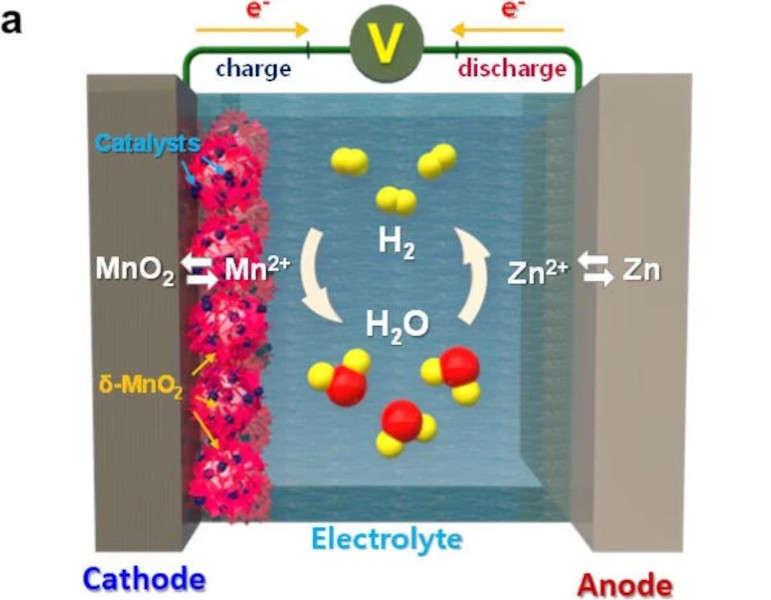
An aqueous battery uses a water-based electrolyte. Instead of relying on organic solvents, it moves ions through an electrolyte where water is the main medium. That simple change has major implications for safety, cost, and performance.
The term covers several families of batteries, not one single design. Aqueous systems can include zinc-ion batteries, zinc-metal batteries, aqueous sodium-ion batteries, zinc-bromine systems, iron-based flow batteries, organic flow batteries, sulfur-based designs, and other water-friendly chemistries being developed for stationary storage.
Some are conventional sealed cells. Others are flow batteries, where liquid electrolytes are stored in external tanks and pumped through a reactor. That architecture is a big deal because it separates energy capacity from power. Want more storage duration? Make the tanks bigger. Want more power? Upgrade the reactor stack. That is a refreshingly practical answer to a problem lithium-ion often solves by simply adding more battery modules and more money.
How Water Helps Solve Lithium’s Biggest Problems
Problem No. 1: Fire risk
The most obvious advantage of an aqueous battery is that water-based electrolytes are not flammable in the way common lithium-ion electrolytes are. That does not mean aqueous batteries are magically risk-free. Every electrochemical system has failure modes. But replacing flammable liquid solvents with water changes the safety profile in a fundamental way.
For utilities, campuses, factories, hospitals, and microgrids, that matters enormously. A safer chemistry can reduce the complexity of thermal management, improve siting flexibility, and ease community concerns. It is a lot easier to sell a battery project to neighbors when the phrase “thermal runaway” is less central to the conversation.
Problem No. 2: Expensive and concentrated materials
Many aqueous battery concepts rely on more abundant and lower-cost materials such as zinc, sodium, iron, sulfur, graphite, bromine, or organic active molecules. These are not all equal, and none are free of supply considerations, but they often avoid the most intense pressure points associated with high-performance lithium-ion supply chains.
Zinc is particularly attractive because it is inexpensive, widely available, and compatible with water-based chemistries. Sodium also gets attention because it is abundant and cheap. Iron and sulfur are downright humble, which is exactly why engineers love them for grid-scale economics. In battery land, being boring can be a superpower.
Problem No. 3: Scaling for long-duration storage
Grid storage increasingly needs duration, not just speed. Utilities want to shift solar energy into the evening, support wind variability, shave peaks, and keep critical services online during outages. Flow batteries and other aqueous systems are appealing because they are inherently suited to stationary applications. Their size is less of a drawback, and some designs can scale economically for multi-hour storage.
In flow batteries, energy lives in tanks filled with liquid electrolyte. That makes the system easier to size for longer discharge times. If lithium-ion is a high-performance sports car, an aqueous flow battery is more like a cargo train: less flashy, but excellent when the job is moving a lot of energy steadily and safely.
The Science Tricks Making Aqueous Batteries Better
Water-in-salt electrolytes
One of the biggest historical limitations of aqueous batteries is water itself. Water has a narrow electrochemical stability window, which means it tends to decompose and generate hydrogen or oxygen gas if voltages go too high. That limits battery voltage and therefore energy density.
Researchers attacked that problem with a clever idea known as “water-in-salt” electrolyte. Instead of treating salt like a seasoning, they dump in so much of it that water behaves very differently. At very high salt concentrations, fewer water molecules are free to participate in unwanted reactions, which can widen the usable voltage window and stabilize interfaces that used to misbehave.
This approach has helped researchers push aqueous batteries to higher voltages than older water-based systems, making them far more competitive. It is chemistry’s version of turning the room so crowded that the troublemakers cannot move around.
Better zinc control
Zinc is attractive, but it comes with a classic problem: dendrites. These are needle-like metal deposits that can grow during charging, reduce efficiency, shorten life, and in bad cases create short circuits. Zinc systems also struggle with corrosion and hydrogen evolution, especially under demanding cycling conditions.
The latest research is tackling those issues from multiple angles. Scientists are redesigning electrolytes, adding salts and additives, engineering interfacial layers, and controlling how zinc plates onto current collectors. Some teams are even using surface structures and liquid-crystal-like ordering effects to make metal deposition smoother and more reversible. In short, the zinc is being asked to behave like a polite houseguest instead of a raccoon with a toolbox.
New cathodes and smarter architectures
Aqueous sodium-ion systems are also improving, especially with cathode materials such as Prussian blue analogs. These materials can offer strong rate performance and long cycling when paired with the right electrolyte environment. Meanwhile, organic and sulfur-based flow systems are attracting interest because they could lower cost and reduce dependence on scarcer metals.
Engineers are also rethinking the architecture of aqueous storage. Some efforts focus on simpler balance-of-plant design, lower-cost membranes, single-tank concepts, or chemistries that can be easier to maintain and rebalance over time. A great battery is not just about pretty lab data. It also needs plumbing, controls, maintenance logic, and economics that do not make project developers cry into a spreadsheet.
Where Aqueous Batteries Could Win First
Renewable energy shifting
Solar and wind are wonderful right up until the sun sets or the breeze takes a coffee break. Aqueous batteries are promising for shifting renewable output across several hours, especially when safety and cycle life matter more than compact size.
Microgrids and backup power
Schools, hospitals, military facilities, data centers, and remote communities need storage that is robust, predictable, and easier to site. A water-based battery with a lower fire burden can be especially attractive where people care more about resilience than shaving every last cubic inch off the footprint.
Industrial peak shaving and grid services
Fast response, frequent cycling, and long life make many aqueous designs attractive for stationary services such as peak shaving, load management, frequency support, and resilience planning. Flow batteries, in particular, can be tuned for duration and repeatedly cycled without the same kind of aging profile seen in some lithium-ion deployments.
Why they probably will not dominate EVs tomorrow
Here is the honest part. Aqueous batteries still trail lithium-ion in energy density, which matters a lot for electric vehicles and portable electronics. Water is heavy, tanks are not pocket-friendly, and even advanced aqueous chemistries often sacrifice compactness for safety and cost. So while aqueous batteries may solve many of lithium’s grid problems, they are less likely to replace lithium in applications where every pound and every inch counts.
What Still Needs Work
Aqueous batteries are promising, but no one should confuse “promising” with “done.” Several challenges remain.
First, voltage and energy density still need improvement. Even with water-in-salt strategies and better interfaces, aqueous systems often cannot match the energy packed into modern lithium-ion cells. Second, side reactions remain a persistent nuisance, including corrosion, gas generation, and electrolyte instability. Third, flow batteries have their own baggage, such as membrane crossover, system complexity, pumps, tanks, and balance-of-plant costs.
There is also the issue of bankability. Utilities and developers want technologies with long field records, reliable suppliers, service support, predictable maintenance, and proven economics. A brilliant chemistry can still lose if investors hear “pilot project” and immediately clutch their wallets.
So, Does an Aqueous Battery Solve Lithium’s Problems?
For stationary energy storage, the answer is increasingly yes, at least to a meaningful degree. Aqueous batteries directly address several of lithium-ion’s biggest weaknesses: fire risk, materials pressure, and the challenge of scaling cost-effectively for long-duration grid storage. They also open the door to batteries built from more abundant ingredients and architectures that fit the grid better than the gadget market ever did.
But the smarter conclusion is not that aqueous batteries will “beat” lithium-ion everywhere. The smarter conclusion is that the battery market is growing up. Different applications need different chemistries. Lithium-ion will remain hugely important, especially where energy density is king. Aqueous batteries, meanwhile, may become the calm, practical workhorses that help the grid absorb more renewables without absorbing more chaos.
That is not a small achievement. If lithium-ion is the battery that got us here, aqueous batteries may be part of the battery family that helps us stay here safely, affordably, and at scale.
Practical Experiences and Real-World Lessons Around Aqueous Batteries
One of the most interesting things about aqueous batteries is how differently people react to them depending on where they sit in the energy world. Researchers often talk about electrolyte windows, zinc morphology, interface stability, and cycle retention. Utility planners, on the other hand, usually start with a much simpler question: “Will this thing catch fire next to my substation?” That difference in perspective explains a lot about why aqueous batteries are getting so much attention now.
In laboratory settings, experience with aqueous systems tends to be a mix of excitement and humility. The excitement comes from seeing water-based chemistries deliver improvements that would have sounded overly optimistic a few years ago. Higher voltages, longer cycle life, better zinc behavior, improved sodium cathodes, and more creative flow battery concepts all suggest that the field is moving beyond theory. The humility comes from the fact that water is both helpful and mischievous. It is safe and conductive, but it also encourages corrosion, gas formation, and other side reactions that can ruin a beautiful experiment by lunchtime.
Among developers and pilot-project teams, the most valuable experience often has less to do with chemistry and more to do with systems engineering. Aqueous batteries may use cheaper active materials, but full projects still need pumps, membranes, piping, controls, enclosures, monitoring systems, and maintenance strategies. In the real world, the cheapest electrolyte on Earth does not help much if the overall system is hard to install, expensive to service, or awkward to scale. That is why practical teams increasingly focus on total system design instead of chasing one headline performance number.
There is also a strong operational lesson emerging from grid storage conversations: customers do not just want a battery that works in a paper. They want a battery that behaves predictably over thousands of cycles, survives abuse, and can be explained clearly to insurers, fire marshals, regulators, and local communities. This is where aqueous batteries often make a memorable first impression. A water-based system may not win every energy-density contest, but it speaks the language of safety in a way decision-makers immediately understand.
Another repeated experience across the sector is that aqueous batteries make the most sense when matched to the right job. Teams evaluating long-duration storage for renewables, backup power for critical infrastructure, or daily cycling for commercial sites tend to view aqueous systems much more favorably than teams trying to maximize driving range in a passenger EV. In other words, success usually comes from honest positioning, not overpromising. The companies and labs that seem most credible are the ones saying, “Here is exactly where this chemistry fits,” rather than pretending one battery can rule the entire planet.
That may be the biggest practical lesson of all. Aqueous batteries are not exciting because they are magical. They are exciting because they are useful. In an industry that sometimes falls in love with futuristic hype, usefulness is refreshingly powerful.