Note: This is a synthesized oral-history-style feature based on public interviews, reviews, DVD-era materials, and industry reporting. It is not presented as a transcript of new interviews.
Before “adult animation” became a streaming category, a brand strategy, and a phrase that could mean anything from prestige sci-fi to a cartoon hot dog yelling at taxes, there was Mission Hill. Bright, weird, emotionally scruffy, and tragically mishandled, the animated sitcom arrived on The WB in 1999 with the confidence of a show that knew exactly who it was for. Unfortunately, network television did not.
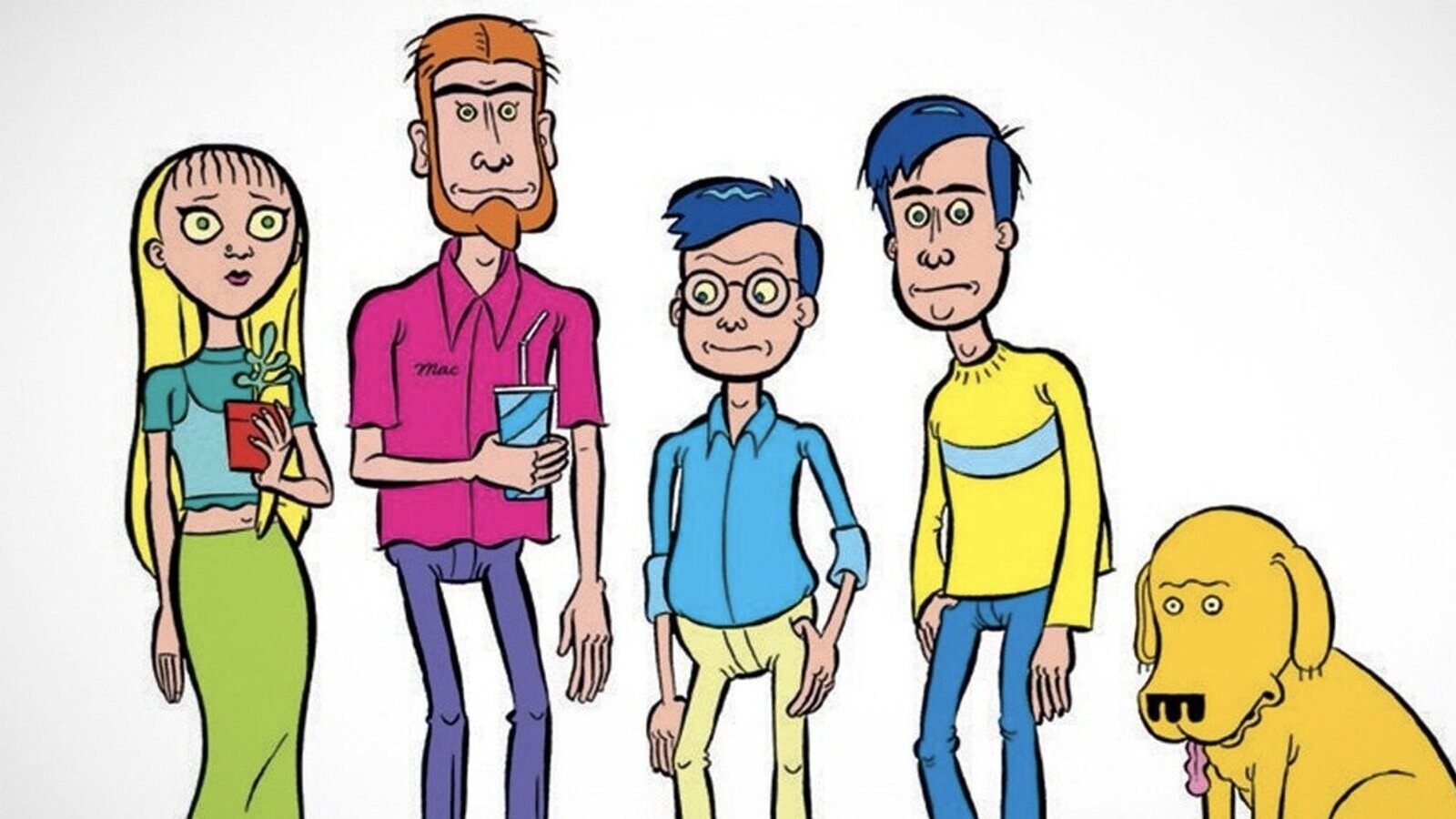
Created by former Simpsons showrunners Bill Oakley and Josh Weinstein, Mission Hill followed 24-year-old Andy French, a slacker cartoonist and professional avoider of responsibility, whose life is disrupted when his nerdy teenage brother Kevin moves into his loft in the fictional city of Cosmopolis. Andy lives with the laconic Jim, the airy-but-secretly-sharp Posey, and Stogie, a dog whose digestive system seems powered by punk rock and bad decisions.
The show lasted only 13 completed episodes. The WB aired it badly, promoted it awkwardly, and pulled it quickly. Then, two years later, Adult Swim gave those same episodes a late-night second life. In reruns, Mission Hill became what it was probably always meant to be: a cult classic for people who had ever worked a lousy job, lived with roommates, overthought romance, failed upward, or believed adulthood should come with a user manual and maybe a coupon for burritos.
The Spark: What Happens After Springfield?
Oakley and Weinstein came to Mission Hill with serious comedy credentials. Their years on The Simpsons included some of the show’s most beloved and structurally adventurous episodes. But after writing for a world of elementary school kids, nuclear plant workers, barflies, and elderly oddballs, they noticed a gap. Where were the people between adolescence and settled adulthood? Where were the broke twenty-somethings, the overeducated underachievers, the people making rent with a job they hated while telling everyone they were “really” artists?
That missing demographic became the center of Mission Hill. Andy French was not a hero in the traditional sitcom sense. He was vain, lazy, funny, talented enough to be frustrated, and self-aware only when it was too late to be useful. His younger brother Kevin was the opposite: anxious, achievement-obsessed, and allergic to coolness. Their relationship gave the show its emotional engine. Andy was not ready to be a guardian; Kevin was not ready for the city. Naturally, the universe threw them into the same apartment and watched the smoke come out of their ears.
The Look: Neon, Indie Comics, and Cartoon Electricity
One reason Mission Hill still feels fresh is that it does not look like most animated sitcoms of its era. Designer Lauren MacMullan helped shape a visual identity that blended thick outlines, saturated colors, rubber-hose exaggeration, mid-century cartoon energy, and the spirit of 1990s alternative comics. The result looked less like a network cartoon and more like a stack of indie zines had fallen into a nightclub and started paying rent.
Cosmopolis, the show’s fictional city, was not one place. It borrowed from Boston’s Mission Hill, San Francisco’s Mission District, Los Angeles’ Silver Lake, Chicago’s Wicker Park, and Brooklyn’s Williamsburg. In other words, it was every neighborhood where someone has said, “This area was cooler before people discovered it,” while standing in line for expensive coffee.
The background details mattered. Fake bands, local businesses, street posters, transit hints, odd advertisements, and throwaway sight gags made Mission Hill feel lived-in. The city had grime, color, and personality. It was not a generic sitcom backdrop. It was a character with rent-controlled bones and a suspicious smell in the hallway.
The Characters: Slackers, Strivers, Neighbors, and Legends
Andy and Kevin French
Andy French was the show’s poster boy for delayed adulthood. He wanted to be a cartoonist, but wanting was often where the plan stopped. His job at a waterbed store was less a career than a slow-motion punishment. Kevin, meanwhile, arrived from the suburbs with high SAT ambitions, Ivy League dreams, and the social instincts of a calculator trapped in a locker room.
The genius of the pairing was that neither brother was completely wrong. Andy understood that life could not be reduced to grades and résumés. Kevin understood that “just vibing” is not a retirement plan. Together, they formed one barely functional adult.
Jim, Posey, and Stogie
Jim Kuback, voiced by Brian Posehn, turned underreaction into a lifestyle. He was so calm he seemed spiritually upholstered. Posey Tyler, voiced by Vicki Lewis, floated through scenes like a new-age cloud with lightning hidden inside. And Stogie, Andy’s beer-loving dog, supplied the kind of anarchic animal comedy that said, “Yes, this is a mature animated series, but also the dog might eat the couch.”
Gus and Wally
The neighbors, Gus Duncz and Wally Langford, became two of the show’s most important supporting characters. An older gay couple written with affection, specificity, and comic friction, they stood out in 1999 network television. Their relationship was not treated as a special episode lecture. They bickered, loved each other, had history, had hobbies, and existed as full comic characters. The show later received recognition for its positive portrayal of a gay relationship, and their on-screen kiss remains one of the reasons Mission Hill is frequently described as ahead of its time.
The WB Problem: A Show Built for the Future, Scheduled in the Past
Mission Hill premiered on The WB on September 21, 1999. On paper, the network seemed like a decent home. The WB had youth-oriented hits such as Buffy the Vampire Slayer and Dawson’s Creek. In practice, Mission Hill was a strange fit for broadcast television’s expectations. It was too adult for kids, too animated for many adults, too specific for broad primetime, and too dry for viewers expecting punchline machinery every seven seconds.
The promotional rollout did not help. Early industry accounts describe marketing confusion, weak first impressions, and a network that did not seem fully prepared to explain what the show was. It was not simply “the next Simpsons.” It was not a kid cartoon. It was not a conventional family sitcom. It was a neon slacker comedy about urban young adulthood, and in 1999 that was a harder sell than it sounds.
After low ratings, The WB pulled the show quickly, later airing several more episodes in scattered fashion. The original order had more ambition than the final broadcast pattern suggested, but the damage was done. A series that needed consistent exposure and word of mouth instead got the television equivalent of being handed a flyer in the rain.
Adult Swim Saves the Day, One Rerun at a Time
Then came Adult Swim. Cartoon Network’s late-night block became the accidental preservation society for strange adult animation. In the early 2000s, Adult Swim did not need Mission Hill to become a giant mainstream hit. It needed unusual, funny, repeatable programming that spoke to viewers who were awake at midnight and possibly eating cereal from a saucepan.
That audience understood Mission Hill. The jokes were observational rather than formulaic. The characters were flawed without being empty. The city felt like somewhere viewers had lived, wanted to live, or had fled after discovering the radiator made whale noises. Adult Swim reran the completed episodes enough times for viewers to memorize them, quote them, and feel as if they had discovered a secret show that belonged to them.
This is the central irony of Mission Hill: its failure proved its point. It was made for a niche audience before niche audiences were considered valuable. Today, a show aimed at specific twenty-something viewers with a strong visual identity and LGBTQ-inclusive supporting characters would likely be pitched as a streaming asset. In 1999, it was treated like a scheduling problem.
Why the Humor Still Works
The late-1990s references are part of the charm: ska clubs, MTV reality-show anxiety, alternative comics, slacker culture, vintage urban cool. But Mission Hill survives because its core topics are not dated. Bad jobs are eternal. Sibling resentment is renewable energy. Trying to become an artist while paying bills has never gone out of style, though the rent has become increasingly rude.
The show’s best episodes turn ordinary young-adult panic into comedy. Andy’s unemployment arc captures the shame, denial, and weird freedom of having nowhere to be and no money to go there with. Kevin’s academic obsession satirizes the pressure to optimize your entire teenage existence for college admissions. Dating episodes expose how self-image can sabotage actual connection. The humor is sharp because it is grounded in behavior, not just references.
Mission Hill also understood that twenty-something life is not one thing. It is ambition and laziness, sincerity and sarcasm, ethical certainty and terrible decision-making. The show made room for contradictions. Andy could be obnoxious and sympathetic. Kevin could be ridiculous and vulnerable. Gus and Wally could be groundbreaking representation and still be very funny old men yelling about nonsense.
The DVD Afterlife and the Music Problem
In 2005, Mission Hill: The Complete Series arrived on DVD, giving fans a legal way to own all 13 completed episodes. The release also highlighted one of the great headaches of television preservation: music licensing. Some original songs were replaced because clearing music for home video can be expensive and complicated. For a show so tied to late-1990s cool, soundtrack changes mattered. Music was not wallpaper; it was part of the show’s texture.
Still, the DVD release kept the series alive. Commentaries, art materials, featurettes, and the ability to revisit episodes helped turn Mission Hill from “that weird cartoon Adult Swim aired” into a documented cult object. Fans could study its palette, its character designs, its writing, and its unrealized potential.
The Lost Future of Mission Hill
One of the most painful parts of the show’s history is that it was designed with growth in mind. Oakley has spoken publicly about the idea that the characters might have aged over time, with Andy’s creative career developing across seasons. That would have made Mission Hill unusually novel for an animated sitcom. Instead of freezing characters in cartoon amber, it could have followed the messy process of becoming an adult.
That unrealized future is part of why fans still talk about the show. Mission Hill did not simply end; it stopped mid-inhale. Viewers can imagine the later seasons: Kevin becoming less rigid, Andy becoming more serious about art, Jim revealing hidden depths, Posey burning down a co-op with kindness, Gus and Wally stealing every scene in sight.
There has also been public discussion of a possible spin-off focused on Gus and Wally, tentatively imagined as a continuation set after the original series. Whether or not such a project ever fully materializes, the interest itself proves the show never disappeared. It just moved into the part of pop culture where beloved failures become passwords among fans.
Why Mission Hill Matters in Adult Animation
Adult animation in the United States has often been dominated by families, shock comedy, workplace chaos, or surreal absurdity. Mission Hill did something different. It used animation to make urban young adulthood visually elastic. Anxiety could become steam. Embarrassment could turn faces tomato-red. The city could pulse with impossible color. Real problems became more expressive because they were drawn.
The show also helped prove that adult animation could be culturally specific without losing emotional reach. It was about a certain kind of late-1990s urban experience, but the emotional material remains widely recognizable. Everyone knows what it feels like to disappoint yourself. Everyone knows someone who performs coolness as a defense mechanism. Everyone has met a Kevin, unless, horrifyingly, they are the Kevin.
Experiences Related to Mission Hill: Watching a Cult Classic Find Its People
Watching Mission Hill now feels different from discovering it on Adult Swim in the early 2000s. Back then, stumbling across it late at night felt like finding a strange zine on a laundromat table. You were not being marketed to with algorithmic precision. You simply landed in Cosmopolis and had to figure out why this cartoon looked like a comic book, sounded like a college radio station, and seemed oddly sympathetic to people who had no idea what they were doing with their lives.
That is one reason the show has such strong nostalgic power. For many viewers, Adult Swim was not just a programming block; it was a mood. It came on when the respectable day was over. The people watching were students, night owls, retail workers, insomniacs, young artists, bored teenagers, and adults who were not ready to sleep because sleeping meant tomorrow would arrive faster. Mission Hill fit that hour perfectly. Andy French was not aspirational, exactly, but he was familiar. He had dreams, excuses, and a couch. Sometimes that is a whole personality.
The show also captures the peculiar feeling of being young in a city before every experience was instantly flattened into content. Characters wander, argue, flirt badly, take jobs they do not respect, and build social lives out of proximity. The loft is not glamorous. The neighborhood is not polished. The city is full of oddballs who seem to have entire backstories even when they appear for five seconds. That density makes the show rewarding on repeat viewing. A billboard, a background character, or a throwaway line can feel like a tiny artifact from a larger world.
There is also comfort in the show’s refusal to solve adulthood. Andy does not become a disciplined genius overnight. Kevin does not magically relax into coolness. Jim does not reveal he has secretly been a billionaire productivity guru. Posey does not become normal, thank goodness. Instead, the show lets people be unfinished. That quality may be even more relatable now, when young adulthood often stretches under student debt, unstable work, impossible housing costs, and the pressure to turn every hobby into a personal brand. Compared with that, Andy’s waterbed job almost looks peaceful. Almost.
For viewers revisiting Mission Hill, the show can feel like a time capsule and a warning label. The fashion, music references, and pre-smartphone social habits belong to another era, but the emotional weather remains current. People still want meaningful work and avoid doing the work that might make it meaningful. People still perform identities before growing into them. People still move into cities hoping to become interesting and discover that interesting people also have to buy groceries.
The Adult Swim rescue matters because it shows how distribution can change destiny. The WB saw a ratings disappointment. Late-night cable found a community. The episodes did not change; the context did. That is the lesson modern media keeps relearning. Some shows do not fail because they are wrong. They fail because they arrive at the wrong door, at the wrong hour, wearing the wrong shoes. Mission Hill eventually found the right door. It was neon, slightly sticky, open after midnight, and Adult Swim was written above it.
Conclusion: The Beautiful Afterlife of a Beautiful Misfit
Mission Hill is a classic case of television being both ahead of its time and exactly of its time. It belongs to 1999 in its music, clothes, slacker rhythms, and analog city life. But it also anticipated a future where adult animation could be niche, visually bold, serialized in spirit, inclusive without self-congratulation, and aimed at viewers who did not see themselves in traditional sitcom families.
Adult Swim did not revive Mission Hill with new episodes. It did something quieter but still important: it kept the show visible long enough for the right audience to find it. That is why the series remains beloved. Not because it ran forever, but because it suggested it could have. Thirteen episodes were enough to build a city, define a mood, and make viewers wonder what might have happened if network television had understood the weird little masterpiece sitting in front of it.
In the end, Mission Hill is not just a story about cancellation. It is a story about timing, taste, and second chances. It is about a cartoon that was too specific for primetime but perfect for midnight. It is about the strange miracle of cult TV: sometimes a show dies on one network and wakes up somewhere else, wearing brighter colors, holding a cheap beer, and asking if anyone wants to split rent.