If you were planning humanity’s next serious search for alien life, you might picture a rocket, a shiny spacecraft, and a dramatic countdown in Florida. Fair enough. Space exploration does enjoy a good flame effect. But some of the most important work in the search for extraterrestrial life begins much farther south, in a place where your eyelashes can freeze, batteries become moody, and the landscape looks like Mars forgot its red filter: Antarctica.
Antarctica is not just a frozen postcard with penguins. It is one of Earth’s best natural laboratories for astrobiology, the science of life in the universe. Its ice shelves, buried lakes, dry valleys, meteorite fields, and dark microbial habitats help researchers ask a very big question in a very practical way: if life can survive here, where else might it survive?
That question matters because the most promising alien neighborhoods in our solar system may not be warm, sunny planets with palm trees and friendly weather. They may be icy moons such as Europa and Enceladus, where liquid oceans could exist beneath frozen crusts. In other words, the search for aliens may look less like a flying saucer chase and more like a very cold plumbing inspection.
Why Antarctica Is the Perfect “Alien World” on Earth
Antarctica is useful to scientists because it is extreme without being imaginary. The continent is cold, dry, windy, isolated, and covered in ice. Some regions, especially the McMurdo Dry Valleys, are so harsh that they are often compared with Mars. These valleys contain little snow or ice on the surface, extremely low humidity, salty soils, and long periods of freezing temperatures. For researchers testing how life hides, survives, or leaves traces behind, that is gold.
The key word here is not “alien” in the Hollywood sense. We are not talking about silver suits, dramatic music, or a creature politely refusing to pay rent. We are talking about microbes, chemistry, biosignatures, and environmental clues. If life exists beyond Earth, the first discovery may be tiny, stubborn, and deeply unimpressed by our movie expectations.
Antarctica gives scientists a way to study the limits of life. How little sunlight can biology tolerate? How much cold? How much salt? Can organisms survive under ice, inside rocks, or in briny water cut off from the surface? These are not abstract questions. They shape how NASA and other research teams design instruments for future missions to Mars, Europa, Enceladus, and other icy worlds.
The Europa Connection: Why Ice Matters in the Alien-Life Hunt
Jupiter’s moon Europa is one of the most exciting places in the solar system for astrobiology. Beneath its icy crust, scientists believe there may be a global ocean. That ocean could contain more water than all of Earth’s oceans combined, and where there is liquid water, chemistry, and energy, scientists start leaning forward in their chairs.
NASA’s Europa Clipper mission is designed to study whether Europa has conditions that could support life. It is not a “catch an alien in a jar” mission. Instead, it will investigate the moon’s ice shell, ocean, surface chemistry, and possible exchange between the interior and exterior. That distinction matters. Before scientists can search for life directly, they need to know where life could realistically exist.
This is where Antarctica becomes a practice field. Researchers cannot simply drop a robot into Europa’s ocean tomorrow. They first need to learn how machines behave under thick ice, how sensors detect meaningful chemical changes, how vehicles navigate where GPS does not work, and how to avoid contaminating pristine environments. Antarctica offers a brutal but useful rehearsal.
Icefin, BRUIE, and the Rise of Under-Ice Robots
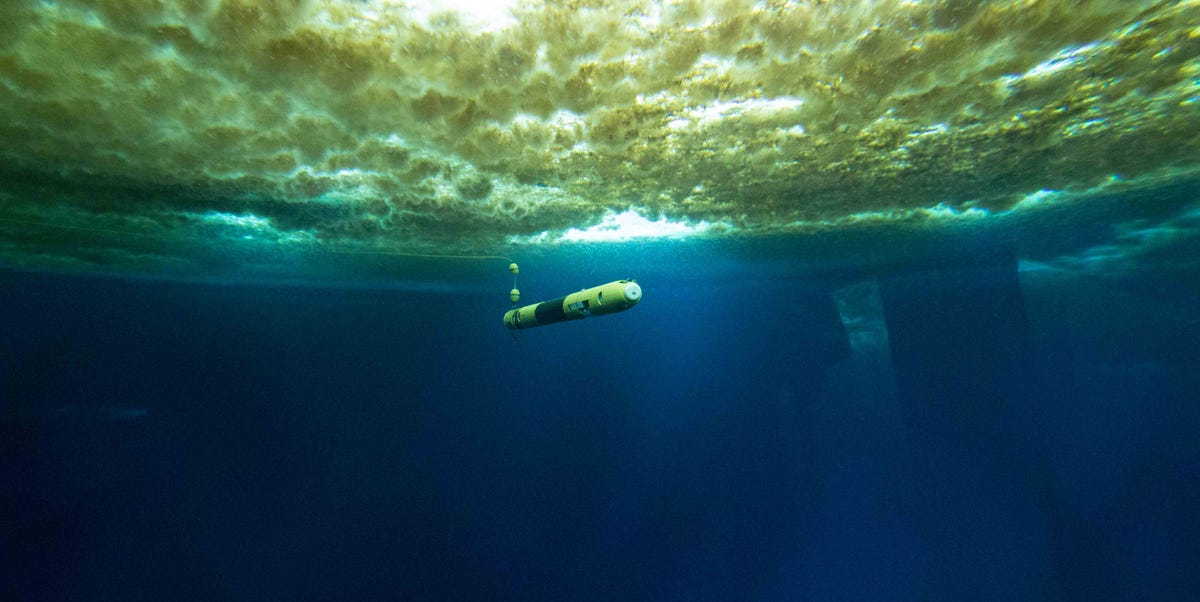
One of the most fascinating parts of this story is the development of under-ice robots. Icefin, a slender robotic vehicle associated with research led by planetary scientist Britney Schmidt and her teams, has been used to explore environments beneath Antarctic ice. It can carry instruments that measure water properties, map ice structures, and observe places humans cannot safely reach.
Another concept, NASA’s BRUIEshort for Buoyant Rover for Under-Ice Explorationtakes a wonderfully clever approach. Instead of rolling on the ground, it is designed to use buoyancy to press itself against the underside of ice and drive upside down. Yes, the robot is basically saying, “Gravity is a suggestion.” That design could help future explorers study the ice-water interface, a zone that may be especially important for life.
These robots are not just cool gadgets. They are answers to hard scientific problems. An ocean world mission may need to survive pressure, darkness, cold, chemical uncertainty, and communication delays. It may need to collect data without stirring up contamination or missing subtle signs of biology. Antarctica lets engineers and scientists discover what breaks, what works, and what needs to be redesigned before a spacecraft travels hundreds of millions of miles.
Microbes Beneath the Ice: Small Life, Huge Implications
Antarctica has already taught scientists that life is more stubborn than once imagined. Blood Falls, an iron-rich outflow from Taylor Glacier, looks like a science-fiction special effect, but its importance is real. Beneath the glacier, cold, salty, oxygen-poor water can support microbial communities. These organisms do not need sunny beaches or smoothie bars. They survive in darkness using chemical energy.
Subglacial lakes add another layer to the story. Lake Whillans, buried beneath the West Antarctic Ice Sheet, has been studied as an example of a hidden ecosystem under ice. Microbes in such environments show how biology can persist far from sunlight. That is exactly the kind of lesson astrobiologists care about when thinking about Europa, Enceladus, or ancient Mars.
The bigger lesson is that life does not always announce itself with leaves, feathers, or dramatic footprints. Sometimes it whispers through chemistry. It changes minerals, consumes compounds, leaves molecular traces, and adapts to conditions that would make most surface life file a formal complaint.
Meteorites: Antarctica’s Delivery Service From Space
Antarctica is also one of the best places on Earth to find meteorites. The Antarctic Search for Meteorites program, known as ANSMET, has recovered thousands of meteorite specimens since the 1970s. The reason is beautifully practical: dark rocks from space stand out against blue ice, and glacial movement can concentrate them in certain regions.
These meteorites are not alien life, but they are messages from other worlds. Some come from asteroids, while others have been identified as pieces of the Moon or Mars. They help scientists study the early solar system, planetary chemistry, impact history, and the materials that shaped planets. In the search for alien life, knowing the ingredients matters.
Meteorites can contain organic compounds, minerals altered by water, and clues about ancient environments. They remind us that planets are not sealed boxes. Material moves between worlds through impacts and long journeys across space. Antarctica, with its natural ice archive, helps researchers collect and preserve some of those rare cosmic samples.
The Search for Aliens Is Really a Search for Habitability
Popular culture often asks, “Where are the aliens?” Science usually starts with a more careful question: “Where could life exist?” That difference may sound small, but it changes everything.
Habitability is about conditions. Does a place have liquid water? Does it have usable energy? Does it have the right chemistry? Could life survive there long enough to leave detectable evidence? Antarctica helps researchers test these questions in environments where life is limited, hidden, or difficult to detect.
This is why astrobiology is not only astronomy. It is geology, chemistry, biology, oceanography, robotics, climate science, and planetary science all wearing the same big parka. A researcher studying salty Antarctic brines may help future scientists interpret data from Mars. A roboticist testing an under-ice vehicle may influence a future Europa mission. A microbiologist studying life in darkness may help define what a biosignature looks like.
What Scientists Are Learning From Antarctica
1. Life Can Be Chemically Powered
Antarctic microbial ecosystems show that life does not always depend directly on sunlight. In dark, icy, or buried environments, organisms may use chemical reactions involving minerals, salts, methane, sulfur, iron, or other compounds. That matters because sunlight is scarce beneath thick ice on ocean worlds.
2. Ice Can Preserve Clues
Ice is not just a barrier. It can also be a vault. It can preserve atmospheric records, trap particles, protect meteorites, and maintain stable environments for long periods. On other worlds, ice may preserve chemical or biological signatures that would be destroyed on an exposed surface.
3. Robots Must Be Field-Tested in Ugly Conditions
A robot that works perfectly in a laboratory may panic when introduced to real ice, pressure, darkness, slush, currents, and cold. Antarctica teaches engineers humility. It also teaches them how to build machines that can operate when repair crews are not exactly around the corner.
4. Contamination Control Is Not Optional
If scientists search for life beyond Earth, they must be extremely careful not to bring Earth microbes along for the ride. Antarctica’s protected and remote environments help researchers practice clean sampling, sterile drilling, and responsible exploration. Finding alien life would be historic. Finding your own accidental contamination would be scientifically embarrassing, like discovering your “rare space organism” is actually lunchbox bacteria.
Why This Research Matters Beyond Space
The Antarctica-alien connection is exciting, but it also has benefits right here on Earth. Under-ice robots help scientists understand glaciers and ice shelves, including how warming oceans interact with Antarctic ice. Microbial research can reveal new biochemical strategies. Meteorite studies improve our understanding of planetary hazards and solar system history.
In other words, the search for aliens is not a distraction from Earth science. It often strengthens it. The same tools that may one day explore Europa can help measure melting beneath Antarctic ice shelves. The same questions that guide the search for life on Mars can deepen our understanding of life’s resilience on our own planet.
Antarctica as a Training Ground for the Next Great Discovery
The search for aliens does not begin with certainty. It begins with disciplined curiosity. Antarctica gives scientists a place to make mistakes, improve instruments, refine theories, and learn what life looks like when it is pushed near the edge.
That is why the title “The Search for Aliens Starts Nowin Antarctica” is more than a catchy line. It captures a real scientific strategy. Before exploring an ice-covered moon, study an ice-covered world. Before looking for life in a hidden ocean, practice in hidden waters. Before interpreting strange chemistry millions of miles away, understand strange chemistry at home.
The aliens, if they exist nearby, may not be waving. They may not be building cities or broadcasting radio shows. They may be microscopic, quiet, and buried beneath ice. But if we find them, the discovery will change biology, philosophy, and humanity’s sense of place in the universe.
Experience Section: What This Search Feels Like From the Edge of the Ice
Imagine following an Antarctic astrobiology team through a field season. The first experience is not wonder. It is logistics. Gloves, fuel, batteries, sterile sample bags, drill equipment, emergency plans, weather windows, data backups, and enough checklists to make a clipboard feel underemployed. The search for alien life begins with very human problems: staying warm, keeping equipment alive, and making sure nothing important blows away.
Then comes the landscape. Antarctica has a way of making ordinary scale disappear. A person becomes tiny against ice, rock, sky, and wind. That emotional shift matters. It helps explain why scientists use this continent as an analog for other worlds. In the Dry Valleys, the ground can look ancient and almost lunar. Beneath sea ice, the world becomes blue, dim, and silent. Under an ice shelf, a robot’s camera may reveal textures and formations no human eye has seen directly before.
The most memorable part of this experience is the patience. Science in Antarctica does not move like a movie montage. Instruments need calibration. Weather delays happen. A robot dive may be postponed because the environment refuses to cooperate. Samples must be handled carefully because one careless touch can ruin the evidence. In astrobiology, the most exciting result may come from avoiding contamination, repeating a measurement, or noticing that a chemical reading changed by a small but meaningful amount.
There is also a strange emotional contrast. The work is about aliens, but it makes Earth feel more precious. When researchers study microbes surviving in cold brines or under ice, they are not just preparing for Europa. They are discovering how creative life on Earth can be. The lesson is humbling: biology is not fragile in the simple way we sometimes imagine. It can be delicate, yes, but also inventive, persistent, and surprisingly good at finding loopholes.
Watching an under-ice robot in this context feels like seeing the future in rehearsal. The machine is not glamorous in the red-carpet sense. It is a tool, a scout, a mechanical question mark. It moves through an environment that humans cannot easily enter, collecting clues one sensor reading at a time. Someday, a descendant of such technology may explore an ocean beneath another world’s ice. If that future robot detects chemistry that hints at life, part of the credit will belong to the frozen tests, awkward repairs, and long field days in Antarctica.
That is the real experience behind the search for aliens in Antarctica: it is not a single heroic moment. It is a chain of careful steps. A meteorite collected from blue ice. A microbe identified in a dark brine. A rover tested beneath sea ice. A sensor redesigned after a failure. A mission planned with more wisdom than the last. The work is cold, slow, and demanding. It is also thrilling, because every frozen field test brings humanity a little closer to answering one of its oldest questions: are we alone?
Conclusion
Antarctica may seem like the end of the world, but for astrobiology it is a beginning. Its ice, rocks, microbes, meteorites, and hidden waters give scientists a rare chance to study life at the edge of possibility. From Icefin and BRUIE to Blood Falls and ANSMET meteorite fields, the frozen continent is helping shape the next generation of alien-life research.
The search for aliens starts now not because scientists expect to find little green creatures under Antarctic ice, but because Antarctica teaches us how to search wisely. It shows where life hides, how machines must explore, what biosignatures might look like, and why icy worlds deserve serious attention. The next great discovery may happen far from Earth, but some of its most important practice runs are happening right here, in the coldest classroom on the planet.