Discounts are the confetti of shopping: they look exciting, they make everything feel like a celebration, and occasionally they hide a little math cleanup afterward. Whether you are staring at a “30% off” sign, comparing two coupons, figuring out a final sale price, or checking whether a deal is actually worth bragging about, knowing how to calculate a discount can save you real money and a surprising amount of checkout-line panic.
The good news? Discount math is not difficult once you understand the basic formulas. You do not need a finance degree, a spreadsheet named “final_final_REAL.xlsx,” or the emotional support of a calculator app. You simply need to know what number you are starting with, what kind of discount is being offered, and whether sales tax, stacked coupons, shipping, or minimum-purchase rules change the final cost.
This guide explains four practical ways to calculate a discount: finding the discount amount, calculating the sale price, working backward from a sale price, and handling multiple discounts. Along the way, you will see easy examples, common mistakes, and real-world shopping tips that help you spot true savings instead of falling for a flashy red sticker with commitment issues.
What Is a Discount?
A discount is a reduction from the original price of a product or service. It may be shown as a percentage off, a fixed dollar amount off, a coupon code, a loyalty reward, a clearance markdown, or a bundle deal. In everyday shopping, the most common discount is a percentage discount, such as 10% off, 25% off, or 50% off.
The basic idea is simple: the original price is the starting point, the discount amount is the money removed from that price, and the sale price is what remains before any taxes, shipping, or extra fees. If an item costs $100 and the store gives you $20 off, your discount amount is $20 and your sale price is $80. No drama. No algebraic thunderstorm.
Key Discount Terms You Should Know
Original Price
The original price is the starting price before the discount is applied. It may also be called the regular price, list price, retail price, or sticker price.
Discount Rate
The discount rate is the percentage taken off the original price. For example, if a jacket is 40% off, the discount rate is 40%.
Discount Amount
The discount amount is the actual dollar value you save. If a $60 item is discounted by 25%, the discount amount is $15.
Sale Price
The sale price is the price after subtracting the discount from the original price. In most stores, sales tax is calculated after the discount is applied, but tax rules can vary by state and by type of coupon, so always check your receipt.
Way 1: Calculate the Discount Amount
The first way to calculate a discount is to find out exactly how much money the percentage discount saves you. This is the most useful method when you want to know whether a sale is worth your attention or just wearing a loud sign.
Formula
Discount amount = Original price × Discount rate
Before multiplying, convert the percentage into a decimal. To do this, divide the percentage by 100. For example, 20% becomes 0.20, 35% becomes 0.35, and 7.5% becomes 0.075.
Example
Suppose a pair of shoes costs $80 and is marked 25% off.
- Convert 25% to a decimal: 25 ÷ 100 = 0.25
- Multiply by the original price: $80 × 0.25 = $20
- The discount amount is $20.
This means you save $20 before tax. The sale price is not $20; the savings is $20. This is a common mistake, especially when the sale sign is aggressive and your coffee has not started working yet.
Way 2: Calculate the Final Sale Price
The second way is to calculate what you will actually pay after the discount. This is the method most shoppers need at the register, online checkout, or while standing in a store pretending not to do math on their phone.
Formula
Sale price = Original price − Discount amount
You can also use a shortcut:
Sale price = Original price × (1 − Discount rate)
This shortcut works because if you receive 30% off, you are still paying 70% of the original price. If you receive 15% off, you are paying 85%. If you receive 50% off, you are paying 50%, which is why half-off sales feel so emotionally supportive.
Example Using the Two-Step Method
A backpack costs $120 and is 30% off.
- Convert 30% to a decimal: 0.30
- Find the discount amount: $120 × 0.30 = $36
- Subtract the discount: $120 − $36 = $84
The sale price is $84 before tax.
Example Using the Shortcut
If the backpack is 30% off, you pay 70% of the original price.
- Convert 70% to a decimal: 0.70
- Multiply: $120 × 0.70 = $84
You get the same answer faster. This shortcut is especially handy when comparing several sale items quickly.
Way 3: Calculate the Discount Percentage from Two Prices
Sometimes a store shows the original price and the sale price, but not the percentage discount. This is your moment to become the detective in a very low-stakes financial mystery.
Formula
Discount percentage = (Original price − Sale price) ÷ Original price × 100
This formula tells you what percentage of the original price was removed.
Example
A coffee maker was originally $95. It is now selling for $76.
- Find the discount amount: $95 − $76 = $19
- Divide by the original price: $19 ÷ $95 = 0.20
- Multiply by 100: 0.20 × 100 = 20%
The coffee maker is 20% off.
This method is useful when a retailer says “You save $19!” but you want to know whether that is a strong discount or just a polite little price haircut. A $19 discount on a $95 item is meaningful. A $19 discount on a $2,000 appliance is less exciting, unless the appliance also makes breakfast and folds laundry.
Way 4: Calculate Multiple or Stacked Discounts
Stacked discounts happen when more than one discount is applied to the same purchase. For example, a store may offer 40% off plus an extra 10% off at checkout. Many shoppers assume that 40% plus 10% equals 50% off. It does not. The second discount usually applies to the already-discounted price, not the original price.
Formula
Final price = Original price × (1 − First discount) × (1 − Second discount)
Example
A coat costs $200. It is marked 40% off, and you have an extra 10% coupon.
- First discount: $200 × 0.60 = $120
- Second discount: $120 × 0.90 = $108
- Final price: $108 before tax
The total savings is $92, because $200 − $108 = $92. To find the effective discount percentage:
- $92 ÷ $200 = 0.46
- 0.46 × 100 = 46%
So 40% off plus 10% off equals a 46% total discount, not 50%. The math is not trying to betray you; it is just applying the discounts in order.
How to Estimate Discounts Quickly in Your Head
You do not always need exact math. Sometimes you just need a quick estimate to decide whether to buy now, wait, or dramatically whisper “not today” to a decorative lamp.
Use 10% as Your Anchor
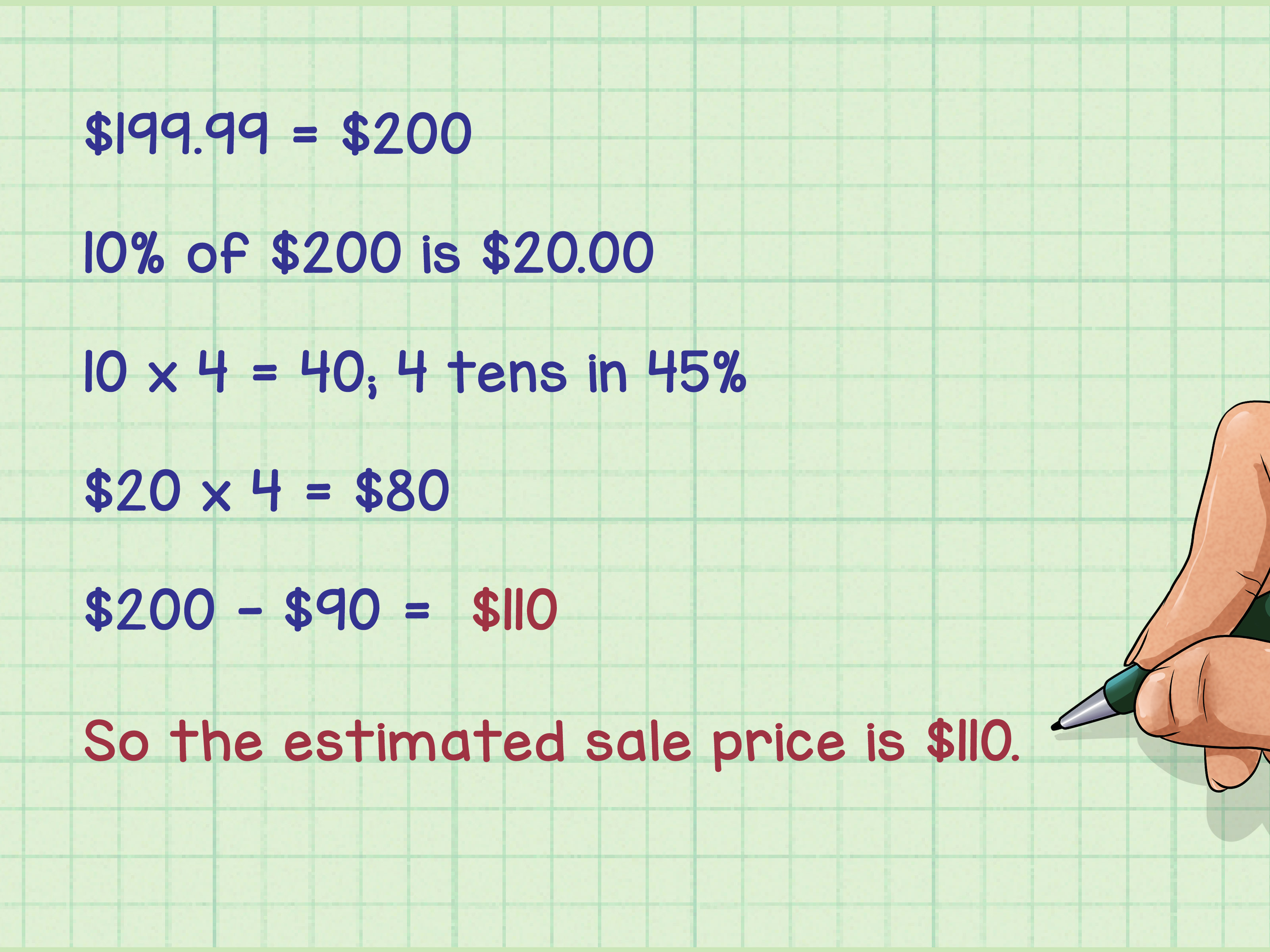
Ten percent is easy because you simply move the decimal one place to the left. Ten percent of $70 is $7. Ten percent of $240 is $24. Once you know 10%, you can build other discounts.
- 20% is double 10%.
- 30% is triple 10%.
- 5% is half of 10%.
- 15% is 10% plus 5%.
Example
A $60 sweater is 15% off.
- 10% of $60 is $6.
- 5% of $60 is $3.
- 15% is $6 + $3 = $9.
- Sale price: $60 − $9 = $51.
This mental math trick is fast, practical, and makes you look suspiciously calm in the clearance aisle.
How Sales Tax Affects a Discount
In many purchases, sales tax is added after the discount is subtracted. For example, if a $100 item is discounted to $80 and your local sales tax rate is 8%, the tax is usually calculated on $80, not $100. That would make the tax $6.40 and the final total $86.40.
However, tax treatment can vary depending on where you live and whether the discount is a store discount, manufacturer coupon, rebate, or special promotion. That is why the final checkout price may occasionally look slightly different from your estimate. The best habit is to calculate the discounted price first, then add tax, shipping, and any fees before deciding whether the deal is truly good.
Common Discount Mistakes to Avoid
Mistake 1: Adding Stacked Discounts Together
As mentioned earlier, 30% off plus 20% off is not 50% off if the second discount applies after the first one. Always apply each discount one at a time.
Mistake 2: Ignoring the Original Price
A big discount is only meaningful if the original price is realistic. Some items are advertised with inflated “was” prices that make the markdown look larger than it really is. Compare prices across retailers before assuming a sale is the deal of the century.
Mistake 3: Forgetting Shipping Costs
A 25% discount can disappear quickly if shipping costs $14.99 and the item is available locally for less. Always compare the total price, not just the sale price.
Mistake 4: Buying More to “Save More”
Minimum-purchase discounts can be useful, but only if you were already planning to buy enough. Spending $75 to use a $10 coupon is not a victory if you only needed $30 worth of items. That is not saving money; that is letting a coupon drive the shopping cart.
Real-World Examples of Discount Calculations
Example 1: 20% Off a $45 Item
Discount amount = $45 × 0.20 = $9. Sale price = $45 − $9 = $36.
Example 2: $15 Off a $75 Item
This is a fixed-dollar discount, so subtract directly. Sale price = $75 − $15 = $60. To find the discount percentage, divide $15 by $75 and multiply by 100. The discount is 20%.
Example 3: 35% Off a $160 Item
Discount amount = $160 × 0.35 = $56. Sale price = $160 − $56 = $104.
Example 4: Sale Price Is $68, Original Price Was $85
Discount amount = $85 − $68 = $17. Discount percentage = $17 ÷ $85 × 100 = 20%.
How to Tell Whether a Discount Is Actually Good
A discount is not automatically a good deal. A product can be 60% off and still be overpriced if the original price was inflated. A 10% discount can be excellent if the product rarely goes on sale, is high quality, and has free shipping. The smartest shoppers look beyond the percentage.
First, compare prices across at least two or three retailers. Second, check whether the product has the features, size, warranty, or quality you actually need. Third, calculate the final cost after tax, shipping, installation, accessories, or subscriptions. Finally, ask the most powerful shopping question in the universe: “Would I still want this if it were not on sale?”
If the answer is no, step away from the cart. The discount may be real, but the need is imaginary. We have all been there. Somewhere, a closet contains a deeply discounted gadget that has never seen daylight.
Discount Calculation for Businesses
Discounts matter for business owners too. Retailers use percentage discounts, seasonal promotions, loyalty rewards, bundle deals, and coupon codes to attract customers, move older inventory, or encourage larger orders. But discounts reduce revenue per sale, so businesses must calculate them carefully.
For example, if a store sells a product for $50 and offers 20% off, the sale price becomes $40. That may attract more buyers, but the store must still cover product cost, payment processing, labor, rent, shipping supplies, advertising, and returns. A discount that increases sales volume but destroys profit is not a strategy; it is a very organized way to lose money.
For small businesses, the best discount is one with a clear purpose. It might reward loyal customers, clear seasonal inventory, promote a new product, or raise average order value. The math should always answer two questions: What does the customer save, and what does the business still earn?
of Practical Experience: What Discount Math Looks Like in Real Life
In real life, calculating a discount is rarely as neat as a textbook example. The sign says 25% off, the coupon says “extra 15% off select styles,” the app says you have $7 in rewards, and the cashier says the blue-tag items are excluded because apparently blue has legal representation. This is why the best discount habit is not memorizing one formula; it is slowing down long enough to identify what kind of discount you are dealing with.
One useful experience is checking the final price before getting emotionally attached to a sale. Imagine you find a kitchen appliance marked down from $180 to $135. At first glance, $45 off looks nice. When you calculate it, $45 divided by $180 equals 0.25, or 25% off. That is a solid discount. But if shipping is $19.99 and another retailer sells the same model for $139 with free shipping, the “bigger” discount may not be the better deal. The lesson: always calculate the full checkout total, not just the markdown.
Another common situation involves stacked coupons. Many shoppers get excited when they see “50% off clearance plus extra 20% off.” That sounds like 70% off, but it is usually 60% off in effective savings. For a $100 item, 50% off brings it to $50. Then 20% off $50 saves another $10, making the final price $40. You saved $60 total, or 60%. Still great, but not 70%. This small difference matters more on expensive items like furniture, electronics, luggage, and appliances.
Grocery shopping offers another lesson: unit price can beat discount percentage. A family-size cereal box may have a bright “sale” tag, while the smaller box quietly costs less per ounce. A discount is only helpful if it lowers the cost of what you actually use. Buying bulk to save money can backfire when food expires, storage space runs out, or your household decides it no longer likes the snack it begged for last week. Children are tiny market disruptors.
Online shopping adds its own twist. A coupon code may reduce the product price but remove free shipping. A loyalty reward may not combine with a sale price. A “buy more, save more” promotion may push you to add unnecessary items. Before clicking “place order,” review the subtotal, discount line, tax, shipping, and final total. If the discount only looks good before fees, it is not the hero of the story.
The biggest real-world lesson is that discount math protects you from impulse buying. When you calculate the actual savings, compare the real price, and ask whether you needed the item in the first place, you turn shopping from a guessing game into a decision. You may still buy the thing. You may even buy the fun thing. But at least the sale sign is no longer driving the car.
Conclusion
Learning how to calculate a discount is one of the simplest money skills you can use every week. The four main methods are easy: calculate the discount amount, subtract it to find the sale price, work backward to find the discount percentage, and apply stacked discounts one at a time. Once you understand these formulas, sale signs become less confusing, coupons become easier to compare, and “limited-time offer” starts sounding less like a command and more like a suggestion.
The smartest approach is to focus on the final price, not just the advertised discount. Compare prices, watch for inflated original prices, include tax and shipping, and avoid buying things only because they are marked down. A discount is only a good deal when it helps you pay less for something you actually want or need. Otherwise, it is just math wearing a party hat.
Note: This article was written in original standard American English and synthesized from reputable consumer, finance, retail, and math education references, including U.S.-focused guidance on comparison shopping, percentage calculations, discounts, coupons, sales price formulas, and retail pricing practices.