The center of gravity of a triangle sounds like something you would need a lab coat, a clipboard, and an extremely serious facial expression to calculate. Fortunately, geometry is kinder than that. For a flat triangle made of uniform material, the center of gravity is the same point as the centroid: the balancing point where the triangle could theoretically rest on the tip of a pencil without tipping over like a dramatic movie villain.
In plain English, the center of gravity of a triangle is the triangle’s “average position.” It is always inside the triangle, no matter whether the triangle is acute, obtuse, right, scalene, isosceles, or equilateral. That makes it different from some other triangle centers, such as the orthocenter, which can wander outside an obtuse triangle like it missed the group meeting.
This guide explains 3 ways to calculate the center of gravity of a triangle: using coordinate geometry, using medians, and using the 2:1 median ratio or height-based shortcut. Each method is useful in a different situation, so you can choose the one that fits your homework, design sketch, engineering problem, or “I just want this triangle to make sense” moment.
What Is the Center of Gravity of a Triangle?
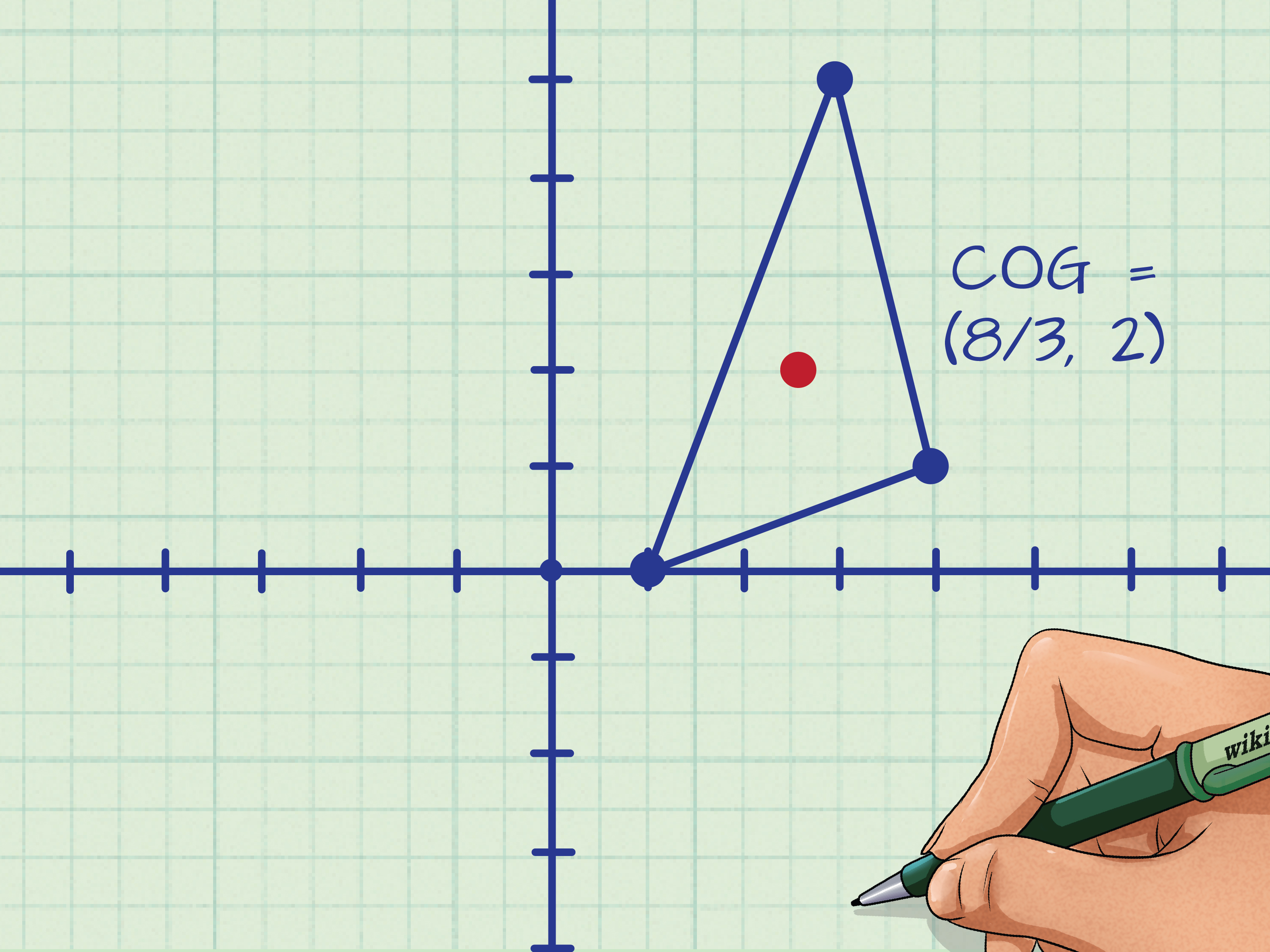
The center of gravity of a triangle is the point where the triangle’s weight is evenly balanced, assuming the triangle is a flat sheet with uniform density. In geometry, this point is called the centroid of a triangle. It is the intersection point of the triangle’s three medians.
A median is a line segment drawn from one vertex of a triangle to the midpoint of the opposite side. Since every triangle has three vertices, every triangle has three medians. These three medians always meet at one point, and that point is the centroid.
Key Properties of the Triangle Centroid
- The centroid is the intersection of the three medians.
- It is always located inside the triangle.
- It divides each median in a 2:1 ratio.
- It is the same as the center of gravity for a uniform triangular sheet.
- Its coordinate formula is the average of the three vertex coordinates.
The magic of the centroid is that it combines visual geometry, algebra, and physical balance. You can draw it, calculate it, or locate it using proportions. That is why the centroid appears in school geometry, engineering statics, architecture, design, robotics, and even computer graphics.
Way 1: Calculate the Center of Gravity Using the Coordinate Formula
The coordinate formula is the fastest and cleanest method when you know the coordinates of the triangle’s three vertices. It works because the centroid is the average position of the triangle’s vertices.
Suppose the triangle has vertices:
A(x1, y1), B(x2, y2), C(x3, y3)
The center of gravity, or centroid, is:
G = ((x1 + x2 + x3) / 3, (y1 + y2 + y3) / 3)
That is it. Add the x-coordinates, divide by 3. Add the y-coordinates, divide by 3. Geometry politely hands you the answer.
Example: Finding the Centroid From Three Vertices
Let a triangle have these vertices:
A(2, 4)B(8, 6)C(5, 1)
Now calculate the x-coordinate of the center of gravity:
x = (2 + 8 + 5) / 3 = 15 / 3 = 5
Then calculate the y-coordinate:
y = (4 + 6 + 1) / 3 = 11 / 3 = 3.67
So the centroid is:
G(5, 3.67)
This means the triangle’s balancing point is located at x = 5 and y = 3.67 on the coordinate plane. If the triangle were cut from cardboard with even thickness, that point would be the best place to balance it.
When Should You Use the Coordinate Formula?
Use the coordinate method when the problem gives you points on a graph, map, CAD drawing, screen layout, or coordinate plane. It is especially useful for analytic geometry, digital design, physics problems, and programming tasks where triangle vertices are stored as numerical values.
The coordinate method is also the least messy option. No ruler. No compass. No suspiciously crooked hand-drawn lines. Just arithmetic.
Way 2: Calculate the Center of Gravity by Drawing the Medians
The geometric method is the classic approach: draw the medians and find where they intersect. It is visual, intuitive, and perfect when you are working with an actual triangle on paper.
Here is the step-by-step process:
- Choose one side of the triangle.
- Find the midpoint of that side.
- Draw a line from the opposite vertex to that midpoint. This line is a median.
- Repeat the process for another side.
- The point where the two medians intersect is the center of gravity.
You technically do not need to draw all three medians. Two medians are enough because all three medians meet at the same point. Drawing the third median is a nice way to check your work, like giving your geometry problem a second opinion.
Example: Finding the Centroid by Construction
Imagine a triangle named ABC. First, find the midpoint of side BC and call it D. Draw a line from vertex A to point D. That line, AD, is a median.
Next, find the midpoint of side AC and call it E. Draw a line from vertex B to point E. That line, BE, is another median.
Where AD and BE cross, mark the point G. That point G is the centroid, or center of gravity, of the triangle.
This method is especially helpful because it shows what the centroid really means. It is not just a formula floating around in math class. It is a real location created by the triangle’s structure.
Why Do the Medians Meet at the Center of Gravity?
Each median divides the triangle into two smaller triangles with equal area. When all three medians are considered together, they create a balanced relationship among the regions of the triangle. The centroid is the point where those balancing relationships meet.
For a uniform triangular sheet, equal area means equal mass. Because the medians divide the shape in a balanced way, their intersection becomes the physical balance point. That is why the centroid and center of gravity are the same for a flat triangle with uniform density.
Way 3: Calculate the Center of Gravity Using the 2:1 Median Ratio
The third method uses one of the centroid’s most important properties: the centroid divides each median in a 2:1 ratio. More specifically, the distance from a vertex to the centroid is two-thirds of the full median, while the distance from the centroid to the midpoint of the opposite side is one-third of the median.
In formula form:
Vertex to centroid = 2/3 of the median
Centroid to midpoint = 1/3 of the median
This method is excellent when you know the length of a median or the height of a triangle and need to locate the center of gravity along that line.
Example: Using the 2:1 Ratio
Suppose a median of a triangle is 12 inches long. The centroid is located two-thirds of the way from the vertex to the midpoint of the opposite side.
Distance from vertex to centroid = (2/3) × 12 = 8 inches
Distance from centroid to midpoint = (1/3) × 12 = 4 inches
So if you start at the vertex and move 8 inches along the median, you reach the center of gravity. If you start from the midpoint of the opposite side, you move 4 inches toward the vertex.
Using the Height Shortcut for Simple Triangles
For some triangles, especially those drawn with a horizontal base and a clear vertical height, the centroid lies one-third of the height above the base. This is commonly used in statics and engineering when working with triangular areas.
For example, if a triangle has a base on the x-axis and a vertical height of 18 centimeters, the centroid is located:
18 / 3 = 6 centimeters
above the base.
That does not mean the centroid is always directly above the midpoint of the base for every triangle. It depends on the shape and orientation. But for a triangle where the median from the top vertex drops to the midpoint of a horizontal base, this shortcut is incredibly convenient.
Comparing the 3 Methods
| Method | Best For | Main Idea |
|---|---|---|
| Coordinate Formula | Graph problems, algebra, digital design | Average the three x-values and three y-values |
| Drawing Medians | Paper geometry, visual learning, construction | Draw lines from vertices to opposite midpoints |
| 2:1 Ratio Method | Known median lengths, height shortcuts, statics | Centroid is two-thirds from the vertex along a median |
The coordinate formula is usually the most efficient. The median drawing method is the most visual. The 2:1 ratio method is the most useful when you already know a median or height measurement. Together, these three methods give you a complete toolkit for calculating the center of gravity of a triangle.
Common Mistakes When Finding the Center of Gravity of a Triangle
Mistake 1: Confusing the Centroid With the Incenter
The centroid comes from medians. The incenter comes from angle bisectors. The centroid balances the triangle’s area, while the incenter is the center of the triangle’s inscribed circle. They may look friendly, but they are not the same point unless the triangle is highly symmetrical, such as an equilateral triangle.
Mistake 2: Confusing the Centroid With the Orthocenter
The orthocenter is where the altitudes meet. In a right triangle, it sits at the right-angle vertex. In an obtuse triangle, it can sit outside the triangle. The centroid, however, always stays inside. It is the responsible one.
Mistake 3: Dividing the Median the Wrong Way
The centroid divides a median in a 2:1 ratio, but the longer section is always from the vertex to the centroid. The shorter section is from the centroid to the midpoint of the opposite side. If a median is 15 units long, the centroid is 10 units from the vertex and 5 units from the midpoint.
Mistake 4: Averaging Only Two Vertices
For the coordinate formula, you must use all three vertices. Averaging two points gives you a midpoint, not the centroid. The centroid is a three-point average, not a two-point shortcut wearing a fake mustache.
Real-World Uses of the Triangle Center of Gravity
The center of gravity of a triangle is not just a textbook concept. It appears in many real-world situations where balance, weight distribution, and shape analysis matter.
In engineering, triangular plates, trusses, brackets, and supports often need centroid calculations to understand how loads transfer through a structure. In architecture, triangular design elements may require balance and placement analysis. In manufacturing, the centroid helps determine how parts should be lifted, supported, or cut.
In computer graphics, triangle centroids can help with mesh processing, object positioning, animation, and collision detection. Since many 3D models are built from triangular faces, knowing the centroid of a triangle is surprisingly useful behind the scenes. Even video games rely on triangle math more often than most players realize.
In education, the centroid gives students a clean bridge between geometry and physics. It shows how a visual construction, an algebraic formula, and a physical balancing point can all describe the same thing. That is the kind of math connection that makes teachers quietly celebrate.
Practical Experience: What I Learned From Working With Triangle Centers
One of the best ways to understand the center of gravity of a triangle is to stop treating it like a mysterious formula and start treating it like a balancing problem. When students first see the centroid formula, they often memorize it quickly but do not immediately understand why it works. The moment they cut out a cardboard triangle, draw the medians, and try balancing it on a pencil point, the idea becomes much more real.
In practice, the coordinate method is the easiest to calculate, but the median method is the easiest to believe. A formula can feel abstract, especially when the coordinates include fractions or negative numbers. But when the medians visibly cross at one point, the centroid suddenly feels less like algebra and more like a physical fact. That is why I recommend learning the visual method first, even if you plan to use the formula most of the time.
Another useful experience is comparing different types of triangles. In an equilateral triangle, the centroid looks perfectly centered because all sides and angles are equal. In a long, skinny scalene triangle, the centroid may look slightly surprising because it shifts toward the wider region of the shape. In a right triangle, the centroid can be found very quickly with coordinates, especially if the right angle sits at the origin. These comparisons help you build geometric intuition instead of just pushing numbers through a formula.
When solving real problems, I have found that the biggest challenge is not the centroid itself, but choosing the right method. If a problem gives coordinates, do not overcomplicate it: use the average formula. If a problem gives a drawing but no coordinates, draw two medians. If a problem gives a median length or asks for a distance along a median, use the 2:1 ratio. The method should match the information you already have.
It is also helpful to check whether your answer makes visual sense. The centroid must be inside the triangle. If your calculated point lands outside, something went wrong. Maybe a coordinate was copied incorrectly, maybe the y-values were averaged badly, or maybe you accidentally calculated another triangle center. A quick sketch can save you from a very confident wrong answer, which is the most dangerous species of wrong answer.
For web design, education, drafting, and simple engineering layouts, centroid calculations are often used quietly in the background. You may not always call it “the center of gravity,” but whenever you need the natural center of a triangular region, you are working with the centroid. Once you understand the three methods in this article, the triangle stops being just three lines and becomes a shape with a predictable, balanced center.
Conclusion
Calculating the center of gravity of a triangle is simpler than it first sounds. The key is knowing that the center of gravity of a uniform triangular shape is its centroid. You can calculate it by averaging the vertex coordinates, drawing the medians and finding their intersection, or using the 2:1 ratio along a median.
The coordinate formula is fast and accurate. The median method is visual and easy to understand. The 2:1 ratio method is perfect when working with distances, heights, and practical geometry problems. Once you know all three, you can handle nearly any triangle centroid problem without breaking into a nervous sweat.
So the next time a triangle asks, “Where is my center?” you will know exactly where to look: at the centroid, patiently waiting inside the triangle like the calm, balanced point it is.