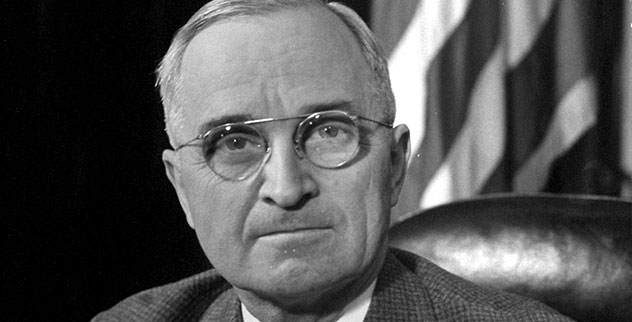
Harry S. Truman never sounded as though a committee had polished his sentences until every trace of personality disappeared. His words were direct, practical, occasionally mischievous, and usually sturdy enough to survive both a political argument and a Monday morning staff meeting.
America’s 33rd president entered the White House on April 12, 1945, after Franklin D. Roosevelt’s death. He had been vice president for only 82 days. Suddenly, the former Missouri farmer, World War I artillery captain, county official, and U.S. senator was responsible for decisions involving the end of World War II, postwar reconstruction, nuclear weapons, civil rights, the emerging Cold War, and Korea. No pressure, then.
Truman’s plainspoken style reflected the life he had lived before becoming president. His leadership of the Senate committee investigating defense spending had already established his reputation for persistence and administrative honesty. In the presidency, that same outlook appeared in the Truman Doctrine, the Marshall Plan, the Berlin Airlift, the creation of NATO, recognition of Israel, and Executive Order 9981, which required equal treatment and opportunity in the armed forces.
The following collection brings together 25 memorable Harry Truman quotes about leadership, responsibility, peace, democracy, education, character, and history. “Top” is not a laboratory measurement here; no team of historians wearing white coats ranked every Truman sentence. These selections stand out because they reveal how he thought and why his words remain useful.
Historical background synthesized from the Harry S. Truman Library, National Park Service, U.S. Senate, Miller Center, Office of the Historian, White House Historical Association, National Archives, Library of Congress, National Constitution Center, American Presidency Project, HISTORY, and Truman Library Institute.
Famous Harry Truman Quotes About Responsibility and Leadership
-
“The buck stops here.”
The small sign on Truman’s desk became the most recognizable summary of his leadership philosophy. It meant that responsibility could travel through departments, advisers, and committees only so far. Eventually, somebody had to decideand the president could not send the decision back down the hallway with a polite note.
-
“I never did give anybody hell. I just told the truth and they thought it was hell.”
This answer grew out of Truman’s energetic 1948 campaign, during which supporters began shouting, “Give ’em hell, Harry!” The line captures his combative humor. Truman presented himself not as a man inventing attacks, but as one stating unpleasant facts with enough force to make opponents wish he had chosen interpretive dance instead.
-
“Do your best, history will do the rest.”
Leaders cannot control every consequence or guarantee that future generations will praise them. They can control preparation, effort, and integrity. Truman’s advice is especially useful when a decision must be made before certainty arriveswhich is inconveniently how most important decisions work.
-
“Progress occurs when courageous, skillful leaders seize the opportunity to change things for the better.”
Progress does not happen merely because everybody agrees that progress would be nice. Truman joins courage with skill: boldness without competence can create chaos, while competence without courage often produces an extremely organized version of doing nothing.
-
“Keep working on a plan. Make no little plans. Make the biggest one you can think of, and spend the rest of your life carrying it out.”
This quote encourages ambition supported by endurance. Truman understood that meaningful programs are rarely completed in one speech, election, or burst of enthusiasm. A large plan requires years of revision, persuasion, setbacks, and returning to work after the applause has wandered elsewhere.
-
“It is amazing what you can accomplish if you do not care who gets the credit.”
Few habits damage teamwork faster than treating every project as an audition for personal glory. Truman’s point is not that achievement should go unrecognized. It is that the mission should remain more important than whose name appears first in the congratulatory email.
-
“America was built on courage, on imagination and an unbeatable determination to do the job at hand.”
Truman’s description of American achievement emphasizes action rather than comfort. Courage begins the work, imagination identifies possibilities, and determination keeps going after the exciting beginning has turned into forms, budgets, disagreements, and several meetings that could have been shorter.
Quote wording checked against the Truman Library and Truman Library Institute collections.
Harry Truman Quotes About Peace and Foreign Policy
-
“I don’t believe that because peace is difficult that war is inevitable.”
This sentence rejects lazy fatalism. Peace may require patience, alliances, economic support, negotiation, and credible strength, but difficulty does not make failure unavoidable. Truman’s presidency helped build institutions intended to prevent another global war, even as international tensions hardened into the Cold War.
-
“We can well afford to pay the price of peace. Our only alternative is to pay the terrible cost of war.”
Peace has expenses: diplomacy, rebuilding, humanitarian assistance, defense, and international cooperation. Truman argued that these costs should be compared not with spending nothing, but with the vastly greater human and economic destruction caused by war.
-
“I’d rather have lasting peace in the world than be president. I wish for peace, I work for peace, and I pray for peace continually.”
Coming from a president associated with some of the most controversial military decisions in history, this statement carries unavoidable complexity. It also reveals Truman’s stated priority: public office was valuable only if it could help produce a safer and more peaceful world.
-
“The supreme need of our time is for men to learn to live together in peace and harmony.”
Truman delivered this message in his 1949 inaugural address after two world wars had devastated the first half of the century. The wording is simple because the principle is simple. The implementation, as humanity has repeatedly demonstrated, is where the paperwork gets complicated.
-
“It must be the policy of the United States to support free peoples who are resisting attempted subjugation.”
This declaration formed the heart of the Truman Doctrine in 1947. It marked a major shift toward sustained American involvement abroad. The policy shaped Cold War strategy for decades and remains debated because principles announced in broad language can produce difficult choices when applied to real countries and conflicts.
Foreign-policy context and quotations checked against the National Archives, Office of the Historian, American Presidency Project, and Truman Library Institute.
Harry Truman Quotes About Democracy and Civil Rights
-
“The protection of civil rights is the duty of every government which derives its powers from the consent of the people.”
Truman made civil rights a federal responsibility at a time when many national politicians preferred to leave discrimination untouched. His record was imperfect and reflected personal contradictions, but his administration’s actions helped return civil rights to the center of federal policy.
-
“Whether discrimination is based on race, or creed, or color, or land of origin, it is utterly contrary to American ideals of democracy.”
This quote measures the country against its stated principles rather than its habits. Democracy cannot be defended merely through patriotic language. It must be visible in access to citizenship, employment, public institutions, justice, and opportunity.
-
“You cannot stop the spread of an idea by passing a law against it.”
Laws can restrict conduct, but ideas require argument, education, evidence, and better alternatives. Attempts to suppress beliefs often give them extra drama and publicitythe ideological equivalent of telling everyone not to look inside a mysterious box.
-
“Once a government is committed to the principle of silencing the voice of opposition, it has only one way to go.”
Truman continued by warning that repression leads toward fear and government terror. The democratic lesson is enduring: opposition is not an annoying defect in the system. It is part of the system’s protection against unchecked power.
-
“There is no indispensable man in a democracy.”
A healthy democracy depends on institutions, laws, peaceful succession, and citizensnot on the permanent presence of one heroic personality. Leaders matter, but anyone claiming that the nation cannot survive without him has misunderstood both democracy and the confidence level appropriate for a human being.
Civil-rights and democratic-governance context checked against Truman’s public papers, the National Archives, Library of Congress, and National Constitution Center.
Harry Truman Quotes About the Presidency and Decision-Making
-
“Never use two words when one will do best.”
This is excellent advice for speeches, emails, reports, and restaurant menus that describe mashed potatoes as an “artisanal whipped tuber experience.” Truman valued clear language because vague language can hide vague thinking.
-
“Being a president is like riding a tiger. A man has to keep on riding or be swallowed.”
The presidency brings enormous power, but it also creates relentless demands. Crises, Congress, elections, foreign governments, public opinion, and the press do not pause because the president would enjoy an afternoon without new problems.
-
“I never sit on a fence. I am either on one side or another.”
Truman preferred decisions to indefinite hesitation. That does not mean leaders should ignore evidence or rush foolishly. It means analysis eventually must produce a choice. A fence may offer a broad view, but it is an uncomfortable place to establish permanent headquarters.
-
“To be president of the United States is to be lonely, very lonely at times of great decisions.”
Advisers can provide facts, arguments, and warnings. They cannot fully absorb the responsibility carried by the person who signs the order. Truman’s observation describes a basic truth of leadership: authority may be shared, but accountability often becomes personal at the decisive moment.
Presidential-leadership quotations checked against the Truman Library Institute collection and Truman Library material concerning the presidential desk sign.
Harry Truman Quotes About Character, Education, and History
-
“Fame is a vapor, popularity is an accident, riches take wings … and only one thing endurescharacter.”
Approval changes quickly, especially in politics. Truman’s own popularity rose, collapsed, and was reassessed after he left office. Character, in this view, is what remains when polls, applause, wealth, and flattering introductions have packed up and gone home.
-
“There is nothing new in the world except the history you do not know.”
Truman was an enthusiastic reader of history and frequently used the past to interpret present problems. Events do not repeat with mechanical precision, but patterns of ambition, fear, miscalculation, courage, and compromise are not exactly fresh inventions.
-
“Education is one thing that can’t be taken away from you.”
Property, employment, status, and influence can disappear. Knowledge becomes part of how a person reasons and adapts. Education is therefore more than a credential; it is portable equipment for handling whatever life decides to place unexpectedly in the road.
-
“Men make history. History does not make the man.”
Circumstances shape the choices available to leaders, but they do not remove human agency. Truman entered office amid conditions he had not created. His quote insists that people still bear responsibility for what they choose to do with the moment handed to them.
Quotations about character, education, and history checked against the Truman Library Institute and National Archives.
What It Feels Like to Put Harry Truman’s Quotes Into Practice
Truman’s quotations become more meaningful when they are treated as working principles rather than decorative sentences placed beneath an eagle on an office wall. A useful experience is to choose one quote and apply it deliberately for a week.
Taking Responsibility Without Performing a Blame Ballet
Start with “The buck stops here.” Imagine that a project misses its deadline. The easiest response is to explain that another department replied late, the instructions were unclear, the software behaved strangely, and Mercury may have been in retrograde. Some of those factors might be true. Truman’s principle asks a different question: What part of the outcome was within your control?
Applying the quote does not require accepting blame for everything. It means acknowledging your authority, correcting what you can, and explaining the solution before composing an epic poem about everyone else’s mistakes. Teams generally trust leaders more when responsibility travels upward and credit travels downward.
Choosing Action After Reasonable Preparation
“I never sit on a fence” is useful when analysis has become procrastination wearing glasses. Suppose you are considering a job change, launching a product, or selecting between two workable plans. Gather the important facts, identify the risks, set a decision date, and choose. The experience may feel uncomfortable because certainty rarely arrives on schedule. Making a thoughtful decision, however, usually produces more useful information than another month of imagining every possible disaster.
Letting Someone Else Receive the Applause
Truman’s quote about accomplishing more when you do not care who receives the credit can be tested during a group project. Contribute an idea, help improve the work, and resist the urge to remind everyonerepeatedly and with visual aidsthat the original suggestion was yours. The surprising experience is that influence often grows when the need for recognition shrinks. People become more willing to collaborate with someone who is not secretly turning every meeting into an awards ceremony.
Using History as a Practical Tool
To experience Truman’s belief in history, take a current problem and research a comparable episode from the past. A business facing technological disruption might study earlier industries transformed by new tools. A community debating public policy might examine how similar proposals worked elsewhere. History will not provide a ready-made instruction sheet, but it can reveal recurring incentives, predictable mistakes, and consequences that enthusiasm tends to overlook.
Practicing Character When Nobody Is Watching
The quote about fame, popularity, and character becomes personal in ordinary moments: admitting an error before it is discovered, keeping a promise that has become inconvenient, defending someone who is absent, or declining an advantage that is technically available but plainly unfair. These choices rarely produce headlines. That is precisely why they are useful tests.
Living with Truman’s words for a week may not make anyone presidential. It can, however, encourage clearer writing, firmer decisions, deeper reading, better teamwork, and a healthier relationship with responsibility. That is a respectable return from a handful of sentences spoken by a former farmer from Missouri.
Conclusion: Why Harry Truman’s Words Still Matter
The best Harry Truman quotes endure because they do not require a lengthy decoder ring. They speak plainly about responsibility, courage, peace, democracy, learning, and character. Even when the historical decisions surrounding Truman remain controversial, his language gives readers a direct view of how he understood leadership.
His central message is demanding but practical: learn from history, tell the truth, make the decision, accept responsibility, protect democratic principles, and keep working after recognition is no longer guaranteed. In an age overflowing with slogans, Truman’s words still have the useful weight of tools.