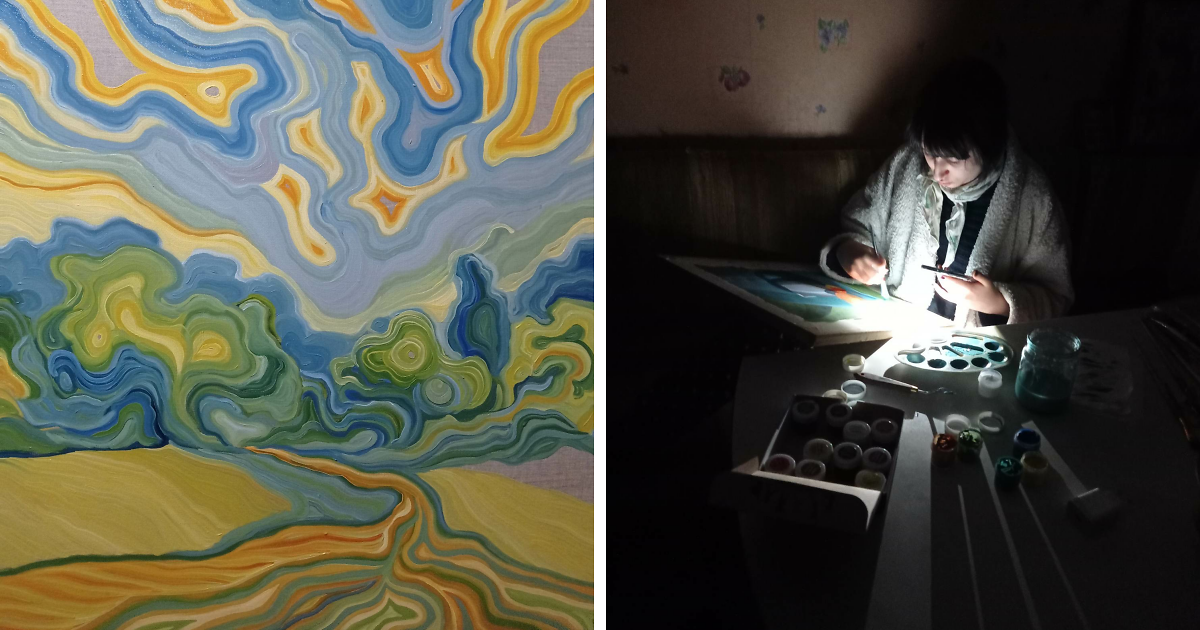
Ukraine in December 2022 was not exactly handing out cozy studio vibes. This was not the month of soft jazz, oversized sweaters, and leisurely brushstrokes beside a frothy latte. It was a month of rolling blackouts, freezing temperatures, missile strikes, and a daily routine shaped by air-raid alerts and uncertainty. And yet, artists kept painting.
That fact matters more than it may seem at first glance. In wartime, painting is not merely decoration. It is not a luxury item with better lighting. It becomes evidence, memory, therapy, protest, identity, and sometimes pure stubbornness in pigment form. If you want to understand how people painted in Ukraine in December 2022, you have to start there: art was no longer sitting politely on the shelf marked “optional.” It had marched straight into the category labeled “essential.”
This article explores what painting in Ukraine looked like during that brutal winter month, why artists continued to work under impossible conditions, and what their persistence reveals about Ukrainian cultural resilience. The story is not only about paint on canvas. It is about keeping imagination alive when a larger power is trying to reduce life to survival alone.
December 2022 Was a Month of Darkness, Cold, and Defiance
By December 2022, Russia’s attacks on Ukraine’s energy infrastructure had turned ordinary life into a logistical obstacle course. Heat, light, internet access, and reliable electricity could disappear without much warning. In practical terms, that changed everything for artists. Painting is a physical act, yes, but it also depends on infrastructure. You need light to see color accurately. You need heat so paint, glue, paper, and your own fingers behave like civilized materials. You need time, focus, and some version of calm. Wartime winter in Ukraine offered those things in short supply.
But Ukrainian artists adapted with a kind of creativity that would be funny if the circumstances were not so brutal. When the power came back, people charged everything at once like contestants on a game show called Beat the Blackout. Phones, lamps, battery packs, laptops, cameras, heaters, and, when possible, spirits. Work schedules shifted around daylight hours. Studios became flexible. Hallways, kitchens, basements, schoolrooms, shelters, and borrowed heated corners all became temporary places to make art.
That improvisation was not only practical. It reshaped the rhythm of painting itself. Instead of waiting for perfect conditions, artists worked in fragments. They painted when there was power. They sketched when there was no power. They stored ideas in notebooks, on phones, in memory, in conversation. They became specialists in the unfinished moment, which is really just another way of saying they learned how to keep going.
So, How Do You Paint in a War Zone?
You paint around the emergency, not after it
One of the most important truths about wartime art is that artists usually do not get to pause life neatly, survive the crisis, and then return to their easels refreshed. That is not how war works. People create in the middle of disruption, not after the credits roll. In Ukraine, that meant painting in between alarms, after volunteer shifts, before curfew, during short windows of electricity, or in the emotional aftermath of a terrifying night.
That kind of schedule changes the work. Paintings made under pressure often become sharper, leaner, more urgent. They stop fussing over whether the vase looks balanced and start asking heavier questions. What deserves to be remembered? What does home look like when it is damaged? What color is fear at 4 a.m.? Can beauty still function when everything around it insists on collapse?
You make the studio portable
War punishes anything bulky, precious, or dependent on ideal conditions. So artists learn to travel light. Smaller canvases, sketchbooks, watercolor sets, charcoal, pencils, gouache, ink, and materials that can be packed quickly become more useful than elaborate studio setups. The romantic image of the grand, paint-splattered atelier gives way to a more realistic one: a backpack, a stool, a flashlight, and a deep belief that making something still matters.
Portable practice does not necessarily mean smaller ambition. In fact, some wartime art becomes more conceptually expansive precisely because the tools are minimal. Limits have a weird way of stripping away fluff. When options shrink, intention gets louder.
You let community do some of the heavy lifting
Art during wartime is often collective, even when the final work appears solitary. Painters depend on friends who share warm rooms, institutions that keep exhibiting, volunteers who keep buildings functioning, and cultural networks that help artists stay visible. In December 2022, that communal backbone mattered enormously. Writers, musicians, performers, curators, and visual artists were not working in isolation; they were helping keep a larger cultural ecosystem alive.
That ecosystem included concerts, exhibitions, readings, pop-up events, and public acts of cultural assertion. Keeping culture active was not a side quest. It was part of national endurance.
Painting Became a Way to Refuse Erasure
The reason art mattered so deeply in Ukraine during late 2022 goes beyond morale. Russia’s war has repeatedly been described not only as a military assault but also as an attack on Ukrainian identity, memory, and cultural independence. That is why museums, libraries, theaters, archives, monuments, churches, and schools became such symbolically charged spaces. Damage to culture was not incidental background noise. It was part of a larger attempt to weaken the story Ukrainians tell about themselves.
In that context, painting acquires a sharper edge. Every canvas made in Ukrainian conditions becomes a refusal to disappear. Every image rooted in local language, memory, landscape, folklore, grief, and humor pushes back against the lie that Ukraine is somehow culturally secondary, derivative, or disposable. That is one reason wartime Ukrainian art has resonated so strongly inside and outside the country. It is carrying more than aesthetics. It is carrying statehood, history, and emotional truth.
This also helps explain why the visual language of wartime Ukraine can feel both intimate and enormous at the same time. A single room, a candle, a window, a figure in a coat, a cup on a table, a child drawing, a church dome, a snow-dark street, a blown transformer in the distance: these are ordinary subjects, yet in December 2022 they were loaded with political and moral weight. To paint them was to say, “This exists. This is ours. You do not get to define it for us.”
The Winter Aesthetic Was Real, and It Was Not Cute
There is a temptation, especially from far away, to romanticize wartime creativity. Candlelight! Snow! Artists bravely painting by hand! It sounds cinematic until you remember that cold rooms hurt, darkness exhausts people, and interrupted sleep makes everything harder, including mixing a decent blue. The winter aesthetic in Ukraine was not a moody Pinterest board. It was survival with visual consequences.
December 2022 likely altered artistic choices in subtle but meaningful ways. Darker palettes made sense because the landscape and mood were darker. Rapid studies and rough textures matched the pace of life. Materials that dried quickly, traveled easily, or tolerated unstable room temperatures became more attractive. Subject matter narrowed toward essentials: bodies, homes, ruins, symbols, memory, weather, light, and the strange beauty of endurance.
At the same time, Ukrainian artists did not stop making work that was imaginative, poetic, playful, or surreal. That is part of the point. War does not erase the need for beauty; it intensifies it. Beauty becomes less about prettiness and more about proof of inner freedom. A whimsical motif, a folk reference, a vivid pattern, or a flash of absurd humor can function like a tiny declaration of sovereignty.
Why Humor Still Belonged in the Room
People who have not lived through crisis often imagine that serious times produce only solemn art. But Ukrainians have shown again and again that humor can coexist with grief without diminishing it. Humor is one of the ways humans keep fear from taking over the entire house. It cracks a window open.
That same energy appears in art. A painting made under pressure may still contain wit, irony, mischief, and visual jokes. Not because the artist is ignoring suffering, but because humor remains one of the last areas tyranny fails to fully control. A regime can bomb a building. It cannot easily bomb a punchline out of a people.
So yes, even in December 2022, amid blackouts and bitter cold, artists could still make work that laughed a little, teased power a little, and insisted that emotional life was bigger than terror. Frankly, that may be one of the most Ukrainian things about the whole story.
What the World Often Missed
From the outside, it is easy to treat wartime art as inspirational garnish on top of the “real” news. Missiles are the headline; paintings are the soft-focus follow-up. But that framing misses the point. In Ukraine, culture was not adjacent to the conflict. It was one of the things under attack and one of the things doing the resisting.
That is why accounts of musicians performing in metro stations, writers keeping wartime diaries, dancers carrying national memory in their bodies, photographers documenting daily life, and artists continuing to produce work despite blackout conditions all belong in the same conversation. They show that creative practice was helping maintain social continuity. Art was saying: daily life is damaged, but not erased; identity is pressured, but not surrendered.
Painting, in particular, has a special power here because it slows attention down. News moves fast. Paintings do not. They hold a gaze. They insist on looking longer. In wartime, that is a radical act. To look carefully is to resist numbness. To paint carefully is to resist disappearance.
This Is How We Paint While In Ukraine In December 2022
So if we had to answer the title plainly, the answer would sound something like this: we paint while the lights are unreliable, while the windows shake, while the heaters fail, while the generators cough, while the internet drops, while friends volunteer, while streets darken early, while fear sits nearby, and while the country keeps insisting on itself.
We paint quickly when the power returns. We paint by memory when it goes out. We paint smaller if we have to. We paint in layers because life itself has become layered: before the siren, after the siren, before the call, after the call, before the news, after the news. We paint ruins, but not only ruins. We paint flowers, saints, kitchens, skies, faces, symbols, and private moments that prove ordinary life is still fighting for room to exist.
We paint because culture is not a side dish to freedom. It is one of freedom’s main courses. And because in a month like December 2022, making art in Ukraine was never just about producing images. It was about staying human in conditions designed to reduce life to darkness, cold, and fear.
Extended Experience Notes: What Painting in Ukraine in December 2022 Likely Felt Like
The following reflection is written as a composite, drawing on the conditions, artistic accounts, and cultural reporting from wartime Ukraine rather than claiming a single person’s diary. That distinction matters. But so does the feeling behind it.
Imagine beginning a painting session not by asking what mood you are in, but by checking whether the building is warm enough to stay in for the next hour. Imagine arranging your brushes near a window because daylight is now part of your supply list. You are not waiting for inspiration in some grand, cinematic way. You are waiting for electricity, for silence, for the next air-raid alert not to interrupt the middle of a line. In another life, you might have obsessed over whether a composition needed one more object in the corner. In December 2022 in Ukraine, the fact that you were able to continue the composition at all felt like a small victory.
There is also the weird intimacy of blackout life. Rooms shrink when the lights go out. The world becomes local: the candle flame, the flashlight beam, the sound from the hallway, the kettle if you are lucky, the message from a friend that says, “We have power for now.” In those moments, painting becomes less theatrical and more essential. You stop worrying about artistic performance. You worry about attention. Can you remain present enough to keep seeing? Can you continue noticing color in a season that seems determined to flatten everything into gray and black?
And then there is the emotional whiplash. One hour you are mixing paint. The next you are scrolling for updates. Then maybe someone cracks a joke because humans are strange and funny and terrified all at once. Then you return to the work, and the canvas has changed because you have changed. Wartime painting is shaped by interruptions, but not only logistical ones. Emotion itself keeps interrupting. Grief walks in. Anger rearranges the furniture. Hope refuses to leave entirely, which is inconvenient in the best possible way.
Yet there is something else in those reported experiences: discipline. Not glamorous discipline. Not the tidy discipline of productivity books and perfect routines. A rougher kind. The discipline of continuing anyway. Of setting out tools in a cold room. Of making one sketch, then another. Of preserving a visual language even when the surrounding world is trying to replace it with noise, fear, propaganda, or exhaustion. That is why the act of painting in Ukraine in December 2022 reads, from a distance, as both fragile and formidable. Fragile because conditions were punishing. Formidable because artists kept choosing to make meaning inside them.
In that sense, the experience was never only about art materials or studio habits. It was about maintaining inner structure when outer structure kept failing. Painting became a rhythm of witness: see, hold, translate, continue. And that may be the clearest lesson of all. In Ukraine’s darkest winter moments, artists were not painting because the circumstances were suitable. They were painting because the circumstances made cultural presence impossible to abandon.
Conclusion
To understand painting in Ukraine in December 2022, you have to let go of the fantasy that art thrives only under ideal conditions. Ukrainian artists proved the opposite. Art can survive cold rooms, unstable power, fear, grief, and interruption. More than that, it can answer them.
What emerged from that month was not merely a story of resilience in the abstract. It was a portrait of practical courage: people carrying culture forward in real time, with real consequences, under real danger. They did not wait for a safer chapter to begin making meaning. They made meaning inside the danger itself.
That is how they painted in Ukraine in December 2022. Not comfortably. Not casually. Not symbolically alone. They painted as witnesses, as caretakers of memory, and as stubborn defenders of a culture that refused to go dark even when the lights did.