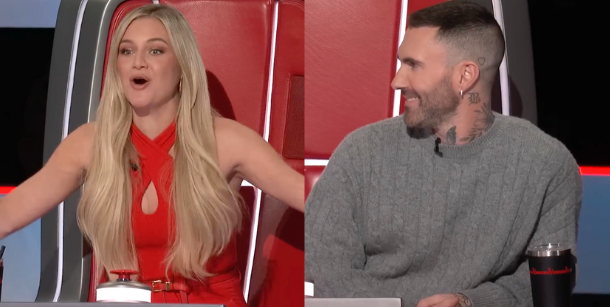
On The Voice, a chair turn is never just a chair turn. It is a declaration, a sales pitch, a tiny musical earthquake, and sometimes a full-blown coach-on-coach comedy routine. But when Adam Levine turned his red chair for Grace-Miller Moody during Season 27 after she performed Maroon 5’s “Sunday Morning,” the moment landed with extra sparkle. Why? Because singing an Adam Levine song in front of Adam Levine is already bold. Getting Adam Levine to turn for it? That is the reality TV version of walking into a bakery, baking a cake for the baker, and having the baker ask for seconds.
The moment quickly became one of the most talked-about blind auditions of the season. Grace-Miller Moody did not merely perform a familiar pop hit; she took a song connected directly to Levine’s career and reshaped it into a soulful, jazzy audition that earned a four-chair turn. Michael Bublé, John Legend, Kelsea Ballerini, and Levine all wanted her. The coaches reacted with surprise, laughter, strategy, and just enough friendly panic to remind viewers why The Voice remains such dependable comfort television.
What Happened During Grace-Miller Moody’s Blind Audition?
Grace-Miller Moody stepped onto the Voice stage during the Season 27 premiere and chose “Sunday Morning,” one of Maroon 5’s signature songs from the band’s early catalog. That choice alone made the audition feel risky. Contestants often sing songs by famous artists, but performing a coach’s own song while that coach is sitting right there is a very specific kind of pressure. It is not just karaoke with better lighting. It is a musical job interview with the original artist in the room.
Her version worked because it did not feel like an imitation. Moody brought a warm, expressive tone to the song, leaning into its jazzy shape and emotional looseness rather than trying to sound exactly like Levine. That distinction mattered. On The Voice, coaches are listening for identity. A singer can have impressive runs, strong pitch, and stage presence, but the question is always: do we know who this artist is?
In Moody’s case, the answer came quickly. The coaches turned one by one until all four chairs faced her. A four-chair turn is always a major signal on the show. It means every coach sees enough potential to fight for the artist. But Levine’s turn added a twist. He was not simply approving a contestant’s performance. He was approving a fresh interpretation of his own band’s song.
Why Adam Levine’s Chair Turn Was So Shocking
The biggest reason Levine’s chair turn caused such a reaction is that he had a reputation for being cautious when contestants performed his own material. Kelsea Ballerini immediately called attention to that history, pointing out that Adam does not typically turn for his own songs. Her reaction gave the moment its headline-worthy punch: Moody had “broken the code.”
That phrase captured the fun of the audition perfectly. Levine was not just listening as a coach. He was listening as the person most closely tied to the original version of the song. A contestant performing “Sunday Morning” in front of him had to overcome a nearly impossible comparison. If she copied him, the performance could feel unnecessary. If she changed too much, it could feel disconnected from the song’s charm. Moody found the narrow path between respect and originality, and that is what made the chair turn feel earned.
Levine’s decision also mattered because Season 27 marked his return to The Voice after years away from the coaching panel. He was one of the show’s original coaches and had long been associated with the red chair rivalry era, especially through his playful back-and-forth with Blake Shelton. When he came back, viewers were curious: would he coach the same way, or would he bring a different energy? This audition suggested he was still competitive, still instinctive, and still capable of surprising the room.
Kelsea Ballerini’s Reaction: The New Coach Spots the Drama
Kelsea Ballerini may have been a first-time full-time coach in Season 27, but she understood the assignment immediately. Her reaction was sharp, funny, and exactly the kind of unscripted-feeling moment that fans love. By calling out Levine’s history with contestants singing his songs, she turned a strong audition into a storyline.
Ballerini’s comment did more than tease Adam. It helped explain the stakes to viewers who may not have known the inside joke. In one quick reaction, she made it clear that this was not a normal button press. It was a rare exception. It was Adam Levine changing the rules of Adam Levine behavior, which is the kind of thing only reality TV can make sound like breaking news.
Her response also showed why she fit the Season 27 panel so well. Ballerini brought youthful energy, country-pop credibility, and a conversational style that helped balance the veteran coaches. She was not afraid to poke fun at Levine, but she also respected Moody’s talent. That balance is essential on The Voice: the coaches need to entertain, but the artist’s moment still has to remain the center of attention.
John Legend’s Reaction: Experience Becomes a Selling Point
John Legend approached the moment like the seasoned coach he is. While Ballerini leaned into the shock factor, Legend focused on persuasion. His pitch to Moody reportedly emphasized coaching experience and recent familiarity with the competition. That was a smart angle. Levine had history with the show, but Legend had been part of more recent seasons. In a four-chair situation, every coach needs a reason the artist should choose them, and Legend’s reason was clear: he knows how the current version of the show moves.
Legend’s reaction also reflected his usual coaching style. He tends to listen for musicality, tone, control, and emotional intelligence. He is rarely the loudest person in the room, but he is often one of the most persuasive because he can make a contestant feel understood. In Moody’s case, he had to compete not only against Bublé and Ballerini but also against the giant elephant in the room: the contestant had just sung Adam Levine’s song and received Adam Levine’s approval.
That is a tough sales environment. Imagine trying to sell someone a guitar lesson while the person who wrote the song they just played is waving from across the stage. Still, Legend’s response added tension and made the coach battle more entertaining.
Michael Bublé’s Role: Charm, Humor, and Competitive Warmth
Michael Bublé’s presence on The Voice has often been defined by warmth, humor, and old-school entertainer charisma. During moments like Moody’s audition, Bublé’s role becomes especially important. He can keep the mood light while still reminding contestants that he is a serious musician with decades of performance experience.
In a four-chair turn, every coach is selling a dream. Bublé sells connection. His background in jazz, standards, pop vocals, and live performance gives him a strong case for artists who want to develop tone and stage presence. For a singer like Moody, whose “Sunday Morning” performance had a jazzy, soulful flavor, Bublé would have been a natural fit on paper.
However, the emotional gravity of the song choice pulled the audition toward Levine. Bublé could charm, joke, and praise, but the central story was already forming: a young singer took on a Maroon 5 song, impressed every coach, and made Adam break his usual pattern. That is hard to beat, even with world-class charm and a smile that looks like it was professionally lit.
Adam Levine’s Pitch: A Full-Circle Moment
Levine’s reaction mattered most because he had the deepest connection to the song. When he turned, he validated Moody’s interpretation. When he pitched, he offered something no other coach could: direct insight into the musical world behind “Sunday Morning.”
For Levine, the audition was also a reminder of why he became such a recognizable coach in the first place. His best Voice moments often happen when he reacts from instinct. He hears something unusual, gets competitive, and suddenly the room changes. Moody’s performance gave him a reason to reintroduce that side of himself to the audience.
Levine ultimately won the battle, with Moody choosing Team Adam. That result felt narratively satisfying because the audition had built toward it from the first note. Still, it did not feel automatic. The other coaches made her decision difficult, which is exactly what a good blind audition should do.
Why the Performance Worked
Moody’s audition worked because she understood one of the most important rules of covering a famous song: do not wrestle the original version to the ground. Dance with it instead. Her version of “Sunday Morning” respected the melody but gave it a fresh vocal personality. She did not simply recreate the Maroon 5 recording. She made the song feel like an introduction to her own artistry.
That is the difference between a good cover and a memorable blind audition. On The Voice, contestants often have less than two minutes to convince superstar coaches that they deserve a spot. The best singers use that time to reveal taste, confidence, and musical instincts. Moody’s performance suggested she could handle pressure, take a risk, and make a familiar song feel personal.
The song choice also carried emotional context. Reports noted that Moody connected “Sunday Morning” to a family memory involving a Maroon 5 concert in Las Vegas after her younger brother’s recovery from leukemia. That backstory added heart without overwhelming the performance. Viewers did not need the story to appreciate her voice, but it helped explain why the song mattered to her.
What the Moment Says About Season 27 of The Voice
Season 27 had a particularly interesting coaching mix. Levine returned as an original coach with a long history on the show. John Legend brought recent experience and refined musical analysis. Michael Bublé added classic showmanship and a defending-champion aura from his earlier success. Kelsea Ballerini entered as the new full-time coach with fresh energy and country-pop perspective.
That combination created exactly what the show needs during blind auditions: chemistry. The performances matter most, but the coaches’ reactions shape how viewers experience them. A great audition becomes even more memorable when the panel turns it into a mini-drama, complete with jokes, strategy, surprise, and emotional investment.
Moody’s audition was a perfect Season 27 showcase because it involved all four coaches in different ways. Ballerini supplied the sharp reaction. Legend supplied the strategic counterargument. Bublé supplied warmth and competitive charm. Levine supplied the shock. Together, they turned a strong vocal performance into a television moment.
Why Chair Turns Still Hook Viewers
The chair turn is one of the simplest ideas in modern reality TV, and it still works because it creates instant suspense. The coaches cannot see the singer. The audience can. That split perspective gives viewers a delicious advantage. We watch the artist’s face, the family’s nerves backstage, the coaches’ hands hovering near the button, and the moment when instinct wins.
When a chair turns, it feels like release. When multiple chairs turn, it becomes a competition. When all four turn, it becomes a coronation. And when Adam Levine turns for his own song after being known for not doing that? That becomes a headline.
The format is also emotionally satisfying because it rewards sound before image. In an entertainment culture obsessed with visuals, branding, filters, and first impressions, The Voice still asks a wonderfully old-fashioned question: can this person sing? The red chair may be flashy, but the basic premise remains powerful.
Fan Reaction: Why Viewers Loved the Surprise
Fans responded strongly because the audition had everything a Voice audience enjoys. There was a brave song choice, a talented singer, a four-chair turn, coach banter, and a surprising decision from a returning favorite. Social media chatter focused on Moody’s vocal quality and the fun of watching the coaches react to Levine’s unexpected move.
The moment also worked for casual viewers. Even someone who does not know every detail of The Voice history can understand the drama. A contestant sang a coach’s song. The coach usually does not turn for his own songs. This time, he did. Simple. Clean. Deliciously watchable.
That clarity is valuable for entertainment content. Not every reality TV moment is easy to explain, but this one practically writes its own headline. It was shocking without being scandalous, emotional without being heavy, and funny without being mean. In other words, it was peak The Voice.
Lessons for Aspiring Singers
Moody’s audition offers several useful lessons for performers. First, risk can be powerful when it is intentional. Choosing “Sunday Morning” could have backfired if she had approached it like a tribute act. Instead, she made it feel personal.
Second, song selection matters as much as vocal ability. A singer needs material that reveals who they are. Moody chose a song with recognizable appeal, emotional meaning, and a direct connection to one of the coaches. That combination created instant stakes.
Third, originality does not always mean changing everything. Sometimes it means adjusting phrasing, tone, dynamics, and emotional focus just enough to make the audience hear an old song with new ears. Moody did that. She did not need fireworks. She needed taste.
Finally, confidence matters. Walking into a blind audition is already intimidating. Singing a Maroon 5 song in front of Adam Levine turns the pressure knob up to “somebody please send snacks.” But Moody stayed composed, and that composure helped sell the performance.
Experience: Watching a Voice Moment Become Bigger Than the Song
Part of the fun of a moment like Adam Levine’s shocking chair turn is the experience of watching it unfold in real time. Viewers can sense when an audition is building toward something special. The camera cuts to the coaches. A hand floats near the button. Someone smiles. Another coach looks sideways. The singer hits a phrase that changes the temperature in the room. Suddenly, the red chair spins, and the entire performance feels bigger.
That experience is why The Voice remains so easy to watch with family, friends, or a bowl of popcorn that was supposed to last the whole episode but mysteriously disappears during the first commercial break. The show gives viewers permission to become instant vocal experts. We start talking about tone, pitch, runs, breath control, and emotional connection as if we have been secretly producing albums in the garage. Then the coaches react, and we either feel validated or personally betrayed by their button choices.
Moody’s audition created that shared-viewing energy. Some viewers likely recognized “Sunday Morning” immediately and wondered whether Levine would turn. Others may have focused first on her voice and only later realized the full risk of the song choice. Either way, the moment invited participation. It made people guess, react, debate, and replay.
For performers watching at home, the experience hits differently. A singer can learn a lot from how Moody handled the audition. She did not appear to chase approval by copying the original artist. She trusted her tone. She allowed the song to breathe. She gave the coaches enough familiarity to connect with the material and enough individuality to imagine her future beyond that one cover.
For longtime fans, Levine’s turn also carried nostalgia. His return to the show brought back memories of earlier seasons, when his rivalry with Blake Shelton helped define the personality of The Voice. Without Blake in the chair beside him, the dynamic was different, but the competitive spark was still there. Watching Ballerini and Legend react to him suggested that the show had found a new rhythm: less old-school Adam-versus-Blake chaos, more ensemble banter with fresh combinations.
The best reality TV moments feel spontaneous even when the format around them is carefully built. This one worked because the emotion felt genuine. Ballerini’s surprise, Legend’s strategic push, Bublé’s warmth, and Levine’s approval all served the same purpose: they made Moody’s audition feel important. The audience was not just watching a singer get chosen. They were watching a small piece of Voice lore being updated.
That is the experience fans remember. Not only the note. Not only the chair. Not only the quote. They remember the sense that something unexpected happened and everyone in the room knew it at the same time.
Conclusion
Adam Levine’s shocking chair turn for Grace-Miller Moody was more than a fun Season 27 highlight. It was a smart, emotional, and highly watchable reminder of what makes The Voice work. A contestant took a risk by singing “Sunday Morning” in front of the man who made it famous. She delivered a version strong enough to earn all four chairs. Kelsea Ballerini instantly recognized the rarity of Levine’s move. John Legend and Michael Bublé joined the battle with their own persuasive pitches. And Levine, back in his red chair after years away, proved he could still surprise his fellow coaches and the audience.
The result was a classic Voice moment: musical talent, coach chemistry, friendly competition, and just the right amount of reality TV drama. No scandal required. Just a great song, a brave singer, and one very meaningful button press.