There are television jokes that arrive with fireworks, swelling music, and the unmistakable feeling that writers have just invented something immortal. Then there is Sideshow Bob stepping on a rake. And another rake. And another. And, somehow, instead of wearing out its welcome, the bit loops around the comedy racetrack and becomes funnier than it has any legal right to be.
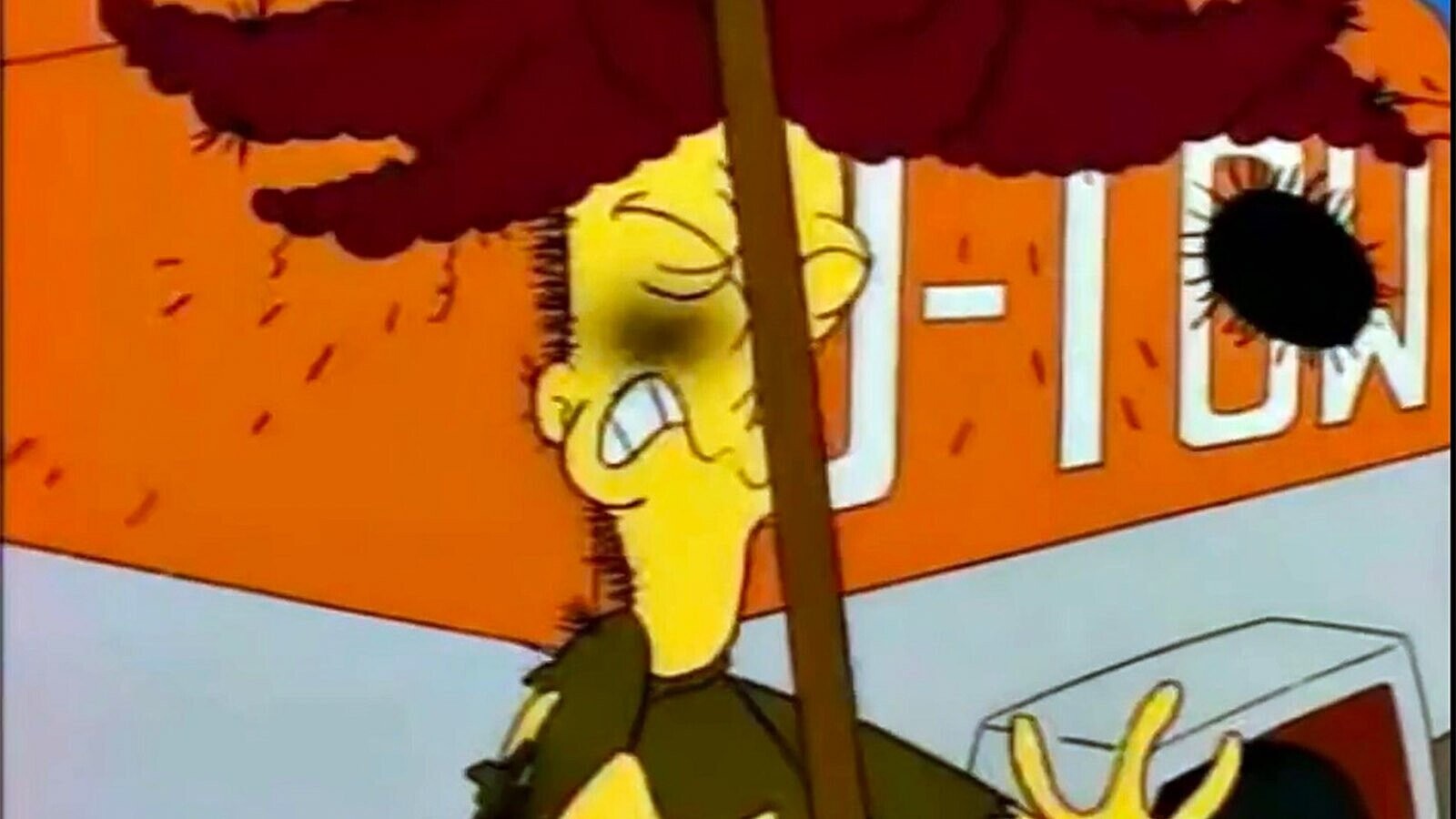
The classic Simpsons rake gag from “Cape Feare” is now one of the most famous visual jokes in the history of the series. It is also one of the purest examples of accidental brilliance in TV comedy. The scene was not originally designed as a sacred monument to repetition, slapstick timing, or the humiliation of a cultured attempted murderer with hair shaped like a palm tree. It was created because the episode was running short.
That production detail makes the gag even better. The writers of The Simpsons needed to fill extra time, so they stretched a simple physical joke until it passed through several emotional stages: funny, not funny, awkward, suspiciously long, and finally, transcendent. By the end, the viewer is not simply watching Sideshow Bob get smacked in the face. The viewer is participating in a comedy experiment involving patience, rhythm, surprise, and one very dangerous garden tool.
The Episode Behind the Rake: Why “Cape Feare” Still Matters
“Cape Feare,” the second episode of season five, first aired on October 7, 1993. Written by Jon Vitti and directed by Rich Moore, it remains one of the most beloved Sideshow Bob episodes. The plot is a parody of Cape Fear, especially Martin Scorsese’s 1991 remake, with a healthy dose of old-school thriller atmosphere, horror-movie references, and Simpsons absurdity piled on top like Homer approaching an all-you-can-eat buffet.
In the episode, Bart begins receiving threatening letters from Sideshow Bob, voiced with theatrical menace by Kelsey Grammer. Bob has been released from prison and, once again, wants revenge on Bart. The Simpson family enters the Witness Relocation Program and becomes “the Thompsons,” moving to Terror Lake in an attempt to hide. Naturally, this plan works about as well as asking Homer to remember his new last name.
The episode balances actual suspense with ridiculous comedy. Bob is genuinely frightening by Simpsons standards: he stalks Bart, hides under the family car, and corners him on a houseboat. But the show keeps puncturing the danger with jokes. Homer misunderstands everything. The FBI’s witness protection training collapses into comic incompetence. Bob’s highbrow villainy is repeatedly dragged into lowbrow pain. That contrast is exactly why the rake scene works so well.
How a Runtime Problem Became a Comedy Landmark
Animated TV episodes must hit a specific runtime, and “Cape Feare” had a problem: it was too short. The production team added material to stretch it, including a longer couch gag, an Itchy & Scratchy cartoon, red herrings about who was threatening Bart, and additional bits around the episode’s suspense structure. Even after those additions, the episode still needed more time.
That is where the rake gag entered Simpsons legend. Originally, Sideshow Bob was only supposed to step on one rake after emerging from under the Simpsons’ car. The handle would smack him in the face, he would groan, and the story would move on. A perfectly fine gag. A respectable gag. The kind of gag that wears a tie to work and pays its taxes early.
But because the episode needed padding, the gag was extended. Bob steps on one rake, gets hit, groans, steps on another, gets hit again, groans again, and continues in a sequence so stubbornly committed to repetition that it begins to feel like the universe itself has developed a personal grudge against him. The same basic sound effect and movement repeat, and the comedy shifts from slapstick into something stranger and more daring.
Why the Rake Gag Is Funny, Then Not Funny, Then Funny Again
The genius of the Simpsons rake gag lies in its timing. A single rake to the face is a traditional cartoon joke. Two or three rakes might still be ordinary slapstick. But by the time Bob has stepped on several of them, the viewer starts to wonder: How long can this possibly continue? That question becomes the joke.
Comedy often depends on surprise, but repetition can create its own kind of surprise. At first, the audience laughs because Bob gets hurt. Then the audience laughs because the show refuses to stop. Then the audience laughs because it has stopped laughing and somehow started again. The scene plays with viewer expectations in a way that feels almost musical. Each rake is a beat. Each groan is a note. Together, they form a symphony for wooden handles and wounded dignity.
This is sometimes called the “rule of repetition” in comedy. A joke repeated too little may feel disposable. A joke repeated too much may feel annoying. But a joke repeated far beyond the normal limit can become absurd, surreal, and hilarious again. “Cape Feare” pushes the rake gag into that magical danger zone where the audience is no longer laughing at the rake. It is laughing at the commitment.
Sideshow Bob Was the Perfect Victim
The gag would not work as well with just any character. If Homer stepped on nine rakes, the joke would be funny, but unsurprising. Homer exists in a permanent state of slapstick vulnerability. If Milhouse stepped on nine rakes, it might feel cruel, though admittedly very Milhouse. But Sideshow Bob is different.
Bob sees himself as refined, intellectual, and superior. He quotes literature, sings show tunes, speaks with elegant diction, and carries himself like a man who believes he should be conducting an orchestra rather than hiding under a station wagon. That makes his repeated rake injuries deliciously humiliating. The universe reduces him from grand villain to cartoon stooge in seconds.
Kelsey Grammer’s performance is also essential. Bob’s groan is not just a noise; it is a miniature tragedy. It contains pain, annoyance, disbelief, and the wounded pride of a man who cannot believe he has once again been defeated by landscaping equipment. Because the sound repeats, it becomes funnier with each use. Bob’s voice gives the gag personality. The rake provides the punctuation.
“Cape Feare” as a Masterclass in Parody
The rake scene is the most famous gag in “Cape Feare,” but the episode’s greatness comes from how many different comic modes it combines. It is a film parody, a suspense story, a character showcase, a musical showcase, and a collection of strange detours that somehow feel perfectly organized.
The episode spoofs Cape Fear with Bob as the menacing stalker and Bart as the terrified target. It also nods to horror and thriller traditions, including ominous letters, shadowy motel rooms, tattoos, dramatic music, and a villain who seems almost unstoppable. But because this is The Simpsons, the menace is constantly interrupted by nonsense. Homer accidentally terrifies Bart with a chainsaw and a hockey mask. The family fails repeatedly to understand witness protection. Bob’s grand plan is ultimately delayed by Bart’s request that he perform the entire score of H.M.S. Pinafore.
That ending is another example of the episode’s weird confidence. Bart survives not through strength, speed, or clever detective work, but by exploiting Bob’s vanity. He knows Bob cannot resist a theatrical performance. The same ego that makes Bob dangerous also makes him ridiculous. That is classic Simpsons writing: character flaw as punchline, plot engine, and escape hatch.
The Rake Gag and the Golden Age of “The Simpsons”
The early and mid-1990s are often called the golden age of The Simpsons, and “Cape Feare” is frequently placed near the top of best-episode lists. One reason is that the show was operating with extraordinary confidence. It could parody a major thriller, build a suspense plot, include musical theater, use violence without losing its comic tone, and spend a surprising amount of prime-time real estate watching a villain step on rakes.
That freedom is part of what made the series revolutionary. The Simpsons did not treat animation as a limitation. It treated it as permission. A joke could be verbal, visual, satirical, cinematic, childish, literary, or all of the above. The rake gag is a perfect example because it is incredibly simple on the surface, yet sophisticated in execution. Anyone can understand it. A rake hits a man in the face. But the way the joke is paced, extended, and positioned inside a thriller parody gives it layers.
In lesser hands, padding would feel like padding. In “Cape Feare,” padding becomes identity. The episode turns a practical production problem into an artistic advantage. It proves that constraints can force writers to take risks they might not have taken otherwise. Sometimes the clock is your enemy. Sometimes the clock hands you nine rakes and says, “Good luck.”
Why Fans Still Remember the Rakes
The rake gag has endured because it is instantly memorable. You do not need a long explanation of the episode’s plot to understand it. You only need the image of Sideshow Bob stepping into rake after rake, each one punishing him with perfect mechanical certainty. It is the kind of joke that lodges in the brain like a catchy song, except the chorus is facial trauma.
It also became a symbol of The Simpsons at its best: smart enough to parody prestige cinema, silly enough to milk a rake joke for nearly half a minute, and confident enough to trust the audience to follow the rhythm. Many shows try to be clever. Fewer are brave enough to be stupid in an intelligent way. The rake gag is brilliantly stupid, which is the highest form of stupid.
Fans often describe the scene as one of the ultimate examples of a joke becoming funny again through overextension. It is not just that Bob gets hurt. It is that the scene dares the audience to become impatient, then rewards that impatience by making the repetition itself the punchline. The first rake belongs to slapstick. The last rake belongs to comedy history.
How the Gag Became a Running Reference
After “Cape Feare,” the rake became permanently associated with Sideshow Bob. Later episodes and promotional material have returned to the image because it is now part of the character’s comic DNA. Bob may be a criminal mastermind, a would-be murderer, a political schemer, and a frustrated aesthete, but he is also the man who cannot be trusted near basic lawn care.
The gag’s legacy also extends beyond The Simpsons. It is often discussed in conversations about comedy timing, repeated jokes, and the thin line between padding and innovation. Many sitcoms and animated shows have used extended repetition, but the rake scene remains one of the clearest examples of how a joke can transform through duration.
Its influence is not merely nostalgic. In the era of GIFs, clips, memes, and short-form video, the rake gag is built for replay. It has a clean setup, a repeated visual pattern, and a payoff that is not a single moment but an escalating state of absurdity. It works on television, online, in memory, and in any conversation where someone says, “That went on so long it became funny again.”
The Accidental Lesson for Writers and Creators
The story behind the rake gag offers a useful lesson for anyone who makes things: not every great idea arrives looking great. Sometimes it arrives as a fix. A patch. A desperate solution to a practical problem. The episode needed time, so the writers extended a joke. That could have produced filler. Instead, it produced one of the most quoted and remembered moments in the series.
The difference is execution. The creative team did not simply add empty seconds. They leaned into rhythm, character, and escalation. They understood that Sideshow Bob’s dignity was the real target. They trusted that discomfort could become laughter. And they recognized that animation allowed them to stage the sequence with clean, repeatable precision.
For content creators, comedians, screenwriters, and even bloggers staring at a blank page while their coffee turns cold, there is comfort in that. Constraints are not always obstacles. Sometimes they are invitations. A strict runtime, a tight deadline, or an awkward gap can push a creator toward a choice that feels risky enough to become memorable.
Experiences Related to the Classic Rake Gag
Part of the fun of the Simpsons rake gag is how many viewers seem to have the same personal experience with it. The first time you watch the scene, you expect a quick joke. Bob steps out, hits the rake, groans, and you think, “Nice.” Then he steps on another one, and you think, “Okay, they’re doing this twice.” Then it keeps going, and your brain starts checking the room for adult supervision.
That shared confusion is important. Many great Simpsons moments work because they make viewers feel like they are discovering the joke at the same time the show is discovering it. The rake sequence has that loose, experimental energy. It feels both perfectly timed and slightly out of control. You can almost imagine someone in the writers’ room saying, “One more,” and then someone else, possibly drunk on power or vending-machine coffee, saying, “No. Several more.”
For longtime fans, the scene often becomes a reference point for everyday frustration. Everyone has had a rake day. Maybe your printer jams five minutes before a meeting. Maybe you spill coffee, change shirts, and immediately spill different coffee on the second shirt. Maybe you finally answer one email and three more appear, each holding its own tiny rake. The gag captures that feeling of repeated, pointless punishment with beautiful simplicity.
There is also something comforting about watching a villain suffer consequences in such a dumb way. Sideshow Bob is dangerous, arrogant, and theatrical. He wants to be feared. He wants to control the room. Instead, the universe places a row of rakes in his path and turns him into a percussion instrument. That reversal is satisfying. It reminds viewers that pomposity is always funnier when interrupted by physics.
The gag also teaches a strange lesson about patience. Modern entertainment moves quickly, and many jokes are built for instant payoff. The rake gag asks the viewer to sit inside the repetition. It risks boredom. It risks irritation. But that risk is why the final laugh feels earned. The scene does not beg for approval. It commits to the bit until the audience gives up resisting.
Rewatching it years later can be even funnier because you know what is coming. Anticipation replaces surprise. You wait for the rakes the way people wait for a favorite guitar solo. The joy is not in wondering whether Bob will step on another rake. The joy is in knowing that he absolutely will, because this is his fate now, and fate apparently shops at a garden center.
That is why the rake gag remains more than a piece of filler. It is a reminder that comedy is not always polished in the obvious way. Sometimes it is awkward, stretched, stubborn, and excessive. Sometimes the thing added to fill space becomes the thing everyone remembers. In “Cape Feare,” extra time did not dilute the episode. It gave the episode its most immortal sound: the thwack of a rake, followed by the wounded groan of a villain who really should have watched where he was stepping.
Conclusion
The classic Simpsons rake gag was created to fill extra time, but calling it “padding” almost feels unfair. Yes, it solved a runtime problem. But it also became a perfect example of how The Simpsons could turn necessity into invention. By extending a simple slapstick bit past the point of reason, “Cape Feare” created a scene that still feels fresh, strange, and hilarious decades later.
The gag works because it understands repetition, character, timing, and audience expectation. It humiliates Sideshow Bob in exactly the right way. It transforms a thriller parody into a surreal comedy experiment. Most importantly, it proves that some of television’s most memorable moments are not born from grand plans, but from smart creators making the most of an inconvenient problem.
In other words, the rake gag is not just funny because Bob gets hit in the face. It is funny because the show found extra time and filled it with genius. Painful, wooden-handled genius.
Note: This article is based on verified public production history, episode information, and critical commentary about “Cape Feare” and the Sideshow Bob rake gag. Source links are intentionally not included in the article body for publication-ready formatting.