When most people picture dinosaur ancestors, they imagine something dramatic: claws scraping the mud, jaws snapping in slow motion, maybe a thunderous stomp that makes nearby volcanoes reconsider their career choices. But one of the most fascinating creatures near the early story of dinosaurs was not a giant at all. It was small enough to make a modern house cat look like a stadium-sized monster.
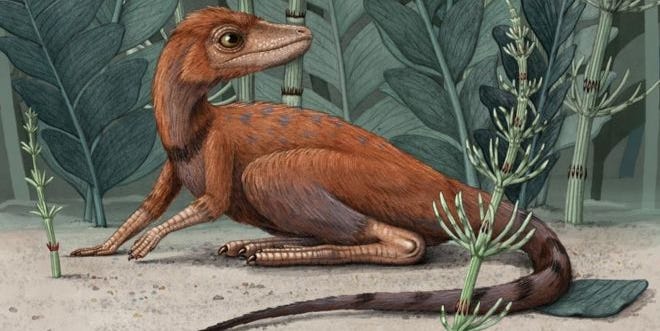
Meet Kongonaphon kely, a Triassic reptile from what is now Madagascar. Its name translates roughly to “tiny bug slayer,” which is both scientifically useful and emotionally delightful. This little animal stood about 4 inches tall, or roughly 10 centimeters. In other words, one of the ancient relatives close to the ancestry of dinosaurs and pterosaurs may have been about the height of a coffee mug with ambition.
That tiny size is not just a cute fossil fact for trivia night. It changes how scientists think about dinosaur evolution, pterosaur origins, body size, diet, insulation, survival, and the surprisingly scrappy creatures that lived before the age of giants. The biggest land animals in history may have had evolutionary roots in something that could have scurried under a fern and vanished before lunch.
What Was Kongonaphon kely?
Kongonaphon kely was not a dinosaur in the strict sense. It lived before true dinosaurs and flying pterosaurs became dominant players in the prehistoric drama. Scientists classify it as an early relative near the group called Ornithodira, the broader lineage that includes dinosaurs and pterosaurs. That makes it important because it sits close to a key evolutionary split: one branch eventually led to dinosaurs, and another led to pterosaurs, the first vertebrates to achieve powered flight.
The fossil comes from Triassic rocks in southwestern Madagascar and dates to around 237 million years ago. The Triassic Period was a strange and competitive chapter in Earth history. Dinosaurs were not yet the celebrity reptiles of the planet. Many other archosaurs, including crocodile-line relatives, were thriving. Ecosystems were recovering and reshaping after the devastating end-Permian extinction, and life was experimenting with body plans like a designer who had too much coffee.
A Name That Deserves a Movie Poster
The name Kongonaphon kely combines Malagasy and Greek roots. “Kely” means small in Malagasy, and the full name is commonly translated as “tiny bug slayer.” That is not just a playful nickname. The animal’s teeth suggest it likely ate insects or other small invertebrates. So yes, this miniature reptile may have spent its days hunting bugs while its distant descendants would eventually include animals as massive as Argentinosaurus and as famous as Tyrannosaurus rex.
Evolution has a sense of humor. Sometimes it starts with a tiny bug hunter and, millions of years later, ends up with a school bus-sized herbivore casually rearranging forests with its neck.
How Tiny Was This Dinosaur Ancestor?
The estimated height of Kongonaphon kely was about 10 centimeters, or 4 inches. Some reports describe it as small enough to fit in the palm of a hand. That does not mean it was fragile or unimportant. In evolutionary history, small animals often play enormous roles. They can exploit food sources that larger animals ignore, hide from predators more easily, reproduce efficiently, and adapt to changing climates in ways that bulky animals cannot.
Think of Kongonaphon as prehistoric pocket power. It was not built to shake the ground. It was built to survive in a world filled with bigger, scarier neighbors. Its size may have helped it move through low vegetation, chase insects, avoid becoming dinner, and occupy a niche that was less crowded than the big-meat-eater lane.
Why Small Size Matters in Evolution
Scientists studying Kongonaphon found evidence for a miniaturization event early in the dinosaur-pterosaur lineage. That means the ancestors near this branch of the archosaur family tree may have shrunk before some of their descendants later grew larger. This is the opposite of the simple “everything starts small and gets big” cartoon version of evolution. Real evolution is messier, more creative, and far more interesting.
Miniaturization can open doors. A smaller body may push animals toward new diets, new behaviors, and new habitats. In this case, the tiny size of Kongonaphon may connect to insect-eating, agile movement, and possibly even the early evolution of body coverings used for temperature control.
The Triassic World: Not Yet the Dinosaur Empire
To understand why Kongonaphon kely matters, we need to step into the Triassic Period. This was not the lush, dinosaur-packed Jurassic world people often imagine. The Triassic was hotter, harsher, and full of ecological instability. The continents were joined into the supercontinent Pangaea, climates could be extreme, and many animal groups were still recovering from the greatest mass extinction Earth has ever known.
Early dinosaurs were present later in the Triassic, but they were not immediately dominant. They shared the world with many other reptiles, including crocodile-line archosaurs that often held the bigger, tougher ecological roles. In that competitive environment, being small may have been an advantage rather than a weakness.
Madagascar’s Fossil Treasure Chest
The fossils of Kongonaphon were found in Madagascar, a place with an extraordinary fossil record. The specimen was discovered during fieldwork that produced hundreds of fossils. At first, its small bones were easy to overlook. That is one of the great lessons of paleontology: sometimes the biggest story is hiding in the smallest drawer.
Fossil discoveries are rarely instant movie moments. They often involve years of fieldwork, careful preparation, comparison, measurement, and debate. A fragment of jaw, a slender femur, a foot bone, or a tiny tooth can change the way scientists reconstruct an entire branch of life’s family tree.
What Did the Tiny Bug Slayer Eat?
The teeth of Kongonaphon kely provide important clues. They were small, simple, and suited to a diet that likely included insects. Scientists also looked at wear patterns and tooth texture to infer feeding behavior. This is detective work at microscopic scale. Paleontologists cannot watch the animal eat, but they can study the tools it used.
Insect-eating makes sense for a small reptile. Bugs were abundant, mobile, and packed with nutrition. A tiny archosaur did not need to tackle large prey or compete with bigger carnivores. It could hunt small targets in leaf litter, around plant stems, or near the ground. In the ancient food web, Kongonaphon may have been less like a roaring monster and more like a fast, alert, bug-snatching specialist.
The Power of a Small Niche
A niche is an animal’s ecological job: what it eats, where it lives, how it behaves, and how it fits into the environment. By eating insects, small early ornithodirans may have avoided direct competition with larger predators. That matters because evolution often rewards animals that find underused opportunities.
It is not always the strongest creature that wins. Sometimes it is the one that finds the snack nobody else is chasing.
Could Tiny Ancestors Explain Feathers and Fuzz?
One of the most intriguing ideas connected to Kongonaphon kely is thermoregulation. Small animals lose body heat quickly because they have more surface area relative to body volume. If early relatives of dinosaurs and pterosaurs were tiny, they may have benefited from some kind of insulating body covering.
Many dinosaurs had feathers or feather-like structures, and pterosaurs had fuzzy filaments often called pycnofibers. Scientists have long debated when and why these coverings evolved. They may have helped with display, sensing, streamlining, or flight-related functions later on. But at the beginning, insulation may have been a major reason.
From Warm Bodies to Feathered Giants
If tiny early relatives needed help staying warm, simple filaments could have been useful long before feathers became complex flight structures in birds. This does not mean Kongonaphon itself is proven to have had fuzz. Fossils of its skin have not settled that question. But its tiny size strengthens the broader hypothesis that insulation may have originated early in the dinosaur-pterosaur family story.
That is a big idea from a very small animal. A four-inch reptile from the Triassic may help explain why later dinosaurs looked less like naked movie monsters and more like strange, feathered, colorful, active animals.
Why This Fossil Changes the Dinosaur Origin Story
Popular culture often tells dinosaur evolution like a simple growth chart: little reptiles became medium reptiles, then big dinosaurs, then enormous dinosaurs. But Kongonaphon kely suggests a more complex path. The lineage leading toward dinosaurs and pterosaurs may have gone through a phase of pronounced small size before later branches expanded into many forms.
This matters because size affects nearly everything in biology. It affects diet, speed, heat loss, reproduction, predator avoidance, metabolism, and habitat choice. A tiny ancestor is not just a scaled-down version of a larger animal. It lives differently. It solves problems differently. It sees the world from ankle height, where every root is a wall and every beetle is a meaningful career opportunity.
Not a Direct Grandparent, But a Close Clue
It is important to be precise: Kongonaphon kely is not necessarily the direct ancestor of all dinosaurs. Fossils rarely represent direct ancestors with a neat label attached. Instead, it is better understood as a close relative near the base of the dinosaur-pterosaur branch. It shows scientists what animals near that evolutionary neighborhood may have been like.
In paleontology, that is incredibly valuable. A close cousin can reveal traits that may have been present in shared ancestors. The more fossils scientists find near key evolutionary splits, the better they can reconstruct how major groups began.
Small Ancestors, Giant Descendants
The contrast is irresistible. From tiny relatives like Kongonaphon, evolution eventually produced long-necked sauropods, armored dinosaurs, horned dinosaurs, duck-billed dinosaurs, swift theropods, and birds. On the pterosaur side, the lineage eventually produced flying reptiles with wingspans ranging from modest to airplane-like.
The lesson is not that small animals are destined to become giants. Most small animals remain small or disappear from the fossil record entirely. The lesson is that evolutionary potential can hide in humble bodies. A creature does not need to be large to be important. Sometimes being small is exactly what allows a lineage to experiment.
Evolution Does Not Care About Our Expectations
Humans tend to admire size. We like the biggest dinosaur, the tallest building, the fastest car, the largest pizza, and the dog that looks most like a friendly sofa. But evolution is not impressed by our rankings. It rewards survival and reproduction. If a tiny insect-eater can make a living in a tough Triassic ecosystem, then tiny is not a limitation. Tiny is a strategy.
That is why Kongonaphon kely is so memorable. It forces us to look away from the obvious giants and pay attention to the little creatures that made later giants possible.
What Scientists Still Do Not Know
Like many fossils, Kongonaphon raises as many questions as it answers. The known fossil material is incomplete. Scientists must compare available bones with related animals to estimate posture, size, relationships, and behavior. Future discoveries could refine its placement in the archosaur family tree or reveal more about its body covering, movement, and growth.
Paleontology is a science of evidence, not guesswork, but the evidence often arrives in fragments. A jaw here, a femur there, a few foot bones, a vertebra, a tooth. From those clues, researchers build the most likely interpretation, then revise it when better evidence appears. That is not a weakness. That is how science stays honest.
Why More Fossils Matter
Fossils from the early history of dinosaurs and pterosaurs are rare, especially from regions that have not been as intensively explored as North America and Europe. Madagascar’s Triassic rocks help fill a major gap. Each discovery from such deposits adds detail to a period when many famous reptile lineages were beginning to take shape.
More fossils could show whether miniaturization was widespread, how long it lasted, and how it influenced later success. They could also help scientists understand whether early body fuzz, insect-eating, and agile movement evolved together or in separate steps.
Experiences Related to the Tiny Dinosaur Ancestor
The best way to appreciate Kongonaphon kely is to stop thinking like a moviegoer and start thinking like a fossil preparator, a museum visitor, or a kid kneeling in the dirt with a magnifying glass. Big skeletons impress us instantly. A towering dinosaur mount in a museum lobby does not need to explain itself. It simply stands there, enormous and theatrical, while everyone silently agrees that nature was showing off. A tiny fossil is different. It asks for patience. You have to lean in.
Imagine seeing a small fossil bone in a museum drawer. At first glance, it might not look like much. It could resemble a chip of stone, a splinter, or something that fell off a larger specimen. But then a scientist points out the curve of a femur, the shape of a tooth, or the surface texture that hints at diet. Suddenly, that tiny object becomes a portal to 237 million years ago. The experience is almost funny: your brain expects the dinosaur origin story to arrive with thunder, and instead it arrives whispering, “Please use a microscope.”
For students, this kind of discovery is a perfect reminder that science is not only about spectacular finds. It is about noticing details. A small fossil can teach big lessons about evolution, climate, anatomy, and survival. When learning about dinosaurs, it is tempting to skip straight to the celebrities: T. rex, Triceratops, Stegosaurus, and the long-necked giants. But Kongonaphon makes the early chapters feel more alive. It shows that before dinosaurs became rulers of the land, their relatives may have been quick, small, insect-eating animals trying not to get stepped on.
There is also a personal lesson in scale. People often assume importance must look large. A big job, a big title, a big audience, a big footprint. But natural history repeatedly proves that small things can change the future. Seeds become forests. Tiny mammals survived alongside dinosaurs and later diversified after the end-Cretaceous extinction. Small feathered dinosaurs eventually gave rise to birds. And a miniature Triassic bug hunter can help reshape our understanding of where dinosaurs and pterosaurs came from.
Visiting a natural history museum after learning about Kongonaphon kely feels different. The huge skeletons are still amazing, of course. Nobody is going to stand beneath a sauropod and say, “Nice, but have you considered being four inches tall?” Yet the tiny ancestor story adds depth to the spectacle. It reminds us that every giant lineage has hidden beginnings. The biggest animals in the room may owe their ancient success to small-bodied relatives that found clever ways to live in difficult worlds.
That is why the story sticks. Kongonaphon kely is not famous because it was terrifying. It is famous because it was unexpectedly small in exactly the place scientists were asking big questions. It turns dinosaur evolution into a better story: less predictable, more surprising, and much funnier. The ancient ancestor was tiny. Really tiny. And that tiny creature carried enormous scientific weight.
Conclusion
Kongonaphon kely proves that the dinosaur origin story is not just about giants. This tiny Triassic reptile from Madagascar stood only about 4 inches tall, yet it offers major clues about early dinosaur and pterosaur evolution. Its small body, insect-eating teeth, and position near the dinosaur-pterosaur lineage suggest that miniaturization played an important role in the early history of these famous animals.
The discovery also reminds us that evolution is not a straight march toward bigger bodies. Sometimes life shrinks before it expands. Sometimes the key to future success is not being huge, loud, or terrifying, but being small enough to slip into a new niche. The ancestors and close relatives of dinosaurs were not all roaring monsters. Some were tiny bug hunters, and their story helps explain how one of the most successful groups of animals in Earth history got its start.