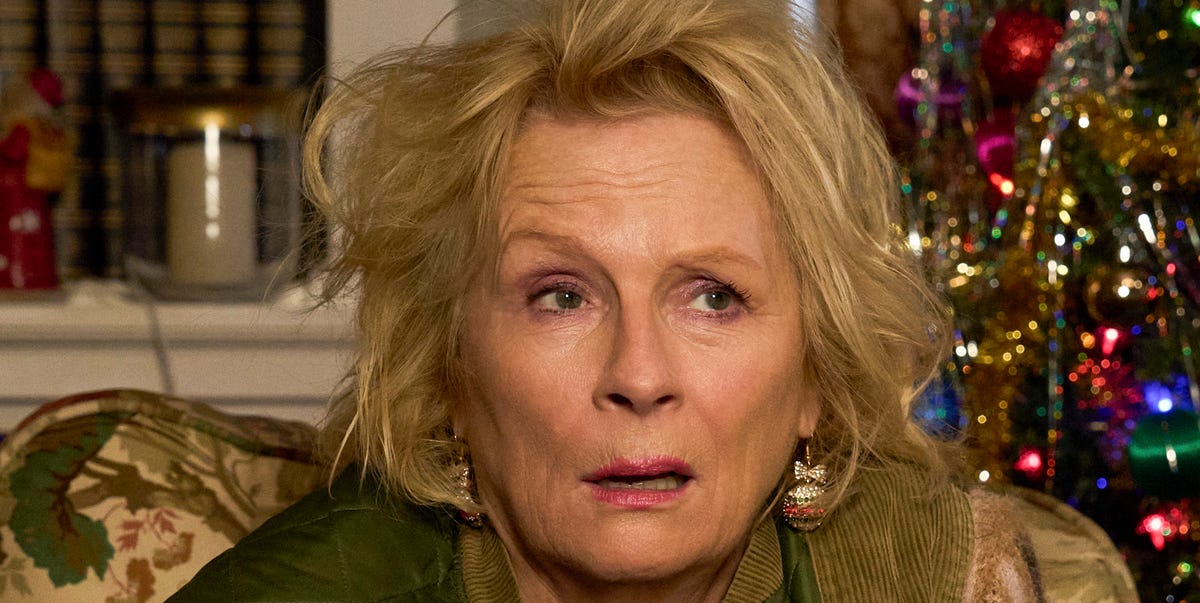
There are Christmas specials, and then there are Christmas specials that arrive carrying a pavlova, family secrets, a shabby country house, a comedy legend, and enough awkward emotional baggage to fill Santa’s sleigh twice. The Amandaland Christmas Special belongs firmly in the second category.
Jennifer Saunders, one of Britain’s most beloved comedy performers, joins the BBC comedy as Aunt Joan, the sister of Joanna Lumley’s deliciously sharp Felicity and the aunt of Lucy Punch’s Amanda. That casting alone is enough to make sitcom fans sit up straighter, spill their tea, and whisper, “Wait… Edina and Patsy are back together?” But Saunders has made it clear that this is not simply an Absolutely Fabulous victory lap with tinsel attached. Joan and Felicity are new women, carrying new grudges, new rhythms, and a very old family tension that turns Christmas into a festive emotional obstacle course.
The phrase catching everyone’s attention is Saunders’ wonderfully blunt description of Joan: she is “fairly shabby,” kind, chaotic, and very much the sort of woman who might host Christmas in a grand old house where the furniture has stories, the dog has better manners than the guests, and the plumbing may or may not be emotionally stable.
Who is Jennifer Saunders playing in the Amandaland Christmas Special?
Jennifer Saunders plays Aunt Joan, Felicity’s sister and Amanda’s aunt. Joan is the host of the family Christmas gathering, which takes Amanda, her children, Felicity, and a few unexpected companions out of their usual social battlefield and into the countryside.
On paper, Joan sounds like the kind of relative families remember through a soft-focus holiday lens: generous, theatrical, a little eccentric, and forever associated with the “magical Christmases” of childhood. In practice, this is Amandaland, so magic arrives with a side of panic, social performance, buried resentment, and dessert-based symbolism.
Saunders has described Joan as the life-and-soul type, someone who keeps the family Christmas tradition alive in a country house that has seen better days. Her home is not sleek, curated, or Amanda-approved. It is not beige minimalism with a scented candle called “Nordic Whisper.” It is lived-in, creaky, slightly crumbling, and probably hiding at least three generations of passive aggression behind the curtains.
Why “fairly shabby” is the perfect Amandaland detail
The genius of the “fairly shabby” description is that it captures exactly what makes Amandaland work. The series is not just about snobbery. It is about the panic underneath snobbery. Amanda, played with precision by Lucy Punch, is forever trying to curate the perfect version of herself: the perfect mother, the perfect neighbor, the perfect social climber, the perfect woman who definitely meant to downsize and absolutely has not lost control of the narrative.
Then along comes Aunt Joan, who seems to belong to a different world. Joan’s house is big, old, and imperfect. Her personality is warm but untidy. Her energy is festive but unpredictable. She is not glossy. She is not trying to impress the local parent committee. She is not arranging olives in height order for a lifestyle reel. She is, in Saunders’ own comic framing, shabby in both surroundings and spiritbut shabby with heart.
That contrast matters. Amanda wants Christmas to become a beautiful memory she can control. Joan represents the messy truth: real family holidays are not designed; they erupt. Someone arrives late. Someone says the wrong thing before lunch. Someone cries near the potatoes. Someone insists a pavlova is symbolic. And somehow, after all the chaos, the day becomes memorable precisely because it refused to behave.
The Ab Fab reunion fans were hoping forbut with a twist
Of course, much of the excitement around the Amandaland Christmas Special comes from seeing Jennifer Saunders and Joanna Lumley together on screen again. Their partnership as Edina Monsoon and Patsy Stone in Absolutely Fabulous remains one of the great comic pairings in television history. For many viewers, their names appearing in the same festive episode is enough to trigger a small internal champagne fountain.
But the clever move here is that Amandaland does not simply recreate Edina and Patsy. Joan and Felicity are sisters, not best friends. They do not operate as glamorous partners in bad behavior. Their dynamic is cooler, pricklier, and more rooted in family history. Felicity, played by Lumley with icy elegance and weaponized timing, has long been Amanda’s impossible mother: judgmental, stylish, and capable of delivering emotional frostbite with a raised eyebrow. Joan, by contrast, is warmer, looser, and more openly sentimental.
That difference gives the reunion freshness. The pleasure is not only “Look, they are together again.” It is “Look, they are together again, but the power balance has changed.” Saunders gets to play someone earthier and more vulnerable than the legendary Edina, while Lumley gets to sharpen Felicity’s discomfort in the presence of a sister who refuses to match her emotional temperature.
What the Christmas Special is about
The festive episode sends Amanda and her family to Aunt Joan’s country house. Amanda hopes to recreate the Christmases she remembers from childhood, which is a dangerous plan because childhood memories are often edited by nostalgia, sugar, and the fact that adults hid the disasters from you at the time.
Plans shift when Mal and Anne become part of the gathering. Anne, Amanda’s loyal and long-suffering friend, is separated from her own family and brings her own brand of anxious holiday energy. Felicity grows irritated by Joan’s relentless cheerfulness. Meanwhile, Mal discovers a hidden photograph that appears to expose a deeper family secret.
This is classic Amandaland: the surface plot is festive and ridiculous, but underneath it sits something sadder and more human. Amanda wants the past back. Felicity wants control. Joan wants everyone to enjoy themselves. Anne wants to survive Christmas without emotional collapse. Mal, unfortunately for everyone, notices things.
Why Aunt Joan works as more than a guest role
Guest stars can sometimes feel like decorative ornaments in sitcom specials: shiny, recognizable, and not strictly necessary. Aunt Joan is different because she opens a new door into Amanda and Felicity’s family history. She helps explain the emotional weather that Amanda has inherited.
In Motherland, Amanda was often a comic monster of privilege and self-absorption. In Amandaland, she remains absurd, but the spin-off has worked hard to make her more than a punchline. Her divorce, move to South Harlesden, teenage children, and ongoing dependency on status have all pushed her into a more exposed place. The Christmas special continues that development by placing her in a house connected to childhood longing.
Joan matters because she is not just an eccentric aunt. She is a memory keeper. Her home represents the version of family Amanda wishes still existed. Her relationship with Felicity hints that Amanda’s emotional neediness did not appear from nowhere. The comedy lands because the characters are ridiculous; the story lingers because the ridiculousness comes from old wounds.
Lucy Punch, Joanna Lumley, and the engine of social panic
Lucy Punch has made Amanda one of the most watchable comic creations on British television: vain, fragile, sharp, desperate, and oddly lovable despite herself. Amanda’s superpower is making every situation worse while believing she is improving it. Her tragedy is that she is often trying, in her wildly Amanda-ish way, to create belonging.
Joanna Lumley’s Felicity remains the perfect counterweight. She is not simply mean; she is magnificently controlled. Every line feels polished, chilled, and served in a crystal glass. Felicity’s presence explains Amanda’s lifelong hunger for approval. If your mother could reduce your confidence to crumbs with one look, you might also become dangerously invested in throw cushions, school-gate alliances, and proving that your Christmas is more emotionally curated than everyone else’s.
Adding Saunders’ Joan into that mix gives the special another texture. Joan’s warmth irritates Felicity because it challenges her cool superiority. Joan’s shabbiness embarrasses Amanda because Amanda has trained herself to fear anything that looks uncontrolled. Yet Joan may be the character closest to the emotional truth of the episode: families are not fixed by presentation. They are fixed, if they are fixed at all, by honesty, forgiveness, and occasionally a dessert that collapses at exactly the wrong moment.
The Christmas setting is not just decoration
Christmas is the perfect arena for Amandaland because it intensifies everything the show already loves: performance, comparison, class anxiety, motherhood, memory, and the terrible pressure to be joyful on command. Amanda approaches Christmas the way she approaches life: as something that can be arranged into success if she chooses the right outfit, the right menu, and the right emotional lighting.
But Christmas has a nasty habit of revealing what people are trying to hide. The more Amanda pushes for magic, the more obvious it becomes that she is grieving a lost version of family life. The more Felicity resists Joan’s cheer, the more viewers sense old sibling pain. The more Anne tries to cope, the more the special reminds us that mothers often carry the invisible work of making Christmas happen while everyone else asks where the tape is.
That is why the episode’s country-house setting works so well. It looks like the ideal festive escape, but it is really a pressure cooker with wreaths. The old house, the hidden photo, the family gathering, and Joan’s determined hospitality all turn the special into a comedy of memory. Everyone has a version of the past. Nobody has the same one.
Why Jennifer Saunders’ performance feels so satisfying
Saunders brings an ease to Aunt Joan that comes from decades of comic mastery. She does not need to force the joke. She understands that a pause, a glance, or a slightly too-cheerful line can carry more comic weight than a big speech. Joan’s humor appears to come from contradiction: she is kind but chaotic, welcoming but exhausting, shabby but grand, sentimental but possibly impossible to live with.
That combination gives the special its spark. Saunders knows how to play a woman who is both ridiculous and emotionally legible. Viewers laugh at Joan, but they also recognize her. She is the aunt who insists everything is marvelous while the oven fails. She is the host who owns too many serving dishes and not enough boundaries. She is the relative who remembers every Christmas as wonderful because forgetting the bad parts is her survival strategy.
In that sense, Joan fits beautifully into Amandaland. The show’s best characters are funny because they are overdrawn, but they endure because they feel socially accurate. Amanda is not every mother, but everyone knows an Amanda. Felicity is not every parent, but plenty of people have met someone who can turn politeness into a knife. Joan is not every aunt, but almost every family has someone whose home is chaotic, whose optimism is suspiciously loud, and whose dog may be the most emotionally intelligent guest in the room.
How Amandaland grew from Motherland into its own comedy world
Amandaland began as a spin-off from Motherland, the acclaimed parenting comedy known for skewering school-gate politics, middle-class competition, and the daily absurdity of raising children while pretending to be fine. Instead of simply copying the original formula, the spin-off shifts the focus to Amanda after divorce, relocation, and the rude discovery that teenage children are much harder to accessorize than small ones.
That change gives the show a new comic engine. Amanda is no longer floating through Chiswick privilege with complete confidence. She has been forced into a new postcode, a new social structure, and a new parenting phase. Her children, Georgie and Manus, are older. Their problems are less about lunch boxes and more about identity, independence, embarrassment, and the terrifying reality that they can now judge their mother in full sentences.
The Christmas special builds on that evolution. It moves Amanda away from the school and neighborhood ecosystem and places her inside family history. That is a smart expansion. Social satire is funny, but family satire is sharper because the stakes are older. You can leave a parent WhatsApp group. Escaping a mother like Felicity is more complicated.
Why the special resonated with viewers and critics
The response to the special was strong because it delivered several pleasures at once. It gave Motherland fans another dose of Amanda’s chaos. It gave Amandaland viewers a festive story that felt bigger than a standard episode. It gave comedy fans a Saunders-and-Lumley reunion that respected their history without lazily repeating it. And it gave Christmas television something that is surprisingly difficult to achieve: warmth without turning into syrup.
The best festive specials understand that Christmas is rarely peaceful. It is emotional theater. Everyone arrives with expectations. Everyone performs a role. The food matters too much. The seating plan becomes diplomacy. A small comment can reopen a wound from 1987. Amandaland leans into that truth, then adds jokes sharp enough to cut through the gravy.
The episode also gained extra weight after Amandaland went on to earn major awards recognition, including BAFTA attention for its comedy performances and a win for Scripted Comedy. Saunders’ appearance as Joan was not treated as a throwaway cameo; it became one of the show’s defining moments, proving that a single guest role can expand a sitcom’s emotional map.
Specific examples of the comedy at work
1. The shabby house versus Amanda’s curated fantasy
Amanda wants a perfect Christmas memory. Joan’s country house gives her something better for comedy: an imperfect one. The slightly faded grandeur becomes a visual joke and an emotional clue. Amanda sees flaws. Joan sees home.
2. Felicity versus Joan
Felicity’s irritation with Joan’s cheerfulness is a classic sibling dynamic. One sister has built a personality around control; the other has built hers around warmth. Neither is entirely honest. Both are funny because they know exactly which buttons to press.
3. Anne separated from her own family
Anne’s holiday anxiety adds another layer. She is loyal to Amanda, but her discomfort reminds viewers that women are often expected to hold everyone else’s Christmas together, even when their own plans have gone sideways.
4. The hidden photograph
The mysterious photo gives the episode narrative momentum. It is a small object with big emotional consequences, exactly the kind of detail that can turn a family lunch into a courtroom drama with stuffing.
Related experience: why Aunt Joan feels like someone from real family Christmases
The reason Aunt Joan feels instantly familiar is that many families have a Joan, even if she goes by another name and has a less dramatic country house. She is the relative who believes Christmas should be abundant, noisy, forgiving, and slightly overcooked. Her home may not be elegant in the magazine sense, but it has the strange comfort of a place where things have happened. A chair is not just a chair; it is where someone once fell asleep after too much pudding. A cracked serving bowl is not trash; it is “the good bowl,” even if nobody can explain why. The dog is not a pet; the dog is a senior family member with better instincts than most adults.
Watching Saunders as Joan taps into that very specific holiday experience: the collision between the Christmas people imagine and the Christmas they actually get. Many of us have walked into a family gathering with a mental picture of candlelight, laughter, and gentle music, only to find someone arguing over oven space while a child eats chocolate decorations off the tree. That is not failure. That is Christmas doing what Christmas does. It exposes the gap between fantasy and reality, then asks everyone to keep passing the potatoes anyway.
Amanda’s desire to recreate childhood magic is also deeply relatable. Adults often return to old holiday places expecting to feel what they felt years ago. But childhood Christmas was magical partly because someone else was doing the work. Someone else bought the food, managed the relatives, wrapped the gifts, remembered who disliked raisins, and quietly absorbed the stress. When Amanda tries to recover that feeling, she is really trying to recover a version of herself before divorce, disappointment, and parental judgment became impossible to ignore.
Joan’s shabbiness becomes important here because it challenges modern perfection culture. In the age of social media, Christmas can start to look like a competitive sport: matching pajamas, flawless tablescapes, handmade wreaths, luxury crackers, and children smiling as if contractually obligated. Joan’s world is different. It is frayed, warm, and human. It suggests that the best holiday houses are not necessarily the most stylish; they are the ones where people can be imperfect without being immediately edited out of the frame.
That is the emotional pleasure of the Amandaland Christmas Special. It laughs at family chaos without sneering at it. It understands that relatives can be unbearable and beloved at the same time. It recognizes that a shabby house may hold more truth than a perfect one, and that a slightly disastrous Christmas can become the story everyone tells for years. Jennifer Saunders’ Aunt Joan works because she embodies that contradiction: messy but generous, embarrassing but necessary, ridiculous but real. In other words, exactly the sort of person a great Christmas special needs.
Conclusion
“She’s fairly shabby”: Jennifer Saunders shares “surprise” details of her role in Amandaland Christmas Special is more than a headline about a beloved comedian joining a hit sitcom. It points to why the episode works. Saunders’ Aunt Joan brings softness, disorder, and old family history into Amanda’s carefully managed world. Her reunion with Joanna Lumley delivers the obvious thrill for Absolutely Fabulous fans, but the real treat is seeing both performers build a new sisterly dynamic filled with tension, affection, and beautifully timed discomfort.
The special succeeds because it understands that Christmas comedy is funniest when it is honest. Families are messy. Memories are unreliable. Old houses creak. Mothers judge. Aunts overshare. Desserts collapse. And sometimes the person who looks “fairly shabby” is the one holding the whole emotional structure together.
For viewers who love sharp British comedy, complicated women, festive chaos, and jokes with a little ache underneath, Aunt Joan’s arrival in Amandaland is a gift worth unwrapping.