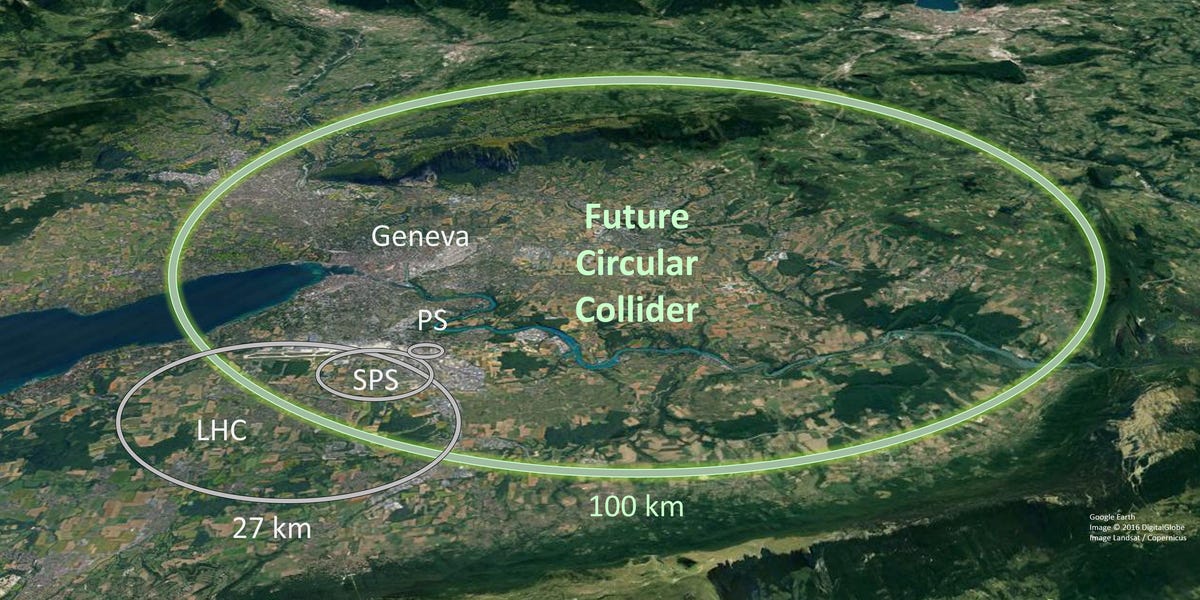
If the Large Hadron Collider is the heavyweight champion of particle physics, scientists are now sketching out something that looks less like a successor and more like a science-fiction infrastructure flex. The proposed Future Circular Collider, often shortened to FCC, would be a massive underground particle collider designed to push beyond the limits of today’s most powerful accelerator. And yes, it would absolutely dwarf the LHC.
The Large Hadron Collider, or LHC, already sounds ridiculous in the best possible way: a 27-kilometer ring buried beneath the French-Swiss border, where protons are whipped around at nearly the speed of light before being smashed together. That machine helped scientists discover the Higgs boson in 2012, one of the biggest moments in modern physics. But particle physicists are not exactly known for saying, “Good enough, let’s pack it up.” They want sharper measurements, higher energies, cleaner collisions, and a better shot at the mysteries the Standard Model still leaves sitting on the table like unpaid restaurant checks.
The FCC is the leading proposal for CERN’s post-LHC future. Its planned tunnel would be about 91 kilometers in circumference, more than three times the size of the LHC. It would loop beneath parts of Switzerland and France near the Geneva region, turning the landscape into the roof of one of the most ambitious scientific instruments ever proposed. If approved, the first phase could begin operations in the mid-2040s, with a later proton-proton version potentially reaching collision energies of up to 100 teraelectronvolts. For comparison, the LHC’s design energy is 14 TeV. In particle physics terms, that is not just upgrading from a bicycle to a sports car; it is upgrading to a rocket with a coffee machine.
What Is the Future Circular Collider?
The Future Circular Collider is a proposed next-generation particle accelerator complex. Unlike a telescope, which studies the universe by collecting light, a collider studies nature by recreating extreme conditions in controlled mini-collisions. Scientists accelerate particles, steer them with powerful magnets, and smash them together inside enormous detectors. The debris from these collisions can reveal how matter behaves at the deepest known scales.
The FCC is planned as a staged project. The first stage, called FCC-ee, would collide electrons and positrons. These are elementary particles, meaning they are not made of smaller internal parts as far as we know. Electron-positron collisions are especially clean, which makes them ideal for precision measurements. Think of it as switching from a chaotic food fight to a carefully measured chemistry experiment, except the ingredients are fundamental particles and the kitchen costs billions.
The second possible stage, FCC-hh, would collide protons at much higher energies. Proton collisions are messier because protons are made of quarks and gluons, but that messiness comes with enormous discovery power. A high-energy proton collider could directly search for new heavy particles, explore dark matter candidates, and probe the Higgs boson in ways the LHC cannot fully reach.
Why Build Something Bigger Than the LHC?
The short answer is simple: bigger tunnels and stronger magnets allow higher-energy collisions. Higher energy gives scientists access to smaller distances and heavier particles. In physics, energy is like a backstage pass. The higher it goes, the more hidden rooms of reality you can check.
The LHC has been spectacularly successful, but it has not answered every major question. The Standard Model of particle physics explains the known fundamental particles and three of the four known forces with stunning accuracy. It is one of the most successful scientific theories ever built. It is also incomplete. It does not explain dark matter, dark energy, gravity at the quantum level, the matter-antimatter imbalance of the universe, or why the Higgs boson has the mass it does.
That last point is a big one. The Higgs boson is not just another particle on the cosmic checklist. It is connected to the Higgs field, which helps explain why many particles have mass. The LHC discovered the Higgs, but discovering something is not the same as understanding it completely. It is like finding a mysterious locked door in your house and then realizing the door has a mortgage, a backstory, and possibly opinions.
The FCC-ee: A Higgs Factory With Very Expensive Taste
The first proposed stage, FCC-ee, is often described as a “Higgs factory.” That phrase may sound like a place where tiny bosons wear hard hats, but it means a collider optimized to produce Higgs bosons in large numbers under clean experimental conditions. Scientists could measure how the Higgs interacts with other particles with extreme precision.
Why does precision matter? Because new physics may not announce itself with a giant neon sign that says, “Hello, I am dark matter.” It might appear as a tiny mismatch between what the Standard Model predicts and what experiments measure. If the Higgs couples to other particles in a slightly unexpected way, that small deviation could point toward new particles or forces too heavy to produce directly.
FCC-ee would also study the Z boson, W boson, top quark, and other key pieces of the Standard Model. These measurements could tighten the net around theories of new physics. In some cases, a precision machine can detect the influence of particles that are far beyond its direct energy range, much like noticing a planet by watching the wobble of a star.
The FCC-hh: The 100 TeV Monster
After the electron-positron stage, the same huge tunnel could later be used for a proton-proton collider known as FCC-hh. This is the version that really earns the “dwarfs the LHC” headline. A 100 TeV proton collider would be a massive leap beyond today’s energy frontier.
At that energy, scientists could search for heavy new particles far beyond the LHC’s reach. They could study the Higgs boson’s self-coupling, which is how the Higgs interacts with itself. That detail matters because it is tied to the shape of the Higgs field and the early evolution of the universe. If you want to understand why the universe settled into its current state instead of choosing a more chaotic option, the Higgs self-coupling is one of the clues.
The FCC-hh could also help test ideas about supersymmetry, extra dimensions, hidden sectors, sterile neutrinos, and dark matter. Not all of these ideas will survive. That is the point. A powerful collider does not exist to confirm everyone’s favorite theory; it exists to make nature answer questions under laboratory conditions.
How Much Would This Giant Collider Cost?
The current estimated construction cost for the first FCC electron-positron stage, including the tunnel, infrastructure, accelerators, and detectors, is about 15 billion Swiss francs. That investment would be spread over many years, with construction potentially beginning in the early 2030s if the project receives approval.
That is a huge number, and it should be treated seriously. Big science projects compete for money, public support, engineering talent, electricity, land use, and political patience. The FCC is not a gadget you impulse-buy because it has free shipping. It would require long-term international commitment, careful environmental review, and public trust.
Supporters argue that major accelerator projects generate benefits beyond particle physics. The LHC helped drive advances in superconducting magnets, cryogenics, vacuum systems, distributed computing, detector technology, and data analysis. CERN itself famously played a role in the birth of the World Wide Web. Critics respond that past benefits do not automatically justify every future megaproject, especially when the scientific payoff is uncertain. Both points deserve air time.
The Big Scientific Questions
1. What Is Dark Matter?
Dark matter appears to make up a large share of the universe’s matter, but it does not emit or absorb light in ordinary ways. We infer its presence through gravity. A future collider could search for particles that behave like dark matter candidates or detect signs of invisible particles escaping the detector.
2. Why Is There More Matter Than Antimatter?
The Big Bang should have produced matter and antimatter in nearly equal amounts. Yet our visible universe is overwhelmingly made of matter. Something tipped the balance. Precision measurements of particle behavior may help reveal where that imbalance came from.
3. Is the Higgs Boson Ordinary or Weird?
The Higgs boson looks Standard Model-like so far, but “so far” is doing a lot of work. Future colliders could measure Higgs properties much more precisely and determine whether it is a simple particle, part of a larger Higgs family, or a clue pointing to a deeper theory.
4. Are There New Forces or Hidden Particles?
New forces may be subtle, weakly coupled, or hidden behind energy scales the LHC cannot reach. The FCC could search directly through high-energy collisions and indirectly through ultra-precise measurements.
Why Not Just Keep Using the LHC?
The LHC is not done. Its High-Luminosity upgrade is designed to collect far more data and extend its discovery potential into the 2040s. That upgrade will improve measurements and may still reveal surprises. Nobody should talk about the LHC like an old toaster with a suspicious smell.
But even an upgraded LHC has limits. The tunnel is fixed. The magnets can only be pushed so far. The collision environment is powerful but messy. If scientists want a clean Higgs factory and a later leap to 100 TeV proton collisions, they need a new machine and a much larger ring.
Planning now is necessary because particle colliders take decades to design, approve, build, test, and operate. The LHC itself was the result of long planning and construction. Future science cannot begin only after the current machine retires; by then, the next generation would already be late to its own party.
The Debate: Genius Investment or Billion-Dollar Gamble?
No honest article about the Future Circular Collider should pretend everyone is cheering in perfect harmony. The debate is real. Some scientists and policy experts argue that the FCC is essential for keeping particle physics moving forward. Others worry that its cost, energy use, environmental impact, and uncertain discovery potential make it difficult to justify.
The strongest case for the FCC is that fundamental physics needs new tools. The biggest breakthroughs often arrive because researchers build instruments that can see what older instruments cannot. The microscope did not guarantee germ theory. Space telescopes did not guarantee exoplanets. The LHC did not guarantee the Higgs would appear exactly where theorists expected. But better tools changed what humans could know.
The strongest criticism is that particle physics is entering an era without a guaranteed target. Before the LHC, the Higgs boson was a clear prize. For the FCC, the scientific case is broader: precision, exploration, and sensitivity to unknown phenomena. That is exciting, but it is harder to explain to taxpayers than “we are hunting one famous missing particle.”
In other words, the FCC is not a treasure map with a giant X. It is more like building the most advanced ship ever made because the ocean still has unexplored depths. That can be inspiring. It can also make budget committees reach for antacids.
What About the United States?
Although the FCC would be a CERN-led project in Europe, U.S. scientists are deeply involved in global particle physics. Thousands of researchers from American universities and national laboratories have contributed to CERN experiments. The U.S. particle physics roadmap has also emphasized participation in a future Higgs factory, along with research and development for advanced collider technologies.
American institutions such as Fermilab, Argonne National Laboratory, Brookhaven National Laboratory, Lawrence Berkeley National Laboratory, and many universities have expertise in detectors, magnets, computing, accelerator design, and physics analysis. If the FCC moves forward, U.S. participation could come through in-kind contributions, detector development, software, computing systems, and scientific leadership.
There is also a broader strategic question. Particle physics is international by nature because the machines are too large and expensive for most countries to build alone. The next great collider may be in Europe, Japan, China, or perhaps one day the United States. What matters scientifically is that the global community builds the right tools and keeps talent flowing into the field.
Engineering a Machine This Large Is Its Own Kind of Madness
A 91-kilometer collider is not just a physics experiment. It is a civil engineering project, a power-management challenge, a magnet-technology marathon, a detector-design puzzle, and a computing problem wearing a lab coat.
The tunnel would need to be carefully routed through complex geology. The accelerators would require radiofrequency systems to boost particles, magnets to bend and focus beams, vacuum systems to keep particles from crashing into stray molecules, and detectors the size of buildings to record collisions. The data flow would be enormous. Every second, detectors would separate interesting events from background noise with the ruthless efficiency of a nightclub bouncer who has a Ph.D.
The proton-proton version would require extremely powerful superconducting magnets. Stronger magnets allow particles to bend around a circular tunnel at higher energies. Developing those magnets reliably and affordably is one of the central challenges for future hadron colliders.
When Could the Future Circular Collider Actually Happen?
The FCC is not approved yet. CERN’s process includes feasibility studies, public consultations, environmental evaluation, cost review, and decisions by member states. A major decision is expected around 2028. If approved, construction could begin in the early 2030s, with the first electron-positron stage potentially operating in the mid-2040s. The higher-energy proton-proton phase would come later, possibly around the 2070s.
That timeline may sound absurdly long, but it matches the scale of the project. The FCC is not designed for one grant cycle, one political term, or one generation of graduate students. It is a century-scale research infrastructure. Some of the students who might analyze its most exciting proton-collision data have not been born yet. Somewhere, a future physicist is currently a twinkle in the universe’s eye, and the universe is already assigning homework.
Experiences and Reflections: What Following a Collider This Big Feels Like
Following the story of the Future Circular Collider is a strange experience because it forces you to think on two scales at once. On one hand, the science is almost impossibly tiny. We are talking about particles, fields, quantum effects, and deviations so small they require years of data and armies of physicists to interpret. On the other hand, the tool needed to study those tiny things is enormous: a 91-kilometer tunnel, giant detectors, international budgets, public hearings, and engineering systems that make an ordinary office printer look like a potato with a power cord.
For readers, the first reaction is often awe. The idea that humans can build a machine under two countries to recreate conditions linked to the early universe is genuinely thrilling. It is one of those projects that reminds us civilization can do more than scroll, argue, and wonder why our phone battery is already at 12 percent. Big science has a way of making the future feel larger.
The second reaction is usually skepticism, and that is healthy. A project this expensive should be questioned. People are right to ask what it will discover, how much energy it will use, whether the money could be spent elsewhere, and who gets to decide. Public science must earn public trust. The FCC will need clear communication, transparent review, and honest discussion about uncertainty. Scientists cannot simply say, “Trust us, we have magnets.” Magnets are cool, but democracy requires receipts.
The most interesting experience is realizing that uncertainty is not a flaw in the project; it is part of the reason for building it. If scientists already knew exactly what they would find, the experiment would be less necessary. The FCC is about exploring the unknown with better instruments. That does not guarantee a blockbuster discovery, but it does guarantee a sharper map of reality.
There is also a human side. The LHC took decades of work from technicians, engineers, theorists, programmers, students, machinists, cryogenics experts, and administrators. A future collider would do the same. The public often sees one headline, but behind it are countless people solving deeply unglamorous problems: alignment tolerances, cooling systems, cable routing, detector calibration, software bugs, safety reviews, and meetings that probably contain too many slides. Scientific glory is built on practical patience.
In that sense, the FCC is not only a particle physics proposal. It is a test of whether societies still believe in long-term knowledge. It asks whether we are willing to build something whose most profound results may arrive decades from now. That is a hard sell in a world trained to expect instant updates. But some questions are too big for instant answers. The universe has been around for 13.8 billion years. It can wait for a careful measurement. The real question is whether we can.
Conclusion: A Giant Ring for the Smallest Questions
The Future Circular Collider would be one of the most ambitious scientific instruments ever built. It would dwarf the LHC in size, potentially exceed it dramatically in energy, and give scientists a new way to study the Higgs boson, dark matter, hidden particles, and the deepest rules of nature. It is expensive, controversial, technically demanding, and scientifically uncertain. It is also exactly the kind of bold tool that has historically expanded the edge of human knowledge.
The FCC may or may not receive final approval. Its future depends on science, politics, engineering, public consultation, and international cooperation. But the fact that scientists are planning it already says something important: the LHC was not the end of the story. It was a chapter. The next chapter may be longer, larger, and buried deep underground, waiting to smash particles together so we can understand why anything exists at all. Not bad for a tunnel.