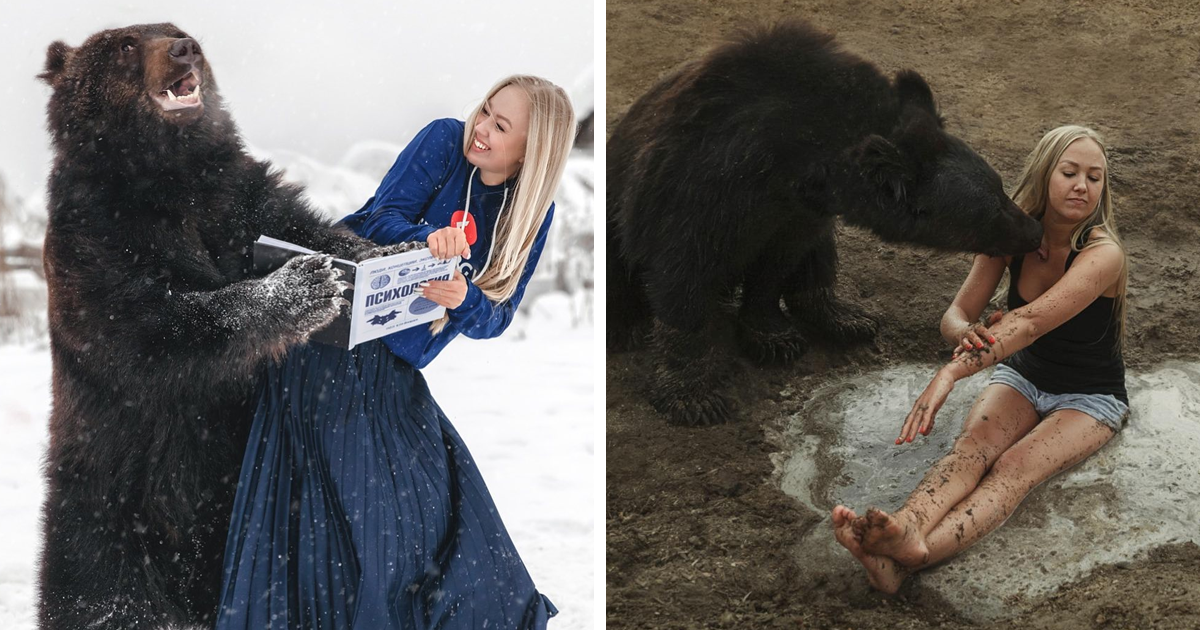
Some friendships begin with a handshake. Others start with a wagging tail, a suspicious cat stare, or a neighbor asking if you can “just watch my goldfish for the weekend.” Then there is the friendship between Russian animal lover Veronika Dichka and Archie, a brown bear from Novosibirsk, Siberia. Their bond is the kind of story that makes the internet stop scrolling, blink twice, and ask, “Wait, is that a bear in a boat?”
Yes, it is. Archie, a captive-born brown bear, became known worldwide after photos showed him calmly spending time with Veronika, including peaceful fishing trips on a lake. The story sounds like a fairy tale with fur, claws, and a very large appetite, but behind the viral images is a rescue story with complicated layers: captivity, animal care, human responsibility, and the unusual relationship that can form when an animal cannot simply be returned to the wild.
This is not a “go adopt a bear” story. Let’s make that clear before someone starts measuring the garage. Bears are powerful wild animals, not oversized dogs with forest-themed pajamas. Archie’s case is unusual because he was born and raised in captivity, reportedly rescued from poor circumstances as a cub, and later needed a stable home after the safari park where he lived could no longer operate as before.
The Story of Veronika Dichka and Archie the Brown Bear
Veronika Dichka, a model, dancer, and fishing enthusiast from Novosibirsk, did not wake up one morning and decide her life needed more claws. Archie’s journey began long before their friendship became famous online. Reports describe Archie as a bear that had first been rescued from a circus as a cub, after concerns that he had not been properly fed. He later lived in a safari park with other bears.
When that facility faced closure and maintaining the animals became increasingly difficult, Veronika stepped in. She had already met Archie through photoshoots, so she was not a complete stranger to him. Over time, that connection grew from acquaintance to caretaker, and from caretaker to what many people now describe as a remarkable human-animal friendship.
The images that made the pair famous show Archie relaxed beside Veronika, leaning close to her, sharing outdoor moments, and even joining her in a boat. For many viewers, it looked like a scene from a children’s bookif the children’s book came with a very serious safety disclaimer in bold red letters.
Why Archie Could Not Simply Be Released Into the Wild
One of the most important parts of Archie’s story is also one of the easiest to misunderstand. When people hear that a bear was rescued, the natural first thought is, “Great! Set him free.” In many wildlife cases, rehabilitation and release are the goal. But Archie’s situation is different.
Archie was reportedly born in captivity and had lived around humans his entire life. That matters. A wild brown bear learns survival skills from its mother and environment: where to find food, how to avoid danger, how to compete, how to den, how to read the landscape, and how to behave around other bears. A captive-born bear may not have those instincts fully developed in a way that would allow safe release.
Releasing an animal without the skills to survive can sound kind, but it may actually be dangerous. The animal could starve, approach humans for food, wander into settlements, or become involved in conflict. In Archie’s case, continued human care became less of a luxury and more of a necessity.
A Bear Friendship That Captured the Internet
The internet loves an unlikely friendship. A dog and a duck? Wonderful. A cat and a horse? Adorable. A woman and a brown bear taking a fishing trip? That one breaks the cuteness meter and possibly the boat’s weight limit.
Veronika has described Archie as deeply attached to her. Reports say he sees her as part of his family, feels secure around her, and enjoys spending time near water. Photos of the two together show an animal that appears calm in her presence, not pacing behind bars or performing under a spotlight. That contrast is one reason the story resonates so strongly with animal lovers.
Still, it is important to look beyond the charm of the photos. Archie is not a teddy bear, even if he occasionally gives the visual impression of one that came to life and got into the protein powder. Brown bears are intelligent, strong, and unpredictable. Their needs are enormous, and their behavior cannot be judged by one peaceful picture.
What Makes Brown Bears So Fascinating?
Brown bears are among the most iconic large mammals on Earth. They live across parts of North America, Europe, and Asia, including Russia. Their size varies widely depending on habitat, sex, food supply, and subspecies, but even a smaller adult brown bear is an animal of tremendous strength.
They are also highly intelligent. Bears can solve problems, remember food locations, adapt to seasonal changes, and display complex behavior. In the wild, they may eat berries, roots, insects, fish, small mammals, carrion, and other available foods. They are often described as omnivores, but that little word does not quite capture the drama of a bear deciding both salmon and blueberries belong on today’s menu.
In nature, brown bears also play an important ecological role. They help regulate prey populations, move nutrients through ecosystems, and disperse seeds. When they fish for salmon, for example, leftovers can feed other animals and enrich surrounding soil. In short, bears are not just impressive; they are part of the machinery that keeps wild landscapes functioning.
The Complicated Ethics of Captive Wild Animals
Archie’s story warms hearts, but it also raises a serious question: what should happen to wild animals that have spent their lives in captivity?
Animal sanctuaries and rescue organizations often face this exact challenge. Many animals rescued from roadside zoos, circuses, private ownership, or neglect cases cannot safely return to the wild. They need lifelong care, appropriate enclosures, veterinary support, enrichment, and trained handlers. A good rescue outcome is not simply “animal removed from bad place.” It is “animal given a stable, safe, species-appropriate life afterward.”
That is where the conversation becomes bigger than one woman and one bear. Archie’s story reminds readers that rescue is not a single heroic moment. It is a long-term commitment involving food, space, medical care, safety planning, and daily attention. With a bear, “daily attention” does not mean tossing a treat and calling it a day. It means understanding an animal that can weigh hundreds of pounds and change moods faster than a toddler denied a cookie.
Why This Story Should Not Encourage Exotic Pet Ownership
There is a clear difference between a unique rescue arrangement and ordinary pet ownership. Archie’s relationship with Veronika developed under unusual circumstances, after he had already lived in human care. That does not make brown bears suitable pets. In fact, the opposite lesson is more responsible: wild animals belong in the wild whenever possible, and when that is not possible, they need expert lifelong care.
Bears can injure or kill people, even without “bad intentions.” They are strong enough that playful behavior can become dangerous. They also need room to move, dig, forage, swim, rest, and express natural behaviors. A backyard, barn, basement, or “very sturdy fence my uncle built” is not an appropriate bear habitat.
Responsible wildlife rescue is not about creating viral content. It is about reducing suffering. The best outcomes are usually quiet ones: a rescued animal eating well, exploring a safe habitat, receiving veterinary care, and living without fear. If cameras are involved, they should never come before welfare.
The Role of Trust in Veronika and Archie’s Bond
One reason people respond so emotionally to Veronika and Archie is the visible trust between them. Trust is not built overnight, especially with an animal as large and sensitive as a bear. It comes from consistency: feeding, routine, calm handling, familiar voices, and repeated experiences that teach the animal it is safe.
Archie’s comfort around Veronika suggests a long pattern of familiarity. He reportedly spends a great deal of time with her and enjoys activities such as being near water. Their fishing photos became famous because they show the softer side of an animal most people only imagine from documentaries, warning signs, or very dramatic camping stories.
But trust should not be confused with domestication. Dogs were shaped by thousands of years of living with humans. Brown bears were not. Archie may be affectionate with Veronika, but he remains a bear. That distinction is not a tiny footnote; it is the whole safety manual.
What We Can Learn From Archie’s Rescue
1. Rescue Requires Long-Term Responsibility
Taking in a rescued animal is not just a feel-good headline. It is a promise. For a bear, that promise includes specialized food, secure housing, veterinary care, enrichment, and constant awareness of safety. Archie’s story shows that rescue does not end when the animal leaves a failing facility. In many ways, that is when the real work begins.
2. Captive Animals Need More Than Survival
An animal can be alive and still not be thriving. Good care means providing stimulation, space, and opportunities for natural behavior. For bears, enrichment might include foraging activities, climbing structures, water access, scent trails, puzzle feeders, and safe ways to explore. A bored bear is not just sad; it can become stressed and unhealthy.
3. Viral Animal Stories Need Context
Photos can make extraordinary situations look simple. A bear in a boat may appear cute, calm, and even funny. But responsible readers should ask what happened before and after the photo. Was the animal rescued? Is it safe? Is it receiving proper care? Is the public being encouraged to imitate something dangerous? Context turns a viral moment into a meaningful story.
4. Wild Animals Deserve Respect, Not Fantasy
Archie may be gentle with Veronika, but brown bears as a species deserve deep respect. They are not props, accessories, or status symbols. They are powerful animals with complex needs. The most loving response to a wild creature is not always closeness. Sometimes it is distance, protection, and habitat preservation.
Why People Love Stories Like This
Stories like Veronika and Archie’s become popular because they touch something old and human in us. People have told stories about bears for centuries. Bears appear in folklore, children’s books, mythology, national symbols, and cautionary campfire tales. They are both familiar and mysterious, cuddly in toy form and humbling in real life.
When we see a bear resting beside a person, it creates emotional surprise. The animal we expect to fear appears calm. The person we expect to run appears relaxed. That contrast makes the story unforgettable. It also reminds us that animals are individuals. Archie’s personality, history, and relationship with Veronika are specific to him.
Of course, the internet also loves a good visual joke. “Woman goes fishing with bear” sounds like the beginning of a comedy sketch. But the deeper reason the story lasts is not the novelty. It is the idea that care can transform an animal’s life. Archie went from uncertainty to companionship, from a failing facility to a daily routine with someone who understands him.
The Bigger Message: Rescue With Wisdom
The best way to appreciate Archie’s story is with both warmth and wisdom. It is perfectly fine to smile at the image of a brown bear enjoying a boat ride. It is also necessary to remember that most bears should never be handled by private individuals, approached for photos, or treated as pets.
For readers moved by Archie’s story, the most helpful response is not to seek a wild animal friendship of their own. It is to support reputable sanctuaries, wildlife rehabilitation centers, habitat conservation, and laws that prevent neglectful captivity. Not every animal rescue will become internet-famous, but every animal deserves safety, proper care, and dignity.
500-Word Experience Section: What Archie’s Story Feels Like to Animal Lovers
There is something strangely personal about reading a story like “Russian Woman Rescued A Bear From A Closed-Down Zoo, And They’re Best Buddies Now.” Even if most of us have never been within arm’s reach of a bearand honestly, let’s keep it that wayit still feels familiar. Many people know what it is like to earn an animal’s trust slowly. Maybe it was a nervous rescue dog that hid under the table for three weeks. Maybe it was a cat that treated human affection like a suspicious government program. Maybe it was a horse, a parrot, or a senior pet that needed patience before it dared to relax.
That experience helps explain why Veronika and Archie’s bond feels so moving. Trust from an animal cannot be demanded. You cannot explain your good intentions in a PowerPoint presentation and expect a frightened creature to applaud. You show up. You feed them. You stay calm. You repeat the routine until fear loosens its grip. With time, an animal begins to read your voice, your movement, and your presence. When that animal finally leans into safety, it feels like being handed a medal no one else can see.
Archie’s size makes the story dramatic, but the emotional pattern is something many rescuers recognize. Animals coming from unstable conditions often need more than food. They need predictability. They need someone who does not disappear when care becomes inconvenient. They need a life where kindness is not random. That is true whether the animal weighs ten pounds or several hundred.
At the same time, Archie’s story teaches an important boundary. Love is not the same as ownership, and affection is not the same as suitability. Many animal lovers feel drawn to unusual bonds, but real rescue work requires asking what is best for the animalnot what looks magical online. A rescued bear needs expert care. A rescued fox needs special housing. A rescued bird may need socialization, flight space, or a lifetime of delicate management. The more unusual the animal, the more serious the responsibility becomes.
For everyday readers, the most useful takeaway is not “find your own Archie.” It is “be someone’s safe place.” That might mean adopting from a shelter, fostering kittens, donating to wildlife rehabilitation, volunteering at a sanctuary, reporting neglect, or simply teaching children to respect animals instead of treating them like toys with legs. It might mean appreciating wild animals from a distance, where they can remain wild.
Archie and Veronika’s friendship is rare, beautiful, and complicated. It makes us smile because it shows tenderness in an unexpected form. It makes us think because it reminds us that rescue is serious work. And it stays with us because, deep down, every animal lover understands the quiet joy of being trusted by a creature that had every reason not to trust so easily again.
Conclusion
Veronika Dichka and Archie’s story is more than a viral tale about a Russian woman and her bear best friend. It is a reminder that animal rescue can be beautiful, demanding, emotional, and ethically complex all at once. Archie’s life changed because someone stepped in when his future became uncertain. Yet his story should inspire responsibility, not imitation.
Brown bears are not pets. They are intelligent, powerful wild animals with serious needs and risks. Archie’s bond with Veronika is extraordinary precisely because it is not ordinary. The heart of the story is not that everyone should get closer to wild animals. It is that animals who cannot return to the wild still deserve safety, care, enrichment, and compassion. And if one of them happens to enjoy fishing trips with his trusted human, well, that is the kind of plot twist nature occasionally writes better than we do.
Note: This article is written for web publication in standard American English, with the story presented warmly while emphasizing that brown bears are wild animals and should not be treated as ordinary pets.