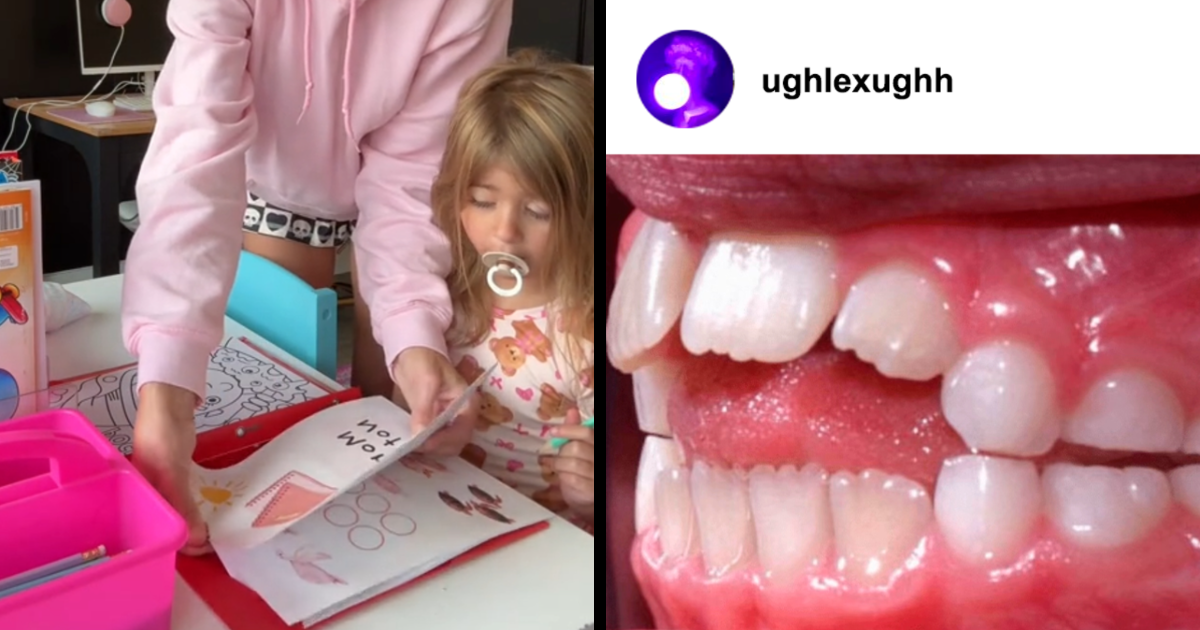
A viral parenting video can turn a kitchen table into a courtroom faster than a four-year-old can lose one sock. That is exactly what happened when a mom of four shared a glimpse of her homeschooling routine with her young daughter and suddenly found herself at the center of a very loud internet debate. Some viewers praised the cozy setup, the flexible learning, and the idea of meeting a child where she is. Others were less charmed, calling it “pretend school to make mom look good” and questioning whether the child was getting enough structure, social interaction, and age-appropriate guidance.
The clip, originally shared by a work-from-home and stay-at-home mom known online as The Modern Mompreneur, showed her homeschooling life with a four-year-old child. What looked to some like a sweet, everyday learning moment became a flashpoint for arguments about homeschooling, preschool readiness, pacifier use, online parenting culture, and the very modern habit of judging an entire family from a few seconds of video.
As with most viral parenting controversies, the truth is probably not hiding in the comments section wearing a tiny graduation cap. The situation is more complicated than “mom is wrong” or “the internet is mean.” Homeschooling young children can be thoughtful, warm, and effective when it is developmentally appropriate. It can also raise real concerns if it becomes isolated, performative, or disconnected from a child’s social and emotional needs. The viral backlash says as much about modern internet culture as it does about early childhood education.
Why This Viral Homeschooling Video Hit Such A Nerve
Homeschooling has become a bigger part of the American education conversation, especially since the pandemic. Before 2020, homeschooling was often treated as a niche choice associated with religious beliefs, special learning needs, family flexibility, or dissatisfaction with local schools. After years of remote learning, school closures, health concerns, and shifting family priorities, more parents became open to education outside the traditional classroom.
That wider acceptance has also brought wider scrutiny. When a parent posts homeschooling content online, viewers do not just see a child practicing letters or coloring a worksheet. They see a symbol. For supporters, the video may represent freedom, family bonding, and child-led learning. For critics, it may represent educational neglect, social isolation, or influencer-style parenting that looks better on camera than it works in real life.
The phrase “pretend school to make mom look good” stung because it captured a fear many people have about social media parenting: that some content is created less for the child’s development and more for the parent’s brand. That does not prove this mother had bad intentions. But it does explain why people reacted so strongly. The internet is already suspicious of curated family life, and homeschooling content adds an extra layer of concern because children’s education is involved.
Homeschooling A Four-Year-Old Is Not The Same As Homeschooling A Fourth Grader
One important detail often gets lost in the outrage: the child in question is four. In most parts of the United States, formal schooling is not legally required at age four. Preschool can be valuable, but it is not the same as compulsory elementary education. A four-year-old does not need a miniature college syllabus, a laminated daily agenda, and a stern lecture on quarterly performance metrics before snack time.
At this age, learning is supposed to look playful, flexible, and sometimes delightfully chaotic. A developmentally appropriate day for a preschooler may include storytelling, pretend play, drawing, counting objects, singing songs, asking 47 questions about worms, helping pour cereal, and learning how to take turns without declaring a tiny constitutional crisis.
Child development experts generally agree that preschool-age children learn best through warm relationships, guided exploration, pretend play, hands-on activities, language-rich conversation, and safe opportunities to interact with others. That means a relaxed home learning setup is not automatically a problem. In fact, it can be exactly right if it supports curiosity, routine, emotional growth, and real-world skills.
What Four-Year-Olds Are Usually Learning
A four-year-old may be learning to recognize letters, count small groups of objects, name colors, retell parts of a story, draw people with several body parts, follow simple directions, and speak in longer sentences. But the academic checklist is only one slice of the pie. Social and emotional development matters just as much.
Many children at this age are learning to ask other children to play, comfort someone who is sad, shift behavior depending on the setting, use imagination, express feelings, and become more independent with daily routines. These skills do not always happen neatly at a desk. They often happen while building blocks, sharing crayons, pretending to be a veterinarian, cleaning up a spill, or surviving the tragedy of a banana breaking in half.
So when viewers judge a homeschooling scene involving a four-year-old, the better question is not, “Does this look like a traditional classroom?” The better question is, “Is this child receiving consistent, loving, age-appropriate opportunities to grow academically, socially, emotionally, and physically?”
The Pacifier Debate: Why Viewers Focused On The Binky
One of the biggest points of criticism was the child’s use of a pacifier. In the comment sections, many people questioned why a four-year-old would still be using one, especially during a learning activity. Some viewers worried about dental development, speech, independence, and emotional regulation. Others argued that comfort objects are not proof of bad parenting and that strangers should be cautious about judging a child’s needs from a short clip.
Both sides have a point, although the loudest comments usually have the grace of a shopping cart with one bad wheel. Prolonged pacifier use can be associated with dental issues such as open bite, protruding front teeth, crossbite, and potential speech concerns. Pediatric dentists and orthodontic professionals often recommend that parents talk with a dentist if a child continues frequent pacifier use beyond toddlerhood.
At the same time, a pacifier in a video is not a full medical history. Some children use comfort items during transitions, stress, sensory overload, or sleep routines. The helpful response is not public shaming. It is gentle guidance, professional support if needed, and a plan that helps the child build new soothing skills over time.
Is Homeschooling Bad For Social Skills?
The classic criticism of homeschooling is that children will miss out on socialization. This concern came up quickly in reactions to the viral video. Viewers wondered whether a homeschooled preschooler would learn how to share, wait, cooperate, handle conflict, follow group routines, and interact with adults outside the family.
The answer depends on how homeschooling is done. Homeschooling does not automatically mean isolation. Many families use co-ops, library programs, sports, music lessons, playdates, religious groups, museum classes, nature groups, and community activities to give children peer interaction. A well-planned homeschool life can be socially rich.
But socialization does not happen by magic just because a child owns crayons. Parents who homeschool young children need to be intentional. Preschoolers benefit from playing with other children, listening to adults who are not their parents, practicing group expectations, and experiencing small frustrations in safe settings. A child does not need to be in a classroom all day to learn these skills, but they do need chances to practice them.
What A Strong Home Preschool Routine Can Include
A healthy home preschool routine does not have to be fancy. It might include a short morning rhythm, picture books, songs, outdoor play, counting games, art, practical life skills, quiet time, and regular social activities. The best routines are predictable enough to make a child feel secure but flexible enough to avoid turning the living room into a corporate training seminar.
For example, a parent might start with breakfast and a simple calendar song, read two picture books, practice counting with toy animals, go outside for a nature walk, and later invite the child to help sort laundry by color. That is real learning. It may not look impressive to people expecting tiny desks and alphabet posters, but it builds vocabulary, observation, motor skills, responsibility, and connection.
The Bigger Issue: Parenting Content And The Child’s Digital Footprint
The viral reaction also raises another question: should children’s learning struggles, routines, or personal habits become public content? Parents often post family moments because they are proud, excited, or trying to connect with other parents. A homeschooling video can inspire others and make lonely parents feel less alone. That is the warm side of social media.
The colder side is that children cannot fully consent to becoming content. A four-year-old cannot understand what it means for thousands of strangers to comment on her pacifier, her learning environment, her maturity, or her family. Once a video spreads, the child’s image and story may travel far beyond the parent’s original audience.
This is why many pediatric and digital-safety experts encourage parents to think carefully before sharing images, routines, locations, school details, or vulnerable moments involving children. The question is not whether parents are allowed to post. The question is whether the child’s dignity and privacy are being protected.
Why The Internet Loves To Judge Mothers
Another reason this controversy exploded is simple: mothers are judged for everything. Work outside the home, and someone says the children need you. Stay home, and someone says you are wasting your potential. Send your child to school, and someone criticizes the system. Homeschool, and someone asks whether you are qualified. Give your child a snack, and suddenly the comment section has a PhD in organic blueberries.
Mothers online are often treated as public property. Their homes, bodies, marriages, schedules, and parenting choices become group projects for strangers. That does not mean criticism is always unfair. Children deserve protection, education, and care. But internet outrage often skips the careful middle ground and runs straight to mockery.
In this case, some concerns were reasonable. People are allowed to ask whether a homeschooled child has structure, social time, dental care, and age-appropriate support. But calling a parent fake, lazy, or attention-seeking based on a short video may say more about the viewer’s assumptions than the family’s reality.
Homeschooling Can Work, But It Requires More Than A Cute Setup
Homeschooling is not just arranging markers in a basket and hoping literacy happens by osmosis. It requires planning, patience, consistency, and honest reflection. Parents need to understand their state’s homeschool rules, track progress when required, choose materials thoughtfully, and know when to seek outside help.
For preschool-age children, the goal is not to recreate kindergarten early. It is to build foundations: language, curiosity, self-help skills, emotional regulation, motor development, basic numeracy, and a love of learning. If the child is four, the “curriculum” can be simple. But the parent’s responsibility is still real.
A strong homeschooling parent asks practical questions: Is my child growing in communication? Does she get enough active play? Does she interact with other children? Are we reading daily? Am I helping her become more independent? Do I know what milestones to watch? Am I willing to adjust if something is not working?
When Critics Have A Point
Critics have a point when they warn against using homeschooling mainly as aesthetic content. Education is not a backdrop. Children are not props. If a parent is more focused on filming the “perfect homeschool morning” than noticing the child’s needs, the priority has slipped.
Critics also have a point when they talk about isolation. A child can be deeply loved at home and still need more peer interaction. A parent can be devoted and still need help teaching certain skills. Homeschooling works best when parents stay humble enough to use libraries, co-ops, pediatricians, dentists, speech therapists, occupational therapists, tutors, and community resources when needed.
When Defenders Have A Point
Defenders have a point when they say a four-year-old does not need rigid schooling. The child is still in early childhood. Play is not a waste of time; it is one of the main ways young children learn. A relaxed home routine can be loving, productive, and developmentally appropriate.
Defenders also have a point when they remind people that a clip is not a complete family portrait. A video may show five minutes of a day that also includes outdoor play, reading, playdates, chores, naps, therapy, or family routines viewers never see. The internet is very good at making final judgments with partial evidence. Unfortunately, confidence and context do not always arrive together.
What Parents Can Learn From This Viral Homeschooling Controversy
The biggest lesson is not “never homeschool” or “never post.” The lesson is to keep the child at the center. If homeschooling is the choice, make it thoughtful. If posting online is the choice, make it respectful. If a child has a habit such as prolonged pacifier use, handle it with care and professional guidance instead of defensiveness or shame.
Parents can also learn to separate helpful feedback from internet noise. A helpful comment might say, “You may want to ask a pediatric dentist about pacifier use at this age.” A noisy comment says, “This is embarrassing.” One offers a next step. The other offers a rotten tomato wearing Wi-Fi.
For viewers, the lesson is to slow down. It is possible to care about children’s wellbeing without turning every parenting video into a public trial. Ask better questions. Avoid mocking the child. Critique systems and choices without humiliating minors. Remember that the child in the video may one day read what adults said about her.
Experience-Based Reflections: What This Topic Feels Like In Real Family Life
For many parents, the viral homeschooling debate feels familiar because early childhood is full of messy decisions that look simple from the outside. A four-year-old may be bright, funny, verbal, stubborn, sensitive, independent in some ways, and still deeply attached in others. One day she may write the first letter of her name with pride. The next day she may refuse pants because the seams have apparently committed a felony. That is preschool life.
Families who try home preschool often discover that learning does not happen in a straight line. A parent may plan a letter activity, only for the child to become fascinated by the glue stick cap. Another day, the child may learn more from helping bake muffins than from a printed worksheet. Measuring flour teaches counting. Stirring builds motor skills. Waiting for the timer builds patience. Spilling sugar teaches everyone humility.
One common experience is the pressure to prove that homeschooling is “real.” Parents may feel tempted to create a classroom corner, buy stacks of workbooks, post neat photos, and use school language because they worry others will not respect play-based learning. But young children do not need performative seriousness. They need rhythm, warmth, conversation, movement, and patient adults who can turn ordinary moments into learning opportunities.
Another common experience is the fear of judgment. Parents know that every choice can be criticized. If the day is structured, someone says the parent is too intense. If the day is relaxed, someone says the parent is not teaching. If the child uses a comfort object, someone calls it babyish. If the parent removes it too quickly, someone calls that harsh. The trick is not to parent for applause. The trick is to parent with enough honesty to ask, “Is this helping my child grow?”
In real life, a balanced home preschool might include both softness and boundaries. A child can be comforted and still encouraged toward independence. A parent can respect emotional needs while slowly building new habits. If a pacifier is still part of the picture, the family can create a gradual plan: limit it to sleep time, offer another comfort tool, celebrate small wins, and consult a dentist or pediatrician if concerns remain. Gentle does not mean passive. Structured does not mean cold.
Social experiences matter too. A parent homeschooling a preschooler may schedule weekly library story time, playground visits, cousin playdates, dance class, swim lessons, or a homeschool co-op. These activities give the child chances to hear other adults, share space with peers, wait in line, lose a game, recover from disappointment, and learn that the world does not always operate according to her personal snack schedule.
There is also the emotional experience of being the parent-teacher. Some days feel magical. The child asks a deep question, remembers a story, or proudly counts ten acorns. Other days feel like trying to teach a raccoon tax law. Parents need permission to admit that homeschooling young children can be both beautiful and exhausting. The best homeschoolers are not perfect. They are observant, flexible, resourceful, and willing to change course.
The viral mom’s situation reminds families that public reaction is not the same as wisdom. Online viewers may notice legitimate issues, but they do not know the full child, the full home, or the full story. At the same time, parents can use criticism as a mirror without letting it become a hammer. If a video sparks concern about structure, socialization, or habits, it may be worth reviewing those areas privately and calmly.
Ultimately, the healthiest approach is child-centered rather than image-centered. The question is not, “Does this look impressive online?” The question is, “Is my child safe, loved, learning, connected, and growing?” A home can be a wonderful place to learn. So can a preschool classroom. So can a library, a garden, a kitchen, a museum, or a muddy backyard where a child discovers worms and immediately names all of them Kevin.
The internet may keep arguing, because arguing is one of its top five hobbies. But parents do not need to win every comment war. They need to build lives where children can thrive. If a homeschooling routine does that, it deserves respect. If it falls short, it deserves adjustment. And if a four-year-old is involved, everyone should probably lower the courtroom drama and remember that early childhood is supposed to include a little wonder, a little noise, and the occasional crayon in a place where no crayon should ever be.
Conclusion: A Viral Clip Is Not A Full Curriculum
The backlash against the mom of four reveals how strongly people feel about homeschooling, preschool readiness, parenting content, and children’s privacy online. Some criticism focused on real issues, including social development, pacifier use, and whether home education is structured enough. Some criticism simply turned a child and her mother into entertainment for strangers.
A four-year-old does not need a rigid school day to learn well. She does need loving guidance, rich language, play, routine, movement, social opportunities, and adults who pay attention to her development. Homeschooling can provide that. Traditional preschool can provide that too. The method matters less than the quality, consistency, and responsiveness behind it.
The better conversation is not whether this mother deserved to be dragged online. It is how parents can educate young children thoughtfully while protecting their dignity in a world where one video can become everyone’s business by lunchtime.
Note: This article is written in original American English for web publishing and is based on publicly available information about the viral homeschooling controversy, early childhood development, homeschooling trends, preschool readiness, pacifier concerns, and responsible parenting content online.