Desktop 3D printing gave makers the power to turn imagination into plastic. Need a bracket, a cosplay prop, a camera mount, or a tiny organizer for the drawer where cables go to disappear? Print it. But for years, one stubborn question has haunted workshops everywhere: what if you need the same freedom with metal?
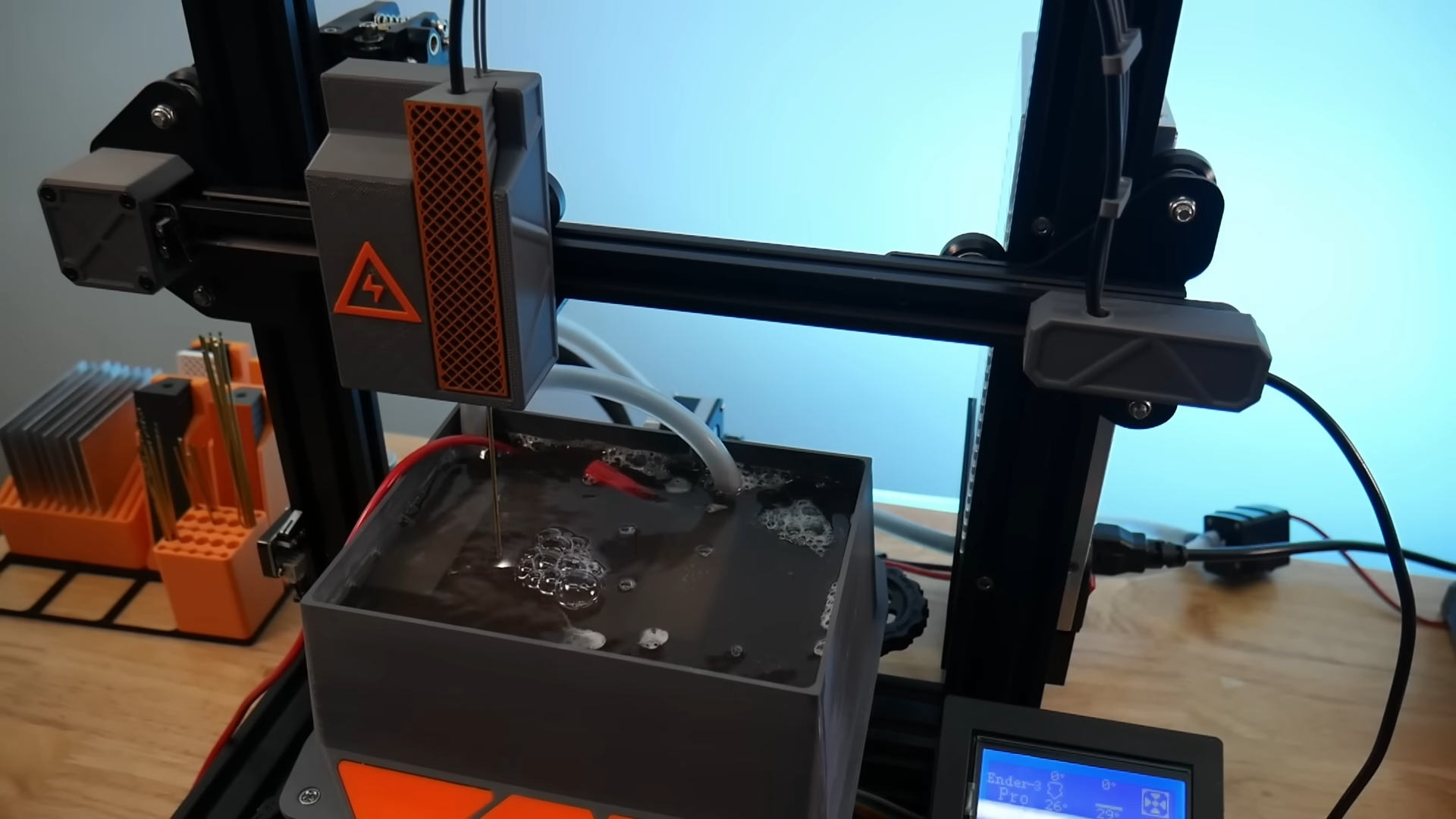
That is where Powercore enters the story. Developed by Rack Robotics, Powercore is an open-source EDM power supply designed to help transform ordinary motion platforms, including many desktop 3D printers and CNC machines, into electrical discharge machining systems. In plain English, it aims to let a machine that usually squirts melted plastic perform controlled spark erosion on conductive metals. It sounds like science fiction, but it is very realand yes, it is exactly the kind of garage-lab wizardry that makes makers pause mid-coffee.
The big idea behind Powercore is simple but bold: instead of asking hobbyists to buy a massive industrial EDM machine, why not use the motion system many of them already own? A 3D printer already has controlled X, Y, and Z movement. Powercore provides the spark-generation side of the equation, while printable toolheads and accessories help adapt the printer or motion system for EDM work.
What Is EDM, and Why Should 3D Printing Fans Care?
EDM stands for electrical discharge machining. Unlike milling, drilling, or sawing, EDM does not remove material by pushing a cutting tool through metal. Instead, it uses repeated electrical sparks between an electrode and a conductive workpiece. Each spark erodes a microscopic bit of material. Repeat that process thousands of times, guide it with a motion system, and the machine can cut or shape metal with impressive precision.
Traditional machining depends on cutting forces. That is why serious metal mills are heavy, rigid, and expensive. The frame has to resist vibration, tool pressure, and the charming chaos of metal chips flying around like angry confetti. EDM is different. Because there is no conventional cutting edge pushing sideways into the workpiece, the mechanical forces are much lower.
This low-force nature is what makes Powercore so interesting for desktop fabrication. A typical consumer 3D printer was never designed to chew through aluminum or steel with an end mill. Its frame may be good enough for moving a hotend, but not for hogging out metal. EDM changes that equation. If the printer can move accurately and the toolhead can maintain the right relationship between electrode and workpiece, spark erosion can do the material removal.
Powercore’s Big Promise: Metalworking Without the Giant Machine
Powercore is not trying to make every 3D printer into a full industrial machine shop overnight. That would be a little like putting racing slicks on a shopping cart and calling it Formula 1. Instead, Powercore targets a more realistic and exciting goal: accessible, small-scale EDM for prototyping, experimentation, thin metal cutting, and custom part creation.
For makers, engineers, educators, and small labs, that matters. A printed plastic prototype is useful, but many projects eventually hit a wall where plastic is too weak, too soft, too heat-sensitive, or simply not the right material. Metal parts are often stronger, thinner, more durable, and better suited for functional mechanisms. But outsourcing small metal parts can be slow and expensive, especially when a design is still changing.
Powercore aims to shrink that gap. By bringing EDM capability to existing desktop machines, it gives users a way to explore conductive materials such as aluminum, brass, copper, and steel in a compact format. It also encourages a hybrid workflow: print the fixture, test the geometry, cut the conductive material, revise the CAD file, and repeat.
How Powercore Works With a 3D Printer
A standard 3D printer provides controlled movement. Powercore provides the electrical discharge machining power source. In a typical conversion concept, the printer’s extruder is replaced or supplemented with an EDM toolhead. Instead of extruding filament, the machine guides an electrode or wire near the metal workpiece while Powercore creates controlled pulses for spark erosion.
This approach is clever because it reuses what desktop makers already have: stepper motors, rails, belts, lead screws, control boards, and a familiar machine footprint. The additional challenge is not merely “add electricity and go.” EDM requires stable spark control, flushing or dielectric management, careful workholding, and a setup that can handle moisture, metal particles, and electrical noise.
Rack Robotics has positioned Powercore as part of an open and hackable ecosystem. Its Powercore V2 materials include electrical schematics, firmware, and CAD files, while later development has moved toward Powercore V3 and related wire EDM tools. That open-source spirit is important because desktop EDM is still a developing space. Users are not just customers; many are experimenters helping discover what works best on small machines.
Why EDM Is So Different From CNC Milling
To understand the appeal, compare EDM with CNC milling. A small desktop CNC router can cut wood, plastic, foam, and maybe soft aluminum if everything is tuned well. But hard metals are another story. Milling steel on a light-duty machine is usually a recipe for chatter, broken bits, sad noises, and the quiet realization that “rigidity” is not just a word machinists say to sound serious.
EDM avoids many of those mechanical problems. Because it erodes material using sparks, it can work on hard conductive metals that would be difficult for a small mill. It also can produce narrow kerfs and delicate shapes. In industrial shops, wire EDM is prized for cutting intricate profiles, tool steels, dies, punches, and precision components.
The tradeoff is speed. EDM is not usually fast compared with aggressive milling. It is a patient process. It removes tiny amounts of material repeatedly, and the cut quality depends heavily on stable electrical conditions, flushing, feed control, and material thickness. For a desktop user, that means Powercore is less about instant metal fabrication and more about adding a new capability where precision and accessibility matter more than raw speed.
Powercore V2, V3, and the Evolution of Desktop EDM
Powercore has evolved from an attention-grabbing maker project into a more mature desktop EDM platform. Powercore V2 was documented as an open-source wire EDM power supply with a focus on affordability, replicability, and hackability. It included design files and specifications intended for custom wire EDM and plunge EDM systems.
Later updates from Rack Robotics show the company moving into Powercore V3, with development focused on improved efficiency, power output, software checks, and production readiness. The company has also worked on wire tool kits and larger EDM systems, including tools designed around brass EDM wire and desktop-friendly work envelopes.
This evolution matters because first-generation maker hardware often proves the concept, while later revisions solve the less glamorous problems: reliability, heat management, enclosure design, electromagnetic emissions, connector choices, production quality, documentation, and user experience. Those details may not look dramatic in a promo video, but they decide whether a tool becomes a workshop regular or a shelf ornament with a cool backstory.
What Can You Actually Make With Desktop EDM?
Powercore-style EDM is best understood as a specialized metalworking tool for small, conductive parts. It is not meant to replace every printer, laser cutter, CNC mill, or bandsaw in the shop. Instead, it shines where low-force cutting and conductive materials matter.
Small Functional Metal Parts
Imagine a robotics builder who needs thin aluminum brackets with clean internal corners. A 3D printer can make the first version in plastic, but the final part may need metal. Desktop EDM could help cut flat metal profiles without needing a heavy mill.
Custom Inserts and Tooling
EDM can be useful for cutting conductive inserts, small plates, alignment features, or specialty tooling shapes. For advanced printer builders, that opens the door to custom metal parts for toolheads, fixtures, and mechanisms.
Delicate Shapes That Hate Cutting Forces
Thin or delicate parts can deform when milled, clamped, or drilled. EDM’s low-force process can be helpful in situations where conventional cutting would bend the workpiece or snap a tiny cutter.
Education and Research
Schools, maker spaces, and engineering clubs can use desktop EDM to teach nontraditional machining, digital fabrication, materials science, electronics, and CNC motion control. It gives students a hands-on way to understand why manufacturing is not limited to drills and spinning tools.
The Open-Source Advantage
One of Powercore’s strongest selling points is its open-source direction. In the maker world, open documentation is more than a nice bonus. It helps users learn, repair, modify, and improve their machines. It also makes the project more transparent.
Open-source hardware encourages community testing. A user might adapt a wire toolhead to a Voron-style printer. Another might mount it on a CNC router frame. Someone else might improve workholding, create better printable guards, or develop smarter control software. This kind of experimentation can move a niche technology forward faster than a closed product alone.
That said, open-source does not mean effortless. Desktop EDM remains more complex than loading PLA and pressing “print.” Users need to understand motion control, workholding, electrical safety, dielectric handling, and machine calibration. Powercore lowers the barrier, but it does not remove the need for careful thinking.
Safety and Practical Limits
EDM is powerful, but it is not a toy. It involves electrical pulses, conductive materials, fluid management, and metal debris. Any desktop EDM setup should be treated as real manufacturing equipment, not as a novelty attachment. Good supervision, proper enclosures, dry hands, appropriate wiring, and careful machine monitoring matter.
There are also practical limits. A small 3D printer frame will not magically gain the precision, durability, or fluid handling of a professional wire EDM machine. Cut size, material thickness, speed, accuracy, and reliability all depend on the full system. Powercore may provide the spark, but the motion platform, toolhead, workholding, dielectric setup, and software all affect the final result.
Users should also remember that EDM only works on electrically conductive materials. It will not cut ordinary plastics, wood, ceramics, or nonconductive composites in the same way. For those materials, 3D printing, routing, laser cutting, or waterjet services may still be better choices.
Why Powercore Matters for the Future of Desktop Manufacturing
The most exciting thing about Powercore is not only what it can cut today. It is what it represents. Desktop manufacturing has been slowly expanding from plastic extrusion into resin printing, laser engraving, CNC routing, PCB milling, pick-and-place assembly, and small-scale automation. EDM adds another serious process to that toolbox.
For years, the phrase “desktop manufacturing” sounded slightly overconfident. A desktop printer could make useful shapes, but most functional products still required metal, electronics, finishing, and assembly. Tools like Powercore push the desktop closer to a true micro-factory. A small team could design a product, print fixtures, cut metal features, assemble electronics, and iterate faster than ever before.
It also changes how people think about 3D printers. A printer is not only a plastic-part machine. It can be a motion platform. Swap the toolhead, change the process, and the same frame can become a plotter, laser engraver, paste dispenser, inspection system, or EDM experiment. Powercore fits neatly into that broader trend of tool-changing, modular fabrication.
Where Powercore Fits Best
Powercore makes the most sense for experienced makers, small engineering teams, research labs, and educators who enjoy experimental tools and understand that the first few jobs may involve tuning. It is ideal for users who already know their way around CAD, G-code, machine setup, and workshop safety.
It may not be the best fit for someone who wants a one-click appliance. EDM has variables. Spark behavior changes with material, thickness, flushing, electrode condition, and feed rate. The process rewards patience. If 3D printing is “measure twice, print once, then print again because you forgot clearance,” desktop EDM is “measure twice, fixture carefully, monitor the spark, and respect the machine.”
Still, for the right user, that complexity is part of the fun. Powercore gives curious builders access to a process that once belonged mainly to industrial shops. That is a meaningful step.
Experience Notes: What It Feels Like To Think About Powercore in a Real Workshop
The first practical reaction to Powercore is excitement. The second is probably, “Wait, can my printer really do that?” That is a healthy question. Anyone who has spent time with desktop machines knows that the frame, cable routing, firmware, and workholding are just as important as the shiny new attachment. Powercore may be the star of the show, but the supporting cast needs to show up on time.
In a real workshop workflow, the most natural use case begins with prototyping. You might design a small flat bracket in CAD and print it first to check fit. The plastic version tells you whether holes line up, whether the shape clears nearby parts, and whether your design looks brilliant or like it was created during a snack-fueled 2 a.m. engineering spiral. Once the shape is right, the same digital file can be adapted for metal cutting.
That bridge from plastic prototype to metal part is powerful. Many hobby projects fail at the “now make it strong” stage. A printed part works for demonstration, but not for heat, wear, tension, or long-term use. Desktop EDM can help makers move beyond plastic without immediately outsourcing everything. Even if the process is slower than sending a file to a professional shop, having the capability in-house changes how often people experiment.
Another experience-related advantage is confidence. When a tool allows fast iteration, users try more ideas. A maker who can cut a small conductive part at home may test three designs instead of settling for the first one that seems acceptable. Over time, that improves engineering judgment. You learn which corners are too sharp, which thin tabs are too fragile, which workholding strategies are annoying, and which materials behave better than expected.
There is also a learning curve that should not be ignored. Compared with 3D printing, EDM feels less forgiving. With a printer, a failed job often leaves spaghetti filament and mild embarrassment. With EDM, the user must think more carefully about electrical safety, fluid handling, conductive debris, and machine supervision. The process feels more serious because it is more serious.
The best mindset is to treat Powercore as a precision tool, not a magic metal button. Start with conservative expectations. Think small parts, careful setups, simple geometries, and controlled experiments. A user who approaches it like a lab instrument will likely have a better experience than someone expecting it to behave like a toaster with G-code.
In that sense, Powercore’s greatest value may be educational. It teaches that manufacturing is not one process but a family of processes. FDM printing builds up material. CNC milling cuts it away mechanically. EDM erodes it electrically. Each method has strengths, weaknesses, costs, messes, and small rituals that make experienced users nod knowingly. Powercore gives desktop makers a chance to learn one of the more fascinating members of that family.
For small shops, Powercore-style EDM could become the tool used for awkward jobs: the tiny conductive part that is too delicate to mill, the thin metal profile that needs clean edges, the prototype insert that would cost too much to outsource repeatedly. It will not replace a professional EDM shop for demanding production work, but it can reduce the distance between idea and testable metal part.
For educators, it is even more interesting. Students can see how electrical energy, material science, CNC motion, software, and mechanical design meet in one process. That is far more memorable than reading a paragraph about “nontraditional machining” in a textbook. Sparks tend to improve attendance.
Conclusion
Powercore aims to bring the power of EDM to any 3D printer, and that ambition captures the spirit of modern desktop manufacturing. It does not promise that every hobby printer will become a full industrial machine overnight. Instead, it offers something more believable and more useful: a path for makers to explore precision metal cutting with machines they may already own.
By combining open-source hardware, desktop motion systems, and electrical discharge machining, Powercore expands the maker toolbox beyond plastic. It gives engineers, educators, and advanced hobbyists a new way to prototype conductive metal parts, learn EDM principles, and rethink what a 3D printer can become.
The future of desktop fabrication will not be one machine doing everything perfectly. It will be modular, experimental, and wonderfully weird. Powercore belongs in that future because it asks a simple question: if your printer already knows how to move, why not teach it how to spark?
Note: This article is written for informational web publishing. EDM uses electricity and machine motion, so real-world use should always follow proper safety practices, supervision, and manufacturer documentation.