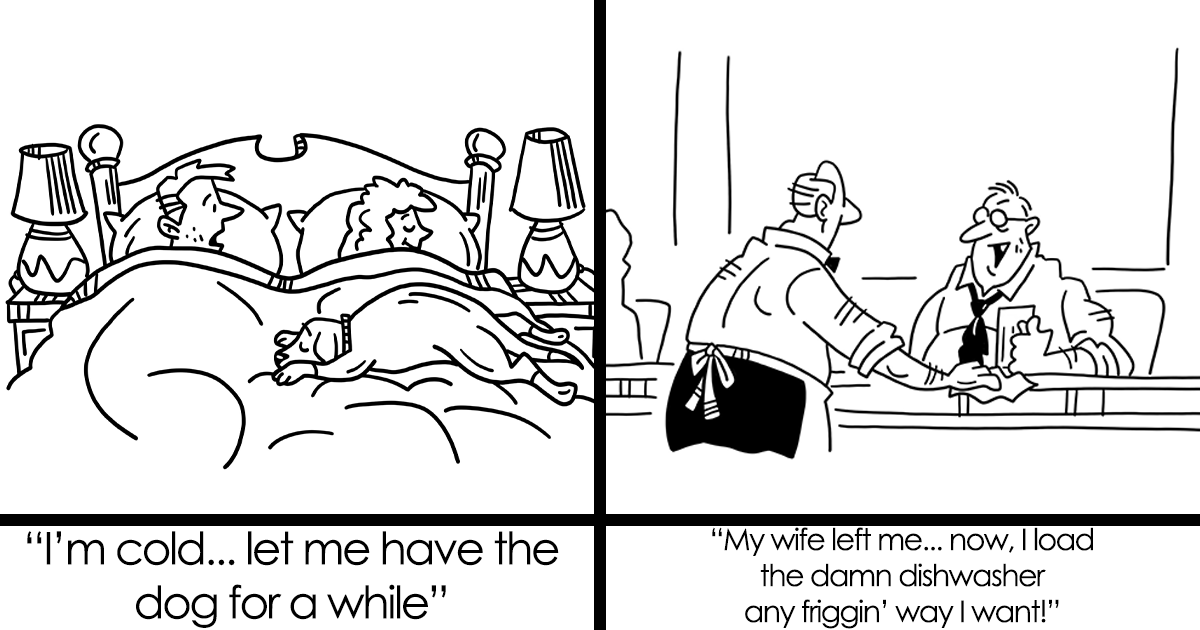
Some days arrive wearing steel-toed boots. The coffee tastes like betrayal, your inbox multiplies like a science experiment, and someone somewhere decides that “quick meeting” means “bring snacks and emotional support.” That is exactly the kind of day when a one-panel comic can sneak in like a tiny rescue boat with a goofy flag.
One-panel comics are small, but they are not simple in the lazy sense. They are compact little joke machines. A whole story must fit inside one drawing, one moment, one awkward silence, one caption, or sometimes one facial expression that says, “I have made a terrible life choice, and now there is a raccoon in my kitchen.” That is the charm. A single-panel cartoon does not ask for much of your time. It just taps you on the shoulder, points at life’s weirdness, and says, “See? It’s not just you.”
This collection, “My 20 One-Panel Comics That Will Hopefully Brighten Up Your Day,” celebrates the everyday absurdity that makes life funny: pets who act like landlords, office workers who have achieved emotional beige, plants with trust issues, and adults pretending they know how paperwork works. Whether you are a longtime fan of funny one-panel comics, a casual scroller looking for a smile, or an artist wondering why a simple cartoon can feel so satisfying, this cheerful dive into visual humor is here to give your mood a gentle nudge in the ribs.
Why One-Panel Comics Work So Well
A one-panel comic is like a joke wearing a picture frame. Unlike a comic strip, it does not build through multiple scenes. There is no slow runway. The cartoonist has one square, rectangle, or delightfully chaotic blob of space to create a setup, a twist, and a payoff. That compression is what makes the format powerful.
The best single-panel comics usually depend on contrast. A serious-looking character says something ridiculous. A normal situation is invaded by one impossible detail. A dog understands taxes better than its owner. A medieval knight complains about bad Wi-Fi. The brain spots the mismatch, solves the joke, and rewards itself with a laugh, a smirk, or at least a dignified nose exhale.
There is also something wonderfully democratic about the format. You do not need to study a complicated plot or remember ten character names. A great one-panel cartoon meets you where you are. It can be enjoyed during lunch, on the bus, between emails, or while pretending to stretch when you are actually avoiding responsibilities.
The 20 One-Panel Comics in This Bright Little Collection
Since the title promises twenty comics, let’s walk through the spirit of the collection. Think of these as the themes, situations, and tiny emotional disasters that make the cartoons feel relatable. Each one is built around a quick visual idea designed to deliver a smile without demanding a full afternoon and a corkboard of character theories.
1. The Cat Who Charges Rent
A tired human stands in the doorway while a cat sits on the couch with a clipboard. The joke is simple: the cat has finally formalized what every cat owner already suspects. The furniture belongs to the cat, the apartment belongs to the cat, and the human is merely a warm appliance with grocery privileges.
2. The Plant With Abandonment Issues
A drooping houseplant watches its owner leave for work and says, “Text me when you get there.” It works because indoor plants often seem dramatic. Water them too much, they faint. Water them too little, they faint. Move them three inches, they file a complaint with the universe.
3. The Office Printer’s Evil Monologue
A printer jams while whispering, “Not today, captain.” Office humor is practically a national language. Everyone has battled a printer that behaves like a haunted toaster with trust issues.
4. The Therapist for Socks
One lonely sock sits on a couch saying, “I just feel like I lost my other half.” It is silly, but oddly emotional. The best cute one-panel comics often find tenderness inside nonsense.
5. The Motivational Snail
A snail looks at a mountain and says, “I packed snacks.” This is the sort of comic that turns slow progress into a victory parade. It is funny because the snail has no speed, but it has planning. Honestly, that may be enough.
6. The Dog Interview
A dog sits across from a hiring manager. Its resume lists “enthusiastic,” “loyal,” and “barks at suspicious leaves.” The humor comes from imagining pet behavior as professional experience. Frankly, many dogs are more emotionally available than half the people on LinkedIn.
7. The Haunted Refrigerator
At midnight, a person opens the fridge and finds a ghost judging their snack choices. This comic plays with the private absurdity of late-night eating. Nobody needs cheese at 12:47 a.m., and yet there we are, conducting research.
8. The Cloud Having a Bad Day
A small cloud rains only on itself. A nearby sun asks, “Do you want to talk about it?” Weather becomes emotion, and emotion becomes a visual gag. It is cute, clean, and instantly understandable.
9. The Dragon at Customer Service
A dragon politely returns a knight’s helmet because it “didn’t spark joy.” Fantasy humor works beautifully in single-panel comics because one familiar mythical image can carry half the joke before the caption even arrives.
10. The Adulting Museum
A museum guide points to a display case containing a folded fitted sheet and says, “No one knows how it was done.” This one lands because adulthood is full of tasks that appear simple until you try them and accidentally invent fabric origami.
11. The Overthinking Owl
An owl stays awake at noon wondering whether it sounded weird in a conversation three winters ago. The joke uses exaggeration, but the feeling is real. Many people have an inner owl wearing tiny anxiety glasses.
12. The Sandwich Courtroom
A sandwich stands accused of being “mostly lettuce.” Food comedy is highly shareable because everyone has opinions. Some sandwiches are meals. Others are architecture projects with mayonnaise.
13. The Alien Trying Small Talk
An alien at a party says, “So, how long have you had bones?” The humor comes from making ordinary human life suddenly strange. Great visual humor often does this: it turns the familiar sideways until we can laugh at it again.
14. The Password Support Group
Several passwords sit in a circle. One says, “I was strong once, then they added a special character.” The modern digital world gives cartoonists endless material. Password rules alone could power a small comedy empire.
15. The Introvert’s Escape Plan
A party guest studies a map labeled “bathroom, snack table, emergency exit, dog.” It is funny because the dog is not just a pet; the dog is a social strategy.
16. The Optimistic Skeleton
A skeleton in a gym says, “I’m focusing on core strength.” It is a classic kind of gag: take a phrase literally, add a visual twist, and let the bones do the rest.
17. The Crow With a Side Hustle
A crow sells shiny bottle caps from a tiny booth marked “premium treasures.” Animals behaving like tiny entrepreneurs are funny because they are barely more absurd than actual online marketplaces.
18. The Time-Traveling Procrastinator
A time traveler arrives from next week and says, “Bad news. You still didn’t start.” It hurts because it is true, and the best relatable comics often use humor to soften a tiny punch of recognition.
19. The Moon’s Vacation Request
The moon asks the sun to cover its shift. The sun replies, “Again?” Celestial bodies with workplace problems make the universe feel less intimidating and much more unionized.
20. The Tiny Victory Parade
A person successfully cancels a subscription, and a marching band appears in the living room. This comic celebrates the microscopic triumphs of modern life. Some achievements deserve confetti, especially when a website hides the cancel button like buried pirate treasure.
The Secret Ingredient: Relatability With a Twist
Funny one-panel comics usually work best when they begin with something recognizable. Pets, work, food, technology, anxiety, chores, weather, and awkward social moments all make strong foundations because readers already understand the situation. The cartoonist does not need to explain why a printer is annoying or why a cat acts superior. The audience brings that knowledge with them.
Then comes the twist. The plant talks. The cloud needs therapy. The password has trauma. The time traveler delivers bad productivity news. This combination of everyday life and mild absurdity creates a fast emotional connection. Readers laugh not because the scene is random, but because it is almost true. The joke stretches reality just enough to make it bounce.
This is also why one-panel cartoons are so popular online. They are quick to read, easy to share, and friendly to short attention spans. A single image can travel across social feeds, group chats, newsletters, and office Slack channels with very little explanation. In a noisy digital world, brevity is not a weakness. It is a superpower wearing tiny cartoon shoes.
Why These Comics Can Actually Brighten Your Day
A cheerful comic will not solve every problem. It cannot do your laundry, reply to your emails, or convince your printer to stop making that grinding noise like it is digesting a fork. But humor can shift the emotional weather. A small laugh interrupts stress. A clever cartoon can loosen the grip of a bad mood. A silly image can remind you that life is strange, and because it is strange, it is also survivable.
Laughter is often discussed as a social connector, and comics are part of that experience. When someone sends you a cartoon with the message “this is us,” the joke becomes more than entertainment. It becomes recognition. It says, “I see the same ridiculous thing you see.” That shared recognition can make a normal day feel less lonely.
One-panel comics also offer a gentle form of perspective. They take small frustrations and shrink them to cartoon size. A stressful meeting becomes a drawing of penguins in ties. A messy kitchen becomes a raccoon negotiation. A bad habit becomes a snail with snacks. Once a problem has been turned into a joke, it may not disappear, but it becomes easier to hold.
What Makes a Strong One-Panel Comic?
A strong one-panel comic usually has three things: clarity, surprise, and personality. Clarity means the reader understands the scene quickly. Surprise means the joke takes a turn the reader did not fully expect. Personality means the drawing, caption, and tone feel like they came from a specific human mind rather than a joke factory with fluorescent lighting.
The drawing does not have to be fancy. In fact, many memorable cartoons are visually simple. A few expressive lines can do more than a polished illustration if the idea is strong. A raised eyebrow, a tiny coffee mug, or a defeated slouch can carry an entire emotional biography. Cartooning is not about drawing everything; it is about drawing the right things.
The caption matters too. In one-panel comics, captions often create the final click. They can reframe the image, reveal the conflict, or add a surprising voice. The best captions sound natural even when the situation is impossible. A dragon returning a helmet should talk like a slightly annoyed customer. A plant with abandonment issues should sound just needy enough to be charming.
Experiences Behind “My 20 One-Panel Comics That Will Hopefully Brighten Up Your Day”
Creating one-panel comics has taught me that inspiration rarely arrives in a dramatic cape. More often, it shows up while I am doing something extremely ordinary, like washing a mug, waiting for a file to upload, or watching a dog inspect a leaf with the seriousness of a detective at a crime scene. The trick is learning to notice when daily life has become slightly ridiculous.
For this collection, I imagined the kinds of moments that make people pause and think, “Yes, unfortunately, that is exactly how it feels.” The office printer comic came from every machine that has ever chosen violence five minutes before a deadline. The lonely sock idea came from folding laundry and realizing socks are basically the most mysterious citizens in the household. The adulting museum came from the universal humiliation of trying to fold a fitted sheet and producing something that looks like a frightened ghost.
One of the best experiences in making these comics is discovering how small a joke can be and still matter. Not every cartoon needs a huge punchline. Sometimes a tiny emotional truth is enough. A snail packing snacks before climbing a mountain says something about persistence. A cloud raining on itself says something about gloomy days. A person celebrating a canceled subscription says something about modern survival. These are not grand themes, but they are honest ones.
Another lesson is that humor becomes warmer when it is not cruel. I enjoy comics that laugh with people rather than at them. The goal is not to mock anxiety, introversion, procrastination, or awkwardness. The goal is to give those feelings a funny little hat so they become less intimidating. When readers recognize themselves in a comic and smile instead of cringe, the cartoon has done its job.
Sharing one-panel comics can also feel surprisingly personal. A drawing that took hours to shape may be consumed in seconds. That sounds brutal until you realize that seconds are the whole point. A comic is a quick spark. It flashes, warms the room, and moves on. If someone saves it, sends it to a friend, or remembers it later while fighting with a printer, that is a wonderful bonus.
The most encouraging reactions often come from people who say a comic made a rough day a little lighter. That is not a small thing. The internet is overflowing with noise, outrage, and recipes that begin with someone’s entire family history. A simple cartoon can be a pocket-sized pause. It can give readers permission to breathe, laugh, and return to their day with slightly less emotional static.
So, these twenty one-panel comics are not meant to change the world in one dramatic swoop. They are more like tiny lamps along a messy hallway. Each one offers a quick glow: a weird animal, a talking object, a confused adult, a snack-based coping strategy. If they brighten your day even a little, then the cartoons have succeeded. And if not, I fully blame the office printer. It knows what it did.
Conclusion
“My 20 One-Panel Comics That Will Hopefully Brighten Up Your Day” is a reminder that humor does not need to be loud, complicated, or dressed in a tuxedo to be effective. Sometimes the best laugh comes from one image, one caption, and one perfectly timed absurd idea. One-panel comics capture life’s odd little truths in a format that is quick, accessible, and wonderfully shareable.
Whether the joke is about a dramatic houseplant, a business-minded crow, a stressed-out cloud, or a skeleton working on core strength, the magic is the same: a familiar feeling gets transformed into something playful. These cartoons invite us to notice the comedy hiding inside daily life. And honestly, daily life could use the attention. It has been acting weird for years.
If your day feels heavy, a small comic may not fix everything, but it can open a window. It can make you smile, send a joke to a friend, or remember that everyone is improvising their way through adulthood with varying levels of confidence and snack availability. That is worth celebrating, preferably with a tiny victory parade in the living room.