A missing pinky may appear to be a minor change compared with losing an entire hand, but hands do not grade their components on a celebrity scale. Every finger has a job. The pinky helps stabilize a power grip, supports objects held across the palm, and forms a useful little fencind Nerdforge a left pinky and caused additional nerve damage, ordinary hand movements became unexpectedly awkward. Rather than accept every dropped object as a permanent feature of daily life, the creator investigated whether a simple prosthetic finger could restore some of the missing function.
The result was not a laboratory-grade robotic digit packed with motors and sensors. It was a body-powered, 3D-printed prosthetic finger based on an existing parametric design. Fishing line supplied the motion, a modified glove supplied the mounting system, and a tiny illuminated tip supplied enough science-fiction glamour to make subtlety quietly leave the workshop.
Why Losing One Finger Can Change So Much
The human hand is a coordinated mechanical system rather than five independent sticks attached to a palm. Fingers cooperate to create several types of grip, including pinching, hooking, cupping, and wrapping around cylindrical objects. When one digit is shortened or absent, the remaining fingers often adapt, but certain tasks may still become slower or less secure.
The pinky is especially useful during a power grip. It helps close the lower side of the hand around tool handles, bottles, bags, and other objects. It also contributes to the cupped shape of the palm. Without that outer boundary, small items can slide through a gap that previously did not exist.
For the Nerdforge project, the difficulty was not simply cosmetic. Holding a smartphone, carrying a collection of small parts, and performing familiar workshop motions had become more troublesome. Nerve damage from the accident added another complication, illustrating why two people with apparently similar finger amputations may have very different functional needs.
A Prosthesis Is a Tool, Not a Universal Cure
Modern partial-hand prostheses range from realistic silicone fingers to articulated mechanical devices and powered systems. Some primarily restore appearance. Others protect sensitive tissue, improve grip, provide opposition, or support a specific activity. A musician, machine operator, office worker, climber, and painter may each want something entirely different.
That is why the most useful prosthetic finger is not automatically the strongest, most realistic, or most technologically dramatic option. It is the one that addresses the wearer’s actual goals while remaining comfortable enough to use. A titanium cyber-pinky that can lift a motorcycle sounds magnificent until it rubs the skin raw while holding a coffee mug.
The Open Design That Made the Project Possible
The starting point was a parametric prosthetic finger created by designer Nicholas Brookins and shared online as a downloadable 3D model. Parametric design matters because fingers are not manufactured in one standard size. Important dimensions can be adjusted in computer-aided design software before printing, allowing the mechanism to better match an individual hand.
Instead of designing every hinge and linkage from a blank screen, Nerdforge could begin with a proven concept, print a test piece, evaluate the fit, and make changes. This is one of the greatest advantages of open-source assistive technology: a maker can build upon existing work rather than repeatedly reinventing the same tiny wheelor, in this case, knuckle.
The first version was printed in resin. Resin printing can reproduce small joints, curved surfaces, and closely fitted components with impressive detail. It is well suited to prototypes that need a cleaner finish than many basic filament printers provide. However, material selection still matters. A resin that looks beautiful may not tolerate repeated impact or heavy loading, so a functional prototype must be tested according to its intended job.
Simple Body-Powered Movement
The prosthetic finger does not depend on electric motors to bend. It uses the wearer’s own hand movement. Fishing line acts like a tendon, transferring motion from the hand or wrist to the articulated finger. When the hand closes, tension in the line pulls the printed segments into a curled position. When the hand opens, the mechanism returns toward extension.
This arrangement offers several practical advantages. Fishing line is inexpensive, lightweight, easy to route, and easy to replace. The mechanism does not require software, charging, wireless pairing, firmware updates, or the sacred workshop ritual of asking why the Bluetooth device has disappeared again.
Body-powered mechanisms can also provide a degree of indirect feedback. The user may not feel temperature or texture through an artificial fingertip, but resistance in the linkage and pressure transmitted through the mount can help indicate when the finger has contacted an object. That feedback is limited, yet it can still support more confident movement after practice.
Improving the Mounting System
A working finger mechanism is only half of a prosthesis. The device must also remain securely connected to the body without creating painful pressure, slipping, or twisting. The original design used a wrist-mounted arrangement, but Nerdforge wanted something that fit the specific shape of the hand and the intended tasks more naturally.
The revised solution attached the finger to a modified glove. Printed components were fastened to the glove in carefully chosen positions, creating a wearable platform that distributed the mechanism across the hand. The glove also made the prosthesis easier to put on and remove as a single assembly.
This approach turned an ordinary garment into a customized prosthetic socket. It was accessible and visually coherent, although it still required careful experimentation. A mount that is too loose wastes movement. One that is too tight can cause irritation, numbness, or skin damage. The alignment of the artificial finger must also complement the remaining fingers rather than collide with them.
Fit Is More Important Than Flash
Professional prosthetic fitting commonly considers residual-limb shape, scar location, skin condition, range of motion, sensitivity, and the forces generated during use. A homemade prototype should be approached with similar respect. Redness that does not quickly fade, blistering, swelling, sharp pain, or new numbness are warnings to stop using the device.
People considering a functional finger prosthesis should consult a qualified prosthetist, hand surgeon, occupational therapist, or rehabilitation specialist. Open-source models can be excellent foundations for experimentation, but a downloadable file cannot examine skin, evaluate nerve damage, or decide whether a particular loading pattern is medically appropriate.
Adding the Fancy Part: A Light-Up Fingertip
Once the replacement finger could move, the project entered the essential second phase of engineering: making it look dramatically cooler than necessary.
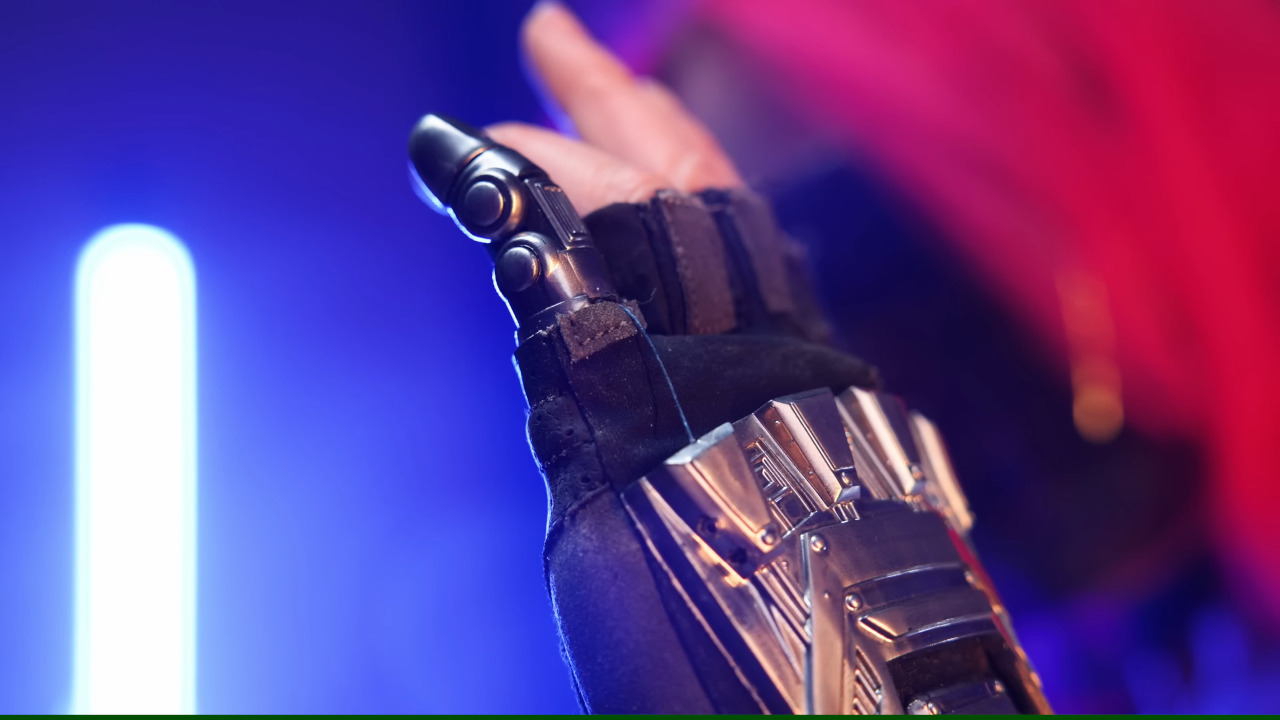
The glove-mounted components offered space for a CR2032 coin-cell battery holder and a microswitch. LED filament was installed inside the artificial fingertip, creating a bright illuminated accent when activated. This did not make the finger stronger or more sensitive, but usefulness is not the only valid design objective. A personal device can also be expressive, playful, and enjoyable to wear.
The printed parts received a metallic-looking finish that transformed the assembly from an obvious prototype into something resembling a cinematic cybernetic accessory. Rather than trying to imitate natural skin, the design embraced its mechanical identity.
Why Visible Prosthetics Matter
Some users prefer a prosthesis that closely matches their skin, complete with realistic pores, wrinkles, veins, and fingernails. Custom silicone restorations can achieve remarkable realism and may improve confidence in professional or social situations.
Other users prefer unapologetically mechanical designs. Bright colors, exposed joints, metallic finishes, artwork, and lights can turn a medical device into an extension of personal style. Neither approach is more legitimate. The wearer should decide whether a prosthesis blends in, stands out, or changes appearance depending on the day.
Nerdforge’s illuminated finger makes an important point: assistive technology does not have to look apologetic. A replacement body part may be functional and decorative at the same time. Eyeglasses made this transition long ago, evolving from purely corrective equipment into fashion accessories. Prosthetic design can follow a similarly personal path.
What the Finished Prosthetic Finger Can Do
The completed device was not intended to deliver a crushing grip or support heavy loads. Its value came from restoring a missing boundary along the side of the hand. With the artificial pinky closing alongside the other fingers, small objects were easier to contain and routine holding tasks became less cumbersome.
This illustrates a valuable engineering principle: solve the actual problem instead of chasing the largest specification. The project did not need individually controlled motors, artificial intelligence, or a neural interface. It needed a movable barrier in approximately the correct location.
A simple prosthetic finger may help with tasks such as:
- Supporting a smartphone along the outer edge of the hand
- Keeping coins, nuts, screws, or craft materials inside a cupped palm
- Stabilizing lightweight cylindrical objects
- Assisting with broad grasping motions
- Improving hand symmetry during selected activities
- Protecting or extending a healed residual digit when properly fitted
It cannot reproduce natural sensation, independent muscle control, or the full strength of an anatomical finger. The printed joints and line-driven mechanism also require maintenance. Lines stretch, fasteners loosen, gloves wear out, and tiny parts occasionally launch themselves under the workbench, where they join a flourishing civilization of lost screws.
Why 3D Printing Works Well for Finger Prostheses
Finger prostheses present a perfect challenge for digital fabrication because they are small, highly individualized, and geometrically complex. Traditional fabrication may require extensive sculpting, molding, machining, or specialized tooling. A digital model can instead be resized, mirrored, revised, and reproduced without rebuilding the entire process.
Rapid prototyping is particularly valuable during fitting. If the first socket pinches near a scar or a linkage bends at the wrong angle, the designer can update the model and print another version. This makes experimentation faster and can lower the cost of early prototypes.
Digital manufacturing also supports hybrid construction. A device might combine rigid printed bones, flexible pads, metal pins, silicone coverings, fabric straps, and cable tendons. The best material can be selected for each job rather than forcing one substance to provide structure, comfort, grip, and appearance simultaneously.
Open Source Does Not Mean Risk Free
Publicly available models expand access, but successful medical fabrication involves more than pressing “print.” Layer orientation, resin curing, filament choice, wall thickness, pin design, and surface finishing all influence safety. Parts that touch the body need smooth edges and appropriate materials. Components exposed to repetitive stress should be inspected frequently for cracks or deformation.
A hobby prototype should not be used around hazardous machinery simply because it fits well during household tasks. Gloves and prosthetic mechanisms can introduce snagging risks near rotating equipment. Workplace use requires a separate safety assessment, particularly around saws, drills, lathes, belts, rollers, and other moving machinery.
The Table Saw Lesson Cannot Be Skipped
The creativity of the replacement finger should not overshadow the accident that made it necessary. Table saw blades can cause catastrophic injuries in a fraction of a second. Proper blade guards, splitters or riving knives, anti-kickback components, push sticks, suitable fences, and disciplined hand placement are not fussy accessories invented to ruin a satisfying afternoon in the shop.
Woodworkers should use the correct blade, support long stock, maintain a stable stance, avoid reaching across the cutting path, and disconnect power before clearing jams or making adjustments. Loose clothing, jewelry, and gloves can be dangerous around rotating machinery. Anyone unfamiliar with a tool should obtain hands-on instruction before operating it.
A clever prosthesis is inspiring. Keeping the original fingers is still the superior manufacturing strategy.
Experiences and Practical Lessons From a Build Like This
The first experience associated with a project of this kind is usually not triumph. It is iteration. A downloaded model may look perfect on a computer screen and still feel completely wrong when attached to a real hand. A few millimeters can determine whether the artificial fingertip meets an object naturally or swings past it like a tiny plastic pendulum.
A realistic build process begins with low-risk fitting tests. The maker checks length, alignment, clearance, and joint movement before adding cosmetic finishes or electronics. Early versions are often worn only briefly. That makes it easier to identify pressure points and observe whether the mounting system causes redness. There is little value in lovingly sanding a metallic finish onto a component that will be redesigned ten minutes later.
Cable tension becomes another lesson. If the fishing line is too loose, the finger responds late and never closes fully. If it is too tight, the mechanism may remain curled, restrict natural hand motion, or place unnecessary force on the glove and skin. Fine adjustment matters more than brute force. Small knots, adjustable anchor points, or replaceable line guides can make tuning less frustrating.
Users also discover that different tasks require different expectations. The prosthetic pinky may be excellent for keeping a phone from sliding but less helpful for typing. It may improve the shape of a broad grasp without contributing meaningful lifting strength. Successful adaptation comes from noticing these distinctions rather than judging the entire device after one awkward attempt.
Practice changes the experience. At first, the user may consciously watch the artificial finger during every movement. Over time, repeated tasks can become smoother as the brain learns how much wrist or hand motion produces the desired position. This does not create natural sensation, but visual cues, cable resistance, and contact pressure can form a workable control loop.
Maintenance quickly becomes part of ownership. The line should be checked for fraying, hinges for cracks, screws or pins for loosening, and the glove for stretched fabric. Skin-contact areas need cleaning according to the materials used. Batteries should be removed when the lighting system will not be used for long periods, particularly if the electronics are integrated close to the body.
The emotional experience may be just as significant as the mechanical one. An injury can make a familiar hand feel unfamiliar. Building or customizing a replacement allows the user to participate actively in deciding what comes next. Choosing the shape, finish, lighting, and behavior of the device replaces some of the helplessness of loss with authorship.
That does not mean everyone should become their own prosthetist. The strongest approach combines lived experience, clinical knowledge, and maker creativity. The user knows which daily frustrations matter most. A therapist can analyze movement and recommend training. A prosthetist can address fit and loading. A designer can translate those needs into adjustable hardware.
The greatest practical lesson is that success does not require recreating a biological finger in every detail. Restoring one useful motion may be enough to improve dozens of small moments throughout the day. Add a glowing fingertip and metallic paint, and those moments arrive with considerably better special effects.
Conclusion
The story of a missing finger receiving a simple yet fancy replacement demonstrates the practical power of open design and desktop manufacturing. A parametric 3D model, fishing line, a modified glove, and several inexpensive electronic parts produced a body-powered prosthetic finger that addressed a specific everyday problem.
Its brilliance lies in restraint. The replacement does not pretend to duplicate every feature of a natural pinky. It restores useful closure along the edge of the hand, makes small objects easier to hold, and gives its wearer room for creative self-expression. The lights and metallic finish may be optional, but they turn a functional aid into something unmistakably personal.
Most importantly, the project shows how assistive technology can grow through cooperation among users, clinicians, engineers, and open-source communities. The future of prosthetics will include advanced sensors and neural interfaces, but it will also include wonderfully straightforward devices that solve one stubborn problem extremely well.