There are two kinds of internet fame: the kind you plan (ring lights, brand deals, “link in bio”), and the kind that
shows up uninvited in the background of a celebrity photoperfectly color-graded, correctly shadowed, and somehow
wearing the exact same expression your uncle makes when he’s “just happy to be included.”
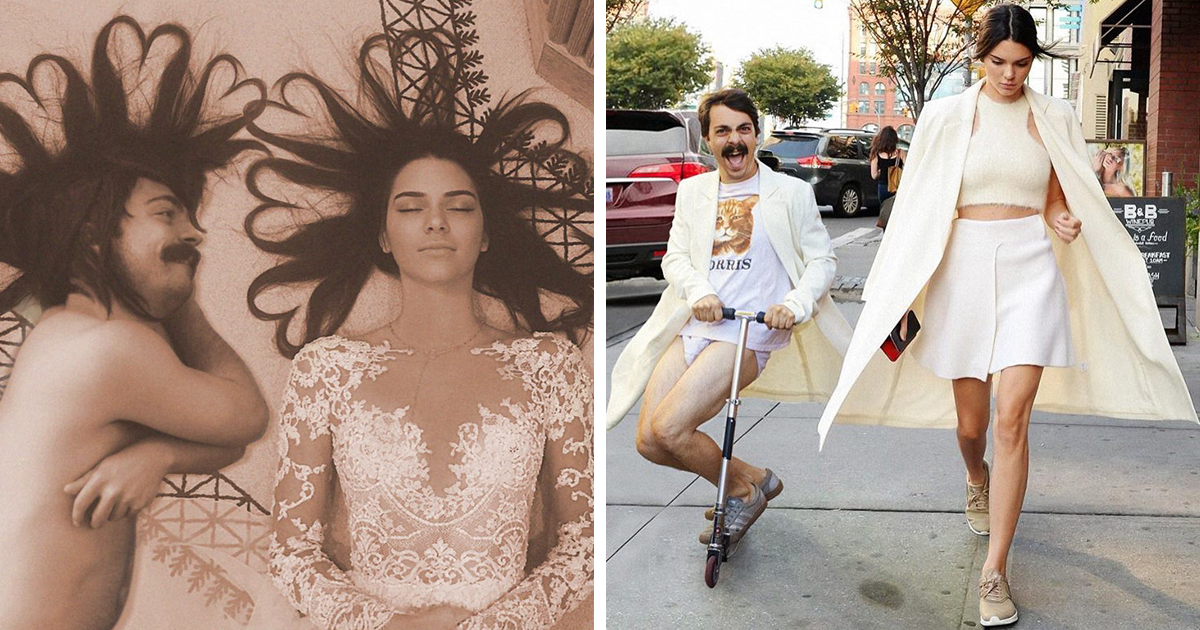
That second kind is where the “man photoshops himself into pictures of Kendall Jenner” phenomenon livesand it’s
why people keep saying the images are “10 times better.” Not because Kendall Jenner needed help looking like a
supermodel (she’s doing fine), but because the edits turn glossy, high-fashion seriousness into something
wonderfully human: awkward, playful, and self-aware.
Quick note about the NSFW label in the title: this trend often uses fashion, swimwear, or lingerie-style
campaign images that might not be “work-friendly” in some settings. This article stays firmly on the safe sideno explicit
descriptionsfocusing on the humor, artistry, and the bigger cultural conversation around celebrity imagery and digital manipulation.
The “Fraternal Twin” You Didn’t Know Kendall Had
The star of this story isn’t Kendall Jenner (though she’s the frequent co-star by way of existing photographs). The star is
Kirby Jenner, an internet performance artist and parody creator who built a following by inserting himself into Kendall’s
photos as her “fraternal twin.” The joke is simple on paper: “What if there was always a guy with a mustache standing right there?”
The execution, however, is where it becomes art.
What made the account pop wasn’t just the conceptit was the commitment. These weren’t sloppy cut-and-paste collages.
Kirby’s edits often match lighting, perspective, and the editorial polish of the original images so well that your brain does a double-take:
“Wait… was he always there?” That tiny moment of confusion is the punchline landing.
As the parody grew, it expanded beyond “look, I’m in the photo” into a broader send-up of celebrity culture: the perfectly curated
world where everything is intentional, exceptsurprisethere’s a random “twin” drifting through campaigns, yachts, and red carpets like
a benign glitch in the matrix.
What Makes the Photoshops Work (It’s Not Just the Mustache)
The internet loves to pretend Photoshop is magic: click-click, boom, masterpiece. In reality, convincing composites require a stack of
micro-decisions that viewers feel even if they can’t name them. The best “Kirby-in-the-frame” edits tend to nail a few specific ingredients:
1) Lighting that matches the scene
A real photo has a “logic” to itwhere the light comes from, how harsh it is, what it does to skin tones and shadows. If you drop a person
into the wrong lighting, it screams “fake.” When the lighting matches, your brain relaxes and the joke sneaks in.
2) Color grading and texture that feels editorial
Celebrity photos often have a distinctive polish: smooth highlights, controlled contrast, a specific palette. A good parody composite doesn’t
fight that styleit imitates it. That’s why the edits feel like they belong in the same glossy universe… until you notice the absurdity.
3) The “supporting character” position
The funniest edits rarely make Kirby the main character. Instead, he’s off to the side, behind a shoulder, half-involved, looking like the
friend who got invited because “we already paid for the table.” That subtlety is crucial: the image stays believable, and the humor stays sharp.
4) Captions that play along
Parody isn’t just visualit’s narrative. The “twin” framing turns the account into an ongoing sitcom, where the audience is in on the joke and
the post itself is another “episode.” The funniest captions don’t over-explain; they act like this is all perfectly normal.
Why People Say the Pictures Are “10 Times Better”
“Better” here doesn’t mean “more attractive” or “more high-status.” It means more entertaining, more memorable, and more shareable.
These edits upgrade a photo’s story. They add a layer of comedy that makes the image feel less like a billboard and more like a moment.
It punctures the bubble of perfection
Celebrity photos are often meticulously styled and curated. Inserting an ordinary-looking “twin” is like tossing a squeaky toy onto a runway:
the seriousness breaks, and suddenly the whole scene looks a little more like theaterwhich is exactly the point.
It turns passive scrolling into a game
People don’t just look; they hunt. “Where is he this time?” That tiny scavenger-hunt effect increases attention and makes the post feel interactive.
In a feed designed to keep you moving, anything that makes you pause is powerful.
It’s satire without a lecture
The edits are silly, but they also function as commentary on celebrity branding: how images are constructed, how personas are maintained, and how
audiences consume it all. The best satire doesn’t wag a fingerit makes you laugh and realize you’ve been participating in the spectacle the whole time.
The NSFW Label: What It Means (and What It Doesn’t)
In internet culture, “NSFW” can mean anything from “mildly spicy swimsuit photo” to “definitely close your laptop.” In this specific trend, it’s usually
on the milder end: the base images often come from fashion or campaign photography where skin is part of the aesthetic. The parody doesn’t need explicitness
to be funny. It needs contrasthigh glamour versus unexpectedly goofy “twin energy.”
If anything, the NSFW tag highlights a bigger truth: celebrity images often blur the line between art, advertising, and attention economy. The parody works
partly because it drops humor into a space that is normally optimized for desire, aspiration, and “perfect” presentation.
Zooming Out: We Live in the Era of Edited Reality
The Kirby-style edits are comedic, but they land in a culture already saturated with image manipulationfilters, retouching, face tuning, body reshaping,
background swaps, you name it. When audiences are constantly exposed to polished images, parody becomes a relief valve.
Even celebrities have talked publicly about how heavy editing can create unrealistic expectations. And the public has become hyper-alert to perceived edits,
sometimes spiraling into “detective mode” over a hand pose, a stretched background, or a suspiciously smooth contour. The result is a weird loop:
the more images are edited, the more people assume everything is edited, and the less anyone feels they can post a normal photo without judgment.
Research and public health discussions around social media regularly point out that appearance-focused content can shape self-perceptionespecially for teens
and young adults. That context doesn’t turn a parody Photoshop into a public service announcement, but it does explain why this kind of humor resonates:
people are tired of the pressure, and laughter is a way to reclaim the feed.
Ethics: Parody Without Being Creepy
Let’s draw a line in bold marker: there’s a difference between playful parody and invasive behavior. A Kirby-style edit works because it reads as satire of
celebrity imagery, not as a claim of real proximity or entitlement. If you’re thinking about creating similar “celebrity photo edit” content, a few ethical
guardrails keep it fun:
- Make the joke about media culture, not someone’s body. Avoid insults, sexualizing, or “gotcha” edits.
- Keep it clearly fictional. The humor should depend on the audience knowing it’s edited.
- Respect context. Steer away from sensitive moments, private settings, or images involving minors.
- Don’t imply endorsement. If a brand or person didn’t collaborate, don’t frame it like they did.
The best internet comedy punches up at systemsfame, perfection, the attention economynot down at individuals.
Is It Legal? A Plain-English Look at Parody, Fair Use, and Risk
Legal questions show up fast when you’re remixing celebrity photos. In the U.S., fair use can sometimes protect parody and commentary, but it’s not
a magic shield you can wave like a “get out of court free” card. Courts generally look at four factors (purpose, nature of the work, amount used, and market
effect). Parodywhen it comments on the original or what it representsoften has a stronger argument than satire that just uses the image as a prop.
“Transformative” is a key idea here: does the new work add new meaning or message, rather than simply re-posting the original for the same purpose? A well-made
parody composite can be more transformative than a simple repost, but outcomes depend on specifics and context.
There’s also another concept creators should understand: rights of publicity (using someone’s name/likeness commercially) and trademark confusion
(making it seem like a celebrity endorses a product). Those rules vary by state and situation. A personal parody account is different from using a celebrity edit
to sell a product.
Bottom line: parody can be protected, but it’s case-by-case. The safest lane is clear commentary, minimal confusion, and no commercial deception.
When the Joke Gets Big: Platforms, Brands, and the “Official” Universe
One reason the Kirby phenomenon stands out is that it didn’t stay a niche Photoshop gag. It became a recognizable pop-culture characterso much so that the concept
eventually leapt into more traditional entertainment formats. That arc is internet culture in a nutshell: one weird joke, repeated with commitment, becomes a “brand,”
then becomes a show pitch, then becomes a trailer you see while trying to watch something completely unrelated.
This also highlights how modern fame works: distribution platforms reward consistency and shareability, and parody accounts can become famous in their own right
without ever needing the original celebrity’s direct involvement. It’s remix culture meeting algorithm cultureand shaking hands.
What This Trend Teaches About Internet Humor (and Photoshop Skills)
The lasting appeal of “man photoshops himself into pictures of Kendall Jenner” isn’t just that it’s funny. It’s that it’s a masterclass in how online comedy works:
a recognizable premise, executed with technical competence, delivered in a format built for sharing.
Lesson 1: A simple bit becomes legendary with consistency
One edit is a joke. Do it again, and it becomes a character. Keep doing it, and it becomes a universe. Consistency turns randomness into identity.
Lesson 2: Craft makes comedy hit harder
The better the composite, the funnier the reveal. Comedy isn’t always “less effort”; sometimes it’s “so much effort that the punchline is invisible until it lands.”
Lesson 3: The internet likes jokes that respect the audience
People can tell when something is lazy. The reason audiences share these edits is that they feel like the creator caredabout the image, the timing, and the bit.
Experiences: The Kirby-Style Edit in the Wild (500+ Words)
If you’ve ever tried making a convincing “insert myself into a celebrity photo” edit, you learn something immediately: the joke is the easy part.
The believability is the hard part. Creators who dabble in this style often describe the process as equal parts comedy writing and visual problem-solving
like you’re directing a tiny movie scene inside a still image.
One common experience is the “shadow spiral.” You think you’re done, then you notice your feet don’t belong to the ground. The light in the original photo is coming
from the left, but your cutout has a highlight on the right. Suddenly you’re adjusting brightness, painting in soft shadows, adding a little blur, tweaking color temperature,
and zooming in so far that you start seeing pixels like they’re individual grains of sand. Ten minutes later you’ve forgotten the original punchline, but you’re weirdly
invested in whether your elbow matches the ambient bounce light.
Then there’s the “texture problem.” High-fashion photos usually have a specific sharpness and skin texture, sometimes with deliberate grain. Your inserted subject might
look too crisp or too flat. Creators talk about adding subtle noise, matching contrast curves, and even mimicking lens blur so the inserted person sits in the same depth of field.
It’s not glamorous workmore like digital housekeepingbut it’s what makes the final image feel like a real moment instead of a sticker slapped on a poster.
The emotional experience is surprisingly split between pride and ridiculousness. On one hand, you’re doing serious technical craft: masking hair edges, matching color grading,
aligning perspective lines. On the other hand, your final masterpiece is a grown man “casually” standing next to a supermodel like he’s waiting for the valet. That contrast is part
of the joyputting professional-level polish into something that refuses to take itself seriously.
Posting the work introduces a new layer: audience interpretation. Many creators describe the best comments as the ones that “play along” rather than simply complimenting the edit.
People might ask, “How did he get invited again?” or “Why does he look like he’s there to fix the Wi-Fi?” The community becomes co-writer of the joke, turning a single image into a
running gag. When a parody account catches on, followers aren’t just consuming; they’re participating.
But creators also report learning boundaries the hard way. A parody that feels harmless to one viewer can feel uncomfortable to another, especially when it uses suggestive imagery or
blurs the line between fantasy and entitlement. The best “Kirby-adjacent” experiences tend to come from creators who make the joke clearly fictional and keep the tone playful rather than possessive.
In other words: satire, not obsession.
Finally, there’s the practical side: platform rules, takedowns, and the reality that remix culture lives in a world of automated moderation. Some creators describe saving layered project files
because a post might get flagged, or re-editing an image to make it more clearly transformative (more commentary, less “straight repost”). Others pivot to using stock images, friends’ photos, or
fully original shoots that mimic the celebrity aesthetic without borrowing the exact original. The experience becomes a mini education in both art and internet governance.
That’s the hidden magic of the trend: it looks like a silly meme, but it’s also a workshop in visual storytelling. The people who try it come away with sharper editing skills, a better eye for
lighting, and a new appreciation for how much “reality” in a photo is actually constructedwhether by a photographer, a retoucher, or a mustached “twin” who refuses to leave the frame.
Conclusion: The Joke That Exposes the Whole Machine
The reason “Man Photoshops Himself Into Pictures Of Kendall Jenner” continues to entertain is that it operates on two levels at once. On the surface, it’s a simple gag: a surprise character
appears where he doesn’t belong. Underneath, it’s a playful critique of the modern image economyhow photos are curated, edited, optimized, and consumed as a form of currency.
In a world where perfection is marketed as normal, a well-made parody edit is a small act of rebellion: it reminds us that images are constructed, fame is theatrical, and sometimes the best way
to cope with the endless scroll is to let a fictional “fraternal twin” wander through itmatching the lighting perfectly, of course.