Editor’s note: This article revisits Ace Hotel Downtown Los Angeles as it appeared after its 2014 debut. Ace ended its operation of the property in January 2024. The historic United Artists Building later reopened as STILE Downtown Los Angeles and remains an active hotel and cultural venue.
Los Angeles has never been shy about reinvention. The city turns warehouses into galleries, office towers into apartments, parking lots into restaurants, and ordinary sidewalks into impromptu photo shoots. Yet even by L.A. standards, the transformation of the United Artists Building into Ace Hotel Downtown Los Angeles was unusually theatrical.
When the hotel opened in 2014, it occupied a 1927 Spanish Gothic landmark on South Broadway, complete with a 13-story tower and an ornate movie palace. The building had survived Hollywood’s silent era, years of office use, a period as a church complex, and enough changes in downtown Los Angeles to fill several screenplays. Then Ace arrived with Commune Design, Atelier Ace, local artists, vintage furniture, modernist references, turntables, handmade fixtures, and the confidence to place a rooftop pool above nearly a century of history.
The result was not a conventional luxury hotel. It was more like an eccentric cultural clubhouse that happened to provide beds. You could drink coffee, examine original plasterwork, browse records, attend a concert, spot a designer carrying a tote bag, and wonder whether everyone else in the lobby had a more interesting job than you.
The building was commissioned for United Artists, the studio associated with Mary Pickford, Douglas Fairbanks, Charlie Chaplin, and D. W. Griffith. Its office tower was designed by Walker & Eisen, while theater architect C. Howard Crane created the adjoining movie palace. The theater’s Spanish Gothic character drew inspiration from the cathedral architecture of Segovia, Spain.
A Hollywood Landmark Finds a New Role
To understand the Ace Hotel Downtown Los Angeles, it helps to begin with the building rather than the brand. This was not a blank concrete box waiting for decorative pillows. It was a landmark created during a period when movie theaters were designed as fantasy environments.
The United Artists Theatre served as a flagship venue for the independent studio’s films. Its soaring arches, decorative plaster, murals, carved details, and cathedral-like spaces treated cinema with almost religious importance. Moviegoing was not merely entertainment; it was an occasion that justified architectural drama.
The office tower beside the theater was more restrained, but it shared the same vertical ambition. At 13 stories, the complex rose prominently above Broadway when it was completed. Over the following decades, the building housed offices, including space associated with Texaco, before becoming the headquarters of a Christian ministry. The enormous “Jesus Saves” sign installed during that chapter remained part of the skyline, creating the sort of visual contradiction Los Angeles handles better than almost any city.
By the time Ace took over, Broadway’s historic theater district contained spectacular architecture but had lost much of its former entertainment traffic. The hotel’s arrival became part of a broader wave of adaptive reuse, retail development, restaurants, apartments, and cultural projects in Downtown L.A.
That revival came with complicated questions. New investment restored neglected buildings and brought visitors back to the neighborhood, but it also increased pressure on longtime residents and businesses. The Ace was therefore both a preservation success and a symbol of downtown’s rapid economic transformation. Its influence cannot be reduced to a simple “hotel saves neighborhood” story. Cities are rarely that tidy, and Los Angeles would probably reject a tidy story on principle.
Designing a Hotel That Looked Like Los Angeles
Commune Design and Atelier Ace approached the project as a conversation between several versions of Los Angeles. The interiors referenced the extravagance of 1920s Hollywood, the practical modernism of architects such as Rudolph Schindler and Richard Neutra, handmade California craft, and the disruptive energy of the city’s punk era.
That sounds like a design recipe written by someone spinning a wheel of unrelated cultural references. In practice, however, the ingredients worked because they shared a local connection. The hotel did not attempt to recreate one historical period perfectly. Instead, it layered eras the way Los Angeles itself does: Gothic ornament beside raw concrete, brass beside plywood, movie-palace grandeur beside deliberately inexpensive materials.
Commune preserved landmark features while exposing parts of the tower’s tougher structure. Original concrete remained visible in many areas. Modest materials such as medium-density fiberboard and Homasote panels were treated as finished surfaces rather than hidden behind expensive veneers. Local designers and craftspeople created furniture, lighting, textiles, artwork, ceramics, and architectural details specifically for the property.
The Exterior: Gothic Drama on Broadway
From the street, the building immediately announced that this was not another glass hotel tower. Its narrow vertical form, pointed Gothic details, decorative stonework, and historic marquee gave it the presence of a movie set that had somehow become real estate.
The façade also demonstrated the value of adaptive reuse. Instead of replacing the landmark with a generic development, the project retained an unmistakable piece of the Broadway Theater District. Travelers received a hotel with genuine history, while the city kept a building that could not have been convincingly reproduced with foam molding and optimistic marketing copy.
The Lobby: A Clubhouse With Cave Drawings
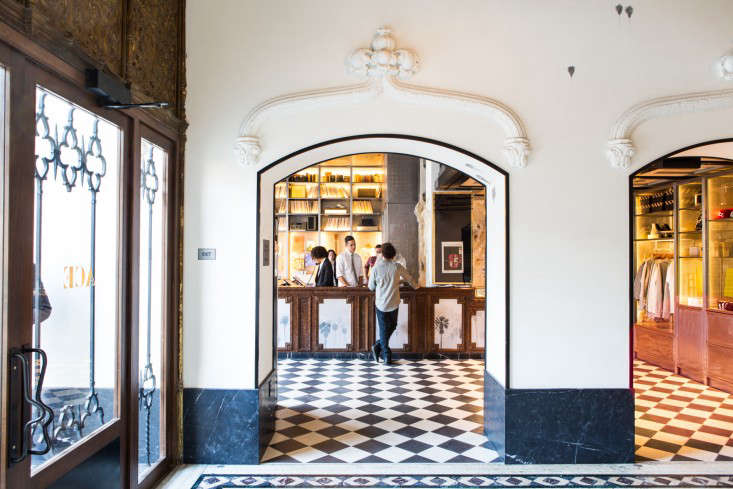
The lobby balanced reverence for the building with Ace’s informal social style. Restored plasterwork framed new arched openings, while black-and-white cement tiles added graphic energy underfoot. Original Gothic forms met stenciled doors, industrial materials, books, art, and furniture that looked collected rather than ordered from a single hotel catalog.
One of the most memorable contributions came from Los Angeles artists Simon and Nikolai Haas. Their graphite drawings covered walls with a loose visual mythology of Southern California: palm trees, personalities, mountains, symbols, strange forms, and cultural references. Instead of hanging a few framed prints and declaring the lobby “artistic,” the project allowed the artwork to become part of the architecture.
The Haas Brothers also created the reception desk using carved wood salvaged from the building. Decorative panels and painted palm imagery turned a functional check-in counter into a piece guests could inspect while pretending they had not forgotten which credit card they used for the reservation.
Mechanical systems presented another challenge. Rather than disguise every duct and utility element with conventional luxury finishes, the designers incorporated perforated metal, dark surfaces, retail displays, shelving, and theatrical ceiling treatments. The result felt polished without becoming precious.
LA Chapter and the Social Life of the Hotel
The original in-house restaurant, LA Chapter, played an important role in making the hotel useful to locals as well as overnight guests. Created by the team associated with Brooklyn’s Five Leaves, it occupied a restored storefront facing Broadway.
The design imagined what a Viennese coffeehouse might have looked like after moving to Los Angeles in the late 1920s and developing excellent taste in lighting. Bentwood chairs, brass-topped tables, dark paneling, patterned floors, stained glass, and warm sconces produced a room that felt historic without behaving like a museum.
Commune restored the building’s iron grillwork and preserved the original checked sidewalk. Inside, patterned tiles referenced the landscape compositions of Brazilian artist Roberto Burle Marx. A stained-glass feature created by the historic Judson Studios reinterpreted Gothic geometry in a more modern composition.
Above the restaurant, the mezzanine offered another gathering space with vintage rattan chairs, low sofas, recycled army-tent fabric, and several seating arrangements. It was an ideal place to work, meet friends, watch the restaurant below, or open a laptop and spend 45 minutes selecting the correct background music.
Guest Rooms: Modernism Without the Museum Rope
The 182 guest rooms provided a calmer counterpoint to the theater and public spaces. Their design took cues from Southern California modernism, emphasizing useful built-ins, honest materials, simple geometry, and filtered natural light.
Walls were lined with Homasote, a paper-based fiberboard appreciated for texture and sound absorption. Black-stained MDF became shelving, desks, and storage. Exposed concrete ceilings preserved traces of the existing structure, while globe lights and custom fixtures softened the industrial surfaces.
The color palette combined black, gray, brown, cream, and mustard tones. Custom Pendleton blankets introduced bold geometric patterns across the beds. The effect was warm but disciplinedless “presidential suite,” more “architect’s studio after someone remembered to add comfortable bedding.”
Selected rooms included record players, vinyl records, or acoustic guitars. These features became part of Ace’s reputation for treating hotel rooms as temporary creative spaces rather than boxes where travelers watched cable television beside an aggressively beige lamp.
Bathrooms That Made Small Spaces Interesting
The bathrooms demonstrated how careful detailing can make compact rooms memorable. Steel-and-glass shower partitions allowed light to move through the space without the visual bulk of conventional walls. Honed Carrara marble, exposed metal supports, leather accessories, unlacquered brass fixtures, and custom mirrors brought craftsmanship to an otherwise practical area.
Even modest objects received attention. Stools, tissue covers, hooks, toilet-paper holders, and signs were treated as design opportunities. Some pieces were handmade by regional craftspeople, reinforcing the sense that the hotel had been assembled through collaboration rather than purchased as a complete package.
The Rooftop: Downtown With a Side of Sunshine
The rooftop became one of the Ace Hotel’s most recognizable attractions. Its small concrete pool, bar, terraces, lounge furniture, plants, ceramic lighting, and city views created a casual gathering place high above Broadway.
From that height, Downtown Los Angeles appeared as a dense architectural collage: historic commercial buildings, theater façades, rooftop signs, newer towers, parking structures, distant hills, and traffic performing its daily interpretive dance.
The rooftop’s appeal was not based on enormous resort amenities. The pool was closer to an urban plunge pool than an Olympic training facility. Its strength was atmosphere. Guests could have breakfast in the sun, attend an event, meet friends for a drink, or watch the light change across the skyline.
The hotel’s rooftop, restaurant, theater, coffee service, music programming, and central location helped make it a destination beyond its guestrooms. Reviewers frequently highlighted the restored building, nightlife, dining program, and rooftop as defining features of the property.
The Theater: The Hotel’s Spectacular Secret
However stylish the rooms and rooftop were, the restored theater remained the building’s masterpiece. With approximately 1,600 seats, it offered a scale and decorative richness that no newly constructed boutique hotel would be likely to attempt.
The auditorium featured Gothic arches, murals, elaborate plasterwork, a dramatic proscenium, balconies, and a richly ornamented ceiling. Restoration work preserved this theatrical fantasy while updating the venue for concerts, film events, comedy, talks, and private programs.
There was something fitting about reconnecting the theater with live audiences. The building had begun as a place where artists tried to control their own work outside the dominant studio system. Nearly a century later, it again hosted musicians, filmmakers, performers, and creative communities.
For hotel guests, the theater changed the meaning of staying there. It was possible to check in upstairs, attend a performance downstairs, visit the rooftop afterward, and return to a room without negotiating L.A. traffic. That may be the closest Los Angeles has ever come to teleportation.
A Sample Ace Hotel Downtown Los Angeles Experience
The experience began on Broadway, where the building’s pale Gothic façade rose above the surrounding storefronts. Even before entering, a visitor could read several chapters of Los Angeles history in a single view: a silent-film landmark, an old religious sign, a restored marquee, and a steady stream of people photographing all three.
Inside, the lobby rewarded slow observation. At first glance, it appeared dark, relaxed, and slightly mysterious. Then the details began to separate themselves from the backgroundthe carved reception desk, pencil drawings, cement tiles, restored arches, books, industrial metal, and furniture that seemed to have arrived from several different decades but somehow knew one another.
Check-in did not feel like entering an anonymous business hotel. The lobby functioned as a public living room, with guests, neighborhood residents, restaurant diners, and laptop users sharing the same space. Someone might be discussing a film project nearby. Someone else might be editing photographs. A third person might simply be staring thoughtfully at a wall drawing while waiting for coffee. At Ace, all three activities appeared equally official.
Upstairs, the hallway shifted the mood. Script pages pasted onto landing walls connected the hotel to Hollywood without relying on framed celebrity portraits. Entering a guest room brought another change: the Gothic drama disappeared, replaced by a restrained mix of concrete, fiberboard, dark furniture, globe lighting, and geometric textiles.
The room encouraged interaction. A record player invited guests to choose music rather than accept whatever playlist an algorithm considered “boutique hotel evening.” A guitar, where available, offered another possibility, although neighboring guests may have preferred that possibility remain theoretical.
The bathroom was compact but clever. Glass partitions prevented the shower from making the room feel boxed in, while brass, marble, leather, and steel added tactile variety. The materials were not conventionally lavish, yet their arrangement made the space feel intentional.
Later, the rooftop provided the broadest view of the hotel’s setting. Downtown stretched outward in layers, with Broadway’s historic buildings below and newer towers rising beyond them. In daylight, the terrace felt casual and sun-washed. Around sunset, the atmosphere became more social as lights appeared across the skyline and the bar filled.
Dinner or coffee downstairs completed the loop. The restaurant’s bentwood chairs, brass tables, patterned surfaces, and dark wood created a sense of age even though much of the interior had been newly designed. It was a useful lesson in adaptive reuse: historical character does not always mean freezing a building in time. Sometimes it means introducing new work that understands the old work well enough to join the conversation.
If a performance was scheduled, the evening could end inside the United Artists Theatre. Walking from a relatively minimal guest room into that spectacular auditorium was like moving from a Schindler house into a medieval movie dream. The contrast made both spaces more powerful.
The experience was not flawless or universally appealing. Rooms could feel dim. The rooftop could become crowded. The social atmosphere sometimes seemed designed for people who had perfected the art of appearing casually fashionable. Travelers seeking formal service, enormous bathrooms, or silent public spaces could find the property unconventional.
Yet those quirks were central to its identity. Ace Hotel Downtown Los Angeles offered something more memorable than polished sameness. It allowed visitors to sleep inside an important landmark while participating, however briefly, in the cultural life surrounding it.
Why the Ace Hotel Mattered to Downtown Los Angeles
The hotel demonstrated that preservation and contemporary design did not need to be opponents. Historic plaster, murals, theater architecture, and exterior details could coexist with raw concrete, modern furniture, local artwork, and practical materials.
It also helped change perceptions of where visitors could stay in Los Angeles. Rather than treating Downtown L.A. as a place for a short daytime visit, the Ace encouraged travelers to make Broadway their base. Museums, restaurants, markets, galleries, performance venues, shops, and transit connections became part of the hotel experience.
Its influence extended beyond hospitality. The project helped confirm that old commercial buildings could support new cultural uses without losing all traces of their previous lives. Later hotels and developments continued the adaptive-reuse trend throughout downtown.
At the same time, the Ace’s story reminds us that fashionable redevelopment is never culturally neutral. A successful hotel can preserve architecture, generate employment, attract investment, and support entertainment. It can also contribute to rising costs and a neighborhood identity increasingly shaped for wealthier visitors. Both realities deserve space in an honest assessment.
Conclusion
Ace Hotel Downtown Los Angeles was memorable because it did not reduce history to decoration. The United Artists Building remained the star, while the hotel’s designers added a new supporting cast of modernist rooms, local artwork, handcrafted details, social spaces, food, music, and rooftop life.
The property captured several versions of Los Angeles at once: silent-film ambition, Spanish Gothic fantasy, modernist efficiency, punk irreverence, creative collaboration, urban reinvention, and the city’s endless appetite for a good rooftop.
Although the Ace chapter ended in 2024, the building continues to evolve. That ongoing transformation feels appropriate. The United Artists complex has never been merely a preserved relic. It has remained useful by changing roles while keeping enough of its architecture and cultural memory to make each new era more interesting.
For travelers, designers, preservation enthusiasts, and anyone who believes a hotel lobby should contain more personality than an airport waiting area, the former Ace remains an important Los Angeles case study. It showed how a boutique hotel could become a neighborhood gathering place, a design laboratory, a concert destination, and a caretaker for one of the city’s most extraordinary historic buildings.