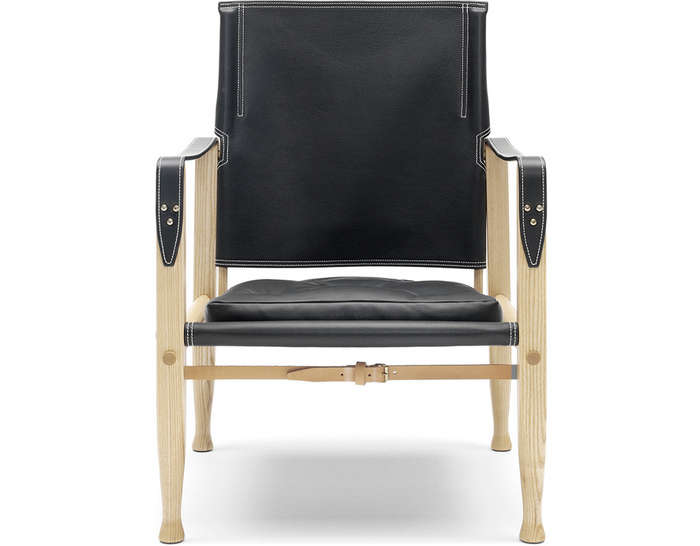
A chair can be stylish, comfortable, portable, and nearly a century old without behaving like a museum relic. The Kaare Klint 47000 Safari Chairusually cataloged as the KK47000proves it. Its pale ash frame, canvas sling seat, and leather arm straps make it recognizable at a glance, yet the design refuses to scream for attention. It just sits there looking calm, capable, and suspiciously good at making a room appear more expensive.
Designed in 1933, the chair turned a portable campaign-furniture idea into a cornerstone of Danish Modern design. It is not a “safari-themed” novelty and not an oversized leather throne pretending to be practical. It is a carefully proportioned lounge chair whose parts, materials, and visible hardware all have a job to do.
What Is the Kaare Klint 47000 Safari Chair?
The KK47000 is a lightweight, demountable lounge chair designed by Danish architect and furniture designer Kaare Klint. Its basic recipe is wonderfully honest: an ash-wood frame, a sling-style seat and back in canvas or leather, leather straps, and metal fittings. The chair can be assembled and taken apart without tools, a feature that links it directly to the portable campaign chairs that inspired it.
Today’s authorized edition from Carl Hansen & Søn is commonly offered in white-oiled FSC-certified ash with natural canvas and saddle-leather details. Retail specifications list the chair at about 22.4 inches wide, 22.4 inches deep, and 31.5 inches high, with a seat height around 13.4 inches. That compact footprint makes the Safari Chair a particularly useful living-room accent chair, library chair, or bedroom reading chair.
The Design Story: From Campaign Furniture to Danish Modern
The Safari Chair did not arrive out of thin Scandinavian air wearing a beret. Klint studied historical furniture types and then refined them for modern living. The chair is often connected with British campaign or Roorkhee-style seating: durable, transportable furniture designed to be disassembled for travel. Klint’s 1933 version edited the idea down to its essential parts and gave it a more disciplined silhouette.
That approach was central to Klint’s influence. He helped establish the School of Furniture Design at the Royal Danish Academy of Fine Arts in 1924 and taught designers to consider human proportions, material behavior, and actual usenot merely a dramatic outline for the catalog photo. His students and followers included major names in the Danish design tradition, which helps explain why the Safari Chair reads as more than one beautiful object. It is a miniature lesson in how Danish Modern became Danish Modern.
The historical name “Safari Chair” reflects the period language and travel imagery tied to campaign furniture. In contemporary interiors, it is best understood as the name of a design classic rather than an invitation to turn the den into a colonial movie set. Skip the pith helmets; keep the good lighting.
Why the Safari Chair Looks So Effortless
Great furniture often appears simpler after someone has solved a pile of difficult problems. The KK47000 looks light because its structure is exposed. It looks warm because the canvas and leather soften the straight ash frame. It looks informal because the sling components have a little give. Put those elements together, and you get a chair that is equally at ease beside a Persian rug, a concrete floor, a wall of books, or a very determined houseplant.
The visible leather straps are not decorative afterthoughts. They help support the seat and arms while providing an appealing contrast to the wood and textile. The canvas creates a relaxed, breathable surface rather than the sealed-up feeling of a heavily upholstered lounge chair. On leather versions, the material adds richness without making the design visually bulky.
The chair also makes a quiet case for repairability. Its knockdown construction means individual components can be replaced when needed instead of forcing an owner to retire the entire chair after one damaged strap or worn cover. That is a remarkably modern idea for a design from 1933, especially in an era when some furniture seems engineered to survive one move and one enthusiastic puppy.
Materials, Construction, and Comfort
The modern Kaare Klint Safari Chair is built around oil-finished ash, canvas, and full-grain leather details. Historic examples may have smoked or stained ash, linen drill, canvas, or leather covers, depending on production era and configuration. Vintage chairs also show the practical consequences of use: canvas may fade, leather may darken, and wood may gain the soft patina that makes collectors weak in the knees.
Comfort is best described as supportive, relaxed, and more adaptable than its lean profile suggests. The sling seat distributes weight differently from a padded club chair, and the flexible construction responds slightly to the sitter. That makes it inviting for reading, conversation, or the noble art of staring out a window while calling it “thinking.”
Still, the Safari Chair is not an overstuffed television cocoon. Its seat is relatively low, its dimensions are compact, and the feel is upright enough for conversation. Buyers who want a sink-in-all-afternoon lounge chair may prefer a deeper upholstered design. Buyers who appreciate posture, airiness, and a chair that does not dominate the room will understand the appeal almost immediately.
How to Style a Kaare Klint 47000 Safari Chair
A single Safari Chair can do more visual work than a small army of throw pillows. In a minimalist space, place it near a floor lamp and a small oak side table for a reading corner that feels settled rather than staged. In a traditional room, the ash, canvas, and leather can soften formality and add an intelligent contrast to antiques. In a mid-century interior, it works with teak credenzas, wool upholstery, pottery, and sculptural lighting without becoming a predictable matching-set casualty.
For a contemporary apartment, use the chair to introduce texture. Pair natural canvas with plaster walls, linen curtains, blackened steel, and a wool rug. In a darker room, a leather version can echo walnut, bronze, or deep-painted walls. The key is to give the chair enough breathing space for its open geometry to register. Cramming it between a bulky sectional and a towering fiddle-leaf fig is a little like parking a bicycle in a ballroom.
Two chairs create an especially effective conversation area. Angle them toward each other with a low table in between, leaving enough room for the leather straps and open sides to stay visible. A matching footstool can make the setup more leisurely, but it is not mandatory. The chair has enough presence to stand alone.
Its versatility is one reason the design continues to appear in high-end residential interiors and contemporary design coverage. It can make an empty corner feel considered without demanding that every other piece in the room be Scandinavian.
New vs. Vintage: Which Safari Chair Should You Buy?
A new authorized KK47000 is the sensible route for buyers who want current materials, a predictable condition, warranty coverage, and reliable replacement parts. It is also easier to specify for a project, especially when matching finishes and delivery timing matter. Confirm the exact configuration before ordering: cushions, cover materials, and leather details can vary by retailer and market.
A vintage Kaare Klint Safari Chair offers a different reward. Earlier chairs associated with Rud. Rasmussen may have distinctive ash finishes, canvas colors, leather upholstery, or signs of age that cannot be reproduced on command. The patina is often part of the attraction, but it should be examined rather than romanticized. A charmingly faded canvas cover is one thing; structural weakness, torn sling material, cracked leather, or an incomplete frame is another.
When shopping vintage, ask for clear photographs of labels, fittings, straps, underside details, wood joints, and any repairs. Auction records show examples made by Rud. Rasmussen with marked labels and demountable stained-ash structures, leather upholstery, and brass fittings. Those details help establish provenance, although condition and documented production history matter more than a seller’s enthusiastic use of the word “iconic.”
Caring for the Chair Without Making It Nervous
Treat the Safari Chair as fine indoor furniture. Keep it away from prolonged direct sunlight, which can fade canvas and dry leather. Dust the ash frame with a soft, dry cloth and follow the manufacturer’s care guidance before adding oil, cleaners, or conditioners. Leather generally benefits from gentle, product-appropriate care used sparingly; too much conditioner can create a greasy-looking surface and attract dust.
For canvas, vacuum lightly with an upholstery attachment and address spills promptly with a minimal amount of moisture after testing an inconspicuous area. Avoid soaking the fabric or scrubbing aggressively. The point is to preserve the material, not give it a boot-camp pep talk.
Because the chair is assembled from parts, periodically inspect straps, hardware, and structural members. Do not overtighten fittings in pursuit of perfection. The design’s character includes controlled flexibility, not the rigid stillness of a dining chair bolted to a restaurant floor.
Is the KK47000 Worth It?
The Kaare Klint 47000 Safari Chair is worth the investment for people who value design history, honest materials, and furniture that gets better through use rather than merely surviving it. It is not the cheapest way to fill an empty corner, and it should not be bought as a prop. Its appeal lies in the unusual combination of visual restraint, practical construction, and cultural importance.
It also has staying power. Designers continue to specify the chair in refined interiors because it works across styles without becoming invisible. The silhouette is familiar but never generic; the construction is simple but never simplistic. In other words, it is the furniture equivalent of the person who wears a white shirt perfectly and somehow makes everyone else question their closet.
The Bottom Line
Kaare Klint’s KK47000 Safari Chair remains one of the clearest expressions of Danish Modern furniture design. Its ash frame, canvas or leather sling, and tool-free knockdown construction were ingenious in 1933 and remain meaningful today. Whether bought new or vintage, it adds character without clutter, comfort without bulk, and history without a lecture.
Living With the Kaare Klint 47000 Safari Chair: An Experience in Everyday Use
The first experience of the Kaare Klint 47000 Safari Chair is visual. Before anyone sits down, the chair announces a different relationship with furniture. Instead of hiding its structure beneath foam, fabric, and mysterious upholstery stapling, it lets you see how it works. The ash frame is legible. The canvas seat is legible. The leather straps are legible. It is furniture with excellent communication skills.
In a real room, that clarity has an unexpected effect: the chair makes surrounding objects look more intentional. A plain side table becomes a companion piece. A stack of art books becomes a reading ritual. Even a half-finished cup of coffee gains a little architectural dignityalthough the chair cannot prevent it from going cold while you admire the joinery.
Sitting in the Safari Chair feels different from sinking into a conventional lounge chair. The canvas supports rather than swallows you, and the chair’s slight flexibility gives it a responsive quality. You settle in, but you do not disappear. For many people, that is precisely the point. It is excellent for a morning read, a long conversation, or the part of the evening when you want to relax without entering a state so deep that standing up becomes a strategic operation.
The low seat height can take a moment to adjust to, particularly for taller guests or anyone accustomed to higher, more cushioned seating. Yet it also contributes to the chair’s grounded, informal mood. With a small ottoman or the matching footstool, the experience becomes even more relaxed. Without one, the chair remains compact and useful in rooms where a large recliner would feel like a furniture-related hostage situation.
Owners also tend to notice how the materials change. Natural canvas develops a softer, lived-in look. Leather straps and armrests deepen in color with use. Oil-finished ash gains warmth. These are not defects to panic over; they are part of the chair’s character. A Safari Chair that has been used thoughtfully often looks more convincing than one kept in a ceremonial no-sitting zone.
The knockdown construction adds a practical pleasure, too. Moving house is rarely fun, but being able to disassemble a valuable chair without a toolbox or a dramatic call to a furniture technician is genuinely useful. It makes the chair feel less precious in the bad sense. You respect it, but you can also live with it.
Most importantly, the experience is not limited to one decorating style. In a sparse modern home, it adds texture and human scale. In a room filled with traditional objects, it supplies restraint. In a small apartment, it provides seating without swallowing the floor plan. It can look thoughtful, casual, scholarly, rugged, or quietly luxurious depending on what surrounds it.
That flexibility explains why the Kaare Klint 47000 Safari Chair has endured. It does not demand that a room become a museum of Danish design. It simply brings its own logic, comfort, and material honestyand lets the rest of the room rise to the occasion.