Some places whisper history. Eastern State Penitentiary does not whisper. It creaks, echoes, stares back through broken windows, and practically dares your camera not to overreact. Located on Fairmount Avenue in Philadelphia, this massive former prison looks like a medieval castle that accidentally landed in an American neighborhood and decided to stay for two centuries.
I visited Eastern State Penitentiary with one goal: take pictures of a place that feels both beautiful and uncomfortable. What I found was more than a photogenic ruin. It was a landmark that tells the story of American prison reform, architectural ambition, social failure, famous inmates, and the strange way sunlight can make peeling paint look poetic. My camera came for the textures. My brain left with a history lesson.
This article is part travel story, part photography reflection, and part deep dive into why Eastern State Penitentiary remains one of the most fascinating historic sites in Philadelphia. Bring curiosity, comfortable shoes, and a fully charged battery. Trust me: the walls have a lot to say, and your phone will panic first.
What Is Eastern State Penitentiary?
Eastern State Penitentiary opened in 1829 as one of the most ambitious prison experiments in the United States. At the time, it was not designed merely as a jail. It was designed as a “penitentiary,” a place where people convicted of crimes were supposed to experience penitence, reflection, and reform.
The idea sounds noble on paper: solitude, labor, silence, and moral improvement. In practice, it became one of the most controversial prison models in American history. The institution used what became known as the Pennsylvania System, which relied heavily on separate confinement. Prisoners lived, ate, worked, and spent most of their time alone in individual cells.
Today, Eastern State Penitentiary is a historic site and museum. Visitors can walk through crumbling cellblocks, listen to audio stories, view exhibits, photograph the architecture, and think seriously about the past and present of incarceration in America. It is not a theme park, although its dramatic stone walls could easily convince a movie director to shout, “Perfect! Add fog!”
The First Impression: Castle Walls In The Middle Of Philly
Before stepping inside, the exterior already feels cinematic. Eastern State’s high stone walls and towers give it a fortress-like presence. The building was designed by architect John Haviland, who created a radial layout with cellblocks extending outward from a central surveillance point. In simple terms, it looks like a wheel, except instead of spokes leading to a bicycle tire, they lead to rows of cells and decades of complicated history.
That design was not just for drama. It allowed guards to observe multiple corridors from a central position and helped organize the prison around the philosophy of separation. The architecture was the system. Every hallway, skylight, wall, and cell was part of the moral experiment.
As a visitor with a camera, the layout is a gift. Long corridors create perfect leading lines. Doorways frame doorways. Light falls through broken ceilings like it signed a contract with every photographer who has ever said, “Just one more shot.”
Why Eastern State Penitentiary Matters
Eastern State Penitentiary was not simply another old prison. It became a model copied by hundreds of prisons around the world. Its radial design, vaulted cellblocks, individual cells, heating, plumbing, and focus on isolation made it a symbol of early 19th-century reform thinking.
In its early years, the prison was considered modern and expensive. Each cell originally had features meant to support isolation, including a small exercise yard, a skylight, and basic plumbing. The skylight was sometimes described symbolically as the “eye of God,” which is either deeply spiritual or the most intimidating ceiling window in architectural history.
But the system drew criticism. Charles Dickens visited in 1842 and strongly condemned the effects of extreme solitary confinement. Over time, overcrowding made the original plan impossible to maintain. By 1913, Eastern State officially abandoned the Pennsylvania System, and the prison functioned more like a conventional congregate institution until it closed in the early 1970s.
Walking The Cellblocks: Quiet, Cold, And Strangely Beautiful
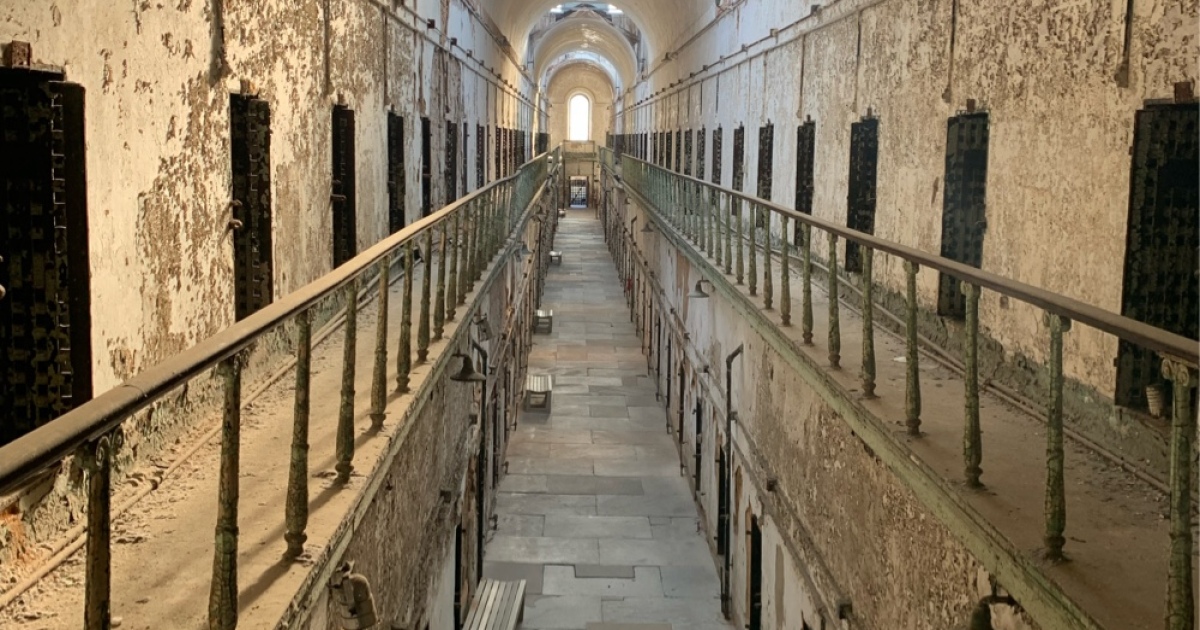
The cellblocks are the heart of the visit. Some corridors are restored enough to help you imagine daily prison life. Others remain in a state of preserved ruin, with peeling plaster, rusted metal, cracked walls, and plants growing where silence once ruled.
Photographically, it is incredible. Emotionally, it is heavier than expected. You may find yourself admiring the way sunlight touches a doorway, then remembering that someone once counted days, years, or decades inside that small space. That tension is what makes Eastern State Penitentiary so powerful. It is beautiful, but it is not cute. It is historic, but not harmless.
The best photos are often not the obvious ones. Yes, the long hallways are spectacular. But the details stay with you: a broken chair, a rusted lock, a fragment of tile, a scratched wall, a narrow bed frame, or a small patch of green pushing through stone. Eastern State reminds you that decay has a visual language. It also reminds you not to romanticize the pain behind it.
Al Capone’s Cell: The Celebrity Stop
One of the most famous stops at Eastern State is Al Capone’s cell. Capone, the Prohibition-era crime boss, spent time at Eastern State in 1929 and 1930. His restored cell looks noticeably more comfortable than the average cell, with furniture and decor that seem almost theatrical compared with the bare spaces elsewhere.
Visitors naturally gather there because famous names attract attention. It is the same reason people slow down when they see a celebrity wax figure, even if the wax figure looks like it just heard bad news. But Capone’s cell is useful beyond the gangster curiosity. It shows how status, money, myth, and media can shape public memory. Many prisoners passed through Eastern State. Only a few became legends.
For photography, the cell is moody and highly composed. Still, it is worth remembering that the flashiest room is not necessarily the most important one. Some of the plainest cells tell the larger story more honestly.
Willie Sutton And The Escape Tunnel
Eastern State Penitentiary also has its share of escape stories. The most famous involved bank robber Willie Sutton and a 1945 tunnel escape. Sutton was one of several men who escaped through a tunnel, although he was captured the same day. Today, the story adds another layer to the site’s already dramatic personality.
The escape tunnel is one of those details that makes visitors lean forward. It has crime, planning, risk, and just enough absurdity to sound like a movie pitch. But again, Eastern State is careful to place these stories within a broader historical context. The site is not only about infamous individuals; it is about systems, confinement, punishment, reform, and consequences.
The Audio Tour: Steve Buscemi In Your Ear, History In Your Face
General admission includes “The Voices of Eastern State” audio tour, narrated by Steve Buscemi and featuring the voices of people connected to the site’s history. It is atmospheric without becoming cheesy. That matters because this place does not need fake drama. The real drama is already standing in front of you wearing a coat of dust.
The audio tour guides visitors through the prison’s history, architecture, daily life, and legacy. It also encourages reflection on the modern criminal justice system. Eastern State’s exhibits do not freeze history in the 1800s. They connect the old prison to ongoing conversations about mass incarceration, race, punishment, rehabilitation, and public responsibility.
That makes the visit more meaningful. You are not just looking at old walls. You are being asked to think about what those walls produced, what they represented, and what echoes remain in the present.
Photography At Eastern State Penitentiary
If you enjoy architectural photography, urban decay, historic sites, or dramatic textures, Eastern State Penitentiary is a dream. It offers vaulted ceilings, sky-lit cells, rust, stone, shadows, peeling paint, and long perspectives that practically arrange themselves into compositions.
However, visitors should respect the site’s photography rules. Personal, non-commercial photography of the building is generally allowed during public hours, but portrait photography, models, props, drones, videography, and staged shoots are restricted. Tripods or similar equipment may require a photography equipment pass. The simple rule is this: take pictures thoughtfully, do not block pathways, do not touch artifacts, and do not turn a serious historic site into your personal album cover shoot.
Best Photo Ideas Inside The Penitentiary
Start with the central rotunda. From there, the original cellblocks stretch outward like corridors into different moods. Use the symmetry. Look for repeating doors, broken lines, and light at the end of dark hallways.
Next, focus on small details. Peeling paint can look like an abstract painting. Rusted metal gives close-up shots a gritty texture. Old cell doors make strong vertical compositions. If the light is harsh, embrace contrast. If the sky is cloudy, enjoy the softer tones. Eastern State is photogenic in almost every condition, which is unfair to other buildings trying their best.
Finally, take a few wide shots that show scale. The prison is massive, and the human feeling of being small inside it is part of the experience. A good photo should not only say, “This wall looks cool.” It should say, “This place was designed to shape human behavior.”
What Surprised Me Most
I expected Eastern State Penitentiary to be eerie. I expected it to be photogenic. I did not expect it to feel so intellectually engaging. The best historic sites do more than preserve objects; they complicate your assumptions. Eastern State does exactly that.
The prison began as a reform project. Its founders believed they were creating a humane alternative to earlier punishment systems. Yet the lived reality of isolation became deeply controversial. That contradiction sits at the center of the visit. Good intentions, powerful architecture, and harmful outcomes can occupy the same space. Eastern State makes that lesson visible in stone.
I was also surprised by how much nature has entered the site. In some areas, plants grow through cracks, softening the harsh geometry. Birds move where guards once walked. Sunlight and vines do what time always does: they interrupt human certainty.
Tips For Visiting Eastern State Penitentiary
Plan for at least two hours if you want to take photos and listen to the main audio tour without rushing. Wear comfortable shoes because the floors are uneven in places, and dress for the weather because the historic site is not climate-controlled like a modern museum.
Arrive with your camera or phone fully charged. Bring a wide-angle lens if you use a dedicated camera, but do not ignore normal focal lengths. Some of the strongest images come from restraint rather than trying to cram an entire cellblock into one frame.
Also, give yourself time to put the camera down. That may sound like betrayal in an article about taking pictures, but it matters. Some moments are better absorbed without a screen between you and the wall.
Why This Visit Stays With You
Eastern State Penitentiary is unforgettable because it operates on several levels at once. It is an architectural landmark, a preserved ruin, a museum, a photography destination, and a moral argument. It gives visitors beautiful images and uncomfortable questions.
That combination is rare. Many tourist attractions are easy to consume. You arrive, smile, photograph, buy a magnet, and move on. Eastern State asks more from you. It asks you to consider the difference between reform and control, silence and suffering, justice and spectacle.
And yes, it also gives you some of the best moody hallway photos in Philadelphia. History can be profound and well-lit. Who knew?
Extra Experience: What It Felt Like To Take Pictures There
Taking pictures at Eastern State Penitentiary felt different from photographing a park, skyline, restaurant, or pretty street corner. At first, my photographer brain took over. I noticed angles, light, patterns, textures, and shadows. The corridors were long and dramatic. The doors looked like they had been designed by someone who believed hinges should have emotional trauma. Every surface seemed ready for a close-up.
But after a while, the mood shifted. The camera stopped being just a tool for collecting cool images and became a way to pay attention. A cracked wall was not only a cracked wall. It was evidence of age, neglect, preservation, and memory. A narrow doorway was not only a frame. It was an entrance into a room where someone once lived under strict confinement.
I found myself taking fewer photos as the visit continued, but thinking more carefully about each one. In a place like Eastern State, composition is not only visual. It is ethical. You have to ask what you are turning into an image and why. Is the photo respectful? Does it show the weight of the place, or does it treat suffering like spooky decoration?
That question matters because Eastern State is undeniably atmospheric. The ruin is visually stunning. The broken plaster, empty cells, and long shadows create a look that many photographers love. But the site is not abandoned in the casual sense. It is preserved and interpreted. It has a mission. Its purpose is not simply to be creepy; it is to help people understand history and reflect on justice.
One of my favorite experiences was standing in a cellblock and waiting for the light to change. Nothing dramatic happened. No ghostly whisper. No sudden cold breeze. Just sunlight moving slowly across a wall. Yet that quiet moment said more than a dozen rushed snapshots. It made the building feel less like a backdrop and more like a witness.
I also noticed how visitors behaved. Some moved quickly, chasing the famous stops. Others stood silently in cells, listening to the audio tour. A few photographers crouched in corners, trying to capture the perfect line of doors. Everyone seemed to be negotiating the same feeling: fascination mixed with discomfort.
By the end, my pictures felt less like souvenirs and more like notes from a conversation. Eastern State Penitentiary is not a place you simply “see.” It is a place you interpret. The best photos I took were not the sharpest or most dramatic. They were the ones that held a little tension: beauty and sadness, order and decay, sunlight and stone.
If you visit with a camera, take the obvious shots, of course. Capture the hallways, the cells, the famous spaces, and the textures. But leave room for slower images too. Photograph the details that make you pause. Photograph the spaces that feel unresolved. Those are the pictures that will still mean something when the dramatic angles start to blur together.
Conclusion
Visiting Eastern State Penitentiary and taking pictures there was one of the most memorable experiences I have had in Philadelphia. It is visually stunning, historically important, and emotionally complex. The building gives photographers endless material, but its real power comes from the questions it raises about punishment, reform, isolation, and memory.
If you enjoy historic places, architectural photography, dark tourism, or meaningful travel experiences, Eastern State Penitentiary deserves a spot on your Philadelphia itinerary. Go for the pictures, but stay for the story. The walls are cracked, the paint is peeling, and the silence is loud enough to follow you home.
Note: This article is written in standard American English for web publication, with historical details synthesized from reputable U.S. sources and current visitor information.