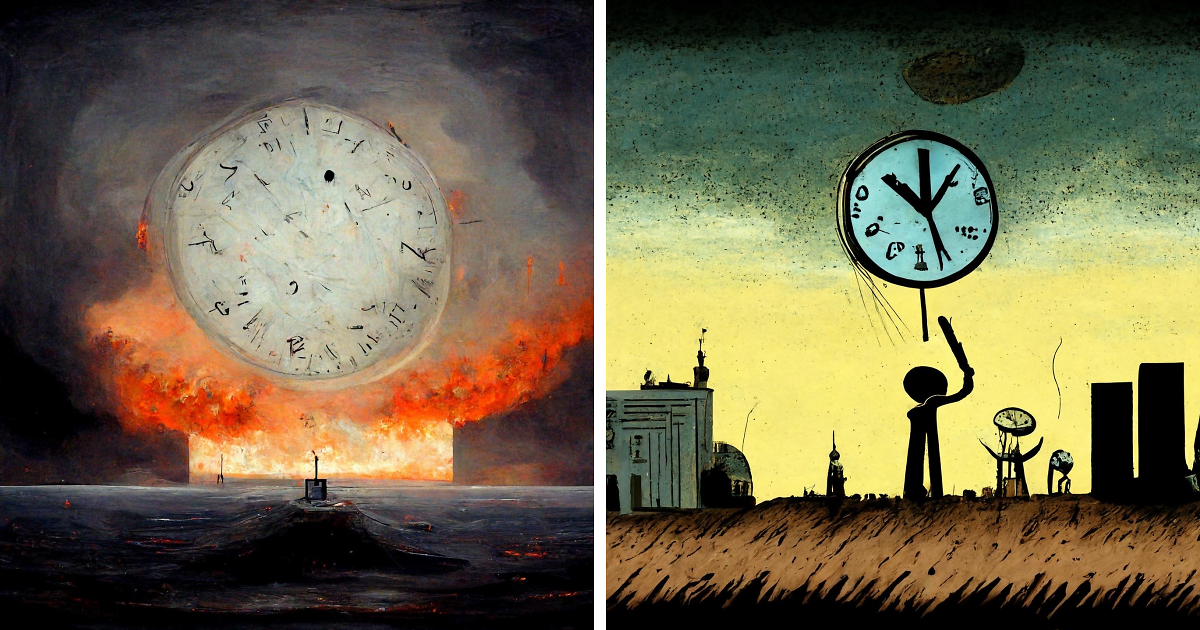
There are many respectable ways to use artificial intelligence. You can analyze spreadsheets, summarize research, or ask it to explain taxes without making your soul leave your body. I, however, decided to aim for something far stranger and much more fun: I used AI to help me create eight stories about the world’s last clock.
Not the last watch. Not the last alarm clock that still screams at 6:00 a.m. like a caffeinated rooster. I mean the final clock left in a world where timekeeping has become fragile, ceremonial, political, emotional, and maybe a little haunted. The premise grabbed me because clocks are never just machines. They are tiny tyrants, loyal historians, navigators, decorators, and, on bad Mondays, sworn enemies.
The idea of a “last clock” feels so rich because it sits at the crossroads of several real-world obsessions. Humans have built clocks to regulate cities, guide navigation, measure work, coordinate railroads, and now synchronize everything from markets to satellites. At the same time, we also use clocks as metaphors for civilizational risk and long-term survival. So when I asked AI to help me imagine the world’s last clock, I was really asking it to write about memory, control, collapse, hope, and that deeply human urge to keep counting even when the room is on metaphorical fire.
What followed was not a magic trick where a machine spit out eight perfect stories while I reclined like a Victorian aristocrat. It was messier than that, and far more interesting. AI was good at generating possibilities, weird turns, tonal variations, and structural prompts. It was much worse at taste. Left alone, it kept drifting toward shiny apocalypse clichés, dramatic fog, and endings that sounded like they were written by a motivational poster with trust issues. So I pushed back, edited hard, and turned the experiment into something useful: a study in AI storytelling, creative writing, and the weird beauty of the world’s last clock.
Why “The World’s Last Clock” Is Such a Good Story Engine
A strong premise does half the writing for you, and this one practically showed up wearing a tuxedo. “The world’s last clock” instantly raises questions. Who keeps it running? Who decides what time matters? Is it a sacred object, a scientific instrument, an antique nobody can repair, or a machine so advanced it makes everyone else look like they’re timing life with a potato?
It also carries a built-in contradiction. A clock is supposed to represent order. “The last” clock implies disorder everywhere else. That tension is delicious. You get civilization and collapse in the same image. You get precision standing in a room full of uncertainty. You get one brave little tick trying to hold the line against cosmic chaos, which is either inspiring or the saddest job description in history.
From a creative standpoint, the last clock can do almost anything. It can become science fiction, literary fiction, satire, dystopia, romance, folklore, or philosophical fantasy. It can live inside a mountain, a museum, a bunker, a church tower, a data center, or the kitchen of one extremely stubborn grandmother who refuses to let history end before dessert. That flexibility made it perfect for an AI-assisted writing experiment because I could test how the tool handled genre shifts while keeping the same symbolic center.
How I Used AI Without Letting It Turn the Piece Into Robot Oatmeal
I did not ask for “eight amazing stories” and hope for the best. That is how you get generic plots, suspiciously symmetrical paragraphs, and the same three adjectives wearing different hats. Instead, I treated AI like a brainstorming partner with infinite stamina and occasionally questionable judgment.
The rules I gave the machine
I asked for constraints. Every story needed a different genre, a different emotional core, and a different relationship to time. One had to be funny. One had to be intimate. One had to be mythic. One had to make the clock feel more like a witness than an object. That forced variety, which is essential because AI loves patterns the way a golden retriever loves tennis balls.
What AI did well
It generated angles quickly. It offered alternative stakes, unusual settings, and unexpected combinations. If I asked for “the last clock, but make it romantic,” it could produce five setups before my coffee cooled into a personality disorder. It was especially useful for helping me see how one central idea could branch into multiple story architectures.
Where AI needed adult supervision
It over-explained. It leaned on familiar end-of-the-world imagery. It occasionally forgot that mystery is more powerful than a five-paragraph lecture from a melancholy machine priest. Most of all, it needed a human to decide what was worth keeping. AI can multiply options; it cannot automatically supply taste, restraint, or emotional honesty. That part is still gloriously, stubbornly human.
The 8 Stories I Created With AI About the World’s Last Clock
1. The Caretaker in the Mountain
The first story imagined the world’s last clock buried inside a mountain, maintained by a lone caretaker who has inherited the role from generations of keepers. He does not own the clock so much as serve it. The twist is that he has never seen a city, a phone, or a digital screen. To him, the clock is not old technology. It is simply the center of reality.
AI helped me build the structure, but the emotional weight came when I rewrote the caretaker as a man who is terrified not of death, but of irrelevance. If the outside world has stopped caring about time, what exactly is he preserving? The story became less about machinery and more about duty. That made it breathe.
2. Noon for One City Only
This version was quieter and more civic. After a global systems failure, one city still organizes itself around a giant public clock in the old train station. Markets open when it rings. School begins when it rings. Weddings wait for it. Arguments end because of it. Naturally, everyone hates it and needs it at the same time, which is pretty much how humans treat any structure that keeps society from turning into a shopping cart on fire.
What I liked here was the social angle. The last clock was not a relic. It was infrastructure with feelings attached. AI gave me the skeleton, but I sharpened it by making the town resentful, dependent, and superstitious all at once.
3. The Museum of Lost Time
For the third story, I turned the premise elegiac. A museum curator maintains the world’s last working clock while surrounding it with silent ones: pocket watches, school bells, ship chronometers, kitchen timers, cracked wristwatches, and stopped mantel clocks from houses that no longer exist. Visitors come not to learn the time, but to remember that time once had textures.
This was one of the strongest concepts AI surfaced because it understood the visual logic immediately. But it still tried to make the curator too poetic, too polished. I roughened the edges. I let the character be funny, tired, and mildly annoyed by tourists who whisper like they’re visiting the ghost of punctuality.
4. The Child Who Had Never Heard Ticking
This one became unexpectedly tender. A child grows up in a future where time is ambient, invisible, and mostly handled by systems no one thinks about. Then she encounters the world’s last mechanical clock and becomes obsessed with the sound it makes. To her, ticking is not normal. It sounds alive.
The story worked because it inverted our assumptions. Adults in the story hear an old machine. The child hears a creature. AI was helpful in generating wonder-filled reactions, but I had to cut away a lot of sugary language. Once trimmed, the story found its real heart: technology becomes magical the moment culture forgets how it works.
5. Midnight Has a Complaints Department
I wanted one story to be openly comic, because not every apocalyptic premise needs to dress like it’s auditioning for prestige television. In this version, the world’s last clock is controlled by a bureaucracy that manages the official arrival of midnight. Citizens file paperwork to appeal delays, request extensions, or argue that existence should not end during tax season.
AI actually had a good instinct for absurd escalation here. It suggested forms, departments, procedural language, and cheerfully terrible slogans. I took those pieces and pushed the satire harder. The result felt less like “AI made a joke” and more like a real story about institutional logic gone berserk. Which, to be fair, is also just a story about institutions.
6. The Clock That Kept Scheduling the Dead
This story tilted darker. An old AI is connected to the world’s last clock and continues to run civil calendars long after many of the people in its system are gone. It keeps issuing reminders, anniversaries, and maintenance notices for lives that ended years earlier. The last clock keeps perfect time, but the society around it has become a graveyard of unresolved appointments.
Here the best move was restraint. AI wanted to explain the system architecture, the server stack, the recovery protocols, and probably the emotional journey of the motherboard. I ignored all that. The haunting part was simple: a machine still believes the world is operating normally. That was enough.
7. Eleven Fifty-Nine, Every Year
Then came the romance. Two people who once loved each other agree to meet once a year beneath the world’s last clock at 11:59 p.m. They do this for decades, even as the world around them changes. Sometimes they arrive bitter. Sometimes married to other people. Sometimes hopeful. Sometimes just curious whether the other one still remembers.
This story taught me an important lesson about AI storytelling: it can assemble emotional beats, but it tends to flatten longing into greeting-card language. I had to put the ache back in. I had to make silence matter. Once I did, the clock stopped being a prop and became a witness, which is exactly what a good symbolic object should do.
8. The Last Clock Was Never a Machine
The final story was my favorite because it broke the premise open. In this version, the world’s last clock turns out not to be a device at all, but a ritual shared by a community. At dusk, one person speaks the day, another names the season, another recites the dead, another announces the birth of the newest child, and the village marks time together with memory instead of gears.
AI did not arrive at this version cleanly. I had to wrestle it away from literalism. But once the idea emerged, everything clicked. The last clock was not about a final machine surviving catastrophe. It was about the final human agreement that time still matters because we say it does. That felt bigger, stranger, and truer than any metal object.
What This Experiment Taught Me About AI Storytelling
First, AI is excellent at ideation but unreliable at distinction. It can generate ten plausible premises before lunch, but plausibility is not the same as originality. The difference between a disposable idea and a memorable one usually appears during revision, when a human decides what to cut, what to sharpen, and what to leave unsaid.
Second, symbolism still needs a pulse. The world’s last clock is a great concept, but concept alone does not make story. Every version improved the moment I anchored it to something human: grief, bureaucracy, romance, childhood curiosity, duty, or communal memory. Without that, the premise stayed clever and emotionally underfed.
Third, AI works best when it is challenged. Better prompts helped, but better editing mattered even more. The strongest lines arrived only after I rejected the obvious ones. That is a useful reminder for anyone using generative AI writing tools: the machine is not your replacement. It is your unruly intern, your mirror, your improvisational partner, and occasionally your overconfident cousin who thinks every story needs fog.
Why Readers Love End-of-Time Objects
There is a reason stories keep returning to libraries, lighthouses, stations, towers, and clocks when the world starts to wobble. These objects promise continuity. They hold a line. They suggest that meaning can survive systems failure. The last clock is especially potent because time is the one thing nobody can stop, negotiate with, refinance, or leave on read.
That makes the symbol feel paradoxical in the best way. A clock measures what cannot be owned. It imposes order on what remains wild. And when you call it the world’s last clock, you are really asking a larger question: what is the final structure humans will defend when everything else gets stripped away?
My answer, after eight stories and one highly caffeinated creative session, is this: it will not just be the object. It will be the meaning around the object. People do not protect clocks because brass is exciting. They protect them because clocks carry agreements. Meet me here. Work starts now. The train leaves then. We remember this date. We survived until morning. That is what the last clock holds together.
My Longer Experience Creating These AI Stories
What surprised me most about creating these eight stories was how quickly the project stopped feeling like a gimmick and started feeling like an argument with time itself. At first, I thought I was just testing a neat premise. I expected a playful writing exercise, maybe a few eerie scenes, maybe one or two concepts worth saving. Instead, the repetition of the image changed the way I thought. Every time I returned to the phrase “the world’s last clock,” it opened a different emotional door. In one draft, the clock was a monument. In another, it was a burden. In another, it was almost a joke, like the universe had decided to leave one tiny manager behind to supervise the collapse. The more variations I built, the more I realized the clock was behaving like a prism. The machine never changed, but the meaning did.
The AI part of the process was both useful and humbling. Useful because it gave me velocity. I could test tones, structures, and genres in minutes instead of spending half a day wandering around an idea like a Victorian detective with poor lighting. Humbling because speed is not the same thing as insight. Some of the machine-generated material sounded polished right away, but when I looked closer, it often lacked friction. It knew how to sound like a story before it knew how to be one. That distinction matters. A real story has residue. It leaves behind a question, a discomfort, a specific image, a strange line you keep turning over later while washing dishes. Smoothness alone does not do that.
I also noticed that the more personal I became, the better the work got. When I allowed my own weirdness into the draft, everything improved. The caretaker got funnier. The lovers became sadder in a more believable way. The bureaucratic midnight story became sharper because I let it sound irritated instead of merely clever. AI could help me open doors, but I still had to decide which room had air in it. That is the part nobody should casually outsource.
And maybe that is why this topic lingered with me after the writing was done. The world’s last clock is not only a dramatic image. It is a creative test. If a machine can help us generate endless possibilities, what will make one version matter more than another? The answer, I think, is judgment. Human judgment. Human specificity. Human refusal to settle for the first shiny sentence that arrives wearing expensive shoes.
By the end of the experiment, I did not feel like AI had written eight stories for me. I felt like I had held eight conversations with an unpredictable tool and then carved something human out of the noise. That, to me, is the most honest version of AI storytelling right now. It is not pure automation. It is not pure originality either. It is a collaboration full of temptation, shortcuts, happy accidents, bad instincts, and occasional sparks. A lot like writing itself, honestly.
And the clock? It stayed with me. Not because it was the last machine standing, but because it represented the last shared rhythm. The final agreement that moments still count. The last audible proof that someone, somewhere, is still listening for the next second. That is a beautiful image. It is also a challenge. If we are lucky, the world’s last clock will never need to exist. But as a story device, it is unforgettable. It reminds us that even in an age of generative tools, infinite content, and algorithmic speed, the things we treasure most are still the things that give shape to human time.
Final Thoughts
Creating eight AI stories about the world’s last clock taught me that the best use of generative AI is not surrender. It is collaboration with standards. The machine can suggest, remix, and provoke. The writer still has to choose, sculpt, reject, and mean it. That is where the real work lives.
So yes, I created eight stories with AI about the world’s last clock. But more accurately, I used AI to test eight ways humans might respond when the final instrument of order is still ticking. Some would worship it. Some would bureaucratize it. Some would fall in love under it. Some would rebuild community around it. And one child, somewhere, would hear that ticking for the first time and ask the best question of all: is it alive?