Red peppers are already charming little overachievers. They are sweet, colorful, and suspiciously good at making an ordinary sandwich feel fancy. But once you roast them, they become something else entirely: softer, smokier, sweeter, and much more dramatic. The skin blisters, the flesh relaxes, and suddenly you have an ingredient that can slide into pasta, salads, soups, grain bowls, omelets, dips, and a heroic number of last-minute appetizers.
If you have ever bought a jar of roasted red peppers and thought, “These are nice, but why do they cost the same as my emotional stability?” the good news is that making them at home is simple. You do not need a culinary degree, a wood-fired oven, or a dramatic soundtrack. You just need fresh red bell peppers, high heat, a little patience, and the willingness to let vegetables get gloriously charred.
This guide walks you through exactly how to roast red peppers, how to peel them without losing your mind, how to store them safely, and how to use them once they are tender and irresistible. By the end, you will be the kind of person who casually says, “Oh, these? I roasted them myself,” which is a deeply satisfying sentence.
Why Roast Red Peppers in the First Place?
Roasting transforms red bell peppers in all the best ways. Their natural sugars become more pronounced, their texture turns silky, and the light bitterness of the raw skin gives way to a mellow, smoky flavor. In short, roasting adds depth. A raw red pepper is bright and crisp. A roasted red pepper is rich, soft, and ready to make every dish taste like you planned ahead.
They are also wildly practical. Once roasted, red peppers can be chopped into sauces, layered into sandwiches, folded into hummus, blended into soup, or marinated in olive oil with garlic and herbs. They are one of those make-ahead ingredients that help dinner come together fast without tasting lazy. That is a strong quality in any vegetable.
Choose the Best Peppers Before You Roast
Start with firm, glossy red bell peppers that feel heavy for their size. Look for smooth skin, bright color, and fresh-looking green stems. Avoid peppers that are wrinkled, soft, bruised, or collapsing into a small emotional crisis in the produce aisle. If the pepper feels sturdy, it is probably a good candidate for roasting.
Wash the peppers under running water and dry them well. Do not use soap. That is a cleaning strategy for countertops, not dinner. Dry peppers roast better because excess moisture can slow blistering and make the skin take longer to char.
What You Need
You do not need much equipment, which is excellent news for anyone whose kitchen drawers already contain nine utensils they cannot identify.
Basic tools
A baking sheet, tongs, a knife, a cutting board, and a bowl with a lid or foil are enough for the oven method. If you are using a broiler, stovetop flame, or grill, tongs become even more important because fingertips are not approved roasting equipment.
Optional but helpful
Parchment paper or foil makes cleanup easier. A glass or ceramic bowl helps with steaming. A small container for storing the finished peppers is useful if you somehow manage not to eat them all immediately over the sink.
How to Roast Red Peppers in the Oven
The oven method is the easiest, most reliable option for most home cooks. It works whether you are roasting a couple of peppers for lunch prep or a whole tray for the week ahead.
Step 1: Prep the peppers
You can roast red peppers whole or halved. Whole peppers work well if you want a more classic char-and-peel process. Halved peppers are easier to manage and usually roast a bit faster. For most kitchens, halved peppers are the friendlier choice.
To prep them, cut each pepper in half from top to bottom. Remove the stem, seeds, and white membranes. Flatten the halves slightly with your hand if needed. Place them skin-side up on a lined baking sheet. A light rub of oil is optional. Some cooks add a little oil to help the skins blister faster, while others skip it. Either way works.
Step 2: Roast until charred
Preheat the oven to 450 to 500 degrees Fahrenheit. Roast the peppers until the skins are blackened, blistered, and wrinkled. Depending on your oven, this usually takes about 20 to 30 minutes for halved peppers and a little longer for whole ones. If roasting whole peppers, turn them occasionally so they char on all sides.
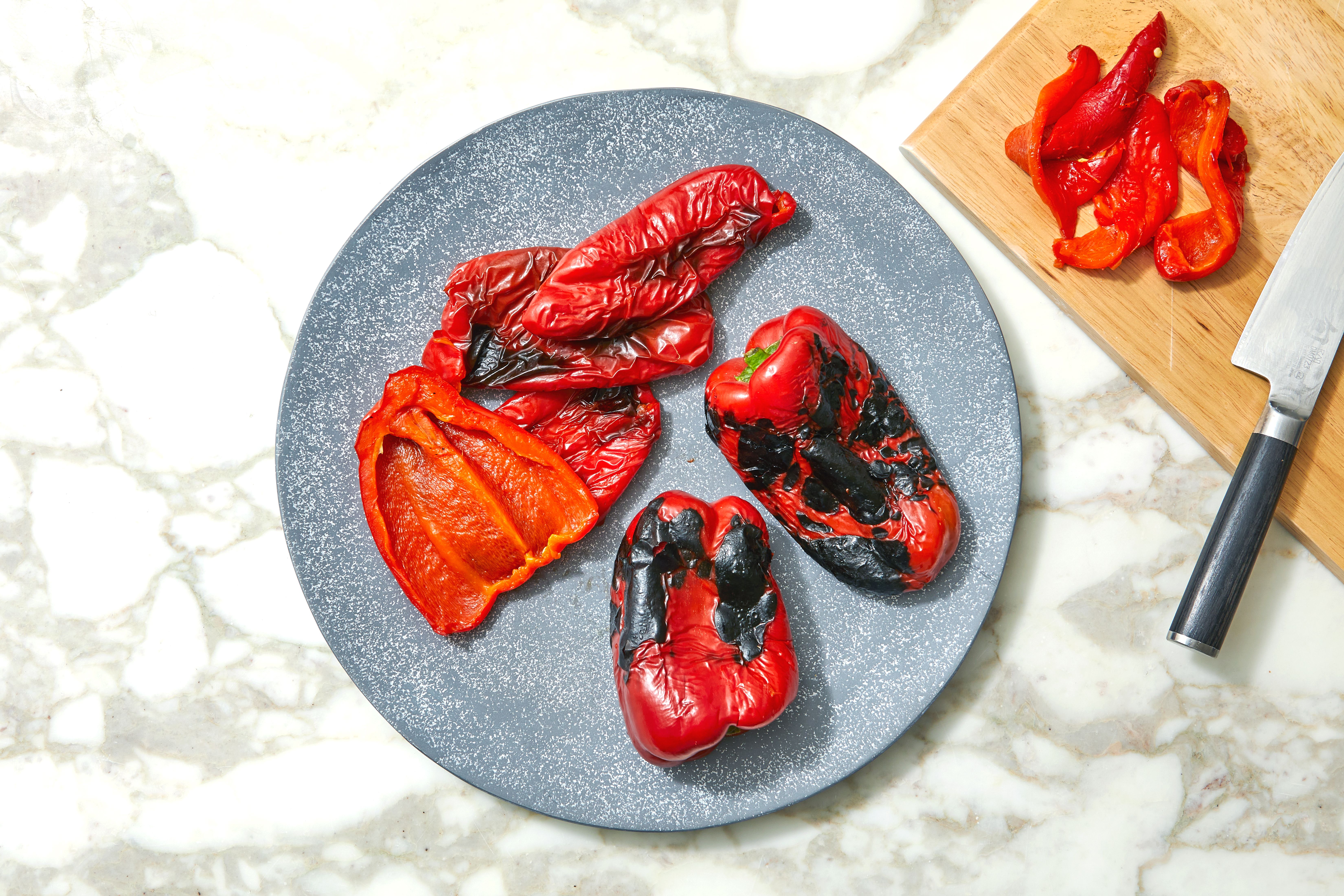
The key here is not “lightly tanned.” You want real blistering. Pale, timid skin will not peel well. Deep char is your friend. The flesh underneath will stay soft and sweet, so let the skins get properly dramatic.
Step 3: Steam the peppers
As soon as the peppers come out of the oven, transfer them to a bowl and cover tightly, or cover the baking sheet with foil. Let them sit for 10 to 20 minutes. This steaming step loosens the skin and makes peeling much easier. Skip it, and you may spend the next fifteen minutes negotiating with a pepper that refuses to cooperate.
Step 4: Peel and clean
Once the peppers are cool enough to handle, peel off the charred skin with your fingers. It should slip away easily. A little stubbornness is normal, and a few tiny bits of blackened skin left behind are not a tragedy. In fact, they add a little smoky flavor. If needed, use the back of a knife to gently scrape off patches that cling.
Remove any remaining seeds or membrane, then slice the peppers into strips or chop them as needed. Save the juices that collect in the bowl. That liquid is full of pepper flavor and deserves better than the sink.
How to Roast Red Peppers Under the Broiler
If your broiler runs hot and fierce, it may be the fastest route to roasted red peppers. Place halved peppers skin-side up on a baking sheet and position them several inches below the broiler. Broil until the skins are blackened and blistered, usually around 10 to 15 minutes, depending on your oven.
After broiling, follow the same steaming and peeling process. This method is great when you want serious char without heating the whole oven for long. Just keep an eye on the peppers, because broilers can go from “perfectly blistered” to “why is there smoke in my kitchen?” with impressive speed.
How to Roast Red Peppers on a Gas Stove or Grill
For maximum smoky flavor, roast peppers directly over a gas flame or on a hot grill. On a gas stove, place whole peppers directly over the flame and turn them with tongs as each side blackens. On a grill, lay them over high heat and rotate until the skins are charred all over and the flesh has softened.
Once fully blistered, move the peppers to a covered bowl so they can steam. Then peel, seed, and slice. This method gives the peppers a slightly deeper smokiness than the oven method, which is excellent if you plan to use them in sauces, dips, or Mediterranean-style dishes.
Common Mistakes That Make Roasted Peppers Less Wonderful
Not roasting them enough
If the skin is only lightly browned, peeling becomes annoying. Let the surface blister and blacken properly.
Skipping the steaming step
Steaming is what loosens the skin. Without it, peeling turns into a tedious side quest nobody asked for.
Rinsing them too aggressively
Some cooks rinse peppers under water to remove skin and seeds. A quick rinse is fine if truly needed, but too much water washes away flavor. Peeling with your hands is usually better.
Overcrowding the pan
Peppers need space so heat can circulate. If they are piled together, they steam before they roast. That is not the assignment.
Storing them while still warm
Cool roasted peppers promptly, then refrigerate them. Warm, covered food lingering on the counter for too long is not the kind of adventure you want.
How to Store Roasted Red Peppers
If you are using the peppers soon, place them in an airtight container in the refrigerator. A little olive oil, a splash of vinegar or lemon juice, and a pinch of salt can help turn them into an easy marinated side dish. For everyday home cooking, small batches are smartest.
If you make more than you can use in a few days, freeze them. Lay peeled pepper strips on a parchment-lined tray, freeze until firm, then transfer to a freezer-safe bag or container. This keeps them from freezing into one giant pepper brick. Frozen roasted red peppers work beautifully in soups, sauces, pasta, and cooked dishes.
If you want to can roasted peppers for shelf storage, use a tested preservation recipe designed for safe home canning. Peppers are low-acid foods, so this is not an area for improvisation or optimistic guesswork. When in doubt, refrigerate or freeze.
Best Ways to Use Roasted Red Peppers
Now for the fun part. Roasted red peppers are the culinary equivalent of a friend who gets along with everyone.
Blend them into sauces
Puree roasted peppers with olive oil, garlic, nuts, or a little cream for a fast pasta sauce, soup base, or sandwich spread.
Add them to sandwiches and wraps
Layer them with mozzarella, turkey, grilled chicken, tuna, or hummus. They bring moisture and flavor without overwhelming everything else.
Fold them into eggs
Chop roasted peppers into scrambled eggs, frittatas, quiches, or omelets. Breakfast deserves some sparkle.
Toss them into grain bowls and salads
They pair beautifully with farro, rice, couscous, quinoa, feta, olives, chickpeas, and fresh herbs.
Build dips and spreads
Roasted red peppers are classic in hummus, muhammara-style dips, romesco-inspired sauces, and creamy party spreads that make crackers very happy.
What Roasting Red Peppers Feels Like in Real Life
There is the technical side of how to roast red peppers, and then there is the human side, which usually begins with confidence and ends with someone saying, “I think the kitchen smells amazing, but also… is that smoke?” The first time you roast red peppers, the process feels slightly rebellious. Every instinct tells you not to let food turn black. Then you learn that this is one of those magical kitchen moments where “a little burned” is not failure. It is progress.
One of the most satisfying parts is the transformation itself. Raw peppers are crisp and squeaky. Roasted peppers collapse into silky ribbons that look like they belong on a fancy antipasto platter. When the skins loosen and slide off in one piece, you feel like a genius. When they come off in twenty-seven tiny fragments, you feel like a normal person making dinner on a Tuesday. Both experiences are valid.
Roasting peppers also teaches patience in a sneaky way. You cannot rush the char. You cannot bully the skin off too early. You have to roast, cover, wait, and then peel. It is a good reminder that some kitchen tasks only become easy after you stop poking at them every twelve seconds. The peppers, like many of us, need a moment.
There is also a practical pleasure in seeing how far a batch goes. Four or five peppers can turn into sandwich fillings, pasta sauce, salad toppings, omelet mix-ins, and snack plates over the next few days. A fridge container of homemade roasted red peppers creates an immediate illusion that you are organized, thoughtful, and possibly the kind of person who owns matching storage jars. Even if your real life includes mismatched lids and one mysterious spoon that appears in every drawer, the peppers still make you look capable.
Then there is the flavor payoff. Homemade roasted red peppers taste fresher and fuller than many store-bought versions. They keep some body, some sweetness, and a little personality. Jarred peppers are convenient, and there is no shame in that game, but homemade peppers have a softer texture and brighter flavor that can make a simple dish feel much more alive. Spread them on toast with goat cheese, pile them onto a burger, or blend them into soup, and suddenly your leftovers are no longer leftovers. They are a plan.
Perhaps the best experience tied to roasting red peppers is that it becomes easier every time. After one or two batches, you stop treating the process like a chemistry exam and start treating it like what it really is: a useful, forgiving kitchen skill. The char looks less alarming. The peeling goes faster. You start making extras on purpose. And then, before you know it, you are the person telling someone else, very calmly, “No, no, let them get blacker. Trust me.”
Conclusion
Learning how to roast red peppers is one of those small kitchen skills with a surprisingly big payoff. It is simple, inexpensive, and flexible, yet it adds serious flavor to everyday meals. Whether you roast them in the oven, under the broiler, on the grill, or over a gas flame, the method is the same at heart: blister the skin, steam the peppers, peel them, and enjoy the sweet, smoky result.
Once you get comfortable with the process, roasted red peppers become less of a recipe and more of a habit. A very delicious habit. The kind that makes lunch better, dinner easier, and your refrigerator look much more competent than it did yesterday.