Trying to predict the exact bottom of a bear market is a little like trying to catch a falling knife while wearing oven mitts: technically possible, but not the sort of hobby most people should brag about. Still, investors naturally want to know the answer to one big question: How long does it take for stocks to bottom in a bear market?
The short answer is that most bear markets take several months to a little over a year to reach their lowest point, but history is annoyingly inconsistent. Some bottoms arrive in a flash, like the 2020 pandemic crash. Others drag on long enough to make every market commentator sound like a weather reporter standing in a hurricane. The better answer is this: the time it takes for stocks to bottom depends on the cause of the bear market, the economy, interest rates, investor sentiment, earnings expectations, and whether a recession is involved.
In this guide, we will break down historical bear market duration, what usually happens before a stock market bottom, why recessions change the timeline, and how everyday investors can avoid making emotional decisions at exactly the wrong moment.
What Is a Bear Market?
A bear market is commonly defined as a decline of 20% or more from a recent high in a major stock index such as the S&P 500, Dow Jones Industrial Average, or Nasdaq Composite. It is more severe than a normal correction, which is usually a drop of 10% to 20%.
Bear markets are not rare. They are part of the stock market cycle, just as bull markets, corrections, rallies, and awkward financial-TV debates are part of investing life. Historically, U.S. stocks have entered bear market territory every several years on average. That does not mean they arrive on schedule. The market does not send a polite calendar invite saying, “Bear market begins Tuesday, snacks provided.”
A bear market can happen because of many triggers: high inflation, rising interest rates, recession fears, banking stress, speculative bubbles, geopolitical shocks, collapsing earnings, or sudden events like a pandemic. The trigger matters because it often determines how quickly stocks find a bottom.
So, How Long Does It Take For Stocks to Bottom in a Bear Market?
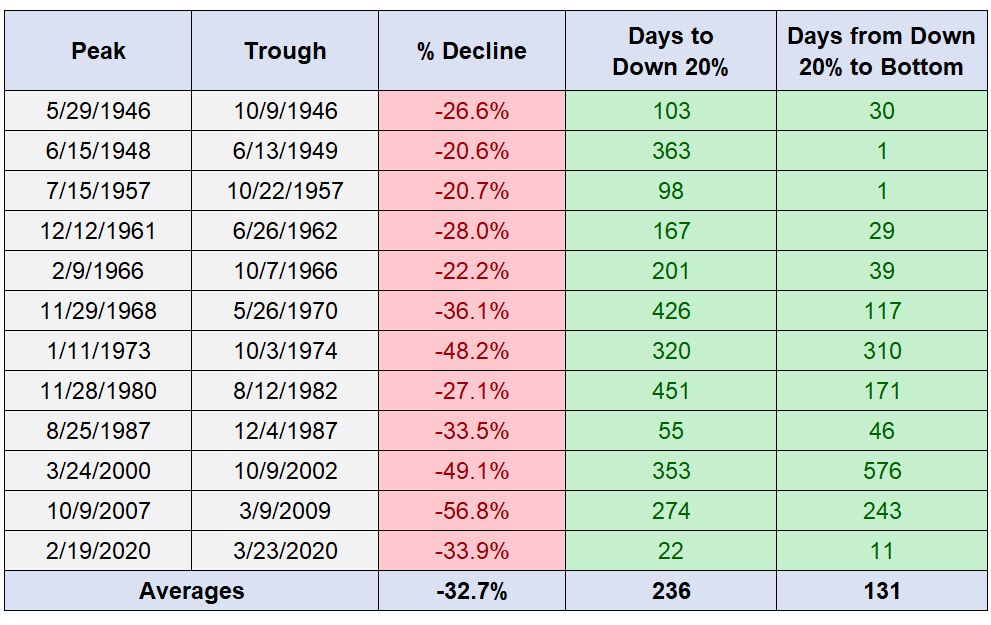
Historical studies vary depending on the starting year, index, and definition used, but a practical range is this: many S&P 500 bear markets have taken about 9 to 17 months from peak to bottom. Some data sets show an average bear market length of roughly 9.6 to 14 months. Other longer-term studies, especially those including the Great Depression and early-20th-century downturns, show deeper and longer averages.
That wide range is the point. Averages are useful, but they can be deceptive. If one person spends one minute in a cold shower and another spends 60 minutes in a snowstorm, the average may look manageable. The lived experience is very different.
Typical Historical Pattern
In many modern bear markets, stocks do not fall in a straight line. The path usually looks like this:
- Stocks decline sharply from a high.
- Investors hope the drop is only a correction.
- Bad economic or earnings news confirms deeper trouble.
- Stocks rally, then fall again.
- Sentiment becomes extremely negative.
- The market bottoms before the headlines feel better.
That last point is crucial. Stocks often bottom before the economy looks healthy. Markets are forward-looking. They tend to move based on what investors expect six to twelve months ahead, not what everyone feels today while doom-scrolling financial news at midnight.
Famous Bear Market Bottoms: Real Examples
The 2020 Pandemic Bear Market: A Bottom in Weeks
The 2020 COVID-19 bear market was one of the fastest in modern history. The S&P 500 fell from its February 2020 high to its March 2020 low in just over a month. The decline was violent, emotional, and globally synchronized. Then, almost as quickly, massive fiscal stimulus, Federal Reserve support, and investor expectations of reopening helped stocks rebound.
This example proves that some bear markets can bottom very quickly when the cause is sudden, visible, and met with aggressive policy action. It also proves that waiting for everyone to feel comfortable can be expensive. By the time the mood improved, much of the recovery had already happened.
The 2022 Bear Market: A Slower Inflation Shock
The 2022 bear market was different. The S&P 500 peaked in early January 2022 and reached its low in October 2022, a decline of about nine to ten months. The main pressure came from inflation, rapid Federal Reserve rate hikes, recession fears, and falling valuations after years of easy money.
This was not a one-day panic. It was a grind. Investors had to process higher mortgage rates, falling bond prices, weaker growth expectations, and the uncomfortable discovery that “buy the dip” does not always work by lunchtime. The bottom formed only after markets began to believe inflation might eventually cool and the economy might avoid a severe recession.
The 2007–2009 Financial Crisis: A Long, Painful Bottom
The global financial crisis was a classic recession-driven bear market. From the 2007 peak to the March 2009 low, the S&P 500 lost more than half its value. The bottom took roughly 17 months to form. Banks were under stress, credit markets froze, unemployment rose, and investors feared the financial system itself was wobbling.
Deep recessionary bear markets often take longer because investors are not just repricing stocks. They are questioning earnings, balance sheets, credit availability, consumer demand, and sometimes the plumbing of the financial system. When the house is on fire, people do not argue about paint colors.
The Dot-Com Bust: When Valuations Need Years to Heal
The 2000–2002 bear market followed the bursting of the dot-com bubble. The S&P 500 lost nearly half its value, while technology-heavy indexes fell even more dramatically. This bottom took about two and a half years to fully develop.
Structural bear markets caused by excessive speculation can last longer because the market must unwind unrealistic expectations. Companies with no profits, no cash flow, and business plans written in glitter pen eventually face reality. When valuations begin from extreme levels, the correction can be both brutal and slow.
Why Some Bear Markets Bottom Quickly and Others Drag On
1. Recession or No Recession?
One of the biggest factors is whether the bear market is tied to a recession. Non-recession bear markets can be shorter because corporate earnings may remain relatively stable. Recessionary bear markets usually take longer because profits fall, unemployment rises, and investors demand lower prices to compensate for uncertainty.
The market often bottoms before the recession officially ends. That surprises many investors. Economic data is usually backward-looking, while stock prices are forward-looking. By the time the official recession end date is announced, stocks may already be well above their lows.
2. Federal Reserve Policy
Interest rates matter. When the Federal Reserve is raising rates to fight inflation, stock market bottoms can take longer because higher rates pressure valuations and slow economic activity. When the Fed cuts rates or signals easier policy, investors may start looking ahead to recovery.
This does not mean every Fed pivot instantly creates a bull market. Sometimes rate cuts happen because the economy is weakening fast. But a shift in monetary policy can change market psychology, especially when investors believe the worst inflation or credit stress is passing.
3. Earnings Expectations
Stock prices ultimately depend on earnings and what investors are willing to pay for those earnings. Bear markets often bottom when earnings expectations stop falling or when investors believe the bad news is already priced in.
Notice the wording: “believe.” Markets do not wait for perfect confirmation. They move when expectations change. This is why stocks can rally on news that still sounds bad, as long as it is less bad than feared. Wall Street is strange that way. It will throw a party because the roof is leaking slightly less than expected.
4. Investor Sentiment
Bear market bottoms often occur when pessimism is extreme. Surveys show fear. Fund flows move toward cash. Headlines become dramatic. People who ignored risk during the bull market suddenly become experts in canned food, gold bars, and bunker architecture.
Extreme pessimism does not guarantee a bottom, but it can create the conditions for one. When nearly everyone who wanted to sell has already sold, even modest good news can spark a powerful rally.
5. Valuation
High starting valuations can make bear markets last longer because prices need to fall enough to become attractive again. Low or reasonable valuations can help markets stabilize sooner. Valuation is not a timing tool by itself, but it matters for long-term returns.
In simple terms, if investors were paying luxury-hotel prices for motel-level earnings, the adjustment may take time. The stock market can forgive many things, but eventually it asks to see the receipt.
Can Investors Predict the Exact Bottom?
No one can reliably predict the exact stock market bottom. Some professionals get it right occasionally, but doing it consistently is extraordinarily difficult. Bottoms are usually visible only in hindsight. The day of the low often feels terrible, not inspiring. There is rarely a marching band, a banner, or a friendly email saying, “Congratulations, this was the bottom.”
Even worse, bear markets produce sharp rallies that can fool investors. These are often called bear market rallies. A major index may jump 5%, 10%, or even more before falling again. That is why trying to time the precise low can lead to frustration and missed opportunities.
Signs That a Bear Market May Be Nearing a Bottom
Although nobody can know the exact bottom in advance, investors can watch for clues. These signals are not guarantees, but they can help build perspective.
Capitulation Selling
Capitulation happens when investors give up and sell in panic. Volume may surge, volatility may spike, and sentiment may become extremely negative. This can mark a turning point, but sometimes markets experience more than one wave of capitulation.
Improving Market Breadth
Market breadth measures how many stocks participate in a move. A healthier bottom often forms when more stocks begin rising, not just a handful of mega-cap names. Broad participation suggests investors are gaining confidence beyond the safest corners of the market.
Stabilizing Credit Markets
Credit markets often reveal stress before stocks do. If corporate bond spreads stop widening and liquidity improves, it may indicate that systemic fear is easing. In recessionary bear markets, this can be especially important.
Inflation or Rate Pressure Eases
If inflation is the main cause of the bear market, signs of cooling inflation can help stocks stabilize. If interest-rate expectations stop rising, valuations may become less pressured.
Bad News Stops Moving Stocks Lower
One of the more subtle signs of a possible bottom is when bad news no longer pushes stocks meaningfully lower. That can mean investors have already priced in a large amount of pain.
What Should Long-Term Investors Do During a Bear Market?
The best strategy depends on age, goals, risk tolerance, cash needs, and portfolio design. Still, several principles have historically helped investors navigate bear markets without turning their brokerage account into an emotional escape room.
Review Your Time Horizon
Money needed within the next few years should not be heavily exposed to stocks. Bear markets are painful because they remind investors that stocks are long-term assets. If your time horizon is ten, twenty, or thirty years, a bear market may be uncomfortable but not necessarily destructive.
Rebalance Instead of Reacting
Rebalancing means adjusting your portfolio back to your target allocation. If stocks fall sharply, rebalancing may involve buying stocks when they are cheaper. This is emotionally difficult but financially disciplined.
Use Dollar-Cost Averaging
Dollar-cost averaging means investing a fixed amount regularly, regardless of market conditions. It does not guarantee profits or prevent losses, but it removes the pressure to identify the perfect bottom. During bear markets, it can help investors buy more shares at lower prices.
Keep Cash for Real Life
An emergency fund is not boring. It is a financial seat belt. Having cash available can prevent investors from selling stocks at depressed prices to cover unexpected expenses.
Avoid All-or-Nothing Decisions
Going completely to cash may feel safe, but it creates a second problem: deciding when to get back in. Many of the market’s strongest days happen near the worst periods, and missing them can damage long-term returns. A balanced plan usually beats dramatic guessing.
How Long Does Recovery Take After the Bottom?
Bottoming is not the same as full recovery. A stock market bottom is the lowest point of the decline. Full recovery means the market climbs back to its previous high. That can take months or years.
For example, the 2020 market recovered quickly. The 2007–2009 financial crisis took much longer. The dot-com bust was even more painful for technology investors, especially those concentrated in overvalued growth stocks.
This is why diversification matters. A broad portfolio may recover differently than a concentrated bet on one sector. Investors who owned only the hottest technology names in 2000 had a very different experience from investors with diversified exposure across sectors and asset classes.
The Practical Answer: Expect Months, Prepare for Years
If you want a practical rule of thumb, here it is: stocks often take around 9 to 14 months to bottom in a bear market, but investors should prepare for the possibility of a longer downturn. The average is helpful, but planning only for the average is risky.
A better mindset is to build a portfolio that can survive multiple outcomes. Maybe the bear market bottoms quickly. Maybe it grinds lower for a year. Maybe recession fears fade. Maybe earnings fall harder than expected. The goal is not to predict every twist. The goal is to avoid being forced into bad decisions when volatility is high.
Experience Notes: What Bear Market Bottoms Feel Like in Real Life
Here is the uncomfortable truth about bear market bottoms: they rarely feel like opportunities while they are happening. They feel like confusion wrapped in anxiety, sprinkled with headlines written in emergency-room lighting. Investors imagine that when stocks bottom, they will feel calm, wise, and ready. In reality, bottoms often arrive when people are exhausted, skeptical, and tired of hearing the phrase “uncertain outlook.”
One common experience during a bear market is the temptation to wait for clarity. That sounds reasonable. Who would not want clarity? The problem is that markets usually recover before clarity arrives. In 2009, investors were still worried about banks, housing, unemployment, and the economy when stocks began to rebound. In 2020, the market recovered while the pandemic was still dominating daily life. In 2022, stocks turned before every inflation and interest-rate concern had disappeared.
Another experience is the emotional trap of checking your portfolio too often. Looking once a quarter can feel like responsible monitoring. Looking twelve times a day can feel like being trapped in an elevator with a very pessimistic accountant. Frequent checking makes normal volatility feel personal. It can push investors toward action even when no action is needed.
Bear markets also reveal whether an investor’s risk tolerance was real or imaginary. During bull markets, nearly everyone says they are long-term investors. It is easy to be brave when the chart goes up and to the right. The real test comes when a portfolio is down 20%, the news is ugly, and cash suddenly looks as glamorous as a beachfront mansion. That is when a written investment plan becomes valuable. It gives you something to follow when your emotions start improvising.
A practical experience-based approach is to separate decisions into categories. First, decide what money must remain safe for short-term needs. That belongs in cash or conservative assets, not in stocks. Second, decide what money is truly long-term. That portion can usually tolerate bear market volatility better. Third, decide in advance how you will add money during downturns. For example, some investors increase contributions gradually as markets decline. Others rebalance on a schedule. The specific method matters less than having a method before panic arrives.
It also helps to remember that bear markets are not only tests of courage; they are tests of patience. A bottom may form quickly, but confidence often rebuilds slowly. Investors who expect an instant return to easy gains may become frustrated. Markets can bounce, retest lows, move sideways, and confuse everyone for months. That does not mean the plan is broken. It means the market is doing what markets do: transferring money from the impatient to the patient, usually while making a lot of noise.
The best experience lesson is simple: you do not need to buy the exact bottom to succeed. Buying near reasonable valuations, staying diversified, avoiding panic selling, and continuing to invest through cycles can matter more than nailing one magical date. The bottom is obvious only after the fact. Discipline is useful before it.
Conclusion
So, how long does it take for stocks to bottom in a bear market? Historically, many bear markets have bottomed within several months to a little over a year, with common averages clustering around 9 to 14 months depending on the data set. But the real answer depends on the cause. Event-driven bear markets can bottom fast. Inflation and rate-driven bear markets may take longer. Recessionary and structural bear markets can drag on for years.
Investors should avoid treating averages as promises. The market is not a vending machine where you insert historical data and receive a perfectly timed bottom. A smarter approach is to stay diversified, maintain enough cash, rebalance thoughtfully, and keep investing decisions tied to long-term goals rather than short-term fear.
Note: This article is for educational purposes only and should not be considered personal financial advice. Investors should consider their own goals, risk tolerance, and financial situation before making investment decisions.