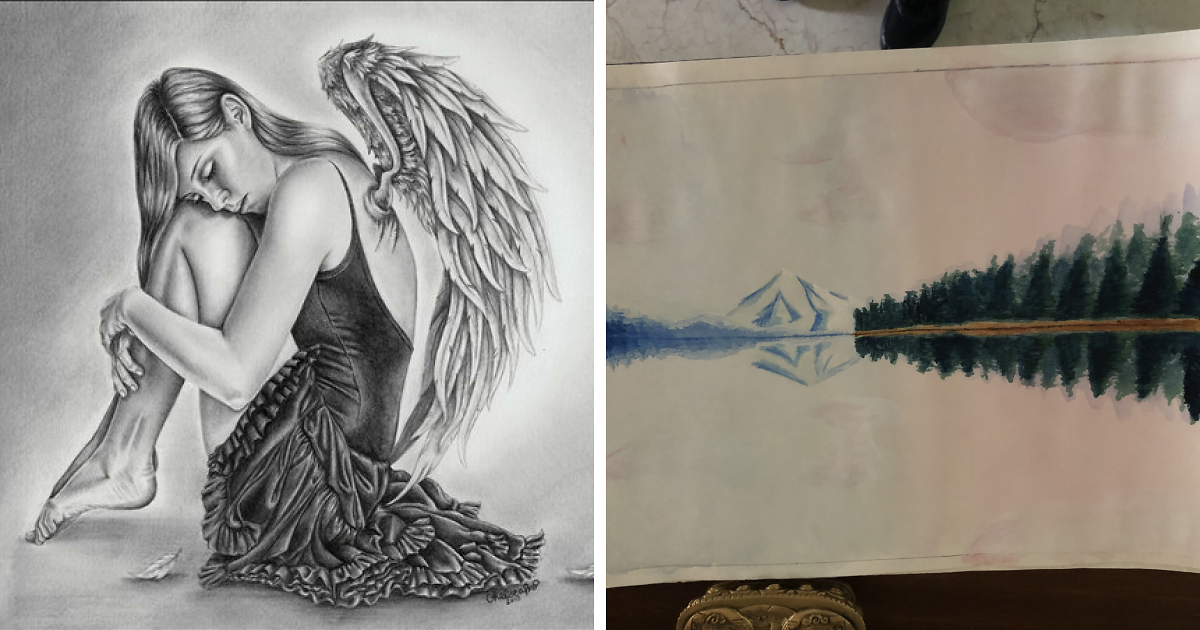
Somewhere in your home, there may be a drawing tucked inside a notebook, a slightly crooked ceramic bowl on a shelf, or a photograph buried beneath 8,000 pictures of pets and accidental screenshots. It may never hang in a museum. A critic may never describe it as “a bold interrogation of contemporary identity.” Still, you look at it and think, I made thatand I’m genuinely proud of it.
That feeling matters. Creative pride is not reserved for professional painters, bestselling authors, gallery photographers, or people who own more brushes than socks. Art can be a pencil portrait, a handmade costume, a quilt, a decorated cake, a digital illustration, a song, a sculpture assembled from discarded objects, or a tiny cartoon created during a meeting that absolutely should have been an email.
So, Pandas, what is one piece of art you made that still makes you smile? More importantly, what is the story behind it?
Why This Question Is More Powerful Than It Looks
Asking someone to share a piece of art they are proud of does more than invite a photograph. It invites a story about patience, risk, memory, experimentation, identity, or persistence. The finished object is only the visible part. Behind it may be weeks of practice, a difficult year, a new skill, a meaningful relationship, or one memorable afternoon when the glue behaved itself for once.
People often judge their creative work by comparing it with the polished work of experienced artists. That is an unfair contest. A beginner’s first watercolor is not competing with a museum collection. Its real comparison is the blank page that existed before it.
Reflection can help people recognize progress and develop a stronger sense of ownership over what they have made. Educational resources also emphasize that publicly sharing creative projects can help makers explain their process, celebrate what they learned, and take pride in their accomplishments.
What Counts as Art Worth Being Proud Of?
The easiest answer is: anything you intentionally created that means something to you. Art does not need a price tag, a frame, or a dramatic artist statement involving the phrase “liminal space.” It simply needs evidence of your imagination and effort.
Your First Successful Attempt
First attempts are rarely flawless, but they carry a special kind of energy. Perhaps you painted a landscape after years of saying you could not draw. Maybe you crocheted a scarf that gradually became wider at one end, creating what fashion experts might call “unexpected geometry.” You still finished it. That completion can be worth more than technical perfection.
A Piece That Captured a Memory
Art often becomes a container for moments that ordinary photographs cannot fully hold. A sketch of a childhood kitchen may preserve the feeling of Sunday mornings. A handmade scrapbook may document a friendship. A song may capture emotions that were difficult to explain in regular conversation.
Artists frequently describe creating art as a way to record fragments of memory, communicate feelings, build connections, have fun, and say things that cannot easily be expressed in another form.
A Technical Breakthrough
Sometimes pride comes from finally understanding a difficult technique. Perhaps you learned how to shade a face without making it appear as though it had been illuminated by five unrelated suns. Maybe you mastered perspective, wheel-thrown pottery, embroidery, photo editing, wood carving, or digital animation.
The result does not have to be your most emotionally significant work. It can simply be the moment your hands finally understood what your brain had been trying to explain.
A Gift Made for Someone Else
Handmade gifts are deeply personal because they contain something store-bought objects cannot: visible time. A portrait of a beloved pet, a painted jacket, a hand-bound book, or a family recipe illustrated in ink may be imperfect, but it carries attention and affection in every detail.
In these cases, the recipient’s reaction often becomes part of the artwork’s meaning. The piece is no longer just an object. It is a relationship with a frame around it.
A Strange Experiment That Somehow Worked
Some of the most memorable creations begin with a question such as, “What would happen if I combined wire, old magazines, dried flowers, and the buttons from a broken coat?” Occasionally, the answer is “a complete disaster.” Occasionally, it is brilliant. Frequently, it is both.
Experimentation teaches artists to tolerate uncertainty. Creative work often requires playfulness, curiosity, open-ended thinking, problem-solving, and a willingness to revise an idea when the materials develop opinions of their own.
Why Making Art Can Feel So Satisfying
Creating something provides a rare opportunity to transform an internal idea into a visible or tangible form. Before the work exists, it belongs only to your imagination. Afterward, there it is: a real thing occupying space, making sound, telling a story, or leaving paint on a surface you definitely promised not to stain.
Research suggests that everyday creative activity may be associated with positive emotion, a sense of meaning, engagement, and well-being. Reviews of arts-based and craft-based activities have also identified potential benefits involving self-expression, social connection, mood, confidence, and stress management, although researchers continue to study how these effects vary among people and settings.
Art-making should not be confused with professional art therapy. Art therapy is a clinical practice provided by trained professionals. However, ordinary creative hobbies can still offer enjoyment, reflection, concentration, and a constructive way to spend time. Major medical and educational institutions describe painting, drawing, sculpting, music, movement, and other creative activities as useful forms of expression in appropriate therapeutic or wellness settings.
How to Tell the Story Behind Your Favorite Creation
When someone asks which artwork makes you proud, posting a picture is a great start. Adding the story makes the response unforgettable. You do not need to write an autobiography or explain what you ate for breakfast on the day inspiration struck. A few specific details are enough.
Start With What You Made
Name the medium and subject clearly. For example: “I painted a watercolor portrait of my grandmother,” or “I built a miniature bookstore from cardboard and recycled packaging.” This gives readers an immediate mental picture.
Explain Why You Began
Did the idea come from a memory, a school assignment, a challenge, a difficult emotion, or simple curiosity? Perhaps you wanted to honor someone. Perhaps you saw a blank wall and decided it had been living too comfortably.
Describe the Hardest Part
Creative struggle makes a story relatable. Mention the section you repainted four times, the clay handle that kept falling off, or the digital file that crashed just before you learned the spiritual importance of saving backups.
Point Out One Detail You Love
Choose a small element others might miss: the reflected light in an eye, a hidden symbol, a carefully stitched border, or a color inspired by a particular place. Specific details help an audience slow down and look more closely.
Say Why It Still Matters
Maybe the work reminds you that you can finish difficult projects. Maybe it marked the beginning of a new hobby. Maybe it belonged to someone you loved. The reason for your pride may have little to do with artistic skilland that is perfectly valid.
Examples of Art People Might Be Proud to Share
A meaningful answer to this creative community prompt could involve almost any artistic form. Here are a few possibilities to help shake loose your own memory:
- A charcoal portrait that finally captured a recognizable expression rather than the look of someone who had just heard a strange noise in the attic.
- A hand-sewn costume designed for a convention, school performance, or Halloween celebration.
- A digital fantasy landscape created after months of learning lighting, texture, and perspective.
- A painted rock garden made with children, friends, neighbors, or relatives.
- A short film or animation produced with limited equipment but unlimited determination.
- A memorial illustration honoring a person or animal who is deeply missed.
- A restored piece of furniture transformed with carving, paint, mosaic, or decorative hardware.
- A handmade comic that turned an awkward experience into something funny.
- A quilt or embroidery project containing fabric connected to family history.
- A sculpture made from recycled materials that gave discarded objects an unexpected second life.
The variety is part of the fun. Community art prompts work best when no single style, medium, or experience is treated as the correct one. Museums and arts organizations increasingly use participatory creative spaces to encourage reflection, exchange, belonging, collaboration, and collective imagination.
How to Share Your Art Without Turning It Into an Audition
Showing your work can feel vulnerable. The moment an artwork leaves your private space, other people can interpret it, praise it, misunderstand it, or offer a critique that arrives wearing muddy boots.
Try to remember that sharing is not the same as requesting a professional evaluation. You are allowed to post a creation simply because it matters to you. You do not need to apologize for being a beginner, point out every mistake, or begin with, “This is terrible, but…” That phrase teaches people to search for flaws before they have even looked at the work.
A healthier introduction might be: “I made this while learning acrylic painting, and I’m proud of the atmosphere I created.” This statement is confident without pretending the piece descended from the ceiling of the Sistine Chapel.
Negative creative experiences can discourage people from making or sharing art for years. Supportive feedback, by contrast, can help preserve curiosity and creative confidence. When discussing someone’s work, focus first on what you notice, what you feel, and what interests you rather than immediately prescribing corrections.
How to Respond When Someone Shares Their Artwork
A thoughtful comment does not require an art-history degree or a black turtleneck. It requires attention.
Notice Something Specific
Instead of writing only “Nice,” mention the texture, composition, color, expression, craftsmanship, or mood. Specific praise feels sincere because it proves you actually looked.
Ask About the Process
Questions such as “How long did this take?” or “What inspired the background?” give the artist room to discuss the invisible work behind the result.
Respect the Meaning
If someone shares a piece connected to grief, identity, family, or trauma, avoid turning the discussion into a contest. Respond to the story they chose to tell.
Offer Criticism Only When It Is Welcome
Not every shared artwork is an invitation for technical advice. Before explaining how you would have handled the shadows, anatomy, composition, glaze, camera settings, or left eyebrow, ask whether feedback is desired.
When Your Inner Critic Shows Up With a Clipboard
Many creators struggle to feel proud because they can see every compromise inside the finished piece. They remember the original plan, the abandoned details, and the mistake now concealed beneath three determined layers of paint. Viewers see the whole. The artist sees the emergency repairs.
One useful strategy is to look at older work. Progress often becomes obvious only across time. A drawing that currently frustrates you may demonstrate enormous growth compared with something you made two years ago.
You can also separate evaluation from creation. While making the work, experiment freely. Afterward, identify what succeeded, what surprised you, and what you would try differently next time. This approach turns imperfections into information rather than evidence that you should throw your pencils into the sea.
A Simple Template for Joining the Conversation
I’m proud of a [type of artwork] I made called [title, if it has one]. I created it because [inspiration or reason]. The hardest part was [challenge], but I kept working by [what you did]. My favorite detail is [specific feature]. It matters to me because [personal meaning].
Use the template exactly, rewrite it in your own voice, or ignore it and tell the story however you like. Creativity is already full of rules about drying time, file formats, perspective, materials, and which end of the glue gun is dangerous. Your personal story does not need another strict formula.
Conclusion: Pride Is Part of the Creative Process
The art you are proud of does not have to be your newest, most polished, or most popular creation. It may be the piece that taught you patience. It may be the project you completed while recovering from a difficult experience. It may be something made for a person you love, or the first work that made you think, “Maybe I really am an artist.”
That last thought can feel surprisingly bold, especially in a culture that often treats the word artist like a professional license. But making art is an action. If you create, explore, revise, imagine, and express, you are participating in that action.
Extended Experiences: The Stories That Make Creative Work Matter
The Drawing That Survived the Awkward Stage
Imagine a teenager attempting a detailed pencil portrait of her older brother. The first sketch goes badly. One eye looks upward, the other appears to be investigating a suspicious sandwich, and the nose occupies territory usually reserved for national parks. She nearly abandons it.
Instead, she starts again. She watches tutorials, studies the proportions of the face, and practices shading individual features. The second portrait is better, but the mouth still looks stiff. On the third attempt, something changes. The expression finally resembles her brother’s familiar half-smile.
Years later, she can identify dozens of technical flaws in that drawing. Yet it remains one of her proudest pieces because it records the moment she learned that frustration did not mean failure. It meant she had reached the edge of her current ability and could choose to continue.
The portrait becomes more than paper and graphite. It becomes evidence of persistence.
The Ceramic Mug With the Uncooperative Handle
Consider an adult taking a beginner pottery class after spending years focused on work and family responsibilities. He expects the class to be relaxing. Instead, he discovers that clay is a soft, spinning agent of chaos.
His first bowl collapses. His second becomes permanently attached to the wheel. Then he attempts a mug. The body is slightly uneven, but charming. The handle, however, refuses to cooperate. It cracks during drying, so he reattaches it. It cracks again. He repairs it once more and adds a small thumb rest to strengthen the joint.
After firing, the mug emerges with a glaze that is darker than expected and a handle that sits at a peculiar angle. It is not the kind of object a luxury kitchen company would photograph beside an immaculate linen napkin. Nevertheless, he uses it every Saturday morning.
Why is he proud of it? Because the mug represents time he finally gave himself permission to spend learning something unnecessary, impractical, and joyful. Its flaws are visible, but so is the work of his hands.
The Digital Painting Made During a Difficult Year
Another maker might choose a digital landscape created during a period of isolation. The image shows a small cabin beneath an enormous night sky. Warm light shines from the windows while cool colors fill the surrounding mountains.
At first, the artist creates the scene simply to practice lighting. Over time, the cabin begins to symbolize safety. Each evening, the artist adds another detail: smoke from the chimney, reflections in a lake, a narrow path through the trees, and stars scattered across the sky.
The finished piece does not erase the difficult circumstances in which it was made. Instead, it gives those feelings a shape. The glowing cabin becomes a visual reminder that comfort can exist even when the surrounding landscape feels vast and uncertain.
When the artist eventually shares the image online, viewers respond with stories of their own. One person says it reminds them of their grandparents’ home. Another says it looks like a place they would visit in a dream. A private coping project becomes a point of connection among strangers.
The Quilt Made From Family Clothing
A final example might be a quilt sewn from pieces of old shirts, dresses, and children’s clothing. The maker is not an experienced quilter. Several squares do not align, the stitching wanders, and choosing the layout takes longer than expected.
Yet every fabric carries a story. One square came from a shirt worn on a memorable vacation. Another came from a child’s first school uniform. A bright floral section belonged to a relative whose laughter is still remembered at family gatherings.
By joining the fragments, the maker creates something new without erasing what came before. The quilt becomes useful, decorative, and deeply emotional all at once. It can warm a bed, but it also gathers years of family history into a form that can be touched.
These experiences reveal why asking people about art they are proud of can produce such wonderful answers. The most meaningful part is often not the object alone. It is the courage to begin, the decision to continue, the memory preserved, or the connection created after the work is shared.
So take another look at your sketchbooks, shelves, folders, closets, camera rolls, and craft boxes. Find the creation that still carries a little spark. Show it to the worldor simply appreciate it privatelyand tell yourself the truth: you made something that did not exist before, and that is worth celebrating.
Editorial note: This article synthesizes research and educational perspectives from U.S. medical institutions, museums, universities, arts organizations, psychology publications, and public arts agencies, including the National Institutes of Health, American Psychological Association, National Endowment for the Arts, Smithsonian, MoMA, Getty, Harvard Health, Johns Hopkins Medicine, Greater Good Science Center, Edutopia, Americans for the Arts, and the National Art Education Association.