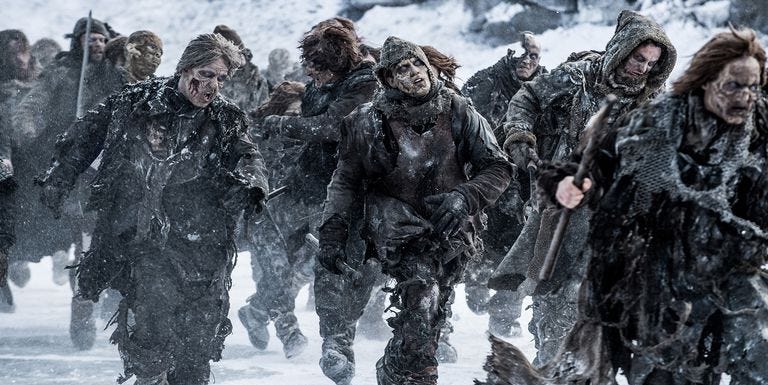
Note: This article explores the fictional undead wights from Game of Thrones using real-world science from anatomy, neuroscience, decomposition, cold-weather preservation, microbiology, and biomechanics. In other words, we are bringing a lab coat to a zombie fight. Sensible? Absolutely not. Fun? Very.
Introduction: The Dead Are Coming, and They Forgot Their Consent Forms
In Game of Thrones, wights are among the most terrifying creatures in Westeros. They are not elegant vampires with capes, tragic ghosts with unfinished business, or charming monsters who simply need better lighting. Wights are corpses reanimated by the White Walkers and the Night King, turned into a silent, icy army that marches, claws, bites, and generally ruins everyone’s evening.
But from a scientific point of view, the question is irresistible: how do wights work? How can a dead body move without a living brain? Why do wights keep fighting after injuries that would stop any normal organism? Why does cold seem to preserve them? And could anything in real biology even slightly explain the nightmare fuel we see on screen?
The short answer: no, real science does not allow dead people to join a supernatural infantry division. The longer, more interesting answer is that wights combine several real concepts: motor control, muscle energy, freezing temperatures, decomposition, infectious behavior, parasite manipulation, and group coordination. Add ancient magic, glowing blue eyes, and extremely poor workplace safety standards, and you have one of fantasy television’s most memorable monsters.
What Is a Wight in Game of Thrones?
A wight is a dead human or animal body reanimated by the White Walkers. Unlike White Walkers, wights are not intelligent commanders. They are more like remote-controlled corpses, serving as soldiers in the Army of the Dead. In the show, wights include dead wildlings, Night’s Watch brothers, horses, giants, and even a reanimated dragon. Westeros really looked at the phrase “labor shortage” and chose the worst possible solution.
The key difference is this: White Walkers are supernatural beings; wights are animated dead bodies. White Walkers can command, create, and strategize. Wights attack, pursue, swarm, and obey. They do not debate policy. They do not pause for snacks. They do not ask whether invading Winterfell in a blizzard is bad branding.
From a science-inspired perspective, wights appear to function as bodies whose muscles, joints, and nervous systems are being externally activated. They are not alive in the biological sense. They do not breathe, heal, digest, reproduce, or maintain normal metabolism. They are corpses being forced to perform movement.
The Brain Problem: Dead Bodies Do Not Walk Themselves
In living humans, movement begins in the nervous system. The brain sends signals through the spinal cord and motor neurons, which carry instructions to muscles. Those muscles contract in coordinated patterns, allowing us to walk, grab, blink, swing a sword, or dramatically stare into the distance like Jon Snow discovering yet another problem.
For a wight to move, something must replace that control system. A dead brain cannot plan movement. Dead neurons cannot maintain normal electrical signaling. Once oxygen and blood circulation stop, brain cells begin failing quickly. Without a functioning central nervous system, coordinated movement becomes impossible.
That means wight movement cannot be biological in the usual way. The White Walkers’ magic would need to act like an external nervous system. It would have to send commands directly into muscles, nerves, or some supernatural equivalent of motor control. Imagine invisible Wi-Fi for corpses, except the router is the Night King and the password is probably “winteriscoming.”
Are Wights Conscious?
Probably not. Wights do not behave like independent minds. They do not show memory, language, personality, fear, or self-preservation. They behave like attack systems. They identify living targets, move toward them, and use whatever body parts remain available. If a wight is missing half its body, it keeps crawling. That suggests the “person” is gone, while the body has become a tool.
Scientifically, this is closer to a puppet than a patient. A wight is not a revived human. It is a corpse being animated by an outside force.
The Muscle Problem: Movement Requires Energy
Here is where wights become especially rude to biology. Human muscles require energy, mainly in the form of ATP, to contract and relax. When you lift a cup, run from a dragon, or climb a suspiciously icy cliff, your muscle fibers rely on chemical energy. After death, ATP production stops. Muscles eventually stiffen through rigor mortis, then soften again as decomposition breaks tissues down.
So how can a wight sprint, claw, leap, and wrestle without a living metabolism?
There are only a few possible explanations, and all of them require fantasy physics:
1. Magic Replaces ATP
The most direct explanation is that White Walker magic provides the energy normally supplied by living cells. Instead of muscles burning nutrients and oxygen, the corpse is powered by supernatural force. This would explain why wights do not seem to tire. They can march for long periods, attack in waves, and keep moving despite injuries.
2. Magic Bypasses Normal Muscle Chemistry
Another possibility is that wight movement does not use ordinary muscle contraction at all. The body may be moved like a marionette, with magic pulling bones and limbs into motion. That would explain why even skeletal or badly damaged wights remain dangerous. If magic is doing the work, the condition of the muscles matters less.
3. The Body Is Temporarily Preserved
Cold temperatures slow decomposition. Since the Army of the Dead is strongly associated with extreme cold, wight bodies may decay more slowly than ordinary corpses. Frozen tissue can remain recognizable for a long time, especially in low-temperature environments. However, preservation is not the same as function. A frozen steak is preserved, but it is not about to pick up a spear and join a cavalry charge.
The most believable fantasy answer is a blend: cold preserves the body’s structure, while magic supplies the command and energy.
Why Cold Matters: The Freezer Section of Doom
Wights and cold are practically a package deal. The White Walkers bring freezing weather with them, and their undead army thrives beyond the Wall. Real-world cold slows many processes involved in decomposition, including microbial growth and insect activity. In forensic science, temperature is one of the major factors that affects how quickly remains change after death.
This helps explain why wights do not instantly fall apart. In a warm, wet environment, a corpse quickly becomes a microbial buffet. Bacteria break down tissues, gases build up, skin changes color, and structural integrity declines. In freezing or near-freezing environments, those processes slow dramatically. That gives a body more time to remain intact.
Still, cold creates problems too. Freezing can damage cells because ice crystals rupture membranes. Repeated freeze-thaw cycles can weaken tissue. Joints may become stiff. Skin can split. Muscles lose elasticity. A scientifically realistic wight would be creaky, brittle, and probably make a sound like someone stepping on frozen celery.
But in Game of Thrones, cold seems less like a hazard and more like a power source. The White Walkers do not merely survive the cold; they embody it. The wights may be preserved by that supernatural winter, as if the environment itself is part of the reanimation spell.
Why Fire Works So Well Against Wights
Fire is one of the most effective weapons against wights. That makes sense both symbolically and scientifically. Fire destroys tissue, dehydrates structures, denatures proteins, and can physically break down the body beyond usable form. If wight animation depends on the corpse remaining mechanically intact, burning it removes the “hardware.”
Think of the wight as a haunted machine. Fire does not need to understand the magic. It simply destroys the machine’s parts.
This also explains why people beyond the Wall burn their dead. Cremation prevents bodies from being turned into wights because it removes the usable remains. Westeros may lack antibiotics, indoor plumbing, and emotionally healthy leadership, but “burn the dead before ice demons recruit them” is honestly solid public policy.
Could a Virus Create a Wight?
Real diseases can alter behavior, and rabies is the classic example people often mention when discussing zombie-like fiction. Rabies affects the nervous system and can cause agitation, confusion, hypersalivation, difficulty swallowing, and aggressive behavior. It spreads through saliva, usually by bites.
That sounds zombie-adjacent, but it does not explain wights. Rabies infects living mammals. It does not reanimate dead bodies. A rabid animal may act strangely or aggressively, but it is still alive until the disease becomes fatal. Wights are already dead. They are not infected in the normal medical sense; they are animated.
So a virus could inspire some zombie fiction, but it cannot explain the Army of the Dead. A rabies-like wight outbreak would need living hosts, incubation periods, and biological transmission. The White Walkers skip the paperwork and raise corpses directly.
Could Parasites Control a Human Like a Wight?
Nature does contain real “zombie” stories, especially among insects. Certain fungi can manipulate ant behavior, causing infected ants to climb vegetation and clamp down before dying. This helps the fungus spread spores. Other parasites can influence host behavior in subtler ways.
This is fascinating, creepy, and extremely unfair to ants, but it still does not give us true wights. Parasites manipulate living nervous systems. They do not operate dead bodies after the nervous system has collapsed. A fungus can alter behavior by interacting with a living host’s biology; it cannot make a skeleton chase Bran Stark through a snowstorm.
However, parasite science does provide a useful analogy. Wights act like bodies controlled by an outside intelligence. The difference is that, in Westeros, the controlling agent is supernatural rather than biological.
Why Wights Keep Moving After Terrible Injuries
One of the scariest things about wights is their indifference to damage. Cut off an arm, and the arm may still twitch. Break the body, and it may still crawl. A living person stops fighting because of pain, blood loss, shock, organ failure, or structural damage. Wights ignore most of those limits.
This makes sense if wights do not depend on circulation, breathing, or pain perception. No heartbeat means no blood pressure to lose. No consciousness means no fear. No normal metabolism means no fatigue in the usual sense. Unless the body is burned, shattered, or magically disconnected, it remains a weapon.
That also explains why wights are terrifying in groups. A single wight may be clumsy. A thousand wights become a wave of bodies that do not panic, retreat, negotiate, or stop to ask who has the better claim to the Iron Throne.
The Hive-Mind Question: Are Wights Remotely Controlled?
The Army of the Dead behaves like a coordinated system. Wights surge forward together, respond to the White Walkers, and collapse when their magical chain of command is broken. This suggests a networked control model. The Night King appears to function as the central signal source, while White Walkers may act as commanders or nodes.
In real biology, coordinated group behavior appears in insect colonies, flocking birds, schooling fish, and human crowds. But those systems rely on living individuals responding to local cues. Wights seem more centralized. They resemble drones controlled by a single will.
If we were building a “science of wights” model, it might look like this:
- The White Walker raises the body and establishes a magical control link.
- The link activates muscles or moves limbs through supernatural force.
- The corpse follows simple target-seeking commands.
- Cold slows physical breakdown and preserves usable tissue.
- Fire or special materials disrupt the body or the magic sustaining it.
Basically, wights are undead drones with terrible skincare.
Why the Blue Eyes?
Glowing blue eyes are one of the visual signatures of wights and White Walkers. In real life, eyes do not glow after death unless an external light source reflects off them. Biological light production, called bioluminescence, exists in organisms like fireflies and deep-sea creatures, but not in human corpses.
So the blue glow is almost certainly magical. Symbolically, it marks the body as belonging to the cold power of the White Walkers. Visually, it also helps viewers instantly recognize that the human identity is gone. The eyes say, “This is not your friend anymore. This is a frozen murder puppet.”
Would Wights Smell?
Yes. Horribly. Even in cold conditions, decomposition does not magically become a luxury spa treatment. Bacteria, tissue breakdown, trapped gases, old blood, and damaged organs would produce odor. The smell might be less intense in freezing weather, but once wights entered warmer spaces, things would get grim very quickly.
This is one of the less discussed survival tips for Westeros: if you smell a battlefield, a butcher shop, and a forgotten refrigerator all arriving at once, maybe do not open the gate.
Could Wights Exist in the Real World?
No. Real wights are impossible under known biology. A dead body cannot restart coordinated movement without oxygen, circulation, cellular energy, intact nerves, and brain control. Even if a corpse were perfectly preserved, preservation does not equal animation. A museum mummy may be intact, but it is not available for military service.
However, wights are effective because they borrow just enough from real science to feel unsettling. We know bodies decompose. We know cold preserves. We know diseases can change behavior. We know parasites can manipulate hosts. We know groups can move like swarms. Game of Thrones takes those real anxieties and wraps them in fantasy horror.
The Best Scientific Explanation: Magic Plus Mechanics
The most coherent explanation is that wights are not living organisms but magically powered biomechanical remains. Their bodies provide the physical structure: bones, joints, tendons, skin, and muscle. The White Walker magic provides command, energy, and coordination. Cold preserves the body long enough to remain useful. Fire destroys the structure. Dragonglass and Valyrian steel disrupt the supernatural system behind the animation.
In other words, wights work because the magic uses the corpse as equipment. The body is not alive; it is being operated.
Experiences and Reflections: Watching Wights With a Science Brain
The first time many viewers saw wights in Game of Thrones, the reaction was not careful scientific curiosity. It was more like: “Nope. Absolutely not. Close the gate, burn the bodies, and someone please give Samwell Tarly a helmet.” But after the shock wears off, wights become one of the most interesting monsters in modern fantasy because they invite questions that sit right at the border of science and imagination.
One experience that makes the wights memorable is how physical they feel. They are not misty spirits floating through walls. They slam into doors. They scratch wood. They pile on top of each other. They break through defenses by sheer mass. That physicality makes them scarier because they obey some rules of the material world. A wight may be magical, but if enough of them push against a barrier, the barrier fails. That is not sorcery; that is force.
This is why the Hardhome sequence works so well. The fear does not come only from the Night King raising the dead, although that moment is iconic. The fear comes from watching the living lose control of space. The dock, the walls, the boats, and the shoreline all become temporary. The wights turn the battlefield into a moving problem. They are not skilled duelists. They are pressure. They are momentum. They are the world’s worst crowd crush with blue eyes.
From a science perspective, that makes them feel less like traditional zombies and more like an environmental disaster. A living army needs food, rest, morale, supply lines, and leadership. A wight army needs bodies. Every battle potentially increases its numbers. That creates a terrifying feedback loop: the more you lose, the stronger the enemy becomes. In epidemiology, we might compare that to exponential spread. In military terms, it is a nightmare. In human terms, it is emotionally rude.
Another striking experience is how wights change the meaning of death in the story. In most battles, death is the end of a character’s agency. With wights, death can become a second weapon used against the living. That is why burning bodies is not merely ritual; it is survival. The dead must be cared for quickly, not only out of respect but to prevent recruitment by ice magic. It adds urgency to grief. Westeros does not even let people mourn without logistics.
Wights also make viewers think about identity. If a familiar person becomes a wight, are they still “in there”? The show strongly suggests no. The body remains, but the self is gone. That is one reason wights are more tragic than they first appear. They are frightening because they attack the living, but they are also victims. Their bodies have been stolen and repurposed. The horror is not just that the dead walk; it is that the dead are denied rest.
On rewatch, the wights become a reminder that fantasy monsters often work best when they dramatize real fears. We fear disease because it can turn the body against itself. We fear decay because it shows the body’s fragility. We fear extreme cold because it strips away comfort and control. We fear crowds because individual strength can vanish inside mass movement. Wights combine all of that into one image: a frozen body moving with someone else’s will.
And yes, the science falls apart if we take it literally. A corpse cannot walk without energy. Bones cannot fight without muscles. Frozen tissue is not flexible enough for athletic combat. A skeleton cannot snarl unless fantasy has upgraded its dental plan. But that is part of the fun. The “science of wights” is not about proving they could exist. It is about understanding why they feel convincing while we watch them.
The answer is that wights are built from recognizable pieces of reality. They decay like bodies, swarm like insects, obey like drones, preserve like frozen remains, and attack like predators. Then the story adds magic to connect the pieces. That blend is why they linger in the imagination long after the episode ends. They are impossible, but they are impossible in a way that feels organized.
So, how do wights work? They work as fantasy, first and foremost. But they also work because they press on real scientific nerves. They remind us that the body is mechanical, chemical, electrical, and vulnerable. Remove the self, add an external command, preserve the structure, and you have a monster that feels disturbingly close to biology even while breaking every biological rule in the book.
Conclusion: Wights Are Bad Biology but Brilliant Horror
Wights from Game of Thrones do not work by real-world science alone. A dead body cannot move with purpose unless something replaces the brain, nervous system, metabolism, and muscle energy that life requires. But as fantasy creatures, wights are brilliantly designed. They combine real fears about death, cold, decomposition, infection, lost identity, and unstoppable crowds.
The best explanation is simple: wights are magically controlled corpses using preserved body structures as physical tools. The White Walkers provide the command. The cold helps preserve the bodies. Fire destroys the usable remains. The result is an undead army that feels scientifically impossible but emotionally convincing.
And that is why wights remain so memorable. They are not just monsters. They are a walking argument that death itself can be weaponized. Which, frankly, is exactly the kind of thing that makes you appreciate locked doors, warm blankets, and living in a world where winter mostly means annoying heating bills.